GitHub Copilot App Preview Turns Issues, Checks, and Merges Into Agent Sessions
GitHub Copilot app technical preview combines issues, sessions, validation, pull requests, and Agent Merge into a desktop workflow for coding agents.
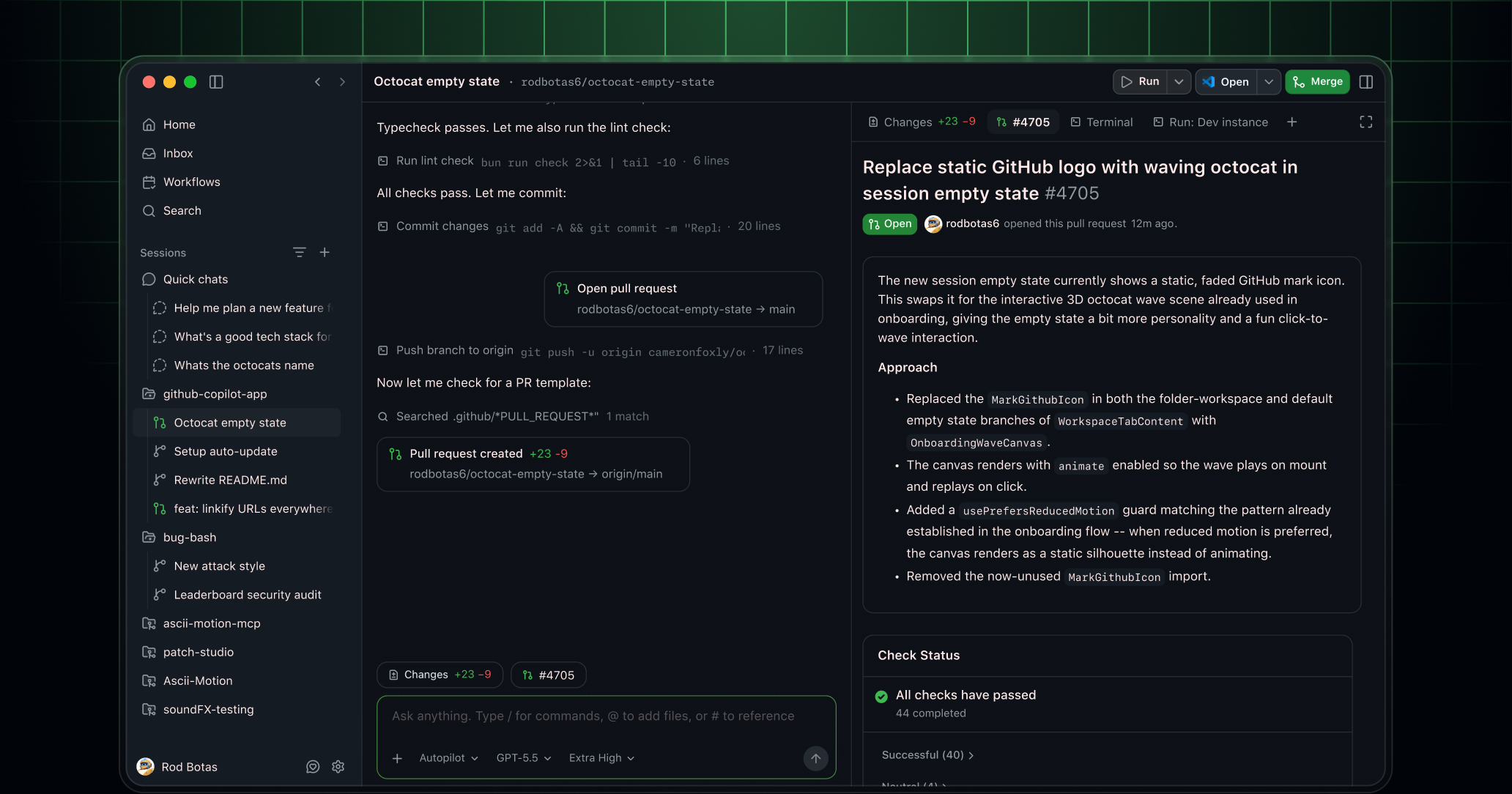
- What happened: GitHub released the
Copilot apptechnical preview on May 14, 2026, letting developers start agent sessions from issues, pull requests, prompts, and prior sessions.- Business and Enterprise access requires preview features and
Copilot CLIpolicy enablement, while Pro, Pro+, and Max users go through a waitlist.
- Business and Enterprise access requires preview features and
- The unit of work: Each session has its own branch, files, conversation, and task state, with terminal and browser validation available inside the app.
- Why builders should care: Agent Tasks API,
Fix batch with Copilot, and 0.33x model routing move agent operations into the pull request workflow.- The practical questions are no longer only model quality. Teams also need model budgets, review boundaries, CI policy, and merge ownership.
- Watch: This is still a technical preview, so quality, cost, permissions, local setup, and CI reliability need organization-specific pilots.
GitHub announced the GitHub Copilot app technical preview on May 14, 2026. The changelog describes it as a GitHub-native desktop experience for agentic development: start from a GitHub issue, pull request, prompt, or previous session; run work inside an isolated session; then land the result through pull request review.
That framing matters more than the existence of another Copilot client. During the same week, GitHub also opened a REST API for starting Copilot cloud agent tasks, added Fix with Copilot and Fix batch with Copilot for code review comments, and introduced cheaper model choices for simple cloud-agent work. The Copilot app is the desktop surface that gathers those pieces into one workflow. The visible product is a desktop app. The deeper product bet is that agent work should begin from GitHub objects, carry a reviewable task state, and end in the pull request system where teams already govern code changes.
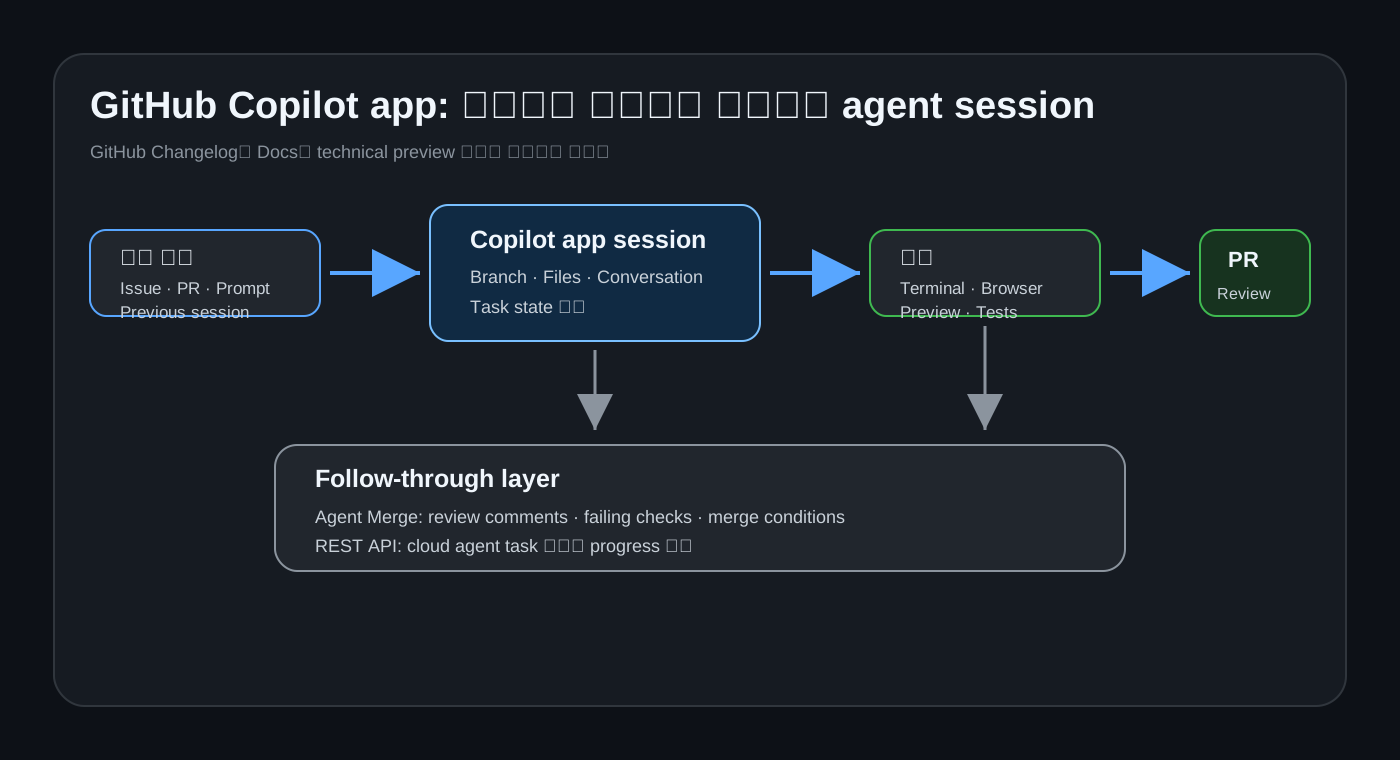
The app starts from GitHub context. GitHub says sessions can begin from an issue, pull request, prompt, or previous session. Developers can browse connected repository issues and pull requests from an inbox, then carry issue details, repository state, review comments, and checks into an agent session. Instead of telling an agent to fix a repository in the abstract, the app pushes the agent toward a work item that the organization has already recorded.
The session model is different from a normal IDE chat. GitHub says each session keeps its own branch, files, conversation, and task state. Multiple tasks can run across one or more repositories without mixing the conversation and diff history. That design targets a common failure mode in coding-agent workflows: after several prompts, it becomes hard to know which branch corresponds to which instruction, which tests failed for which task, and where a reviewer should reconstruct the agent's reasoning.
GitHub's getting-started docs for the Copilot app add the access and workflow details. Business and Enterprise customers need the organization or enterprise to enable preview features and Copilot CLI. Pro, Pro+, and Max users are routed through a waitlist. The app is presented as a local desktop installation for macOS, Windows, and Linux. After setup, the sidebar exposes Inbox, Workflows, Search, and Sessions. The Inbox is not just a notification list; it is where users filter issues and pull requests, check CI status, and leave reviews.
The issue-to-session flow shows GitHub's intended operating model. A user opens an issue from Inbox and selects Start a session. The app creates a new session with the issue context already attached and automatically uses Plan mode. The agent proposes a plan, and the user chooses whether the agent should begin pull request work or whether to apply suggested changes manually. GitHub's docs say the agent can create a branch, make changes, and open a pull request when instructed. The starting record is an issue, the intermediate artifact is a branch and diff, and the terminal state is a PR review.
The integrated terminal and browser make the product direction clearer. GitHub's announcement says users can run commands, open previews, and execute tests inside the app. That keeps the validation loop next to the agent session instead of reducing the product to a diff viewer. If the app works reliably in real repositories, the valuable unit is not simply generated code. It is a task record with a branch, proof of checks, preview behavior, and review context.
Agent Merge is the follow-through step. In the Copilot app announcement, GitHub describes Agent Merge as a capability for handling review comments, failing checks, and merge conditions. The name sounds like an automatic merge button, but the more important claim is operational continuity. The agent does not stop at opening a PR. It can continue through reviewer feedback, CI failures, and readiness conditions that normally turn a generated patch into a mergeable change.
GitHub narrowed that same idea to code review comments on May 19 with the Copilot code review handoff update. The old Implement suggestion button became Fix with Copilot. Users can choose whether the change is applied to the current PR or a new PR, select a model, and add extra instructions. A PR Overview comment's Implement all suggestions flow became Fix batch with Copilot, letting users select multiple Copilot code review comments and hand them to the cloud agent.
The important part is the handoff boundary. A review comment has traditionally been a human-readable request for a human patch. GitHub is turning that comment into an agent task. For teams, the useful questions become concrete: which branch receives the change, whether a new PR is opened, which model budget is consumed, and where a human reviewer re-enters the loop. The Copilot app exposes those choices as part of the desktop workflow rather than leaving them as ad hoc prompt instructions.
On May 18, GitHub added cheaper model routing for simpler Copilot cloud agent tasks. The model update lists Claude Haiku 4.5 and GPT-5.4-mini at a 0.33x multiplier. Users can route small changes to smaller and faster models while keeping stronger models for harder work. That update was not the same announcement as the app, but it belongs in the same operating story. Once teams create many agent sessions, model choice becomes part of workflow policy, not a hidden parameter.
The REST API completes the loop. On May 13, GitHub opened the Agent tasks REST API public preview for Copilot Business and Enterprise users. GitHub says customers can programmatically start cloud agent tasks and track progress. The examples include fanning out refactors or migrations across repositories, starting repository setup from an internal developer portal, and preparing releases with weekly release notes. Authentication supports personal access tokens and OAuth tokens, while GitHub App installation access tokens and Pro or Pro+ access were still listed as coming soon.
With that API in place, the Copilot app becomes more than a standalone UI. Internal developer portals, release pipelines, security backlogs, and dependency migration scripts can create cloud agent tasks, while humans use the desktop app to inspect sessions and PR state. GitHub is attaching agent execution to existing surfaces: Actions, PRs, checks, reviews, repository search, token policy, and protected branches. That is a different starting point from editor-first agent tools because GitHub owns the canonical repository and pull request records.
For development teams, the first question is not whether to replace the IDE. The first question is what record should exist for agent work. Copilot app still supports prompt-driven work, but code-changing sessions have a branch and task state, and they can start from an issue or review comment. If this pattern sticks, agent prompts move out of private chat history and into issue descriptions, review comments, failing checks, and saved workflows that the organization can audit.
The second question is permissions. GitHub's docs require preview features and Copilot CLI policy enablement for Business and Enterprise access. That is more than an administrative footnote. A coding agent that can touch a local repository, cloud-agent environment, terminal, browser preview, pull request, checks, and merge conditions turns product configuration into engineering policy. Teams need to decide which repositories allow sessions, which models are allowed, which MCP servers or plugins can attach, whether an agent can rerun failing checks, and what protected branch requirements must stay under human control.
The third question is cost. The 0.33x model option signals that GitHub expects task-class routing. Documentation edits, type errors, narrow refactors, and review-comment patches may be good fits for smaller models. Architecture changes, multi-repository migrations, flaky test investigations, and security-sensitive work need stronger models and longer context. If Copilot app stores sessions and workflows, teams will eventually want to answer a very practical question: which task types were good enough on which model, and where did cheaper routing create rework?
The fourth question is verification responsibility. GitHub's announcement stresses that work is not finished when code changes. That line is product copy, but it points at the real bottleneck in agent adoption. Faster patches can make humans read more diffs, run CI more often, and repeat the same review comments. Fix batch with Copilot and Agent Merge are attempts to reduce that afterwork. They do not remove the need for high-quality tests, protected review ownership, and human judgment about whether a comment was fixed in the right way.
The competitive position is straightforward. OpenAI Codex app foregrounds a separate agent workspace and automation model. Cursor keeps pushing agent workflows inside the editor. Google Antigravity emphasizes an agent harness around the Gemini ecosystem. GitHub Copilot app combines issues, pull requests, checks, review, repository search, and a cloud agent API. All of these products are described as coding agents, but they claim different control surfaces: the IDE, the independent agent workspace, the GitHub object graph, or an enterprise harness.
Early community reaction appears cautious rather than settled. The research note for the Korean article found no large Hacker News or GeekNews discussion, while Reddit and regional developer coverage focused on Copilot moving toward autonomous development, technical preview access limits, and concerns about usage and pricing. That is consistent with a technical preview. The announcement is easier to evaluate as a direction of travel than as a finished productivity claim.
The limits are still visible. GitHub has shown the workflow shape, not universal proof that every organization can trust it immediately. A real pilot will expose repository size, monorepo layout, private package access, local service startup, browser preview reliability, flaky CI, protected branch policy, and review ownership at once. Agent Merge may handle review comments and failing checks in the app, but each team still needs evidence that it understands the failing check and preserves the intent of the original PR.
The direction is clear enough to plan against. GitHub is moving Copilot beyond autocomplete and chat into the operating units of software delivery: issue, branch, diff, test, review, and merge. The Copilot app technical preview is a sign that AI coding tools are shifting from screens that generate code to screens that manage code changes. Teams evaluating it should design pilots around a small set of issue types, explicit model budgets, required checks, branch protections, and reviewer handoff points. Without those decisions, an agent desktop is likely to become one more place where work happens without enough shared record.
GitHub's advantage is that those records already exist in its system. An issue is a work request. A PR is a change record. Checks are validation evidence. Review comments are human feedback. Copilot app tries to turn those objects into the input and output of agent sessions. Whether the technical preview matures into a dependable product is still open, but the May 2026 Copilot updates move the coding-agent comparison away from model scores alone. The new comparison points are task boundaries, review handoffs, cost routing, permission policy, and verification evidence.