The coding agent market gets a new enterprise scorecard
Gartner and OpenAI show how AI coding agents are moving from model benchmarks toward governance, sandboxing, auditability, and cost control.
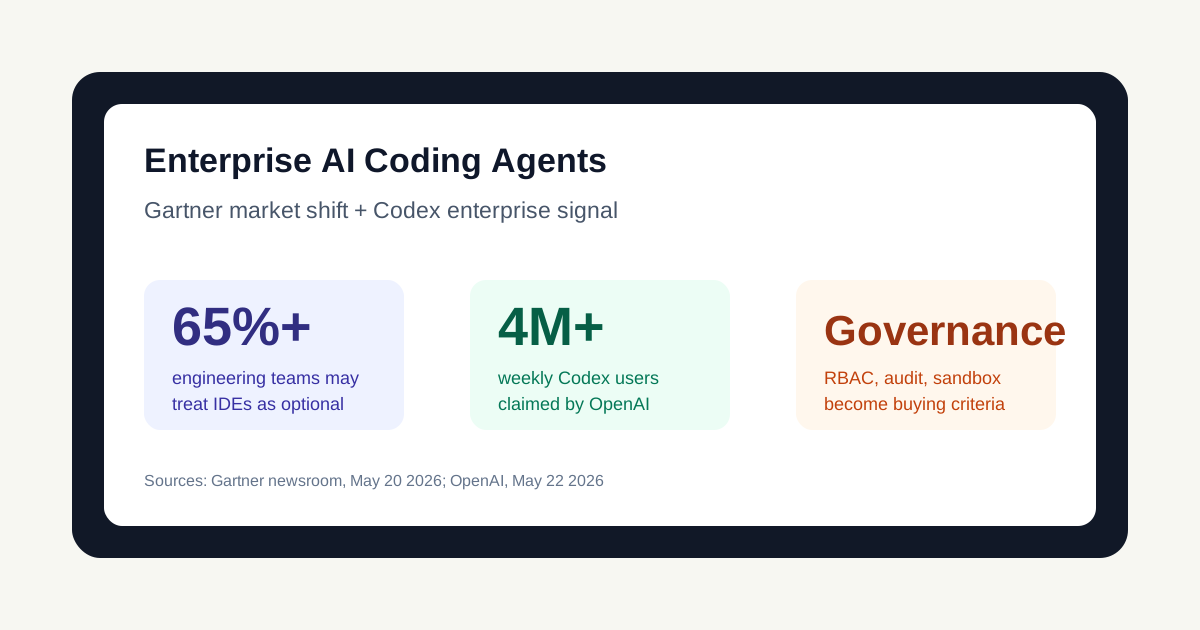
- What happened: Gartner says the enterprise AI coding agent market has entered a new phase of expansion and competitive realignment.
- Its headline forecast is that by 2027, more than 65% of engineering teams using agentic coding may treat the IDE as optional.
- OpenAI signal: OpenAI says Codex was named a Leader in Gartner's assessment and is used by more than 4 million people each week.
- Why it matters: The buying criteria are shifting from autocomplete quality to
governance,sandboxing,RBAC, audit logs, and predictable operating cost. - Watch: Gartner's framing is market language for buyers, not proof that one tool is the right default for every engineering team.
The important question in AI coding is changing. The first question was easy to state: which model writes better code? Which IDE extension feels faster? How natural is the autocomplete? Enterprise buyers and platform teams are now asking a different set of questions. When an agent reads a repository, edits files, runs tests, and prepares a pull request, who approved that work? Which permissions did it use? How much did the failed session cost? Is there an audit trail? How far did sensitive code travel?
That shift showed up clearly in two announcements this week. On May 20, 2026, Gartner said the market for enterprise AI coding agents is entering a new phase of expansion and competitive realignment. The provocative line is Gartner's forecast that by 2027, more than 65% of engineering teams using agentic coding will be able to treat the IDE as optional, with control, governance, and validation moving into automated platforms.
Two days later, OpenAI said Codex was named a Leader in the Gartner Magic Quadrant for Enterprise AI Coding Agents. OpenAI also said Codex is used by more than 4 million people each week, with enterprise examples including Cisco, Datadog, Dell Technologies, and NVIDIA. The more interesting part is not only the adoption number. OpenAI's feature language puts approval gates, role-based access control, customizable policies, OS-level sandboxing, and auditable workspace governance at the center of the product story.
On the surface, this is a mix of analyst market framing and vendor promotion. For engineering teams, the signal is still useful. Coding agents are no longer being evaluated as better autocomplete alone. They are moving into the operating, procurement, and security layers of software organizations.
Coding agents are moving beyond the IDE
Gartner's 65% forecast should not be read as "developers will abandon IDEs." That would overstate it. Code will still be read and changed in editors. VS Code, JetBrains IDEs, Xcode, Vim, Cursor, and similar tools are not about to disappear. The better interpretation is that the control point for coding work is no longer bound to one local editor.
Modern coding agents already live across several surfaces. A task can start inside an IDE extension, in a CLI session, from a web interface connected to an issue or pull request, or in a cloud workspace that runs for longer than a local editing session. Some products now expose mobile review or approval flows. Cloud development environments and sandboxes can keep working after the developer steps away from the laptop. In that world, the IDE remains an important surface, but it is not the only place where the agent's life cycle is managed.
This is not a small user experience detail. When a person writes code directly, the editor's permissions are usually the person's permissions. When an agent acts as an independent session, the operating model changes. The agent may access the filesystem, package managers, test runners, browsers, internal docs, and cloud resources. Longer sessions create more intermediate decisions. Can this command run? Can this file be changed? Can this failing test be skipped? Can this migration touch three repositories instead of one?
That is why Gartner's phrase "automated platforms" matters. It does not mean only a convenient portal. It points to an operating layer with permission boundaries, policy enforcement, cost tracking, log retention, and quality validation. If a coding agent is a tool that types code on behalf of a developer, the IDE is the center. If a coding agent plans, executes, and verifies work as an actor in the software delivery process, the platform becomes the center.
The buying criteria after the magical demo
One of the most important phrases in Gartner's release is the move from "magical developer experience" competition toward operational excellence, commercial maturity, and enterprise readiness. That language captures the temperature of the market. In the early phase, the demo mattered most. A user could ask for a feature in natural language, watch a tool edit files, fix tests, and open a pull request. The emotional hook was simple: this actually works.
Enterprise adoption begins after the demo. A few developers experimenting with an agent is not the same as hundreds of developers using the same system across regulated codebases. In a personal project, a bad agent run can often be reverted manually. In a company repository, a bad run can become a security incident, a license problem, a customer data exposure, a CI cost spike, or a review backlog. Buyers therefore cannot evaluate only the model's best moments.
OpenAI's announcement is written in that same language. The explanation that Codex can understand large codebases, use tools, change code, test, and prepare work for human review is a capability story. The next layer is the enterprise story: speed with control, governance, security, and auditability. OpenAI lists Codex surfaces across the app, IDE extensions, CLI, SDKs, and cloud-based orchestration, then names enterprise controls such as approval gates, RBAC, customizable policies, OS-level sandboxing, and auditable workspace governance.
That list is separate from the question of whether the agent writes good code. Who can assign an agent to which repository? Which files can it edit? Can external network access be blocked? Are package installation and test execution isolated? Can it push or deploy without approval? Are session logs retained? If something goes wrong, can the organization reconstruct who approved what? A strong model that cannot answer these questions is hard to standardize inside a large company.
| Evaluation axis | Early coding AI | Enterprise agent |
|---|---|---|
| Primary surface | IDE autocomplete, chat panel | IDE, CLI, web, cloud sessions, approval console |
| Quality signal | Suggestion accuracy, code generation speed | Task success rate, failure cost, passing tests, reviewability |
| Control model | Individual user settings | RBAC, policies, approval gates, audit logs |
| Buyer question | Do developers like it? | Can the organization operate it safely at repeatable scale? |
What the Codex 4 million number really signals
OpenAI's claim of more than 4 million weekly Codex users can be read in two ways. First, coding agents have moved beyond lab demos into large-scale product usage. Second, that scale makes operations more important, not less. As usage grows, edge cases multiply: unusual monorepos, older build systems, closed networks, regulated data, custom deployment pipelines, internal test infrastructure, and workflows that do not look like clean public benchmark tasks.
OpenAI says Cisco used Codex to develop a substantial part of its AI Defense security platform and reduce delivery time from multiple quarters to weeks. That is a customer story in a vendor announcement, so it should be read with the usual caution. Still, the direction is clear. Suppliers are no longer positioning coding agents only as personal productivity tools. They are positioning them as execution layers for enterprise workflow change: internal platforms, security products, large refactors, migration projects, and review preparation.
The risk grows with the ambition. An agent removing boilerplate from one file is not the same as an agent running a cross-repository migration. The second case touches test environments, deployment order, compatibility, rollback paths, license obligations, and security policy. A stronger model is helpful, but it is not enough. A strong model with dangerous permissions and a poorly framed goal can create larger damage faster.
This is where sandboxing becomes a market criterion. OS-level sandboxing protects the host environment and sensitive resources when the agent runs code and invokes tools. Approval gates insert human judgment before high-risk steps. RBAC limits who can assign which work across which repositories. Auditable workspace governance makes later reconstruction possible. These controls can slow the developer experience slightly, but in enterprise adoption they are also what allow speed to continue without turning every agent run into an unmanaged exception.
Gartner is market language, not an answer key
There is an important caveat. A Gartner Magic Quadrant is a way to describe a market in buyer language. It does not mean one product is the best fit for every team. OpenAI's announcement includes the standard notice that Gartner does not endorse any vendor, product, or service, and that Gartner research publications are opinions rather than statements of fact. That may look like legal boilerplate, but it is also the right way to read the signal.
Engineering teams should not stop at quadrant placement. They need to evaluate agents against their own work. A small startup may value fast iteration and low cost more than heavyweight governance. A team in finance, healthcare, government, or security software may need sandboxing, audit trails, data boundaries, support terms, and contract language before it can even run a pilot. An open source-centered organization may care more about portability, self-hosting options, and vendor lock-in.
Vendor numbers need context too. Weekly users indicate adoption, but they do not directly describe success rate or cost efficiency. Customer stories show what is possible, but they do not guarantee reproducibility. Gartner's forecast describes market direction, not the right adoption date for a specific team. The practical answer is still internal evaluation.
That evaluation should be more concrete than a model benchmark. Can the agent fix real issues in our repositories? Does it keep changes small when it is uncertain? Does it hide test failures? Does it follow our style? Does it read files it should not read? Can it work in a network-restricted environment? What is the average cost per accepted change? Can reviewers understand the result quickly? These questions are closer to the buying decision than a single benchmark score.
Pricing and ROI get harder to reason about
Gartner also points to pricing and ROI dynamics as part of the market realignment. That is a problem engineering leaders will feel quickly. Autocomplete tools were relatively easy to understand as seat-based products. Agents can vary by task volume, model choice, token usage, execution time, tool calls, cloud workspace cost, CI usage, repository count, and security features.
The uncomfortable part is that agents can become more expensive when they fail. The same issue may be attempted several times. The agent may reread logs, rerun tests, refactor in the wrong direction, and trigger additional model calls and command executions. From the outside, it can look like "one task." Internally, it may be dozens of model interactions plus compute and CI time. ROI becomes less like multiplying seats by price and more like analyzing a portfolio of task types.
Teams will need to classify the work they hand to agents. Repetitive tasks with low failure cost are natural candidates: dependency updates, test expansion, documentation synchronization, simple bug fixes, migration drafts. Work with large design judgment or security risk needs stronger approval and review. The goal is not to make an agent do everything. The goal is to identify work where the sum of failure cost and review cost still leaves the organization better off.
This is why Gartner's market signal is not only a procurement story. Engineering leaders need agent usage policy inside the development process. Some tasks can run automatically. Some should require plan approval before execution. Some should stop at a draft pull request. Some should be prohibited. Cost limits and model policies may vary by task type. "Buy a good agent" is becoming less accurate than "design an operating model for agents."
What global engineering teams should ask next
Every engineering organization has local constraints. Data residency, legal review, audit retention, internal network access, multilingual requirements, and legacy codebases all matter. Even as global vendors add enterprise features, actual adoption still has to pass security review, procurement, and the people who own production risk.
Language is part of the evaluation too. Code may be mostly English, but issues, requirements, QA reports, policy documents, and domain vocabulary often are not. An agent that reads code well is not necessarily enough. It needs to interpret requirements, connect them to implementation details, respond to reviewer comments, and keep domain terms consistent. The evaluation set should therefore include real internal issue formats and documentation patterns, not only public benchmark tasks.
There is also a process question. If an agent opens a pull request, what should the reviewer inspect first? Are agent-written tests trustworthy? Who cleans up failed agent sessions? Who owns code that an agent generated? If a mobile approval allows a risky step and something breaks, where is the responsibility boundary? These are process questions, but enterprise adoption cannot avoid them.
The Gartner and OpenAI announcements show a maturing market. Coding agents are moving past the "look, it writes code" phase. The next competition is about who can run agents safely, predictably, and audibly across more surfaces of an organization.
For developers, that cuts both ways. A good agent can reduce repetitive work, help navigate large codebases, automate test and review preparation, and make slow maintenance projects easier to start. At the same time, the developer's role may shift from using an agent to operating one: breaking down goals, limiting permissions, validating outputs, and analyzing failures.
The real news is not that OpenAI landed in a particular quadrant. It is that Gartner is treating AI coding agents as a distinct enterprise market, while OpenAI is putting governance and auditability beside model capability in the core message. The next scorecard for coding agents is becoming less about how smart they look inside the IDE and more about how responsibly they can act inside an organization.