65% See the IDE as Optional, Coding Agents Face Procurement
Gartner's enterprise AI coding agent evaluation and new OpenAI, Cursor, and GitHub claims show the market moving from model performance to governance and procurement.
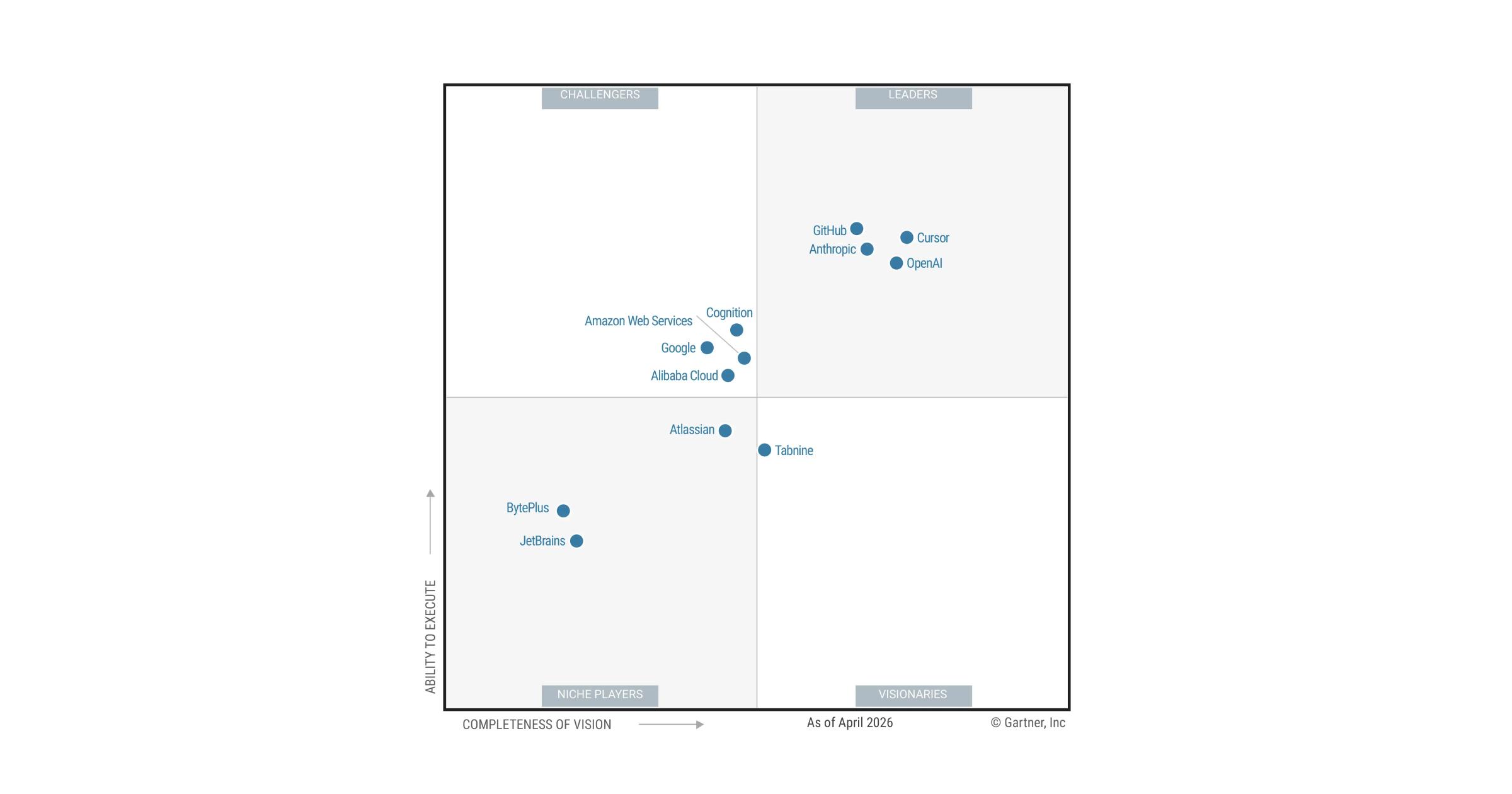
- What happened: Gartner treated Enterprise AI Coding Agents as a distinct market and published its 2026 evaluation.
- OpenAI, Cursor, and GitHub used the same week to highlight their Leader positions, usage numbers, and enterprise adoption.
- The key number: Gartner expects more than 65% of engineering teams using agentic coding by 2027 to see the IDE as optional.
- Why it matters: AI coding competition is moving from
autocompletetoward SDLC operations, auditability, pricing, permissions, and procurement maturity. - Watch: A Magic Quadrant is a buying input, not a proof of product fit. In real deployments, permission boundaries and accountability can fail before code quality does.
- Gartner also stressed that product momentum alone does not explain enterprise adoption.
On May 20, 2026, Gartner published material that put enterprise AI coding agents directly into the analyst spotlight. Its press release said the market was entering a new phase of expansion and competitive realignment. Read quickly, that can sound like ordinary analyst language. In context, it is a sharper signal: the basis of competition in coding agents is changing.
For most of the past year, public debate around AI coding tools focused on model capability, IDE experience, completion quality, benchmark scores, and how long a task an agent could carry without drifting. Gartner's market language is different. The release points to frontier model providers moving up the stack, more agentic workflows, broader coverage across the software development life cycle, and more complicated pricing and ROI dynamics. In other words, the question is no longer only whether the tool writes good code. It is whether an enterprise can buy, govern, audit, and operate the system.
The vendor responses around the same announcement make that shift visible. OpenAI said Codex was recognized as a Leader in Gartner's Magic Quadrant for Enterprise AI Coding Agents, and said Codex is used by more than 4 million people each week, including teams at Cisco, Datadog, Dell Technologies, and NVIDIA. Cursor said more than 70% of the Fortune 500 uses Cursor and emphasized its position on the Completeness of Vision axis. GitHub said Copilot is used by 140,000 organizations and has grown more than 100% year over year. None of those messages is just "our model writes better code." Each company is saying, in its own way, that its coding agent platform is something enterprises can buy and standardize.
The next stage after IDE-centered development
Gartner's most provocative number is 65%. It predicts that by 2027, more than 65% of engineering teams using agentic coding will view the IDE as an optional tool, with control, governance, and verification moving into automated platforms. For developers, that is a loaded sentence. The IDE has been the center of software work for decades. It is where developers read code, search, run tests, debug, inspect diffs, and prepare commits.
But once coding agents begin taking asynchronous work, the center of gravity changes. Instead of editing every line by hand, a developer may assign an issue, let an agent create a branch, run tests, open a pull request, respond to review comments, and pass security checks. In that flow, the IDE is still important, but it is no longer the only control surface. GitHub, cloud agent dashboards, CLIs, desktop apps, issue trackers, CI systems, security scanners, and policy engines all become part of the operating surface.
This does not mean the IDE disappears. It means the IDE becomes one surface inside a broader agent operating system. Developers will still use IDEs for hard design work, review, and debugging. Yet as agentic coding grows, engineering leaders will ask different first-order questions: where does the agent run, what repositories can it read, which changes require human approval, which commands are blocked, and who tracks the cost?
The scorecard now reaches beyond model quality
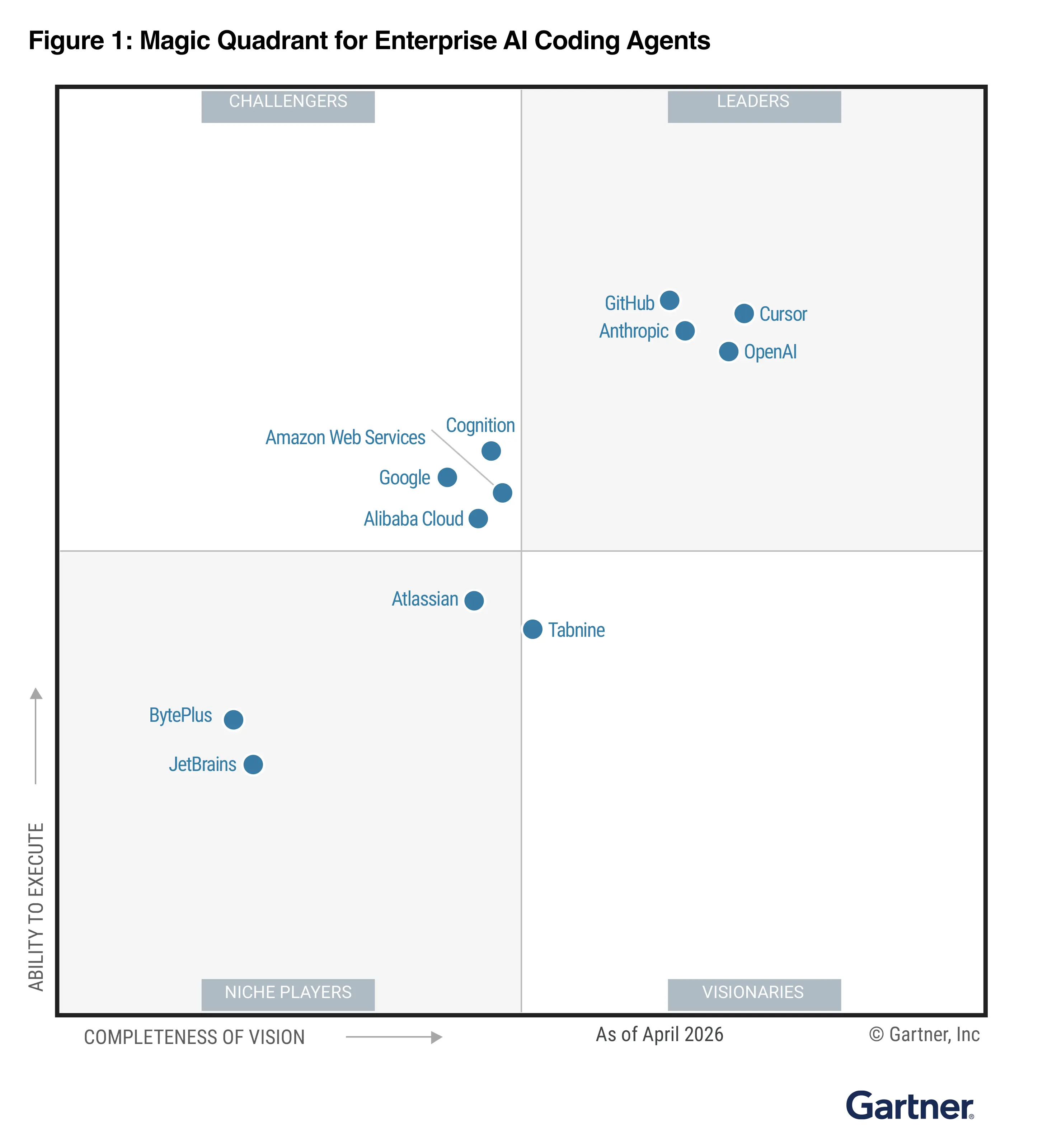
Gartner's Critical Capabilities abstract shows how wide the category has become. The evaluated vendors include Alibaba Cloud, AWS, Anthropic, Atlassian, BytePlus, Cognition, Cursor, GitHub, Google Cloud, JetBrains, OpenAI, and Tabnine. The comparison is not limited to code completion. It covers synchronous development, asynchronous development, application delivery, testing and debugging, context enrichment and selection, code translation, documentation, requirements management, deployment types, model choice, code review, analytics dashboards, spec-driven development, custom specialized agents, FinOps, and agent governance.
That list is the real battlefield. Whether a model can fix one file is now table stakes. Enterprise buyers want to know whether a tool can understand their monorepo, fit into pull request review and security gates, give managers visibility into cost and risk, support model and deployment controls, preserve audit logs, and define accountability when an agent fails.
| Old evaluation question | New evaluation question | Practical meaning |
|---|---|---|
| Does it complete code well? | Can it carry work from issue to pull request? | Asynchronous task management matters more than isolated edits. |
| Which model is smarter? | Can teams control model choice and deployment location? | Regulated industries and large enterprises do not buy on model quality alone. |
| Do developers like it? | Can admins see cost, permissions, and audit logs? | Developer experience and governance collide inside the same product. |
| Can it run tests? | Can verification and approval be enforced as policy? | Explainability of change can matter more than raw agent speed. |
This is where coding agents differ from ordinary developer tools. If a linter or formatter fails, the blast radius is limited. An agent can read files, run commands, call networks, generate test fixtures, open pull requests, and sometimes touch deployment workflows. Enterprises therefore have to answer two questions at once: how much productivity can this unlock, and how much authority should the system receive?
OpenAI frames Codex as an enterprise operating layer
The most interesting part of OpenAI's announcement is not only the usage number. OpenAI said Codex is used by more than 4 million people every week, which is large on its own. But the more important point is how OpenAI describes Codex: not as a coding model, but as an agentic system for enterprise software development workflows.
OpenAI emphasized the Codex app, IDE extension, CLI, SDK, and cloud-based orchestration as developer surfaces. Around those surfaces, it described enterprise controls such as approval gates, RBAC, customizable policies, OS-level sandboxing, and auditable workspace governance. That is the language of development infrastructure, not just a chat window or command-line assistant.
OpenAI also put Cisco forward as a case study. It said Cisco used Codex to develop significant parts of its AI Defense security platform, compressing work that could have taken quarters into weeks. The surface-level message is productivity. The buyer-level message is more specific: can an agent be trusted inside important security product work, and can the process still be reviewed and controlled? That is why this example fits the Gartner framing so closely.
Cursor is moving from developer love to enterprise platform
Cursor reaches a similar conclusion from a different direction. The company said Gartner named it a Leader and placed it furthest for Completeness of Vision. It also said more than 70% of the Fortune 500 uses Cursor. That claim positions Cursor beyond the individual developer and startup adoption story. It says Cursor is now part of enterprise buying conversations.
Cursor's stated direction is also notable. One track is frontier intelligence for long-running coding agents. Another is automation across the SDLC through Bugbot, security agents, Automations, and the Cursor SDK. A third is enterprise control through admin integrations, agent controls, analytics dashboards, and self-hosted cloud agents. This is almost the same vocabulary Gartner used in its evaluation criteria. Cursor appears to understand that being a beloved AI IDE is no longer enough.
Recent discussion around Cursor Cloud Agent already pointed in the same direction. The hard problems were not only model quality. They were virtual machines, indexing, permissions, orchestration, and operational reliability. Gartner's announcement turns that operational layer from an implementation detail into a market criterion. A company that gives developers a smooth editor experience still has to explain security, cost, administration, region choices, and self-hosting options to buyers.
GitHub leans on its SDLC home field
GitHub's message is even more directly about the software development life cycle. Announcing that Copilot was recognized as a Leader for the third year in a row, GitHub said the bottleneck has moved from generating code to shipping software. The constraints are review, security, governance, and deployment. GitHub said Copilot is used by 140,000 organizations, grew more than 100% year over year, and that GitHub Copilot CLI usage is nearly doubling month over month.
GitHub's advantage is easy to understand. Issues, pull requests, Actions, code review, security scanning, and repository permissions already live inside GitHub. If a coding agent is going to work inside an organization, it eventually has to touch those surfaces. A separate IDE or CLI can be excellent, but the final change still lands in a repository, pull request, and deployment pipeline. GitHub already owns much of that terrain.
GitHub also cited Gartner's prediction that asynchronous AI coding agent workflows could raise software engineering productivity by 30% to 50% by 2028. That number should be read carefully. Productivity depends heavily on team structure, codebase quality, test maturity, review culture, and agent permission design. But the way GitHub uses the number is clear: autocomplete was a narrower productivity tool, while asynchronous agents are part of a deeper workflow redesign.
Why procurement may be harder than the technology
Once coding agents become an enterprise procurement category, the hard questions multiply. Developers can say a tool feels useful. Security teams ask where data goes. Legal teams ask who is responsible for generated code and what licensing risks exist. Finance teams ask whether token costs and agent runs can be allocated by project. Platform teams ask whether the product integrates with self-hosted runners, VPCs, SSO, SCIM, RBAC, and audit logs.
That is why Gartner's release says product excellence and momentum are not enough. A tool that shines in a public demo is not always a tool that can be deployed across a large enterprise. Coding agents have a bigger blast radius than typical SaaS tools. They can read entire repositories, inspect configuration files that may contain sensitive references, modify migrations, and execute shell commands. Procurement is not a bureaucratic afterthought here. It is part of system design.
Enterprise agent discussions on Reddit show a similar pattern of skepticism. People are excited that agents can connect issues, pull requests, reviews, and tests into one flow. But the recurring doubts are about cost visibility, accountability, audit trails, security review, data location, and long-term memory. The question "can you explain what the agent did?" matters far more in a large organization than it does in a tiny team. Humans create production incidents too. But when an agent-authored change causes one, the organization will ask who approved it, which policy applied, and what logs remain.
Developers get more choice, teams get more standardization pressure
For individual developers, this market reset can be good news. Competition among Codex, Cursor, Copilot, Claude Code, JetBrains, Cognition, Tabnine, Google Cloud, AWS, and others should improve features quickly. Model choice is widening. Execution surfaces outside the IDE are improving. Cloud agents and local agents are developing in parallel. Many developers already use several tools at once: one for design, one for implementation, and another for review.
At the team level, though, choice creates standardization pressure. If every developer gives repository access to a different agent, connects different MCP servers, and runs jobs through different billing accounts, management becomes difficult. If multiple agents read different rule files for the same codebase, shared knowledge fragments. One agent may know the security policy while another does not. One may be allowed to call an internal API while another cannot. Those differences may appear as operational risk before they appear as productivity gains.
Enterprises will therefore try to choose platforms. That does not necessarily mean using only one tool. It means creating a common layer for SSO, RBAC, audit logs, data retention, model routing, policy, cost dashboards, and approved connectors. Gartner's category definition matters because once a market has a name, it receives budget lines, comparison tables, and procurement processes. Coding agents are moving from a personal productivity tool to an object of CIO and platform-team governance.
The better question is not who won
When a Magic Quadrant appears, it is natural to look for who is higher or lower. For this news, the more important question is not the ranking. It is: what is our organization's operating model for coding agents? Teams need to decide which tasks agents can take, which repositories are excluded, which changes require human approval, whether failed tests can trigger automatic repair, whether external network calls are blocked, and how cost limits are enforced.
Another question is how to preserve developer agency. As agents handle more work, developers spend less time typing and more time instructing, reviewing, approving, rolling back, and defining quality bars. That can raise productivity. Configured poorly, it can also turn developers into reviewers of oversized agent output. Teams need to manage pull request size, change scope, test evidence, and explanation format. In many cases, an agent that produces smaller diffs with better evidence is more valuable than an agent that simply moves faster.
Vendor lock-in is the third question. Cursor is strong in IDE and agent runtime experience. GitHub is strong in repository and SDLC integration. OpenAI is pushing Codex across models, sandboxing, and multiple developer surfaces. Anthropic has strong developer mindshare around Claude Code and the MCP ecosystem. None of these is the universal answer for every organization. Enterprises will likely prefer architectures that separate model choice, execution environment, repository permissions, knowledge base, policy, and billing.
The practical conclusion is operable AI coding
The point of Gartner's announcement is not that coding agents are mature. It is that they are now important enough to face harder questions. Many teams have already seen that agents can write code. The next question is how to run them inside an organization with hundreds or thousands of developers. Permissions, cost, auditability, verification, accountability, deployment location, model choice, and data policy now belong in the same sentence.
OpenAI's 4 million weekly users, Cursor's claim of more than 70% Fortune 500 usage, and GitHub's 140,000 organizations all show that the market is growing. But as markets grow, buyers become more demanding. Autocomplete could be enabled or disabled by an individual. Coding agents change the development process of an organization. That difference is what Gartner captured this week.
For developers, the practical takeaway is simple: do not evaluate coding agents only by whether the answer looks smart. Look at repository understanding, test execution, browser verification, pull request explanations, permission limits, logs, cost tracking, and failure recovery. For engineering leaders, the takeaway is sharper. The immediate need is not a better demo. It is an operable AI coding policy. The 2026 coding agent race may have started as a contest over models, but inside enterprises it is becoming a test of procurement and governance.