Small browser agents cross Operator's 58% line
Microsoft Fara1.5 shows why small computer-use models, synthetic web environments, verifiers, and approval policies are becoming the browser-agent bottleneck.
- What happened: Microsoft Research introduced
Fara1.5,MagenticBrain, andMagenticLite.- Fara1.5 is a family of browser-operating computer-use agent models in 4B, 9B, and 27B sizes.
- Key number:
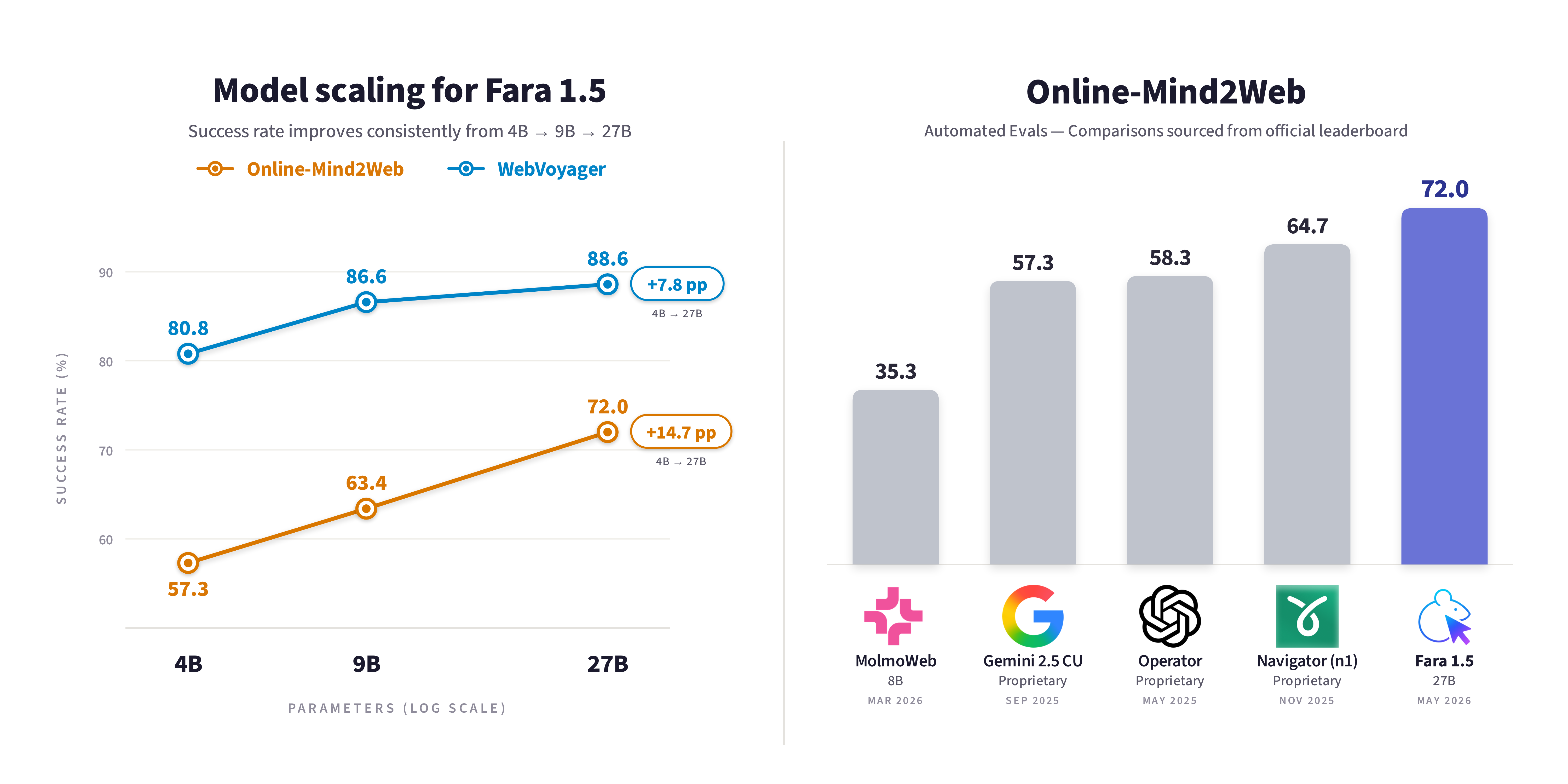
Fara1.5-27Breached 72.0% on Microsoft's Online-Mind2Web automatic evaluation.- In the same Microsoft table, Operator is listed at 58.3%, Gemini 2.5 Computer Use at 57.3%, and Yutori Navigator n1 at 64.7%.
- Why it matters: The browser-agent race is shifting from giant model calls toward small models, synthetic environments, verifiers, harnesses, and approval rules.
- Watch: This is still a research preview. Benchmark leads do not automatically translate into full product superiority.
Microsoft Research introduced the Fara1.5 model family on May 21, 2026. It also published a related post on MagenticLite and MagenticBrain. The short version is clear: browser agents do not have to be driven only by the largest closed frontier models. With smaller models, a dedicated harness, synthetic web environments, and strong verifiers, Microsoft argues that practical computer-use performance can move into a cheaper and more controllable zone.
That makes this more than another model release. Browser-agent competition is gathering around the same idea: AI should be able to use the web that humans use. OpenAI Operator, Google Gemini Computer Use, Yutori Navigator, Playwright-based automation systems, and Browserbase-style runtimes all sit near that frontier. But once a team tries to productize browser control, the question changes. How well does the model understand the screen? How expensive is each step? How does it learn workflows behind login screens? When does it stop before an irreversible submit button? Can the resulting action log be audited later?
Fara1.5 is Microsoft's research-system answer to those questions. The company presented computer-use agent models at 4B, 9B, and 27B parameters. It says Fara1.5-9B reached an 86.6% task success rate on WebVoyager and 63.4% on Online-Mind2Web. The larger Fara1.5-27B reached 72.0% on Online-Mind2Web. In Microsoft's same table, OpenAI Operator is listed at 58.3%, Google Gemini 2.5 Computer Use at 57.3%, and Yutori Navigator n1 at 64.7%. Those numbers make it tempting to write the simple headline: a small model beat the big agents. The more important story is why that result is possible.
Why small models matter
Browser agents fail in more expensive ways than chatbots. A model writing a wrong answer is one kind of failure. A model purchasing the wrong item, submitting a company document to the wrong place, or sending an email under the user's name is another. Computer-use agents need more than reasoning ability. Latency, execution cost, private or local deployment, reproducible logs, user approvals, and sandbox boundaries all become part of the product.
Calling a large frontier model at every step can work in a demo. Browser agents, however, rarely complete a task in one response. They observe a screen, click, observe again, type, close a modal, recover from an error, and sometimes ask the user for missing information. Microsoft's Fara1.5 description is built around this observe-think-act loop. At each step, the model sees the recent browser screenshots and conversation history, then predicts one atomic action. In that structure, the per-step cost becomes the product cost. Smaller models open options such as on-device inference, private GPU deployment, and lower-latency execution.
Small does not automatically mean safe. In some ways, smaller models depend more heavily on tools and harness design. That is where Fara1.5 becomes interesting. Microsoft is not only saying that smaller models can operate a browser. It is also showing a training and verification pipeline meant to make those models useful. The center of gravity moves from parameter count toward data generation, evaluation, runtime control, and task verification.
Fara1.5 does not see the web exactly like a person
Fara1.5 is a computer-use model that looks at browser state and emits actions. Microsoft says the model can produce standard mouse and keyboard actions, web-specific actions such as search, and context-management actions such as remembering information or asking the user a question. That last category matters. Real web workflows often cannot proceed without user preference, private information, or explicit consent. The agent may need a shipping address, payment approval, a date clarification, or permission to perform an irreversible action.
Microsoft identifies those moments as critical points. If required user information is missing, if the task is underspecified, or if the next action cannot be undone without approval, the model should pause and ask. This is one of the most important UX rules for browser agents. A useful agent automates a lot. A trustworthy agent also knows what it should not automate.
That makes Fara1.5's benchmark result more than a claim about clicking well. A production browser agent must satisfy two requirements at the same time: it needs to operate the UI effectively, and it needs to stop at the right boundaries. Classic web automation tools are strong at selectors, DOM structure, and repeatable actions, but weak at meaning and approval boundaries. General LLM agents infer meaning more flexibly, but screen state, repeated actions, runtime cost, and uncertainty make them hard to operate. Fara1.5 tries to narrow the gap with a small model and a dedicated action space.
The real weapon is FaraGen1.5
The most practical part of the announcement is not the model name. It is FaraGen1.5, which Microsoft describes as an end-to-end synthetic data generation pipeline for computer-use data. The structure has three parts: environments, solvers, and verifiers. First, the system creates environments. Then a stronger solver agent generates task trajectories. Finally, verifiers filter those trajectories for correctness, efficiency, and appropriate user interaction.
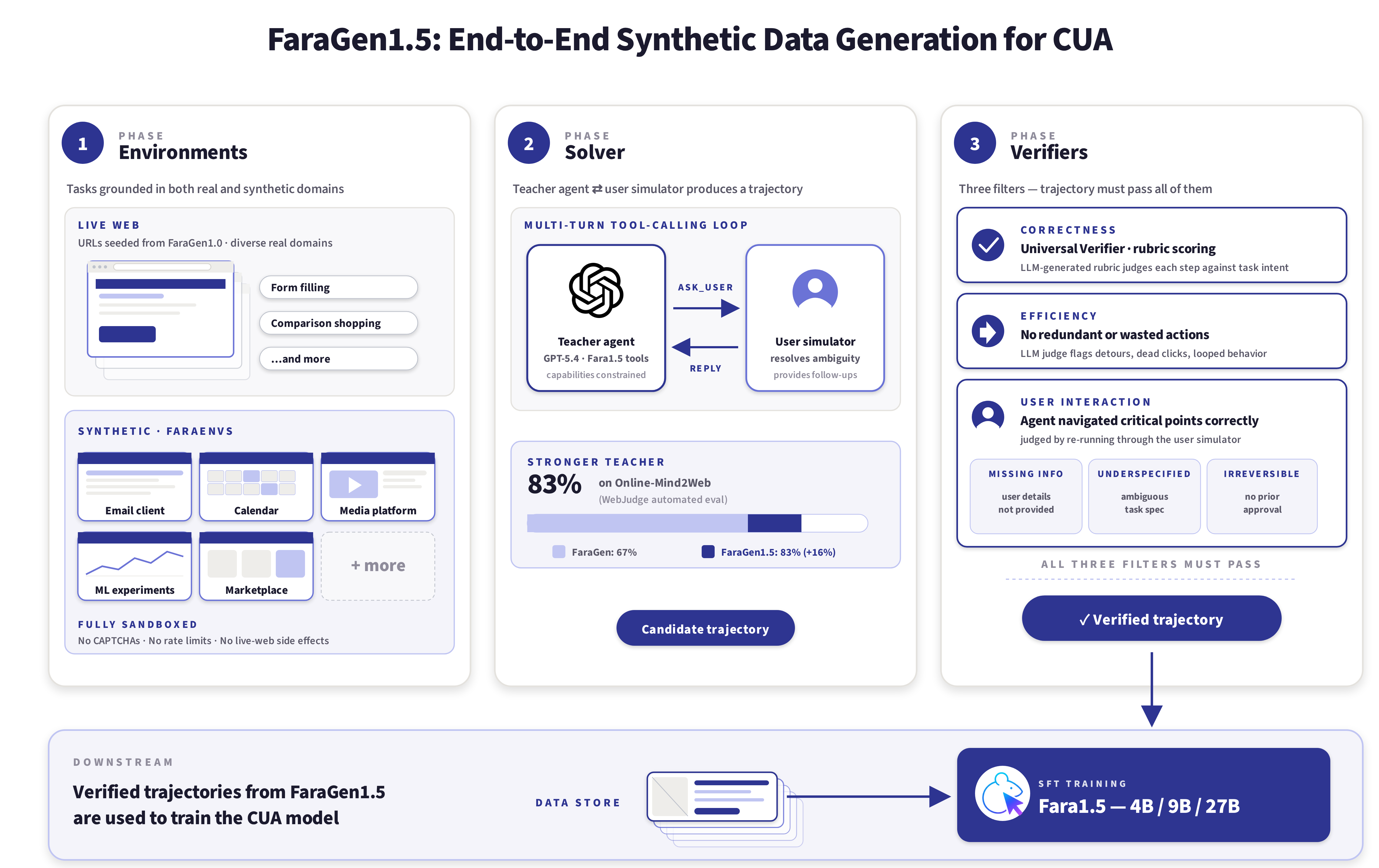
Synthetic environments are necessary because many important browser-agent tasks cannot be learned safely on the live web alone. Login-protected websites, real email sending, booking confirmation, payments, internal tools, and data-changing workflows raise account, privacy, and safety problems. Those are also exactly the workflows users want agents to handle. The hard task is not simply "find flights." It is closer to "check my constraints, proceed if they match, and stop before final purchase approval."
Microsoft addresses this with synthetic domains. It models environments such as email clients, calendars, media platforms, ML experiment managers, and marketplaces, while controlling the UI, database, and task definitions. One detail stands out: Microsoft says it used GitHub Copilot CLI to help create synthetic environments. The team gathered interaction trajectories from real domains, used a coding agent to help produce specs for functional sandbox clones, and then involved humans in iterative validation. In other words, a coding agent helped build the practice ground for a browser agent.
This pattern is likely to become familiar for AI development teams. To train and evaluate agents well, a team needs more than generic test data. It needs a miniature version of the product, a safe place to fail, database snapshots with known answers, action logs, and verifiers. That is much closer to production than ordinary fixtures, and much more controlled than the real production environment. Fara1.5 is a model release, but it also sketches the shape of agent-training infrastructure.
The numbers are strong, but they need careful reading
Microsoft's table is impressive. Fara1.5-27B reaches 72.0% on Online-Mind2Web, higher than Operator, Gemini 2.5 Computer Use, and Yutori Navigator n1 in that comparison. Fara1.5-9B reaches 63.4% on the same benchmark. On WebVoyager, Fara1.5-27B reaches 88.6%, and Fara1.5-9B reaches 86.6%. Microsoft also notes that its Fara1.5 results are averaged over three independent runs.
But it would be risky to read those numbers as a definitive product leaderboard. Browser-agent benchmarks are sensitive to session stability, site changes, blocking rates, task distributions, judge quality, and the available action space. Microsoft also explains that it used Browserbase to stabilize browser sessions and reduce session-level blocking. Even when product scores appear in one table, the performance users feel in practice can vary by workflow, logged-in state, action restrictions, and browser runtime.
So the right conclusion is not "Microsoft has fully beaten OpenAI and Google." The more useful conclusion is this: a smaller specialized model can compete with closed general-purpose agents in specific web benchmarks when it is paired with synthetic training, verifiers, and a browser harness. That distinction matters. The first claim is hype. The second is an actionable signal for AI product teams.
| Area | Fara1.5's answer | Production question |
|---|---|---|
| Model size | 4B, 9B, and 27B computer-use models | Should the model run locally, on private GPUs, or behind a hosted API? |
| Training environment | Live web plus synthetic gated domains | Can the team build a sandbox replica of its own product workflows? |
| Verification | Filters for correctness, efficiency, and user interaction | How close is the judge score to real task success? |
| Safety | Pause on missing information, underspecified tasks, and unapproved irreversible actions | Where do organization-specific approval policies and audit logs live? |
MagenticLite is closer to a lab bench than a finished product
MagenticLite is the accompanying agentic experience for browser and file-system tasks. In Microsoft Research's framing, Fara1.5 is the browser-control model, MagenticBrain is the smaller orchestration model, and MagenticLite is the interface and harness where users can try the system. Fara1.5-9B is available through Microsoft Foundry and integrated into MagenticLite, while the 4B and 27B versions are described as coming soon to Foundry.
The microsoft/fara GitHub repository adds useful context. Its README includes a May 21, 2026 update saying that the Fara1.5 agent harness is coming soon, alongside earlier Fara-7B execution notes and evaluation assets such as WebTailBench and CUAVerifierBench. This is not yet a fully open, polished product surface. It is better read as a research direction and a preview of where Microsoft is investing.
For developers, two takeaways are more durable than the launch mechanics. First, building a browser agent is not just a matter of swapping models. The action space, sandbox, verifier, user-approval flow, and telemetry layer have to be designed together. Second, smaller models now deserve serious attention. Not every browser task should be routed to the most expensive frontier model. Repetitive and well-structured tasks may become candidates for specialized smaller models, while frontier models handle ambiguous or high-stakes exceptions.
The next axis of browser-agent competition
This release fits a broader pattern. WebMCP asks websites to expose structured tools for agents. Chrome DevTools for agents gives coding agents a richer way to inspect real browser runtime state. Fara1.5 focuses on models that operate the browser directly and synthetic environments that train them. All three point toward the same question: if agents are going to use the web, what new layer has to exist outside the human-facing UI?
There is not one layer. Web applications may need agent-facing tool surfaces. Agent runtimes need to manage sessions and sandboxes. Model teams need synthetic environments and verifiers. Security teams need to prevent unapproved irreversible actions and define audit boundaries. Product teams need to decide where users intervene and where automation earns trust.
That is why the 72.0% number is a useful headline hook, but not the whole story. The browser-agent market is moving from "who has the smartest model?" toward "who can train, run, verify, and approve web tasks as a system?" Microsoft's decision to present small models with MagenticLite and FaraGen1.5 is a signal that this competition will not end at a single model API.
What teams should inspect now
AI product and platform teams can turn this announcement into a concrete checklist. Can their browser-agent tasks be evaluated on the live web, or do they require controlled replicas? Can the most important workflows behind login screens be reproduced in a synthetic environment? Which actions are irreversible and require user approval? What database snapshots, logs, and rubrics would allow the system to judge task success without a human watching every run? Which repeated tasks are safe enough for a smaller specialized model, and which still need a stronger frontier model?
These questions are not academic. They connect directly to deployment cost and safety. Once browser agents become product features, failures become support tickets, security incidents, and customer-trust problems. The upside is real too. Well-designed agents can automate repetitive web operations, internal admin tasks, QA flows, data entry, comparison research, and customer-response workflows. Fara1.5 sits in that middle ground. It is a research preview, but it shows that small models can take on part of the browser-workload map when the surrounding environment and verification are strong enough.
The core news, then, is not simply that Microsoft released another agent. It is that browser-agent capability is no longer defined only by model size. Fara1.5 packages the model, harness, synthetic websites, verifier, and approval policy into one research story. That package is the part developers should watch. In the agentic web, the infrastructure that safely trains and verifies web actions may become more important than the model that sees the page.