Docusign MCP Beta Turns Agreements Into Agent Tools
Docusign Iris Agents and its MCP beta show how agreement data can become a callable work surface for Claude, Gemini, and ChatGPT.
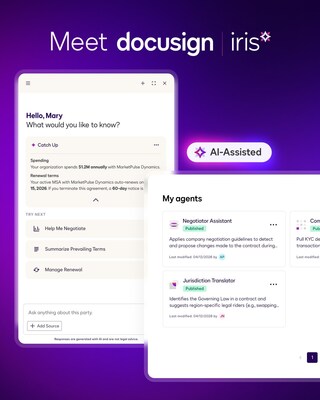
- What happened: Docusign announced Iris Agents, Agent Studio, and a Docusign MCP beta together.
- The pitch is to handle contract review, approvals, risk flags, and obligation tracking through natural language and agent workflows.
- Why it matters: Agreements stop being static PDFs after signature and start becoming work context that Claude, Gemini, and ChatGPT can call.
- Builder angle: The durable advantage may be less about one model and more about
MCP, permissions, audit logs, and agreement data schemas.- Docusign MCP was announced as a global English-language beta on May 21, 2026, while rollout timing for related products varies by region.
Docusign's May 21, 2026 Momentum conference announcement is not just another "AI summarizes contracts" update. The company introduced Iris AI assistant, Iris Agents, Agent Studio, and a Docusign MCP beta as one package. On the surface, the message sounds familiar: review agreements faster, automate approval requests, flag risk, and track obligations. The more interesting developer story is that Docusign wants to expose agreement history, approval standards, relationship data, renewal dates, and contractual obligations as a tool surface external AI agents can use.
Until recently, most contract AI workflows lived inside the document. A user uploaded a PDF, the system summarized the clauses, and risky terms were highlighted. Docusign's announcement pushes that surface outside the document and into the surrounding workflow. The company says Docusign MCP can make agreement intelligence available inside tools such as Anthropic Claude, Google Gemini, and OpenAI ChatGPT. In practical terms, a user could ask an agent to prepare renewal routing by checking three years of supplier agreement history and exception clauses, then have the agent move beyond a generic chat answer by calling Docusign's internal context and workflows.
That is the core of this news. It is not simply an e-signature vendor adding AI features. It is an example of old SaaS business data entering the execution environment of general-purpose agents through MCP. As model capability becomes more evenly distributed, the enterprise AI defensibility question shifts from "who writes the smartest answer?" to "who lets agents safely call the real business context?"
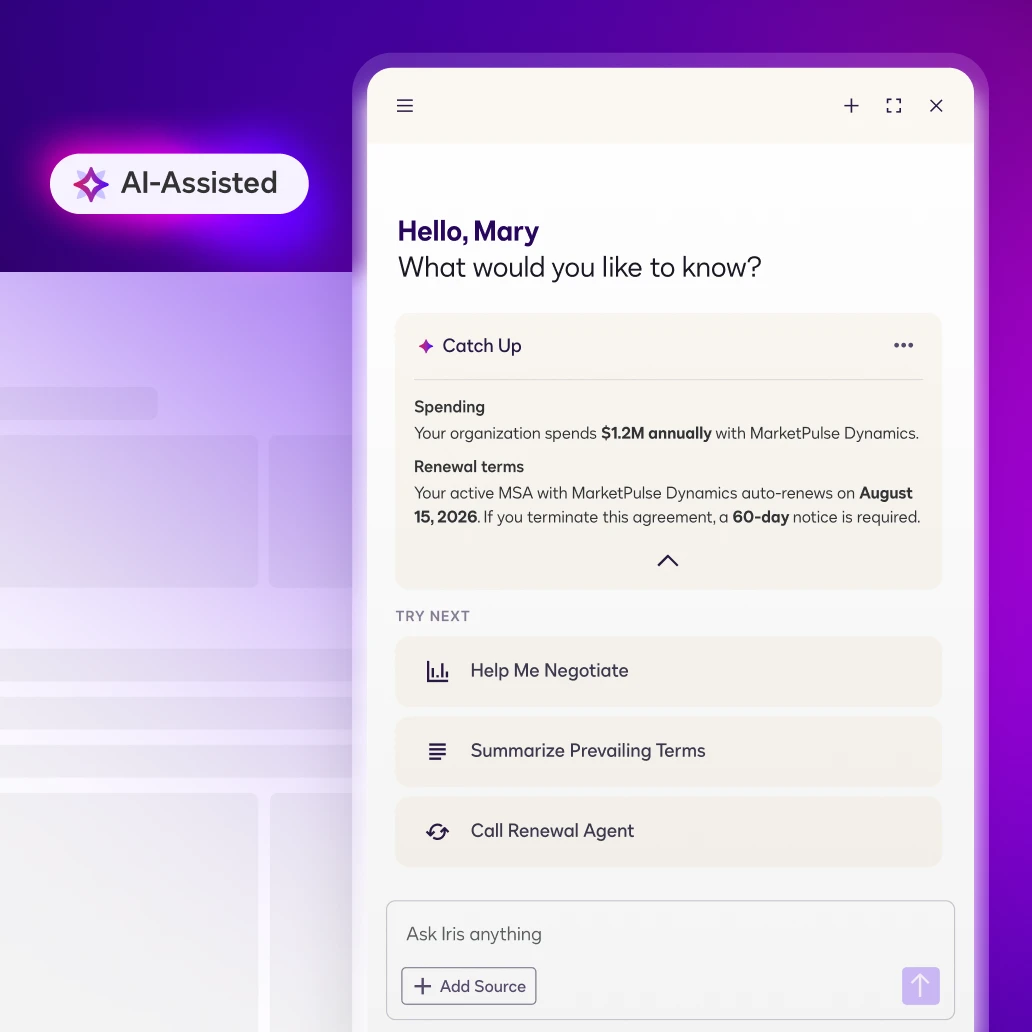
The Visible Announcement: Iris Assistant, Agents, and Agent Studio
Docusign presents Iris as an AI engine for agreements. Iris assistant is designed to understand agreement history and Docusign usage context, so users can ask in natural language for risk checks, approval requests, intake classification, and similar tasks. Iris Agents move closer to execution. They can review agreements against company standards and prior approval conditions, identify exception clauses, request the right approvers, and monitor renewals or obligations in the background.
Agent Studio extends that flow into team-specific rules. The product page says users can describe a vendor renewal workflow or a new-contract approval process and create an agent for it. The noteworthy part is not the usual "AI replaces contract experts" framing. It is closer to "team knowledge becomes an automated process." In real companies, contract review itself is often only one bottleneck. The harder work is exception handling, approval rules, CRM updates, procurement-system handoffs, renewal reminders, and the timing of legal review. Docusign is trying to bundle those bottlenecks into one agreement-specific agent surface.
The release schedule is split by product. Docusign AI assistant, agents, and Agent Studio are in early access in the United States, with US rollout planned from July 2026. IAM for HR is scheduled for US early access in June 2026. IAM for Sales is available globally. AI-assisted Web Forms are planned for global availability in June 2026. Docusign MCP was announced on May 21, 2026 as a global English-language beta. Those timing details matter. This does not mean every Docusign customer immediately gets the same level of contract automation. It means Docusign is opening the connection layer and a set of workflow scenarios first.
Agreements Are a Strong Agent Testbed
Agreement work has many properties agent products like. There are documents, dates, conditions, approvers, and repeated procedures. At the same time, the work is unforgiving. One phrase can change payment terms, liability, termination rights, privacy obligations, or regulatory exposure. That is why contract AI needs more than summarization. It needs execution with evidence: why a clause was treated as risky, which company policy it was compared against, who should approve it, and how a proposed change landed in the actual document.
A general-purpose model is not enough for this kind of workflow. A model can understand language and draft suggestions, but it does not automatically know a company's historical contracting practice or approval policy. That is where a system vendor such as Docusign has leverage. Docusign already sits across signing, contract management, templates, workflow, CRM integrations, and legal operations. If that data and permission structure becomes callable by models, the model is no longer reasoning only from general contract knowledge. It is operating inside a specific organization's agreement context.
MCP is a useful lens for the shift. It has become a protocol for exposing tools, resources, and prompts between models and external systems. In developer terms, it is a standardized adapter that lets a chat model call functions in business systems. Docusign MCP matters because agreement data usually has strict permission and audit requirements. This is much more sensitive than a weather API or public-document search. If MCP works in this kind of environment, more enterprise SaaS vendors are likely to follow the same route.
The Numbers Are Attractive, but the Reading Matters
Docusign's Deloitte study page describes research with more than 1,100 global leaders. The page says organizations using agentic workflows on an end-to-end agreement platform reported about 29% higher ROI, reduced manual work and total cycle time by an average of 36%, and reduced errors and missed compliance obligations by 72%. The announcement also says about 40,000 global customers are seeing measurable results from the IAM platform.
Those are strong sales numbers, but they should not be read as "add AI agents and ROI rises 29%." Docusign's phrasing ties the results to an end-to-end agreement platform and agentic workflows together. The real variables may be workflow integration, data quality, clearly defined approval rules, and business adoption. If agreement work is scattered across email, spreadsheets, PDFs, and disconnected CLM records, even a capable agent may struggle to create an executable state.
That is why the announcement is better understood as a data-cleanup and workflow-integration story than a pure AI feature race. Are clauses structured? Are exception criteria documented? Are approvers and delegation rules stored in systems? Are renewal dates and obligations connected to CRM, ERP, HRIS, or procurement tools? Organizations that can answer those questions will likely see the benefits of agreement agents sooner. Without that foundation, an agent may produce convincing summaries and task lists without actually finishing the work.
The Real Product for Developers: A Work Context API
Docusign MCP beta asks a direct question for developers: is a human-facing SaaS UI enough, or does every business application now need an agent-safe work context API? This is not only Docusign's problem. Salesforce, Atlassian, Microsoft, Google Workspace, ServiceNow, GitHub, Linear, Notion, Slack, and other work systems are facing the same pressure.
Agents can read screens and click buttons. Enterprises, however, do not really want fragile screen automation. They want execution where permissions are constrained, inputs and outputs are validated, audit logs are preserved, and human approval points are clear. Agreement work makes this especially obvious. If an agent changes a clause or sends an approval request, the system must record which authority it used and which data it accessed. "The AI decided" is not an acceptable explanation for legal or security teams.
That is why Docusign's references to built-in oversight, human-in-the-loop approvals, and transparent audit trails should be read as more than marketing language. They are base requirements for SaaS in the agent era. Developers designing enterprise agent features need the same checklist: permission checks before tool calls, minimal data exposure, dry-run or preview stages, approval queues, change diffs, execution logs, and rollback paths.
The Boundary With Legal AI
Docusign also mentioned collaboration with legal AI platforms such as Harvey, Legora, and CoCounsel by Thomson Reuters. That is a smart positioning move. Rather than claiming that Docusign will own all legal reasoning, the company is positioning itself as the central workflow hub that can connect specialized legal AI into the agreement lifecycle.
Legal AI products have strengths in clause analysis, legal and regulatory research, and legal-review assistance. Docusign's strength is making that analysis usable inside the actual contract flow: create, negotiate, approve, sign, store, and renew. With MCP attached, an external model or legal AI system can call Docusign agreement context, while Docusign keeps the result inside workflow and audit structures.
The boundary could still turn competitive. Legal AI platforms may move downward into contract lifecycle management. Docusign may make Iris a deeper analysis engine. Microsoft Copilot, Salesforce Agentforce, and other general enterprise agents may try to absorb contract workflows. In that environment, Docusign MCP becomes both a defensive layer and a distribution channel. Wherever users run their agents, Docusign can try to keep the source agreement context and execution authority inside its platform.
What AI Teams Should Take From This
For anyone else building B2B SaaS, the lesson is less "use Docusign" and more "design your product's agent surface." A dashboard built for humans may not be enough for much longer. Customer agents will need to safely read, search, execute, and create approval requests inside your system, and that requires product design beyond publishing API documentation.
First, the data model must be legible to agents. In agreement software, that means parties, clauses, exceptions, approval status, renewal dates, obligations, and attachments should be structured. Second, tool calls should be decomposed into small, verifiable units. Instead of a giant "process contract" function, a system needs steps such as "find risk candidates," "suggest approvers," "generate a change diff," and "draft an approval request." Third, human approval boundaries should be explicit. The agent recommends, the person approves, and the system executes. That boundary has to live inside the product.
MCP alone does not solve this. MCP is a connection format. The responsibility model still has to be designed by the product team. Docusign's announcement is interesting because the company is not just saying it built a better model. It is packaging agreement context, approval workflow, external model connectivity, a legal AI ecosystem, and auditable execution together. That bundle is where enterprise AI agents may start producing real economic value.
Watch the Beta, Permissions, and Overstated Autonomy
The word to handle carefully in this announcement is "agent." Adding the label does not mean agreement work becomes fully autonomous. The products are split across regional early access and beta stages, and responsibility for agreement work still stays with the organization and its people. Contract review and legal judgment depend heavily on regulation, industry, jurisdiction, and company policy. Iris Agents' suggested edits or risk flags should be treated as review candidates, not final decisions.
Data boundaries are another variable. Connecting Docusign MCP to external AI tools creates convenience, but also security questions. Which agreement data is sent to which models and tools? How is customer data isolation enforced? Which actions can external agents call? How does the system defend against prompt injection or malicious documents that try to trigger tool calls inside a contract workflow? The announcement materials do not fully answer those questions.
Still, the direction is clear. The next phase of enterprise AI is less "a chat window replaces everything" and more "business systems become safe tools agents can call." Docusign is showing that pattern in a complicated, high-stakes domain where money and legal responsibility are attached to the workflow. Other SaaS vendors will face the same question: will the important work context inside their products remain a human-only screen, or become an agent tool with permissions and auditability?
Conclusion
Docusign Iris Agents and the MCP beta are a product update for contract AI, but they are also a signal for the AI agent infrastructure market. General-purpose models can do more every month, but real enterprise work still requires agreement data, approval rules, integration points, audit logs, and human approval procedures. Docusign is turning that bundle into what it calls agreement workflows.
For developers, the practical message is simple. Products in the agent era cannot stop at readable documents and polished dashboards. They need callable tool surfaces, structured context, verifiable execution units, and human approval flows. It is too early to know how quickly Docusign's new agent products will be adopted in the market. But the direction is already visible: agreements are becoming more than files. They are becoming business objects that agents can call.