The 15x token bill and the return of the AI-native cloud
DigitalOcean AI-Native Cloud shows why agent costs are shifting from GPU rental to inference routing, data, state, and operations.

- What happened: DigitalOcean used Deploy 2026 to introduce
AI-Native Cloudand expand its Inference Engine.- Its core claim is a new cost shape: agent-native workloads can need 15x more tokens than human users and 4x more CPU than traditional workloads.
- Why it matters: AI infrastructure competition is moving beyond GPU rental toward an operations stack that bundles routing, RAG, state, sandboxes, and agent orchestration.
- Watch: The 42% cost reduction and monthly
$67,727comparison are vendor-provided analyses. Teams should recalculate them from their own traces and failure rates.
DigitalOcean announced AI-Native Cloud at Deploy 2026 on April 28, 2026. At first glance, this looks like another cloud vendor packaging a set of infrastructure products. Follow the numbers, though, and the story gets more interesting. DigitalOcean says an agentic task can involve hundreds of model calls, hundreds of database queries, and more than one million tokens. It also says agentic systems can use roughly 4x more CPU capacity than comparable traditional workloads and 15x more tokens than human users.
That framing captures where AI infrastructure is going. For the last two years, the market mostly asked where to rent GPUs. H100, H200, B200, and MI300X sounded almost like strategy. But once an AI product reaches production, the bottleneck rarely ends at a single GPU line item. Data retrieval, cache, retry logic, tool execution, sandboxes, state storage, authorization, guardrails, tracing, and cost routing all sit around the model call. Whether the product is a coding agent, a support agent, or a travel booking agent, the cost comes from the whole loop, not the model pricing table alone.
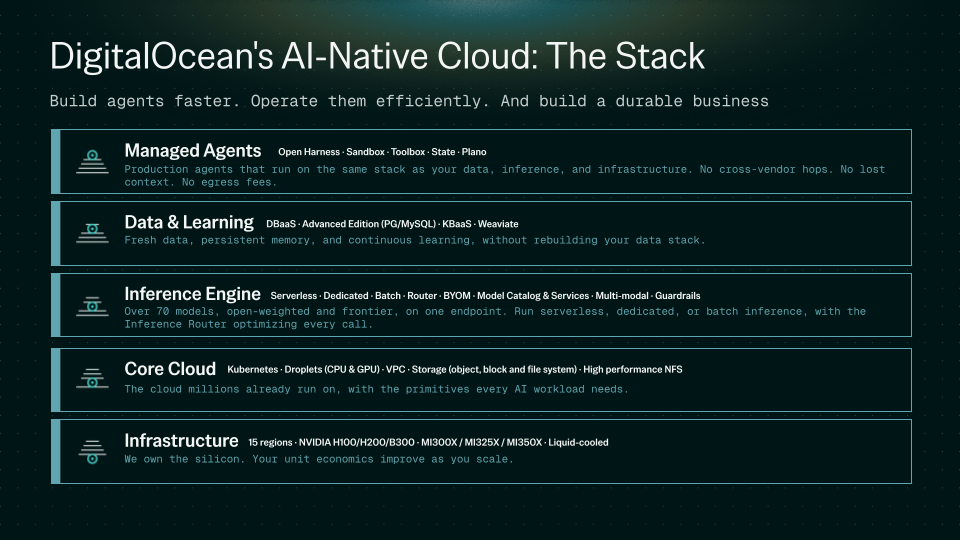
That is why DigitalOcean's announcement is worth watching. The company describes AI-Native Cloud as five layers: infrastructure, core cloud, inference, data, and managed agents. It wants serverless inference, dedicated inference, batch inference, a model catalog, Inference Router, Knowledge Bases, Managed Weaviate, and managed agents to live in one platform. The interesting claim is not that one product is faster than another. It is that operating AI applications now requires too many separately stitched parts.
Inference is less dramatic than training, and often more expensive
AI news makes training look like the main event. GPU cluster size, trillion-parameter counts, and benchmark wins are easy to understand. Production teams see a different bill. Inference calls, context length, embeddings, reranking, vector databases, queues, browser sandboxes, file storage, log retention, evaluation jobs, retries, and human recovery work pile up more often.
DigitalOcean calls this the inference era. Its announcement projects that the world will process more than 500 trillion inference tokens per day by 2030, up from roughly 50 trillion today. That is a forecast, so it is better read as direction than certainty. The important point is that an AI product's marginal cost does not scale only with user count. If an agent calls several models in the background and repeats search and verification at each step, one user's request can look internally like dozens of API users.
Consider a travel booking agent. The user says, "Plan my San Francisco business trip next month." The system may search flights, search hotels, check company policy, inspect calendars, compare prices, request payment approval, draft emails, monitor schedule changes, and analyze cancellation terms. Each step creates model calls and data queries. Failure triggers retries. Safer execution adds evaluation and guardrails. The user made one request, but the infrastructure has to process a long execution graph.
That is the problem DigitalOcean is trying to push into view. GPUs are necessary. But renting GPUs does not solve agent loop state, data, networking, security, evaluation, or routing. On the other side, assembling a hyperscaler stack service by service gives teams flexibility but adds glue cost. DigitalOcean is positioning itself between those poles: an integrated stack for AI-native builders that can be used without rebuilding every operational layer.
The five-layer stack is a cost structure, not just packaging
DigitalOcean's AI-Native Cloud has five layers. The first is infrastructure. The announcement names 20 global datacenters, NVIDIA H100, H200, HGX B300, AMD Instinct MI300X, MI350X, and MI355X GPUs, plus a 400G RoCE RDMA fabric. The second is core cloud: Kubernetes, CPU and GPU Droplets, VPC, S3-compatible object storage, and block and file storage.
The third layer is the inference engine, and this is the center of the announcement. DigitalOcean groups serverless endpoints, dedicated endpoints, batch processing, a model router, a model catalog, bring-your-own-model, a custom vLLM fork, KV-cache tuning, speculative decoding, and GPU-aware scheduling. The fourth layer is data and learning: PostgreSQL and pgvector, Valkey, Knowledge Bases, and real-time data capability. The fifth is managed agents: open agent harness support, secure sandboxes, durable state management, and agent orchestration.
If you read that as a product brochure, it may not look new. Every cloud company lists compute, storage, databases, and AI services. In agent-native workloads, however, the seams between those layers become cost boundaries. Model calls create inference cost. Retrieval creates vector and RAG cost. Sandboxes create CPU and storage cost. State creates database and object storage cost. Tracing creates observability cost. When each layer lives with a different vendor, egress, latency, auth, debugging, and billing attribution become part of the system.
DigitalOcean describes this as a stitching problem. An AI team can choose a model provider, GPU cloud, vector database, managed PostgreSQL service, queue, observability stack, and agent framework independently. That maximizes options early. In production, it also blurs responsibility when things go wrong. Is the model slow, the retrieval layer slow, network egress expensive, the routing rule wrong, or a request that should have gone through batch being handled in real time? DigitalOcean says it can reduce that complexity inside one platform.
| Question | Traditional cloud assembly | GPU-cloud centered | AI-Native Cloud claim |
|---|---|---|---|
| Main bottleneck | Service stitching, permissions, networking, cost attribution | Securing GPUs, then building the surrounding platform | Optimize inference, data, and agent state in one stack |
| Model selection | Wire each provider API directly | Center on self-deployed models | Mix open and closed models through a catalog and router |
| Agent operations | Configure frameworks, databases, sandboxes, and tracing separately | Leave runtime design to the team | Provide managed agents, sandboxes, and durable state |
Inference Router turns model selection into an operations problem
The most concrete developer-facing piece is Inference Router. DigitalOcean's docs say Inference Router entered public preview for all users on May 1, 2026. The feature description is straightforward: group models into a model pool, then configure routing rules and selection policies for inference requests. There are prebuilt templates, natural-language custom task-matching logic, and fallback settings for reliability.
This fits how AI apps are actually being run. The era of sending every request to one model is ending quickly. A simple classification task may be fine on a small open model, while long code analysis may need a stronger one. Customer conversation summaries may prioritize latency, while legal document review may prioritize quality and residency. Once image, voice, text, and video generation are mixed into the same application, routing becomes hard to maintain with a few if statements.
DigitalOcean points to LawVo as an example. According to the announcement, LawVo runs more than 130 AI agents, processes more than 500 million tokens per week, and reduced inference cost by 42% after moving to DigitalOcean without code changes. That is a vendor case study, not an independently verified benchmark. Still, it reveals the optimization target. The cost lever is not just the price of one model. It is which request goes to which model and deployment type.
This is not only DigitalOcean's story. Vercel AI Gateway, OpenRouter, LiteLLM, hyperscaler model routers, and internal LLM gateways all deal with similar problems. The difference is how much responsibility the platform takes. A simple gateway abstracts provider calls. A deeper inference platform includes model catalogs, evaluation, guardrails, batch processing, dedicated endpoints, and cost policy. DigitalOcean is trying to move further down the stack by tying that to databases and agent runtime.
Knowledge Bases and MCP make RAG part of the agent toolchain
DigitalOcean's Knowledge Bases are also worth attention. The official blog describes Knowledge Bases as a managed RAG service for ingestion, chunking, embedding, retrieval, and reranking. The docs mention semantic, keyword, and hybrid search; filtering; retrieved-chunk inspection; live code examples; reranking; and a RAG Playground. The important detail is that Knowledge Bases can be exposed as MCP tools.
RAG is an old pattern, but its role changes in the agent era. If a chatbot searches a few documents to answer a question, retrieval quality is a UX issue. If an agent uses retrieved results to make payments, deploy code, respond to customers, edit documents, or change source files, retrieval becomes part of execution safety. The wrong chunk can lead to the wrong action. RAG is no longer just a feature that enriches answers; it is an input boundary for the agent loop.
Exposing a Knowledge Base as an MCP tool means the agent can call it as a structured capability. That simplifies developer experience. It also raises operational questions. Which agent can read which knowledge base? Are retrieved chunks preserved in the trace? What does reranking cost, and what happens when it fails? How do data residency and retention policies apply? If DigitalOcean wants AI-Native Cloud to feel like one stack, these answers need to connect in one operational view.
The cost comparison is useful, but not something to accept at face value
DigitalOcean gives a representative corporate-travel agent workload of one million bookings per month and estimates its AI-Native Cloud cost at $67,727 per month. It compares that with $84,827 for Baseten plus AWS and $110,337 for AWS AgentCore. In the announcement's framing, that is a 20% to 40% reduction. A separate Inference Engine announcement says early design partners reported up to 67% lower inference cost.
Those numbers make a strong headline. In practice, teams should be careful with them. First, the result depends heavily on the workload shape: model-call ratio, context length, batchability, cache hits, vector search frequency, region, egress, retries, and human review cost. Second, discounts, enterprise commitments, reserved capacity, and in-house optimization can change the comparison. Third, agent cost has to be read alongside success rate. A cheaper model that fails more often can make the total run more expensive.
The lesson is not that DigitalOcean is automatically cheaper. The useful question is whether your team can break down the cost of an agent run by layer. Teams that only track model calls miss sandbox CPU, database queries, embeddings, reranking, observability, and failure recovery. Teams that send every request to the strongest model miss savings from routing. The phrase AI-native cloud only matters if the platform helps teams trace, route, and experiment with those costs.
Developers should start with traces, not vendors
DigitalOcean's promise is attractive for AI-native builders: mix open-source and frontier closed models inside one application, change routing dynamically, and operate Knowledge Bases and agents from the same platform. The direction is realistic. Most production AI teams will struggle to stay on a single-model strategy for long because cost, quality, latency, privacy, region, and modality vary by request.
But whichever platform a team uses, the first requirement is trace data. How many model calls does one agent task need? Which model fails at which step? How much does retrieval improve output quality? Which calls can be delayed into batch? Which steps are safe on a smaller model? Without this data, an Inference Router becomes a guessing machine. Writing routing rules in natural language is convenient, but the only way to know whether those rules improve cost and quality is through evaluation jobs and production telemetry.
That is why DigitalOcean's references to model evaluation, agent tracing metrics, and agent evaluation metrics are important signals. AI platforms are moving past simple model endpoints. Developers need to inspect the full run, not just one call. The operational questions become: Did this agent succeed? Where did cost spike? Did fallback preserve quality? Did RAG reduce hallucination? Did human intervention decrease?
A quiet but important cloud reshaping
This news did not land with the same noise as a new OpenAI or Google model release, and that makes sense. AI-Native Cloud is infrastructure positioning, not a consumer demo. For developers and AI product teams, however, these announcements often matter longer. Models change every few months. Production stacks are harder to move once data, state, observability, and routing settle into one platform.
DigitalOcean's strategy is double-edged. On one side, it reduces fragmentation. Smaller teams may operate AI products faster without assembling a complex hyperscaler stack or managing low-level GPU-cloud infrastructure. On the other side, it creates a new integrated-platform lock-in. A model router, knowledge base, managed agent runtime, tracing, and sandbox are convenient together, but their portability matters when a team later moves to another cloud or an internal stack.
DigitalOcean emphasizes open standards and open-source technology. The announcement mentions OpenCode, LangGraph, PostgreSQL, MySQL, pgvector, Qdrant, DeepSeek, Llama, Qwen, NVIDIA Nemotron 3 Nano Omni, Claude, GPT, Kubernetes, Cilium, and S3-compatible storage. That list is a market message: the company wants to present this as an open stack rather than a closed ecosystem. Real openness will show up in API compatibility, export formats, tracing schemas, routing rule portability, and data migration.
The cloud is being reshaped around AI applications again
The point of DigitalOcean AI-Native Cloud is not simply that another cloud product exists. The larger shift is that the basic unit of an AI application is changing from a single request into a long-running agent loop, and cloud platforms are being reorganized around that shape. In the SaaS era, the cloud was arranged around web servers, databases, object storage, queues, and CDNs. In the agent-native era, the cloud needs model routing, RAG, tool execution, sandboxes, state, evaluation, guardrails, and tracing as core pieces.
In that sense, "15x more tokens" may be a marketing number, but the direction is right. Agents turn one user sentence into a long execution graph. If teams cannot see the cost of that graph, an AI product can look convincing in a demo and unstable in production economics. DigitalOcean is trying to put that cost graph at the center of the cloud product.
There are three things to watch next. First, whether Inference Router can reliably improve cost and quality in mixed-model production. Second, whether Knowledge Bases and managed agents connect naturally with ecosystems such as LangGraph, OpenCode, and MCP. Third, whether DigitalOcean's cost comparison repeats across different workload shapes. The answers will come from production traces, not launch posts.
The direction is clear even now. The next round of AI infrastructure competition will not be decided only by who owns more GPUs. It will be shaped by who can make the whole agent loop cheaper, more observable, and easier to change. DigitalOcean's AI-Native Cloud is an explicit declaration of that transition. Model calls are a feature; agent execution is infrastructure.