Microsoft Work IQ APIs go GA June 16 with ten tools for M365 agents
Microsoft Work IQ APIs reach GA on June 16, bringing Microsoft 365 work context, ten MCP-style tools, and Copilot Credits pricing to agents.
- What happened: Microsoft said Work IQ APIs will become generally available on June 16, 2026.
- The APIs package email, calendar, meetings, chat, files, people, and collaboration patterns from Microsoft 365 into agent-ready workplace context.
- The scale claim: Microsoft cites an average 600 TB-plus Fortune 500 data footprint and an internal 80% token reduction versus traditional APIs.
- The interface: Work IQ is split into
Chat,Context,Tools, andWorkspaces.- Tool calling uses MCP-style progressive disclosure to compress Microsoft 365 operations into ten generic tools.
- Watch: Pricing runs through Copilot Credits, while the GitHub preview warns that APIs may change and tenant admin consent is required.
Microsoft announced on June 2, 2026 that Work IQ APIs will reach general availability on June 16. Work IQ is the Microsoft 365 workplace-intelligence layer that processes email, calendars, meetings, chats, files, people, collaboration patterns, and work systems so agents can operate with organizational context instead of raw application data. Microsoft describes it as the default path for agents that need to interact with Microsoft 365 data and apps.
The announcement sits inside Microsoft's larger Build 2026 context-layer story. The company presented Microsoft IQ as a shared layer for GitHub Copilot, Microsoft Foundry, and Copilot Studio. Inside that layer, Work IQ handles workplace intelligence, Fabric IQ handles structured business data, Foundry IQ handles retrieval planning, and Web IQ handles MCP-native web grounding. Recent devlery coverage has focused on Microsoft Scout, Rayfin, MAI-Code-1, Aion, ASSERT, and ACS as execution, model, and governance pieces. Work IQ APIs are about a different part of the stack: turning Microsoft 365 work data itself into an agent surface.
Work IQ is broader than a thin Microsoft Graph wrapper. Microsoft says it continuously processes email, calendar, meetings, chats, files, people, collaboration patterns, and line-of-business systems to build a semantic understanding of how a company works. That framing matters because an agent does not only need a list of messages or files. It needs to know which meeting, document, person, team, thread, and follow-up are relevant to the task in front of it.
Microsoft's first number is scale. The company says Work IQ has an average data footprint of more than 600 TB inside Fortune 500 organizations, based on internal Microsoft data from May 2026. That is not a performance benchmark. It is a measure of how much enterprise work already lives in Microsoft 365. For developers, the practical implication is direct: once an agent can read that much context, retrieval quality, permission checks, citations, stale data, and cost control become part of the API design rather than after-the-fact operations work.
The second number is the tool surface. Microsoft says Work IQ APIs use MCP progressive disclosure to reduce operations to ten generic tools. In the older pattern, an agent would need to learn detailed APIs and schemas for mail, calendars, files, people, messages, and each new Microsoft 365 entity. Work IQ Tools instead use resource paths and verbs to express the work scope, avoiding a long and constantly growing tool list. That design directly affects prompts, tool schemas, context windows, and model billing.
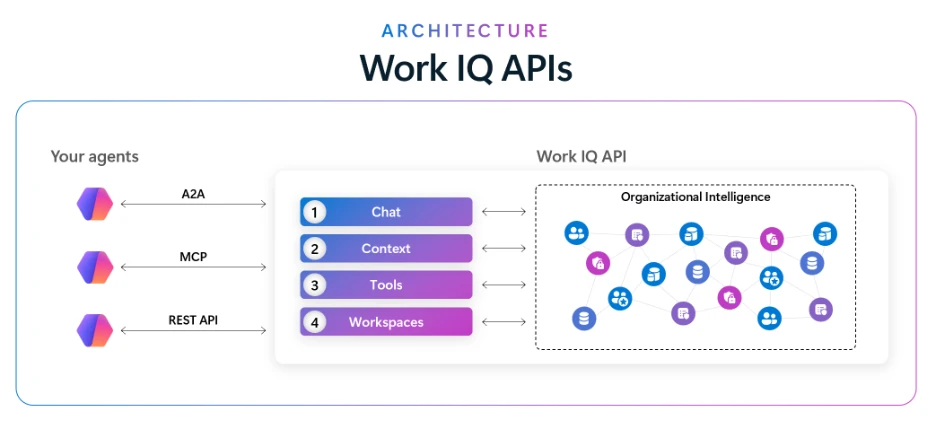
The official architecture divides Work IQ into four domains. Chat gives programmatic access to answers and citations that Microsoft 365 Copilot would return to a user. Context returns the source data Copilot would use, formatted for an agent. Tools exposes Microsoft 365 entities and actions such as sending email, scheduling meetings, and uploading documents. Workspaces stores state, files, memory, progress, and intermediate outputs that long-running agents create while reasoning.
Workspaces is the most operationally interesting domain. Microsoft says it was a critical enabler for long-running agents such as Copilot Cowork and Microsoft Scout. A workplace agent that prepares meetings, resolves calendar conflicts, or revises documents over several days needs somewhere to keep intermediate state. Microsoft is proposing that the state should remain inside the Microsoft 365 tenant boundary instead of being scattered across an external vector database, temporary worker storage, or a developer-managed blob bucket.
The efficiency claim is more direct. Microsoft says Work IQ APIs reduce total token usage compared with traditional APIs because the runtime uses specialized LLMs and agents to package context and data before the requesting agent consumes it. The announcement also points to token savings from trimming file record strings, message IDs, app IDs, and similar API-level noise that models do not need to reason over.
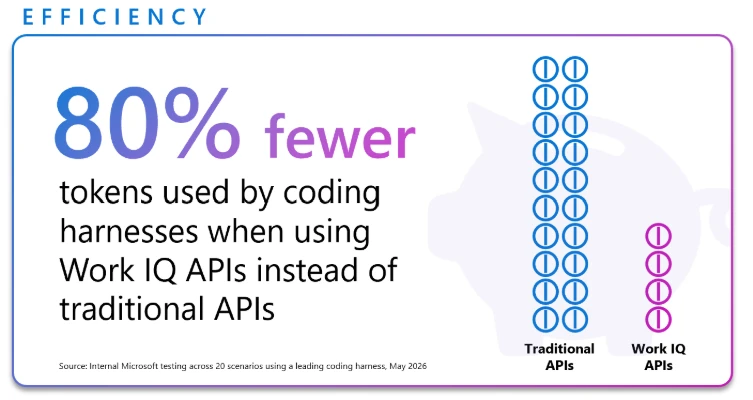
Microsoft's chart claims Work IQ APIs use 80% fewer tokens than traditional APIs in an internal coding harness. A second chart in the same announcement claims 2x faster runtime. Neither number is an independently reproduced benchmark. Results will vary by tenant policy, data source, connector shape, and task type. The news value is that Microsoft is competing on agent API surface area and token bill, not only on model quality.
The pricing model arrives with the API. Work IQ APIs use consumption-based pricing shown as Copilot Credits. Tools have a fixed component, while Chat and Context have variable components. Microsoft 365 admin center is getting a cost-management dashboard where administrators can view AI credit usage, configure prepaid or pay-as-you-go billing, set spending limits at tenant, group, and user levels, and monitor user credit requests. Microsoft says Work IQ APIs are the first product managed through this experience, with Copilot Studio and other products planned for inclusion later.
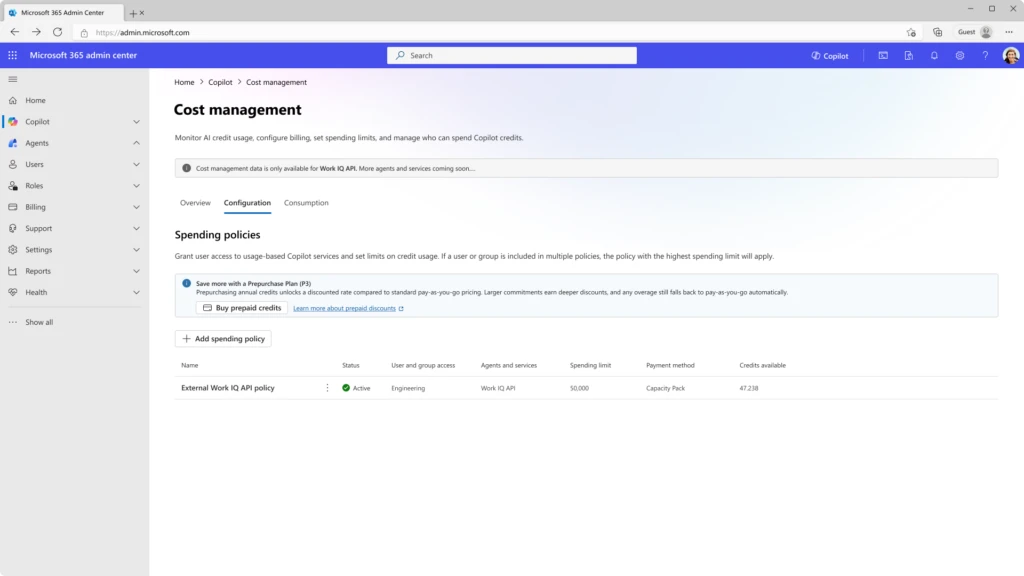
That billing screen captures a real deployment bottleneck. When a person opens Outlook, Teams, SharePoint, or OneDrive to find information, the cost is usually buried inside seat licensing. Agents behave differently. One task can chain calls across mail, calendars, files, Teams messages, people data, and external work systems. Multiple sessions can multiply the same user's context access many times over. Credit budgets, group limits, audit, and chargeback need to be part of the prototype, not only the production rollout.
The developer entry point is the microsoft/work-iq GitHub repository. Its README describes an MCP Server and CLI for accessing Work IQ and presents it as the official Microsoft Work IQ plugin collection for GitHub Copilot. The quick start tells GitHub Copilot CLI users to run /plugin marketplace add microsoft/work-iq, then install plugins such as workiq@work-iq, workiq-preview@work-iq, microsoft-365-agents-toolkit@work-iq, and workiq-productivity@work-iq. For standalone MCP usage, it shows npm install -g @microsoft/workiq, workiq mcp, and npx -y @microsoft/workiq mcp.
The README's warnings are part of the story. The repository is labeled Public Preview, so features and APIs can change. Access to Microsoft 365 tenant data requires permission consent for the WorkIQ CLI and MCP Server, and the consent path can require a tenant administrator. That makes Work IQ less like a quick personal developer API and more like an enterprise preview that assumes an Entra tenant, company account, and admin approval workflow.
Microsoft's security promise is the Microsoft 365 tenant trust boundary. The company says data, context, and insights stay inside that boundary, and agent actions remain auditable and discoverable. That language should be read as a deployment requirement, not just a product slogan. A workplace agent that sends mail, schedules meetings, uploads files, or rewrites documents needs an answer for who authorized the action, which source it read, which identity performed it, and how the organization can investigate the event later.
This is where Work IQ differs from ordinary Microsoft Graph usage. Graph is organized around endpoints and entities. Work IQ is organized around the agent loop: ask a question, receive source context, invoke an action tool, preserve intermediate state, and cite the result. Developers must decide whether their product should use a synthesized Copilot answer, raw source context before synthesis, generic action tools, or workspace state. The right choice will differ between an internal knowledge Q&A bot, a meeting-preparation agent, and a document-workflow agent.
The competitive set is clear. Google is pulling Workspace, Drive, Search, and enterprise connectors into Gemini Enterprise and Agentspace-style products. AWS is connecting Bedrock Knowledge Bases and AgentCore around runtime, memory, and tool execution. Salesforce binds CRM data and workflow to Agentforce. ServiceNow is moving through IT and operations workflows. Microsoft's advantage is that Outlook, Teams, SharePoint, OneDrive, Office documents, and the organization chart already hold a large share of a knowledge worker's day.
For organizations evaluating Work IQ, four checks come first. If Microsoft 365 is the center of work, teams need to decide whether Work IQ replaces or complements existing Graph integrations. Admin consent and tenant boundaries should be tested separately across development, staging, and production tenants. Copilot Credits need practical limits for runaway agents, repeated context calls, and parallel sessions. Workspaces also needs review by security and legal teams because intermediate files, state, and outputs may fall under retention, deletion, eDiscovery, and audit policies.
Community discussion is still small relative to the product scope. The research note for the Korean article did not find a focused Hacker News thread on Work IQ APIs. Reddit discussion in r/copilotstudio asked about the difference between Work IQ User MCP and Work IQ Copilot MCP, while r/microsoft365 described the Work IQ CLI public preview as a CLI and MCP server for Microsoft 365 Copilot data. Those reactions are more practical than ideological: identity, read-only behavior, schema stability between preview and GA, and the boundary between user-context queries and structured entity tools.
Work IQ APIs are unlikely to become the universal enterprise-agent layer by themselves. They are strongest for companies where Microsoft 365 is already the work hub, Copilot Credits are acceptable, and Entra, Purview, and Defender are part of the governance baseline. In organizations where Slack, Google Workspace, Notion, Jira, Confluence, or a custom ERP holds more operational context, Work IQ will be one connector inside a broader agent memory and action system.
The practical takeaway is that Microsoft is repackaging workplace applications from user-facing UI into an organizational context API for agents. After GA on June 16, developers will need to decide whether Work IQ is a search path, a Copilot Chat facade, a Microsoft 365 action surface, or a state store for long-running agents. The same API can lead to very different products. A knowledge Q&A tool starts with Context and citations. A meeting agent likely needs Chat, Tools, and Workspaces together. Cost and permission checks are not operational footnotes. They are input parameters for the first prototype.