DeepSeek Replaces V4 Pro With V4.1 Flash on September 14, Trading Knowledge for Coding
DeepSeek released the 552B open-weight V4.1 Flash on September 10 and will route V4 Pro calls to it from 04:00 UTC on September 14. Agentic coding beats Pro and output is 70% cheaper, but factual recall drops from 55.2 to 42.3.
- From 04:00 UTC on September 14, calls to
deepseek-v4-proare answered by V4.1 Flash. - DeepSWE rises from 62.7 to 74.2 and output costs 70% less than on V4 Pro.
- Factual recall falls from 55.2 to 42.3, so compare knowledge-heavy tasks before the switch.
DeepSeek released V4.1 Flash on September 10. The API model ID is deepseek-flash, and the weights are on Hugging Face under the MIT license. The Hacker News thread reached 900 points and 500 comments on launch day.
The same notice carries a more urgent item for existing customers. V4 Pro, which went GA only a month ago, is retired at 04:00 UTC on September 14 (noon in Singapore and Beijing, midnight on the US East Coast). After that, requests to deepseek-v4-pro are silently served by V4.1 Flash and billed at Flash rates. Leave the model name untouched in your code and a different model starts answering. The old deepseek-v4-flash ID and the experimental image-input model deepseek-v4-flash-vision-exp have pointed at V4.1 Flash since September 10.
DeepSeek says V4.1 Flash beats V4 Pro "in performance, cost, speed, and total time to completion." The model card supports half of that claim.
Where it beats V4 Pro: agentic coding
On agent work that edits code and runs commands, the smaller model now beats the larger one. V4 Pro activates 49B of its 1.6T parameters per token. V4.1 Flash activates between 8B and 16B of 552B. Even so, V4.1 Flash leads on most of the agent benchmarks in the model card.
| Benchmark | V4 Flash | V4 Pro | V4.1 Flash | Claude Opus 5 |
|---|---|---|---|---|
| Terminal-Bench 2.1 | 82.7 | 87.9 | 90.6 | 89.1 |
| Terminal-Bench 4.0 | 7.0 | 12.4 | 31.2 | 51.8 |
| DeepSWE v1.1 | 54.4 | 62.7 | 74.2 | 74.0 |
| AutomationBench | 37.7 | 43.2 | 54.8 | 50.3 |
| HLE (with tools) | 51.5 | 60.0 | 63.9 | 63.6 |
Source: DeepSeek-V4.1-Flash model card on Hugging Face. All models at maximum reasoning effort.
On DeepSWE v1.1, which asks the model to fix bugs in real repositories, V4.1 Flash scores 11.5 points above V4 Pro and ties Claude Opus 5 (74.0). On Terminal-Bench 4.0, the newest and hardest set of terminal tasks, it goes from 12.4 to 31.2, a 2.5x jump, yet still trails Opus 5's 51.8 by more than 20 points. On shorter tasks it matches the top models; on long ones the gap is still wide.
Independent measurement points the same way. On the Artificial Analysis Intelligence Index, which aggregates several benchmarks, V4.1 Flash scores 40 and ranks 6th of 113 models. V4 Pro scores 36 and ranks 8th on the same index. Output speed is 190.1 tokens per second, 2.8 times V4 Pro's 68.8.
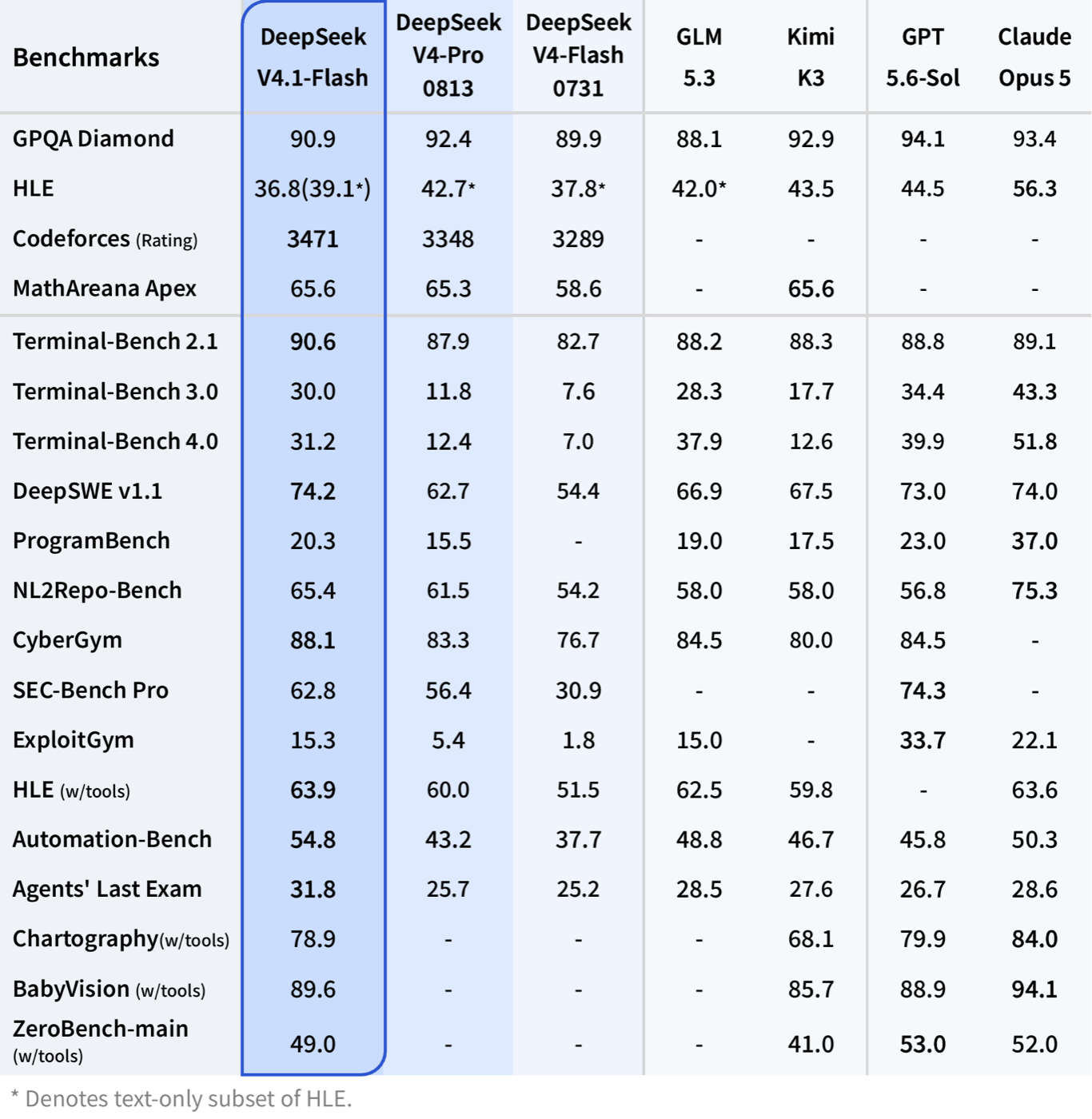
One caveat on those numbers. DeepSeek measured coding-agent scores with the minimal mode of its own tool, DeepSeek Harness. The per-harness breakdown in the model card puts DeepSWE v1.1 at 74.2 in mini-SWE, but 69.8 in Claude Code and 65.6 in Codex. If you plan to run this model inside Claude Code or Codex, budget 4 to 9 points below the headline figure. The same harness sensitivity showed up in GPT-6 Astra's ARC-AGI-3 score.
What you lose moving off V4 Pro: knowledge and multilingual
On tests of what the model has memorized, V4.1 Flash is clearly below V4 Pro. The base-model table in the model card shows it plainly. Despite DeepSeek's "better across the board" framing, V4 Pro leads on every row below.
| Benchmark (what it measures) | V4 Pro | V4.1 Flash | Change |
|---|---|---|---|
| SimpleQA-Verified (factual recall quiz) | 55.2 | 42.3 | -12.9 |
| LongBench-V2 (long-document understanding) | 51.5 | 45.2 | -6.3 |
| MultiLoKo (multilingual knowledge) | 50.9 | 45.5 | -5.4 |
| MGSM (multilingual math problems) | 84.4 | 80.2 | -4.2 |
| HLE text (hardest questions, no tools) | 42.7 | 39.1 | -3.6 |
Source: Hugging Face model card. HLE is the instruct model at maximum reasoning effort; the other rows are base-model scores.
The biggest drop, SimpleQA-Verified, is a quiz of factual questions answered without search. Going from 55.2 to 42.3 means missing nearly one in four of the questions V4 Pro got right. DeepSeek gives no explanation. The drop coincides with total parameters shrinking from 1.6T to 552B, roughly a third, but nothing in the model card connects the two. On Hacker News, one commenter pointed the other way: the near doubling from the previous V4 Flash's 284B is what explains the gains over V4 Flash.
If your workload is not in English, read the multilingual rows on their own. On MGSM, which poses math problems in many languages, V4.1 Flash scores 80.2, below V4 Pro and below the previous V4 Flash (85.7) as well. The model card does not break out scores by language.
Why it got cheaper: reading input uses only 8B
DeepSeek redesigned the model to make input cheap. Coding agents reread the same files and conversation history every turn, so input tokens dominate the bill. V4.1 Flash activates only 8B parameters per token while reading input and 16B while writing output. The model card describes this as a design for "cost efficiency on input-heavy agentic workloads."
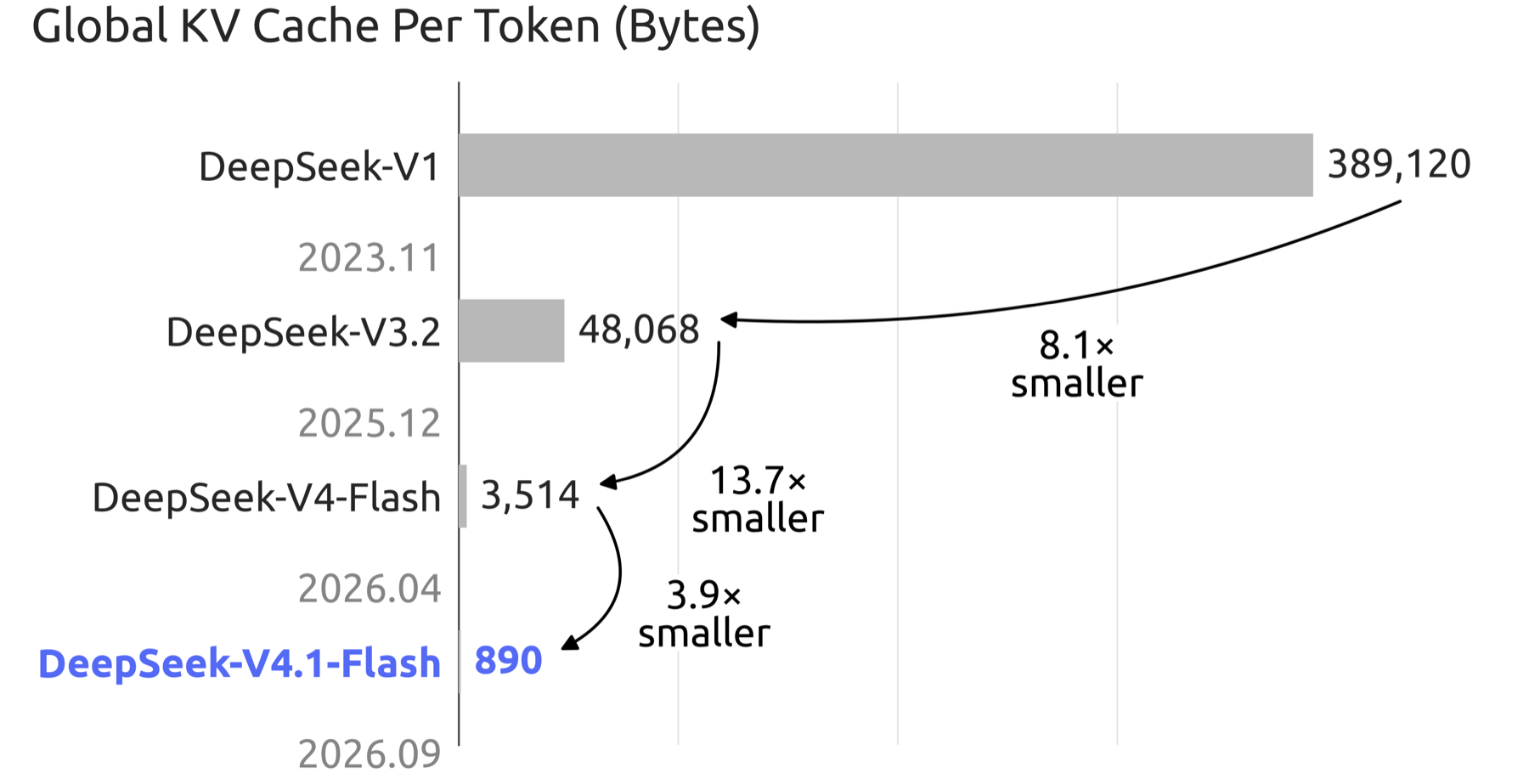
The KV cache is the working memory a model keeps so it does not recompute what it has already read. The smaller it is, the more concurrent requests one server can hold. V4.1 Flash needs 890 bytes per token, down from 3,514 bytes on V4 Flash, about a quarter.
The price list reflects the change. Below are USD prices per million tokens from DeepSeek's API pricing page. Peak hours are 01:00 to 04:00 and 06:00 to 10:00 UTC on weekdays; every other hour costs half the peak rate. In Singapore and Beijing (UTC+8) that means 09:00 to 12:00 and 14:00 to 18:00, seven hours of a nine-to-six workday.
| Peak / off-peak | V4 Pro (until 9/14) | V4 Flash (since 8/16) | V4.1 Flash |
|---|---|---|---|
| Input (cache hit) | 0.044 / 0.022 | 0.014 / 0.007 | 0.006 / 0.003 |
| Input (cache miss) | 1.32 / 0.66 | 0.44 / 0.22 | 0.30 / 0.15 |
| Output | 3.96 / 1.98 | 1.32 / 0.66 | 1.20 / 0.60 |
Source: DeepSeek API pricing page, USD per million tokens. V4 Flash prices are after the August increase.
For V4 Pro users, output gets 70% cheaper on September 14. Output drops from $3.96 to $1.20 and cache-miss input from $1.32 to $0.30, a 77% cut. For V4 Flash users the change is small: output falls 9%, from $1.32 to $1.20. Cache-hit input, which drives agent costs, more than halves from $0.014 to $0.006. That only claws back part of the August increase that multiplied output prices 4.7x, and it is still far from the $0.28 of late July.
One factor pushes the bill the other way: V4.1 Flash is verbose. A single run of the Artificial Analysis index took 250 million output tokens, against 160 million for V4 Pro on the same evaluation. Unit prices fell far enough that cost per task still dropped, from $0.67 on V4 Pro to $0.27.
Can you use it today
The API is available now, on these terms.
| Item | Details |
|---|---|
| Who | Developers with a DeepSeek platform API key and prepaid balance. No free allowance |
| Model ID | deepseek-flash. deepseek-v4-flash already routes to it; deepseek-v4-pro follows from 04:00 UTC on September 14 |
| Price | Table above. Peak windows cover seven hours of the business day in UTC+8 markets such as Singapore, Hong Kong, and Perth |
| Region | No regional restriction announced. No choice of region either: DeepSeek's privacy policy says its servers are in the People's Republic of China and data is processed there |
| Compatibility | OpenAI Responses API and Anthropic API formats, 1M-token context, 384K max output, image input on Flash only |
| Self-hosting | MIT weights on Hugging Face, with vLLM and SGLang examples. Hacker News estimates about 384GB of GPU memory for usable speed |
Where the data goes is the main regional question. A Singapore team sending customer records through the hosted API is moving personal data to servers in China, so the PDPA's transfer limitation obligation applies, and there is no in-region endpoint to pick instead. Government action so far has targeted the DeepSeek app rather than developers: Australia banned it from government devices in February 2025. The US joint advisory of September 8 names DeepSeek as a distillation actor but makes no recommendation to organizations that use its models.
If sending data to DeepSeek's servers is the blocker, you can run the weights yourself. The MIT license puts no limits on commercial use. This release ships without a Jinja chat template, though, so you have to build prompts with the encoding.py script or the deepseek-recipe library that the model card points to.
If you call V4 Pro through the API today, the cheapest check is to switch the model ID to deepseek-flash before 04:00 UTC on September 14 and rerun 20 to 30 of your usual tasks. If the workload is mostly agentic coding, both scores and prices improve, so you can let the switch happen. If it mixes in factual answers without search or summaries of long non-English documents, pull those tasks out and compare the two models' answers side by side while you still can. Once the switch lands, there is no way to call V4 Pro again.