Kimi K3.1 Pro Lands 0.7 Points Behind Opus 5.5 at Half the API Price
Moonshot AI shipped Kimi K3.1 Pro on October 23. It scores 65.7% on Terminal-Bench 4.0 against Claude Opus 5.5 at 66.4%, bills $2 input and $10 output per million tokens, 33% under K3, and the full weights land by November 4.
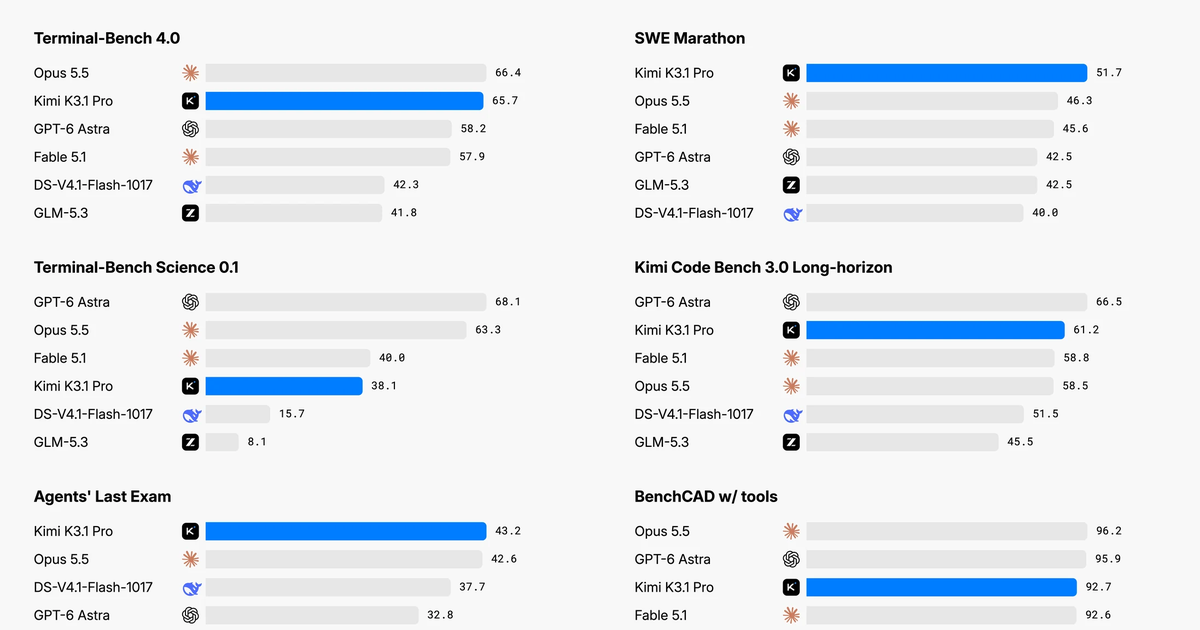
- Kimi K3.1 Pro scores 65.7 on Terminal-Bench 4.0 against Opus 5.5's 66.4.
- Its API bills $2/$10 per million tokens, half of Opus 5.5 and 33% under K3.
- Full weights land by November 4, with the cyber-exploit training data stripped out.
A Chinese open-weights model just scored within a point of Anthropic's top model on an agentic coding benchmark. On Terminal-Bench 4.0, Kimi K3.1 Pro from Moonshot AI hits 65.7% against Claude Opus 5.5's 66.4%. The API costs half as much, and Moonshot committed to releasing the full weights by November 4 in its launch post on October 23.
The announcement reached the top of Hacker News the same day with 510 points. K3.1 Pro went live immediately in the Kimi app and web client, the Kimi Work desktop app, the Kimi Code coding tool, and the API. A K3.1 Pro Highspeed variant, two to three times faster, shipped alongside it.
What changed from K3
K3.1 Pro is not a new pretrain. It takes Kimi K3, the 2.8 trillion parameter MoE model released in July, and spends far more compute on post-training, the refinement stage that runs after pretraining finishes. The context window is unchanged at 1 million tokens.
Here is what Moonshot published next to the K3 numbers.
| Measure | Kimi K3 | Kimi K3.1 Pro |
|---|---|---|
| Kimi Code Bench 3.0 long-horizon tasks (internal) | 55.95% | 61.2% |
| Hallucination rate on hard factual queries (lower is better) | 23.4% | 8.3% |
| Financial research (internal) | 58.8 | 70.4 |
| Artificial Analysis Intelligence Index | 44 | 55 (4th overall) |
| Output speed (measured by Artificial Analysis) | 37.9 tokens/sec | 77.1 tokens/sec |
The largest move is in how often the model states something false. On an internal benchmark built from deliberately confusing questions, checking each individual claim inside an answer, the error rate fell from 23.4% to 8.3%. Opus 5.5 scores 15.0% and GPT-6 Astra 5.5% on the same test. Moonshot notes separately that this is a stress test, not an everyday error rate.
Outside measurement points the same way. Artificial Analysis, which aggregates several benchmarks into one score, gave K3.1 Pro 55 points and ranked it 4th out of 215 models. It scores K3 at 44.
Against Opus 5.5 and GPT-6 Astra
In Moonshot's own comparison table, K3.1 Pro matches or beats the top US models on long coding work and falls well behind on specialized domains like scientific computing.
| Benchmark | K3.1 Pro | Opus 5.5 | GPT-6 Astra | Fable 5.1 |
|---|---|---|---|---|
| Terminal-Bench 4.0 | 65.7 | 66.4 | 58.2 | 57.9 |
| SWE Marathon | 51.7 | 46.3 | 42.5 | 45.6 |
| OSWorld V2.1 (computer use) | 79.6 | 81.8 | 75.8 | 80.7 |
| Terminal-Bench Science 0.1 | 38.1 | 63.3 | 68.1 | 40.0 |
Moonshot picked and ran these benchmarks itself. It evaluated K3.1 Pro using Claude Code as the harness. The competitor scores come from each vendor's own announcements or public leaderboards. Footnotes under the table add two caveats: Claude models may have fallen back to a different model mid-run, and the GPT models may have had cybersecurity guardrails active.
Hacker News commenters pushed back that Kimi models feel weaker in practice than their benchmark scores suggest. There is no reason to take this table at face value before running it on your own work.
Half of Opus 5.5 per token, but more tokens per task
The K3.1 Pro API bills $2 per million input tokens and $10 per million output. K3 in July charged $3 and $15, so the price dropped 33% while the scores went up. Opus 5.5 charges $4 and $20, making K3.1 Pro exactly half.
| Model (per million tokens) | Input | Output | Cached input |
|---|---|---|---|
| kimi-k3.1-pro | $2.00 | $10.00 | $0.20 |
| kimi-k3.1-pro-highspeed | $4.00 | $20.00 | $0.20 |
| kimi-k3 (previous) | $3.00 | $15.00 | $0.30 |
| Claude Opus 5.5 | $4.00 | $20.00 | $0.20 |
Highspeed doubles the price along with the speed, which puts it level with Opus 5.5. Unless response latency drives your product, the base model is the one to use.
Half the unit price does not mean half the cost per task. During Artificial Analysis's index run, K3.1 Pro consumed 150 million output tokens, 1.7 times the 87 million median across the models it compared. The model cannot turn thinking off, and the default reasoning_effort is max, the setting that thinks longest, so even short prompts produce long outputs. Dropping reasoning_effort to low or high pulls that back.
Where you can use it
Moonshot's documentation names no country restrictions. Two separate platforms carry the model: platform.kimi.ai bills in USD at the prices above, and the China platform platform.kimi.com lists ¥13 and ¥68, close to the same figures. The docs checked for this post do not name a processing region for the international platform, though API customers can use a zero data retention (ZDR) option.
OpenRouter listed moonshotai/kimi-k3.1-pro the same day at the same $2/$10 with the full 1,048,576 token context. One limit matters if your data has to stay in Europe: OpenRouter does not offer EU in-region routing for this model.
| Item | Detail |
|---|---|
| Individuals | Selectable directly in Kimi web, the mobile apps, and Kimi Work 3.1.0 or later (Windows, Apple Silicon Macs) |
| Developers | K3.1 Pro unlocks on platform.kimi.ai only after you top up at least $1. Per-minute rate limits scale with cumulative top-ups |
| Enterprises | Kimi Business requires an admin to enable it, and it was off at launch. API customers can request ZDR |
| Coding tools | Select it in Kimi Code with the /model command |
| Constraints | Image input accepts base64 only, not URLs. Built-in web search is mid-rework and not recommended for production. Sampling parameters such as temperature are fixed |
The subscription tiers draw complaints. One Hacker News user on the $99 per month plan reported hitting the five-hour cap after 47 minutes in a single session. For heavy use, metered API billing is easier to predict than a subscription.
Moonshot also posted on its pricing page that the K2 series closes to new sign-ups on October 31 and shuts down entirely at the end of December. If a service of yours runs on K2.6 or K2.7 Code, K3.1 Pro is effectively the only place to move it.
The hacking ability was removed on purpose
Moonshot says it searched for and deleted cybersecurity training data from the K3.1 Pro release build. Its explanation: the team observed that scaling post-training also raised the model's ability to find and exploit vulnerabilities, traced the cause, and found security-related material mixed into both the general training corpus and the reinforcement learning environments.
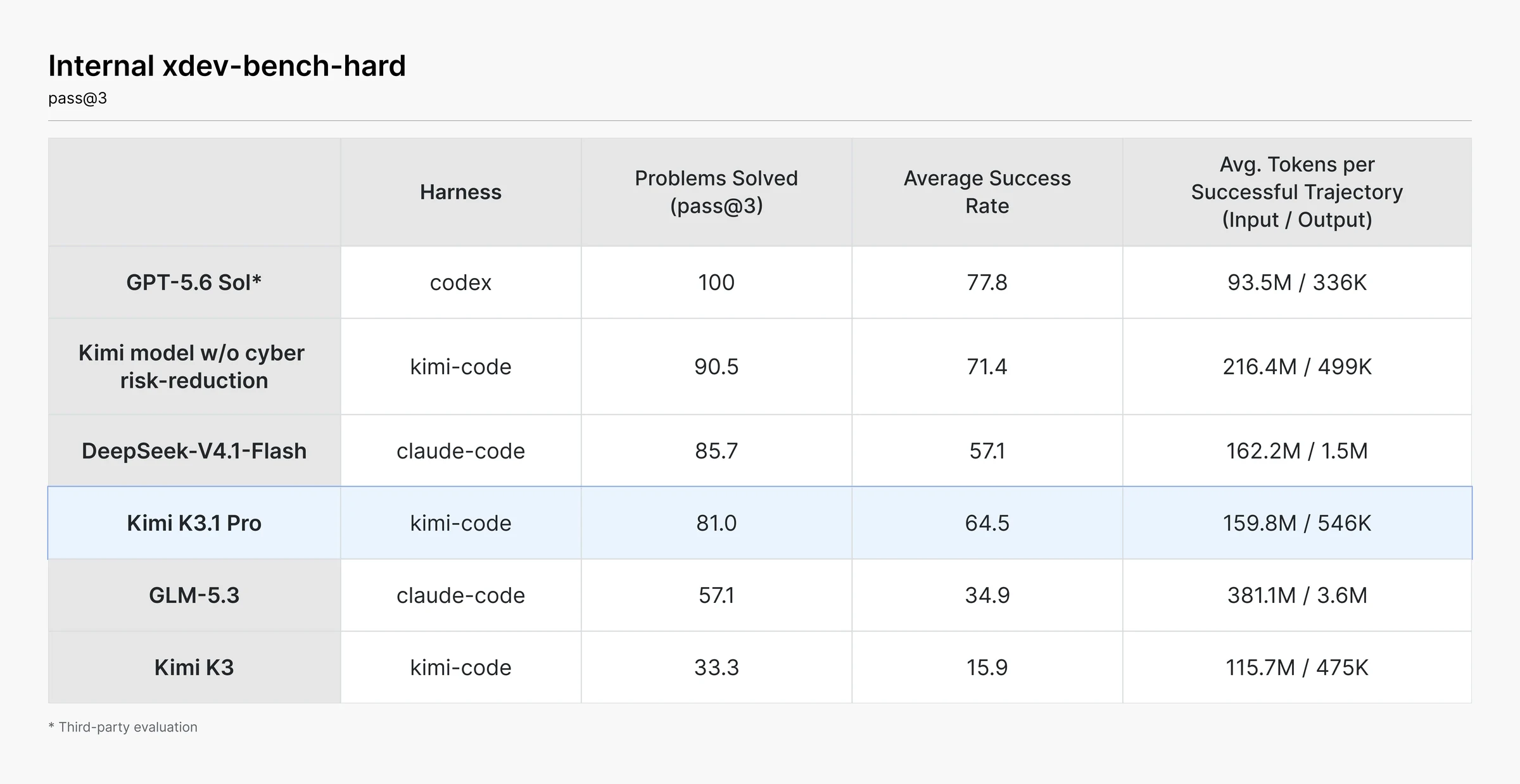
The internal benchmark xdev-bench-hard reproduces published vulnerabilities in real software such as the Linux kernel and Node.js and asks the model to write working exploits. The checkpoint with the data left in solved 90.5%. The released build solves 81.0%. That is still far above K3's 33.3%.
Moonshot's stated principle runs two lines: do not use open weights to push the absolute frontier of cyber capability, and raise the cyber capability of open weights incrementally. The most-replied comment on Hacker News read it as an admission that the capability is there and withheld.
Weights on November 4, the first under China's draft export controls
This weight release commitment arrived one week after the Chinese government proposed adding large model weights to its export control list. On October 16, the Ministry of Commerce and the Ministry of Science and Technology published a draft revision of the Catalogue of Technologies Prohibited or Restricted from Export for public comment. Comments close November 15.
According to an analysis of the draft by ChinaTalk, a model falls under control if it crosses any single one of three thresholds: more than 2 trillion parameters, more than 10^26 FLOPs of training compute, or world-leading capability. K3 has 2.8 trillion parameters, and Moonshot describes K3.1 Pro as a "3T-class" model. On the parameter count alone, the draft would cover it.
The draft does leave a path open for open releases. The ministry's Q&A document states that open-sourcing AI technology gets automatic licensing, so that it can "essentially be exported as soon as it is filed." Technology already in the public domain falls outside the regime entirely. Using a model through an API or an app was never an export in the first place.
What remains open is the definition of "open source," which the draft does not provide. ChinaTalk points out it is unclear whether a release under a custom license, as K3 shipped, qualifies for automatic licensing. Moonshot's announcement does not mention export controls at all, and the K3.1 Pro license has not been published yet.
If your team already runs Claude Code or another coding agent on an API key, take three or four real issues from this week's queue and run them again through K3.1 Pro with reasoning_effort: high. Put the output token count on your bill next to the Opus 5.5 run, not just the quality of the diff, because that is the only way to learn what half the unit price actually saves. If you plan to self-host, start with the license file in the Hugging Face repository that goes up on November 4.