This Week in AI: Sonnet 5 Price Hike Cancelled, Gemini 3.7 Flash, Qwen3.8-Max
Anthropic cancelled the September 1 Claude Sonnet 5 increase, so $2 and $10 per million tokens is now the standing price. Google opened Gemini 3.7 Flash on August 13 at $0.75 and $3.75 through year end, and Alibaba published Qwen3.8-Max weights.
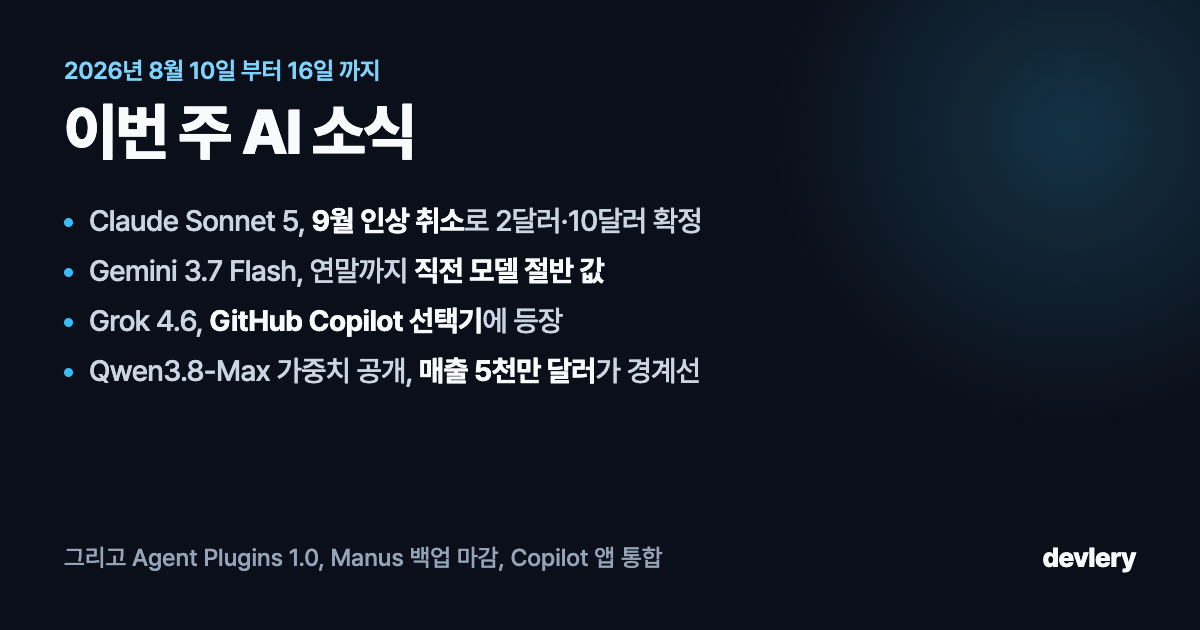
Inference prices went the other way this week. On August 10 Anthropic cancelled the Claude Sonnet 5 increase it had scheduled for September 1, and three days later Google opened Gemini 3.7 Flash at $0.75 per million input tokens, exactly half the list price of the model it replaces. Alibaba published Max-tier weights for the first time, with a separate license required from anyone whose model business clears $50M in trailing revenue.
Here are seven items from August 10 through August 16.
1. The September increase on Claude Sonnet 5 was cancelled
On August 10 Anthropic turned the Claude Sonnet 5 introductory price into the standing price. At launch the guidance was that $2 per million input tokens and $10 per million output tokens applied only through August 31, rising to $3 and $15 on September 1. The release notes now say that increase "will not happen."
The size of that becomes clear against the previous generation. Had the increase landed as planned, Sonnet 5 would have matched Sonnet 4.6 at $3 and $15; instead it stays a third below that on both input and output. DeepSeek moved the opposite direction in the same week, raising V4 API output pricing 4.7x.
If you have an API key the new rate applies with no action on your part, and there are no regional restrictions. If you had a plan to shift Sonnet 5 work to Haiku 4.5 ahead of the September increase, you can drop it.
Claude API pricing after September 1 (USD per million tokens)
| Model | Input | Output | Note |
|---|---|---|---|
| Sonnet 5 | 2 | 10 | Confirmed as standing price on August 10 |
| Sonnet 5 (scheduled price) | 3 | 15 | Increase cancelled |
| Sonnet 4.6 | 3 | 15 | Previous generation |
| Haiku 4.5 | 1 | 5 | Smaller model |
| Opus 5 | 5 | 25 | Top-tier model |
Source: Claude Platform pricing docs, updated August 10, 2026. Through the Batch API, Sonnet 5 is $1 input and $5 output.
2. Gemini 3.7 Flash opened at half the list price of the model it replaces
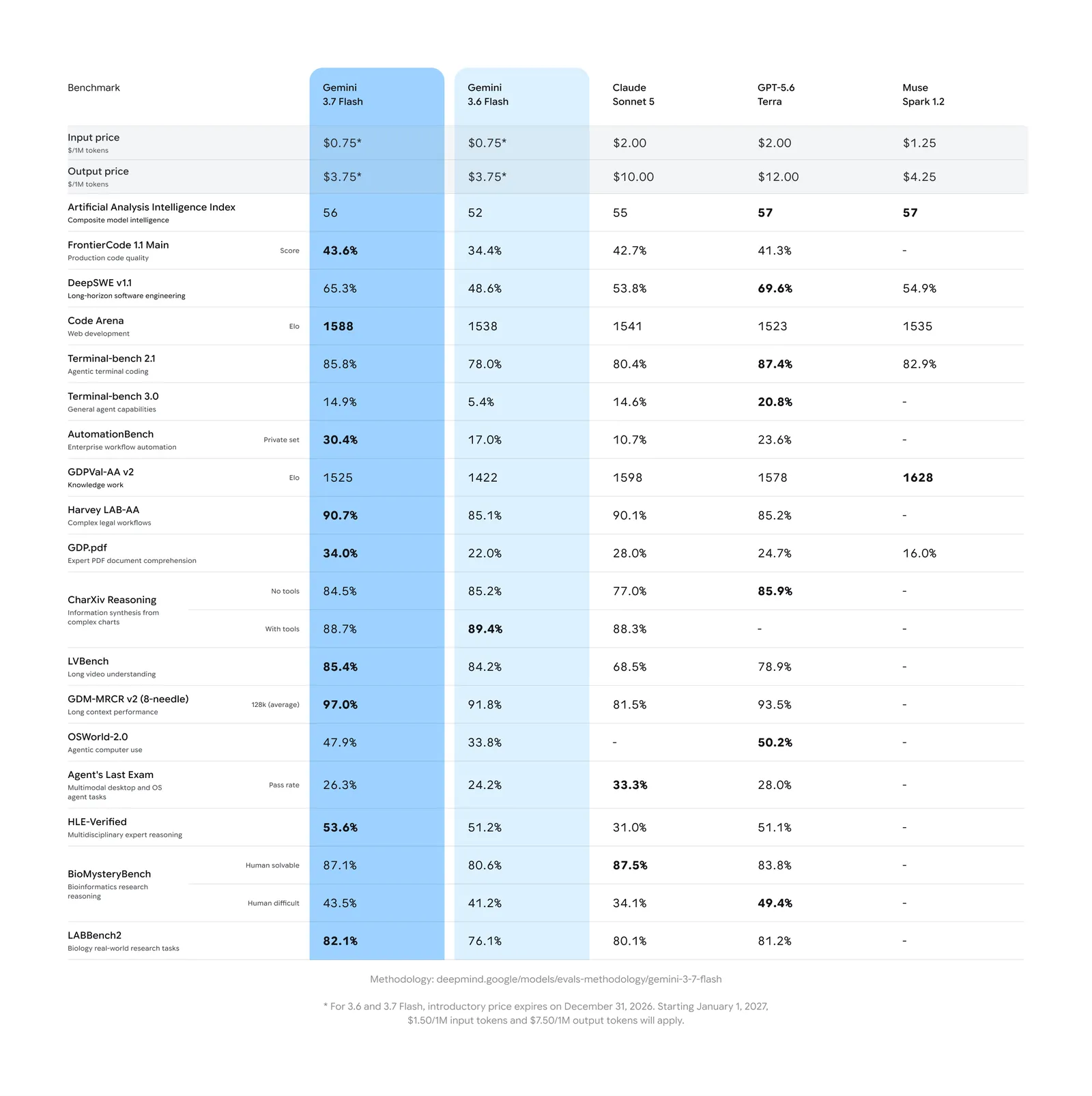
On August 13 Google released Gemini 3.7 Flash. It is built for cheap, high-volume work such as writing code and reading documents, and it follows 3.6 Flash, which shipped three weeks earlier. The input window is 1,048,576 tokens and output is 65,536 tokens.
Google's own numbers show a wide gap over 3.6 Flash. On DeepSWE v1.1, which measures long-running engineering tasks, 3.7 Flash scored 65.3% against 49.0%. On AutomationBench, which measures workplace task automation, it was 30.4% against 17.0%. Document understanding came in at 34.0% against 22.0%.
Pricing is $0.75 per million input tokens and $3.75 per million output tokens. When 3.6 Flash launched in late July it was $1.50 and $7.50, so this is exactly half, and only through December 31. On January 1, 2027 it returns to $1.50 and $7.50. There is a free tier, and the Gemini API availability list covers most regions. The direct test is to change the model name to gemini-3.7-flash in a call you already make to 3.6 Flash, send the same input, and compare.
3. Grok 4.6 landed in the GitHub Copilot model picker
On August 12 xAI released Grok 4.6, and two days later GitHub made it selectable in Copilot. The work xAI put into this release targets tasks that run for a long time on a single instruction. The announcement says it improved the model's ability to check its own results mid-task and the first-attempt quality of visual work.
Coding scores moved the most in xAI's own measurements. DeepSWE v1.1 reached 65.9%, up almost 12 points from Grok 4.5's 54%. API pricing is $2 per million input tokens and $6 per million output tokens, with the fast variant at double that.
It is available on Copilot Pro, Pro+, Max, Business, and Enterprise, and shows up in the picker in VS Code, Visual Studio, JetBrains, Xcode, Eclipse, and the Copilot CLI. Business and Enterprise require an administrator to enable the policy, and the default is off. The rollout is staged, so it may not appear yet. On an individual plan, switch the picker to Grok 4.6 and run one refactor you have been putting off; on a company account, the first step is asking an administrator to turn the policy on.
Grok 4.6 vs Grok 4.5, measured by xAI
| Benchmark | Grok 4.6 | Grok 4.5 |
|---|---|---|
| DeepSWE v1.1 (long engineering tasks) | 65.9% | 54% |
| CursorBench v3.2 (in-editor coding) | 69.9% | 66.7% |
| FrontierCode v1.1 (production code quality) | 61.3% | 56.6% |
| AA Intelligence Index (composite) | 61 | 56 |
Source: xAI Grok 4.6 announcement, August 12, 2026. Vendor-reported figures, not independently verified.
4. Agent Plugins 1.0 shipped in VS Code and the Copilot CLI
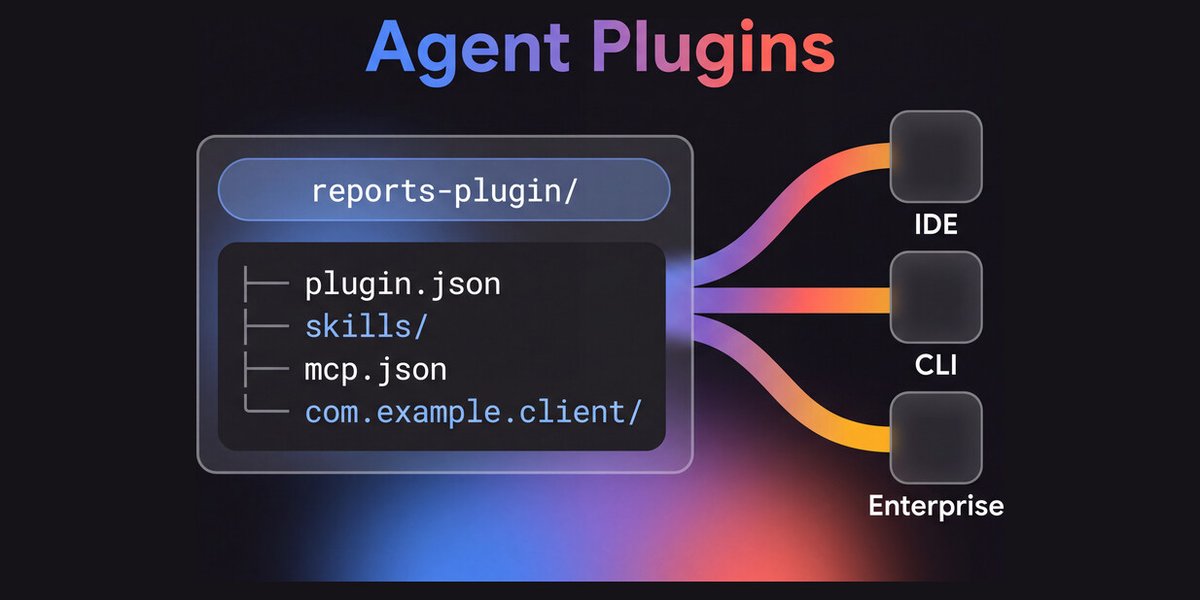
On August 12 GitHub shipped general availability for Agent Plugins 1.0. The format bundles skill files and MCP server configuration into a single folder that moves between coding tools unchanged. When six companies published the spec document on August 6 it was a promise on paper; it now runs in VS Code, the Copilot CLI, the Copilot SDK, and the Copilot app.
To follow the spec, add $schema to plugin.json, put skills under skills/, and put MCP configuration in mcp.json. Existing Copilot plugins that do not follow the spec keep working, so there is no obligation to migrate.
It is included on every Copilot plan at no extra cost, with no stated regional restrictions. VS Code, the Copilot CLI, and the Copilot app ship with the Awesome Copilot marketplace registered by default, so you can install from there directly. Business and Enterprise administrators can auto-install or block specific plugins through the enabledPlugins setting. If you already pass a skills folder around internally, add the one $schema line and check that the same plugin appears in both VS Code and the Copilot CLI.
5. Qwen3.8-Max weights went up, with $50M in revenue as the dividing line
On August 12 Alibaba uploaded the Qwen3.8-Max weights to Hugging Face. This is the first time Max-tier weights have been published. The architecture activates 95B of 2.4T total parameters per token, and context runs to 262,144 tokens, extensible to roughly 1.01M. Unlike the API version, it accepts text only and the thinking mode cannot be turned off.
Last week's roundup said to open the license file first. Doing so shows a custom license rather than Apache 2.0. If you sell the model as a service or run an AI work-assistant business and your trailing 12-month revenue exceeds $50M, you need a separate license from Qwen. Commercial products above 100M monthly users or $20M in monthly revenue must display the model name prominently in the interface.
The download itself is ungated and available to anyone, with no regional restrictions. It loads directly in vLLM, SGLang, and Transformers, and Ollama, llama.cpp, and LM Studio support quantized builds. If your revenue is under the threshold, pull it down for internal evaluation and compare results against the API version; if you are over it, the order of operations is sending those two license clauses to legal first.
Qwen3.8-Max license: where the conditions start
| Personal, research, and internal-only use | No conditions |
| Commercial products above 100M monthly users or $20M monthly revenue | Must display the model name in the interface |
| Model-as-a-service or AI work-assistant businesses above $50M trailing 12-month revenue | Requires a separate license agreement with Qwen |
Source: Qwen3.8-Max License text in the Hugging Face repository, published August 12, 2026. The license does not state a rate.
6. The Manus backup window closes at 07:59 SGT on August 23
On August 11 Manus posted a note to its users saying it will delete tasks created or updated on or after December 29, 2025. Manus is a service that takes a one-line instruction, searches the web on its own, organizes what it finds, and builds out slides or a website; what is being deleted is the conversations and outputs accumulated that way.
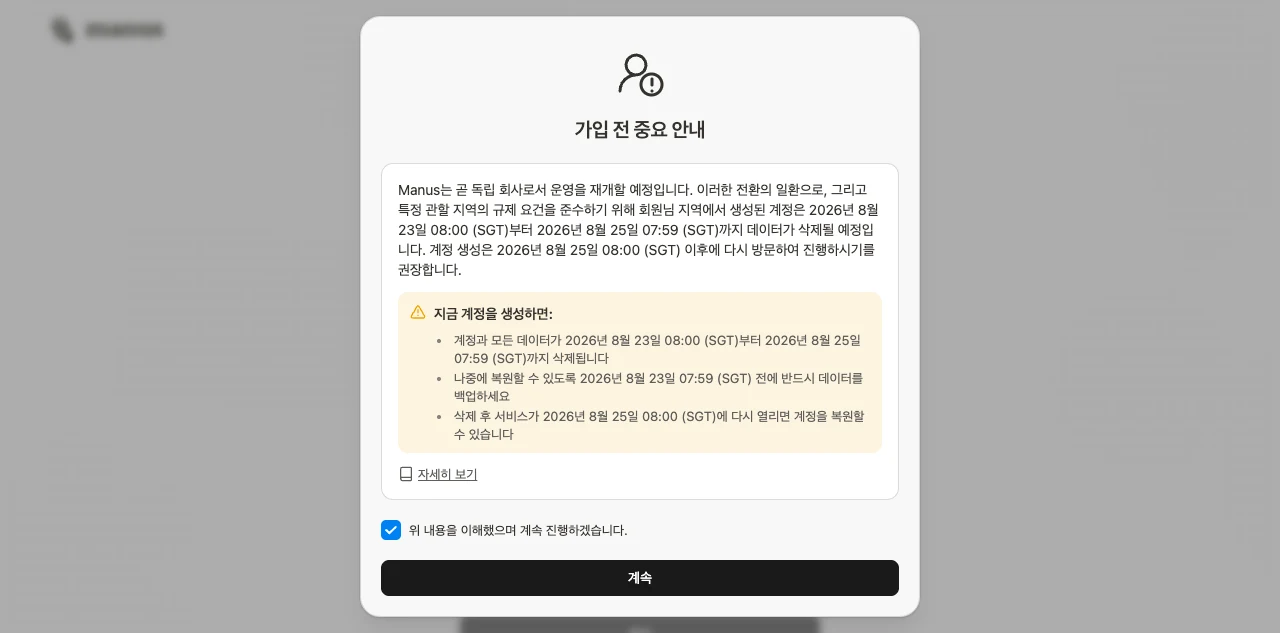
The cause is not an outage or a breach but the unwinding of the Meta acquisition. Every time in the notice is stated in Singapore Time. The backup deadline is 07:59 SGT on August 23, deletion and access cutoff begin at 08:00 SGT the same day, and the restore portal opens at 08:00 SGT on August 25.
In affected regions, opening the sign-up screen shows a notice first that data for accounts created there is scheduled for deletion. Backups are free and unrelated to your plan. If you have even one output built in Manus, download it before 07:59 SGT on August 23.
7. The Microsoft Copilot apps merge and three features go away
Starting the week of August 13, Microsoft began merging consumer Copilot and workplace Microsoft 365 Copilot into a single app. The support document says account updates begin on August 18 and the web address moves from m365.cloud.microsoft to copilot.cloud.microsoft. It starts with a small Windows Insider group; mobile and web land in mid-August, and the Windows and Mac apps in mid-September.
Three features disappear on the same date. Podcasts can no longer be created or opened. Group chats convert to one-on-one conversations, so existing threads cannot be continued with multiple people. Deep Research leaves the consumer product, and only Microsoft 365 Premium subscribers keep the equivalent through Researcher.
There is no pricing change, the free tier stays as it is, and the change applies worldwide with no regional restrictions. The web redirects to the new address automatically; mobile requires installing the new app. If you have been using Copilot group chats, files uploaded by other people cannot be opened after the switch, so download them before August 18.
What changes in Copilot starting August 18
| Item | What changes |
|---|---|
| Podcasts | Discontinued. Neither creating nor opening works |
| Group chats | Convert to one-on-one. Files uploaded by others must be downloaded first |
| Deep Research | Ends for consumer. Microsoft 365 Premium keeps it as Researcher |
| Web address | Moves from m365.cloud.microsoft to copilot.cloud.microsoft |
| Mobile app | New version must be installed |
| Windows and Mac apps | Switch over in mid-September |
Source: Microsoft support document "Updates to Copilot and the Microsoft Copilot app." Work and school accounts only see the icon and name change.
The short version
The biggest change this week is the cancelled September increase on Claude Sonnet 5: if you have an API key, $2 and $10 per million tokens hold with nothing to do. Gemini 3.7 Flash has a free tier and broad regional coverage, so you can compare it against 3.6 Flash by changing one model name. Grok 4.6 is selectable right away on individual Copilot plans, but company accounts need an administrator to enable the policy. Agent Plugins 1.0 is now in real tools rather than a spec document, and Qwen3.8-Max weights are open to anyone to download, though a model-selling business above $50M in revenue needs a separate agreement. Two deadlines remain: Copilot group chat files before August 18, and Manus task history before 07:59 SGT on August 23.