DeepSeek Open-Sources Its Coding Agent, Then Raises Output Tokens 4.7x
DeepSeek released the coding agent runtime dsh under MIT on August 13. The same day it announced V4 API pricing changes taking effect 16:00 UTC on August 16, with peak-hour rates that land squarely on Asian working hours.
- DeepSeek open-sourced its coding agent runtime
dshunder MIT, and it drew 38K stars in a day. - The same day it announced V4 output tokens rising 4.7x from 16:00 UTC on August 16.
- Peak hours cover most of the Asian workday and none of the US one.
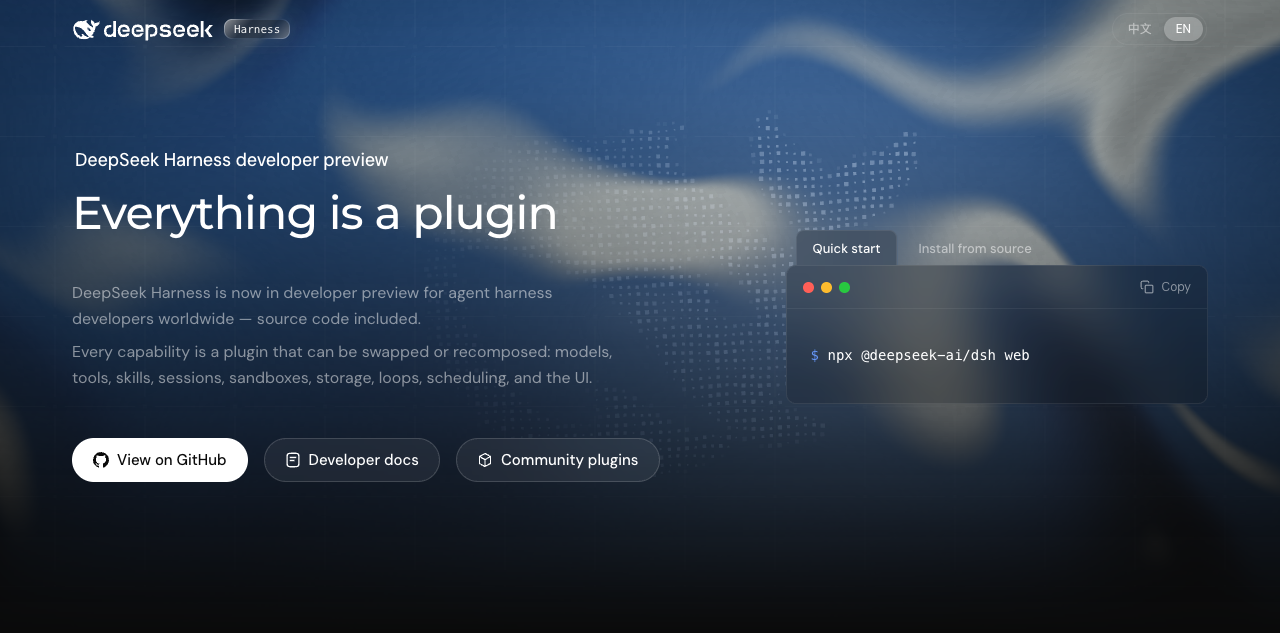
On August 13 DeepSeek published dsh (DeepSeek Harness), a coding agent runtime, under the MIT license. The GitHub repository picked up 38,154 stars and 2,976 forks before the day was out.
DeepSeek also raised prices on August 13. Alongside the general availability of V4-Pro, it announced that V4-series token pricing changes at 16:00 UTC on August 16.
The model thinks, the harness does the work
A language model only produces text. Something else has to take that text, open the files, run the commands, and hand the results back. That wrapper is the harness. Claude Code, Codex, and Gemini CLI are all harnesses. DeepSeek states the relationship on its product page as AGENT = MODEL + HARNESS.
What dsh ships with will look familiar to anyone using Claude Code. It reads a repository to work out its structure, edits files, and runs shell commands. It also does file and web search, plan tracking, skill invocation, and subagent delegation, and it asks for approval before risky operations. The repository's package list includes MCP, LSP, sandboxing, scheduling, background jobs, and a terminal.
There are four runtime modes. The official page describes them like this.
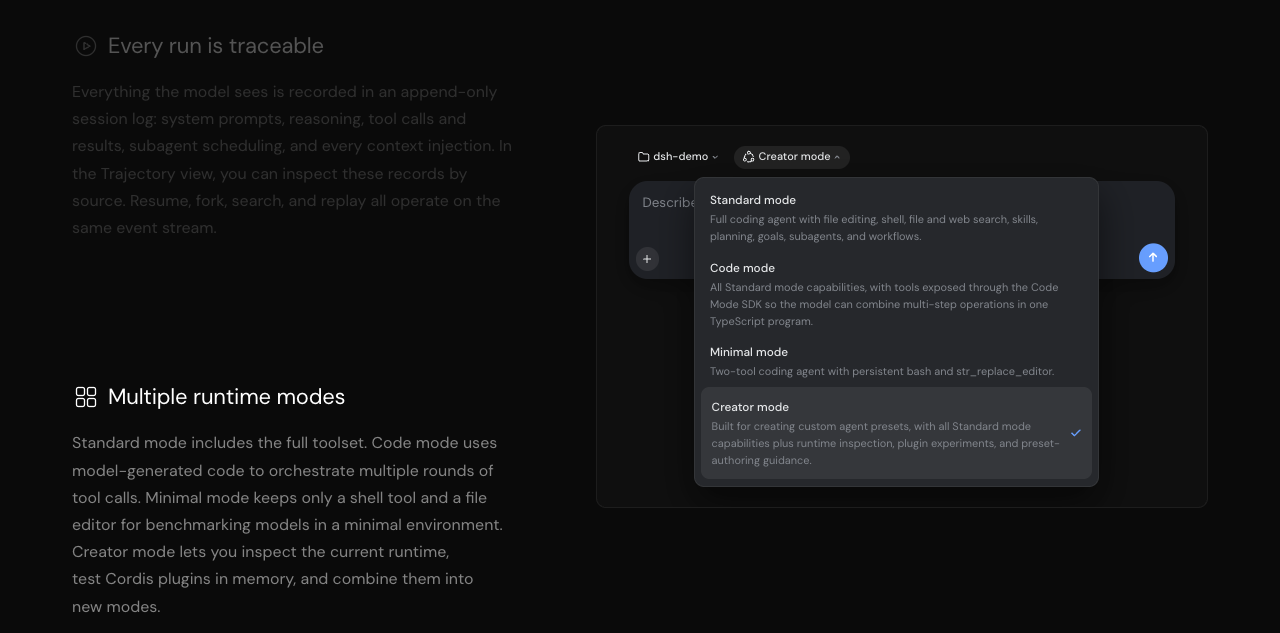
- Standard is the default, with the full toolset enabled.
- Code exposes tools through a Code Mode SDK, so the model can bundle a multi-step task into a single TypeScript program and run it.
- Minimal leaves only a shell and a file editor. It exists for benchmarking, where minimizing environment variables isolates the model's own performance.
- Creator is for inspecting a running runtime and testing plugins in memory to build new modes.
The architectural difference is how much of the system is swappable. In dsh, the model adapters, tool registry, session log, and the agent loop itself are all plugins. The architecture document puts it as having no privileged core to patch. Adding capability means mounting a plugin alongside rather than forking the core. As the Schema case, where changing only the harness produced a self-reported 99% on the ARC-AGI-3 public set showed, the same model scores differently depending on its wrapper. dsh makes that wrapper a config-file swap.
One default stands out. Per the dsh-base bundle documentation, Codex and Claude Code are already registered as subagent providers, dormant by default. Turn them on and dsh hands work to Claude Code. The tool positioned as a replacement ships with its replacement targets as callees.
Output tokens go from $0.28 to $1.32
Two weeks ago, when DeepSeek opened V4-Flash in public beta with Codex integration docs, the headline number was $0.28 per million output tokens. That number changes at 16:00 UTC on August 16.
The amount is not the only thing changing. Time-of-day pricing is new: peak hours cost the full rate, everything else costs half. Below are the per-million-token dollar prices from the DeepSeek API docs.
| Model | Item | Current | Off-peak | Peak |
|---|---|---|---|---|
| V4-Flash | Input (cache hit) | 0.0028 | 0.007 | 0.014 |
| V4-Flash | Input (cache miss) | 0.14 | 0.22 | 0.44 |
| V4-Flash | Output | 0.28 | 0.66 | 1.32 |
| V4-Pro | Input (cache hit) | 0.003625 | 0.022 | 0.044 |
| V4-Pro | Input (cache miss) | 0.435 | 0.66 | 1.32 |
| V4-Pro | Output | 0.87 | 1.98 | 3.96 |
Against current pricing, V4-Flash output tokens go to 4.71x at peak and V4-Pro output tokens to 4.55x. Shifting everything to off-peak still leaves 2.36x and 2.28x.
The "up to 1,100%" figure circulating in English coverage needs unpacking. That multiple comes from V4-Pro cache-hit input tokens, which go from $0.003625 to $0.044 per million, a 12.14x jump. It is the cheapest of the six line items and output tokens dominate a real invoice. The number worth remembering is around 4.5x, not 1,100%. At the other end, V4-Pro cache-miss input rises 1.52x off-peak, the mildest change on the list.
DeepSeek gives the reason as enabling more flexible workload scheduling, meaning move batch jobs off the expensive hours. Where those hours fall depends entirely on where you sit.
| UTC (peak) | US Eastern (EDT) | Central Europe (CEST) | Korea and Japan |
|---|---|---|---|
| 01:00 to 04:00 | 21:00 to 00:00 (prev. day) | 03:00 to 06:00 | 10:00 to 13:00 |
| 06:00 to 10:00 | 02:00 to 06:00 | 08:00 to 12:00 | 15:00 to 19:00 |
The UTC peak windows convert to 09:00 to 12:00 and 14:00 to 18:00 in China Standard Time, which is where DeepSeek's own daytime load sits. For a developer in Seoul or Tokyo, seven of the nine hours between 10:00 and 19:00 are peak, leaving a two-hour off-peak gap in the early afternoon. A team in Berlin loses its morning and keeps its afternoon. A team on US Eastern time pays off-peak rates for its entire workday, because both peak windows land overnight there. Batch work can be scheduled around this. Interactive coding agents in Asian time zones cannot.
The switchover itself is 16:00 UTC on August 16, which is midday Sunday in New York, Sunday evening in Europe, and 01:00 Monday in Seoul and Tokyo.
Can you use it today
dsh and the API have different conditions.
| Item | DeepSeek Harness (dsh) | V4 API |
|---|---|---|
| Who | Anyone | Developers (API key required) |
| Price | Free, MIT licensed | Table above |
| Regional limits | npm package, no region gating | No separate regional restriction announced |
| Requirements | Node.js | DeepSeek account and API key |
| Stability | Developer preview | GA |
Installation is Node.js plus one command. A web UI comes up at http://127.0.0.1:3080.
npx @deepseek-ai/dsh web
You do not need a DeepSeek account to run dsh. The model configuration docs cover adding Anthropic and OpenAI as catalog providers, and you can register any OpenAI-compatible endpoint directly, including an internal gateway or a self-hosted server. Bedrock, Vertex, Azure, and Codex need more than an API key field: each requires its own authentication (AWS credentials and region, ADC project, api-version, OAuth). Keys are stored in $DSH_HOME/.credentials.yaml and never displayed again.
Two constraints are worth knowing. First, images: DeepSeek's own chat-completions path is text-only, so screenshots cannot be attached. Using images means using a different provider. Second, and more consequential, the README states in capitals that this is a developer preview and that there will be compatibility-breaking changes. The repository was created on August 13, but the design documents inside it have history going back to June 11. Two months of work landed at once.
If you already pay for the DeepSeek API, pull your last month of usage broken out by hour before 16:00 UTC on August 16 and count what share of calls falls inside 01:00 to 04:00 and 06:00 to 10:00 UTC. That share multiplied by 4.5 is the floor on next month's invoice. If you do not use DeepSeek models, skip the pricing table and run dsh with an Anthropic key instead, then compare the approval policy and subagent delegation against whatever you use now on a single repository.