Snowflake CoCo puts 7,100 accounts on governed agents
Snowflake expanded CoCo with Cloud Agents, SDKs, Slack, and Datastream, moving coding agents into Snowflake RBAC and audit controls.
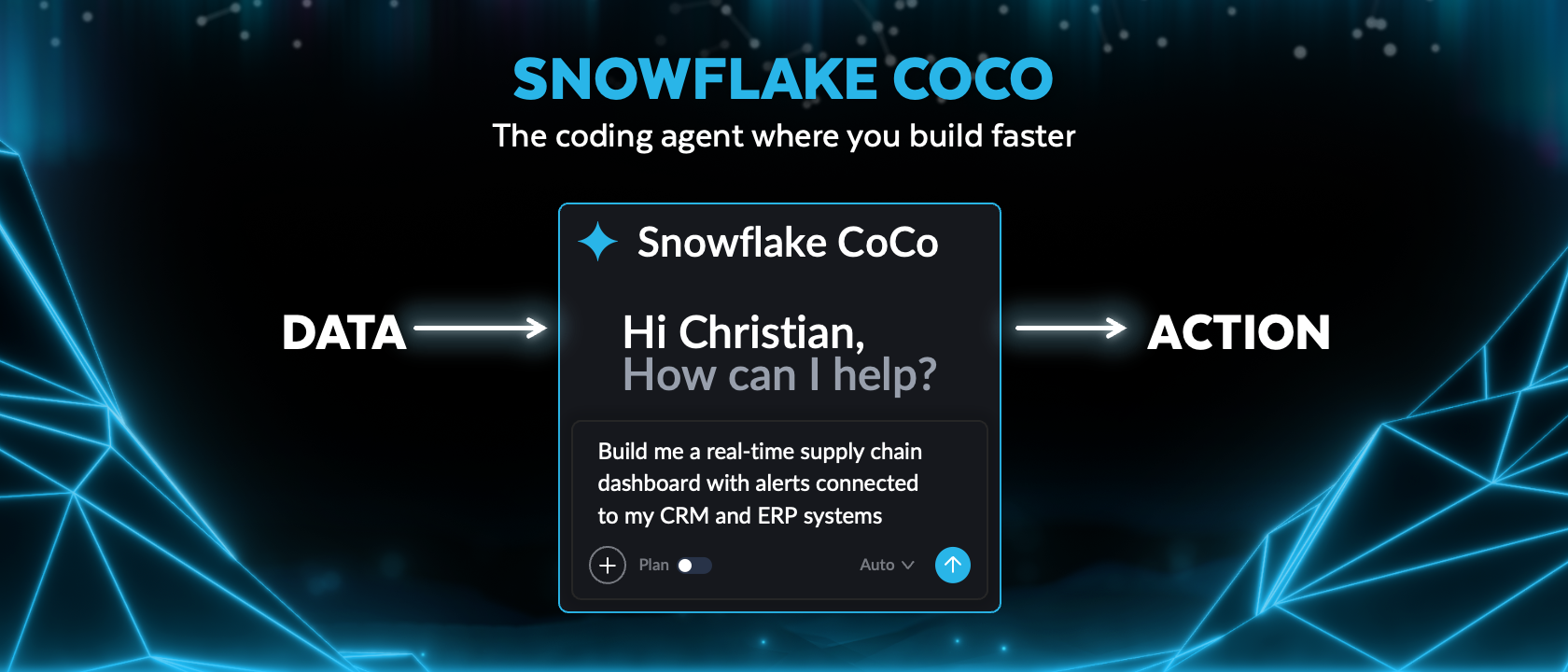
- What happened: Snowflake expanded CoCo at Summit 26 across desktop, Cloud Agents, SDKs, Slackbot, mobile, Excel, VS Code, and Claude Code surfaces.
- On its May 27, 2026 Q1 FY2027 earnings call, Snowflake said CoCo was already used by more than 7,100 accounts.
- Why it matters: The coding-agent runtime is moving from IDE plugins into environments governed by Snowflake RBAC, audit logs, query tagging, and usage controls.
- Developer impact: Cloud Agents add isolated containers for web search, shell commands, and Python execution, while the CoCo Agent SDK exposes agent capabilities to
TypeScriptandPythonapps. - Watch: Cloud Agents are still in Public Preview, and data engineers have publicly criticized Cortex Code context design and SQL quality.
Snowflake used Snowflake Summit 26 on June 2, 2026, to push Cortex Code into a broader product line under the CoCo name. The rename is the least important part of the announcement. The company grouped CoCo Desktop, Cloud Agents, the CoCo Agent SDK, Automations, Skill Catalog, a Claude Code plugin, a VS Code extension, a Microsoft Excel extension, and upcoming Slackbot and mobile app surfaces into one product story. Snowflake is not positioning CoCo as a faster autocomplete tool. It is trying to make CoCo the builder interface that connects Snowflake data, permissions, logs, application deployment, and automation.
That matters for AI developers because Snowflake is moving the coding-agent debate away from model quality alone and toward execution location. GitHub Copilot, Claude Code, Cursor, and Codex have expanded around repositories, terminals, editors, and browsers. CoCo is expanding inside a data warehouse control plane, where role-based access control, schema context, query history, and cost governance already shape how work gets done. Snowflake's Cortex Code documentation describes the system as an AI-powered agent optimized for data engineering, analytics, machine learning, and agent-building work, with awareness of Snowflake RBAC, schemas, and best practices.
The adoption number gives the announcement more weight than a typical AI feature launch. In Snowflake's corrected Q1 FY2027 earnings-call transcript from May 27, 2026, the company said CoCo was being used by more than 7,100 accounts. On the same call, Snowflake reported $1.334 billion in product revenue, up 34% year over year, and described Snowflake Intelligence and CoCo as two of the fastest-adopted products in its history. Those are management-reported figures, not independent usage audits, but they show that CoCo is now part of Snowflake's investor and revenue narrative rather than a side demo.
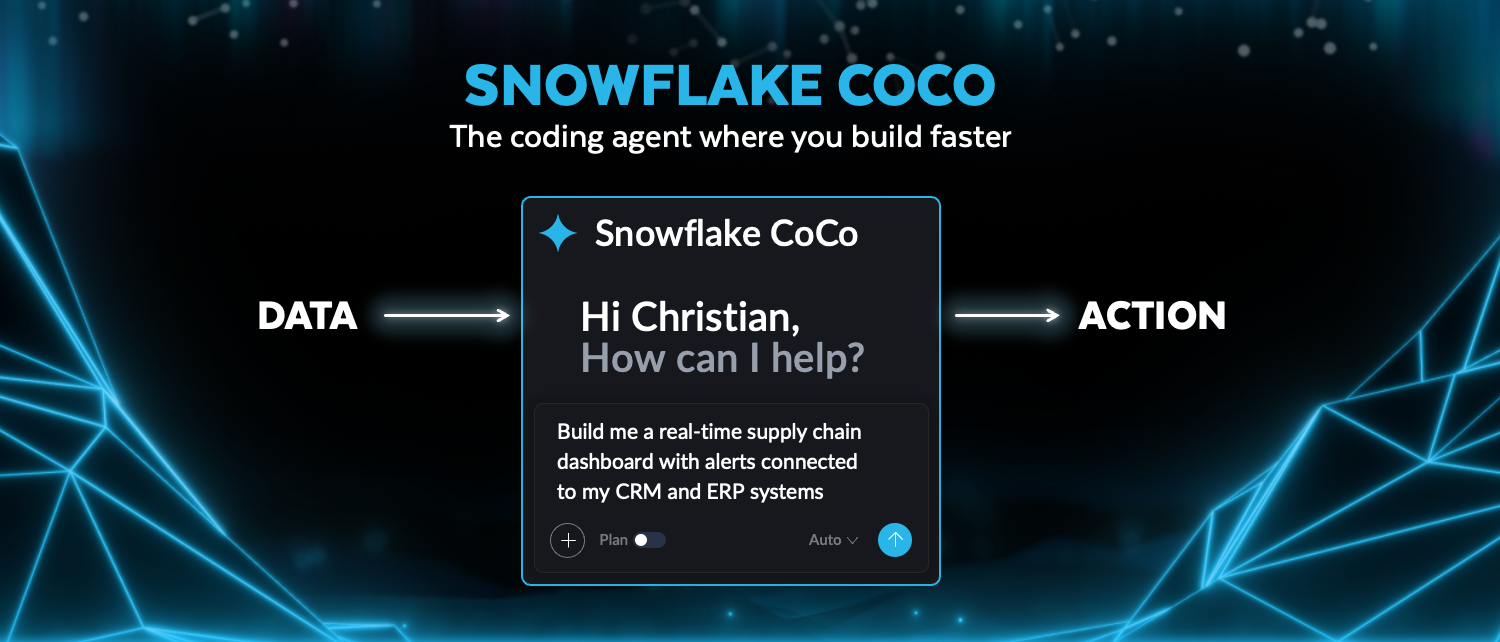
The first expansion is the work surface. CoCo Desktop is a standalone IDE for macOS and Windows. Snowflake's press release places CoCo Mobile App and CoCo Slackbot in the "public preview soon" category. The direction is clear: CoCo should not require a user to stay inside Snowsight. It reaches toward the desktop, Slack, mobile, Excel, Claude Code, and VS Code so data teams can use the same agent across the places where they already inspect data, write SQL, manage notebooks, and package applications.
Snowflake attached customer examples to that surface expansion. Fanatics described data demand that changes quickly and said CoCo helps engineers resolve pipeline and modeling issues in hours rather than days. Thomson Reuters pointed to more than 37,500 governed tables and 350 data sources on Snowflake as the foundation for legacy modernization and AI pipeline work. WHOOP framed CoCo as something that can move beyond the data team into the wider organization. All three examples emphasize enterprise data work, not individual developer convenience.
The second expansion is Cloud Agents. Snowflake's documentation describes Cloud Agents as a Public Preview feature inside the Snowsight Cortex Code experience. Each session gets an isolated Snowflake-managed container with access to web search, arbitrary shell commands, and Python script execution. That brings package installation, scripts, and CLI-style work into the Snowflake-managed runtime rather than leaving those tasks only to a local machine or browser-only assistant.
The preview has explicit boundaries. Snowflake says Cloud Agents are available for all accounts, but region availability is limited to AWS and Azure commercial cloud regions. GCP, Government, Virtual Private Snowflake, and China deployments are excluded. The documentation also states that Cloud Agents do not change existing Snowflake RBAC privileges and that each session runs in a separate container. For organizations that already control warehouse access through roles, that distinction is central: enabling the agent does not automatically widen data access.
Network access is also controlled. Cloud Agents do not get open outbound internet by default. Snowflake lists an allowlist centered on package registries and build tooling, including PyPI, npm, Yarn, RubyGems, crates.io, Go module proxy, Maven, and Gradle-related endpoints. If an agent needs to call an external host, administrators must configure an external access integration, and credentials follow Snowflake's Secrets model. The product promise is not "let the model do anything." It is "let the model run useful build and analysis steps inside the same governance model that controls the data."
| Area | Cloud Agents documentation scope | Operational check |
|---|---|---|
| Runtime | Snowflake-managed isolated container per session | Cross-session file persistence is outside the current scope. |
| Tools | Web search, shell commands, and Python execution | Full parity with local CLI workflows still needs team-level testing. |
| Network | Allowlist centered on package registries and build tools | External APIs require an administrator-managed external access integration. |
| Regions | AWS and Azure commercial regions | GCP, Government, VPS, and China deployments are currently excluded. |
The third expansion is the CoCo Agent SDK. Snowflake's Summit blog says the SDK lets developers call CoCo production capabilities from TypeScript and Python. The example uses a query() call to profile a Snowflake table and receive streaming messages. Snowflake says the SDK supports multi-turn sessions, structured output, MCP server integration, hooks, streaming output, and system prompts. That puts CoCo into CI/CD workflows, internal data apps, ISV products, and domain-specific automation rather than limiting it to a first-party chat interface.
The SDK's tool list is revealing. Snowflake describes CoCo as able to work with data, query Snowflake, read files, run shell commands, search a codebase, execute SQL, and edit code. That sounds close to a general coding agent. The difference is the authority boundary. CoCo runs under the user's Snowflake permissions and is surrounded by governance controls such as prompt and response logs, query tagging, usage monitoring, and administrator cost and configuration settings. For a data platform team, the question is often less "can the model write code?" and more "whose role ran this query, where was the cost recorded, and what audit trail exists?"
Datastream is part of the same product arc. Snowflake's press release describes Datastream as a fully managed Apache Kafka-compatible streaming service, intended to connect real-time data and AI inside Snowflake. The company cited a Grand View Research estimate of a $128 billion streaming data and real-time AI market opportunity, then described CoCo as a way to build real-time pipelines and AI applications on top of Datastream with natural-language prompts. Snowflake wants CoCo to be seen not only as a SQL helper, but as an agent that can assemble pipelines and deploy data apps where new events are continuously arriving.
The official story has an obvious blind spot: governance does not automatically make an agent good at SQL or tool selection. A recent Reddit thread in r/dataengineering criticized Cortex Code CLI performance and context design. The author claimed that a session began with about 25,700 tokens of context and that instructions to check documentation before writing Snowflake SQL were not reliably followed. One example cited generation of ALTER VIEW ... COMPILE, a pattern the author said was not valid Snowflake SQL. The thread also mentioned /sql-author, /sql-verify, and documentation-search tools that were allegedly available but unused.
The comments around that post were mixed. Some users reported similar SQL mistakes. Others said Snowflake support responded quickly to feedback. There were also counterpoints about cache cost and how skills are loaded in long sessions. The thread should not be treated as a statistical benchmark, but it identifies the right evaluation axis. An enterprise runtime can restrict data access, preserve logs, and require external network approval. It cannot, by itself, guarantee that the agent chooses the right tool, checks the right documentation, or produces correct dialect-specific SQL.
That distinction becomes more important as Cloud Agents and the SDK add execution power. Shell commands, Python scripts, code editing, and SQL execution make CoCo more useful, but they also raise the cost of bad routing. If an agent ignores a verification tool or generates invalid SQL, the audit trail will preserve the bad run more cleanly. Governance helps teams understand and constrain behavior. It is not the same thing as correctness.
For developers evaluating CoCo, the first question should be the work boundary, not the model benchmark. CoCo has a natural advantage where Snowflake context determines the answer: data pipelines, dbt projects, Airflow logs, Snowpark code, data quality checks, cost analysis, governed tables, and internal data applications. In those cases, the native permission model and schema context may be more valuable than a general agent running from a local repository.
For general application work, the answer may be different. Frontend changes, API server refactors, non-Snowflake cloud integrations, and broad repository maintenance may still be faster or more transparent in Claude Code, Codex, Cursor, or GitHub Copilot. Snowflake's own integrations with Claude Code, VS Code, and ACP-compatible editors suggest the company understands that boundary. CoCo does not need to replace every coding agent to matter. It needs to own the place where data authority, query execution, and application building meet.
Security and platform teams have a more operational checklist. Before turning on Cloud Agents broadly, they need to know which roles can access which databases and schemas, which package registries are reachable, how external access integrations are approved, and how Snowflake Secrets are managed. If Automations run recurring tasks without a human in the loop, teams need query tagging, cost ceilings, result review, failure alerts, and rollback procedures. If the CoCo Agent SDK enters CI/CD, generated SQL and app changes should pass through human review gates before production state changes.
Snowflake's internal productivity claims point to the company's business case. On the earnings call, executives said CoCo helps customers build applications, pipelines, agents, and workflows inside Snowflake. They also said Snowflake's internal support organization used CoCo to improve case-resolution speed by more than 25%, reduce complex-case resolution time by about 30%, and cut engineering time per ticket by about 40%. Those figures come from Snowflake leadership, so they should be read as company-reported operational claims. They still show why CoCo is being tied to platform consumption and sales conversations.
The practical conclusion from Summit 26 is narrow but significant. If your data is already in Snowflake, if authorization and auditability matter as much as raw development speed, and if your AI applications depend on real-time pipelines, CoCo deserves evaluation as a platform feature rather than another IDE plugin. Adopting it is not just a bet that an agent will write better SQL. It is a decision about which agent actions should be allowed inside Snowflake permissions, which network paths should be open, which logs should be reviewed, and where humans approve changes.
After this announcement, the comparison criteria become concrete: prompt-response quality, Cloud Agents latency, SDK hook behavior, external network policy, audit-log coverage, query tagging, cost controls, and the size of the change unit that still needs human approval. Snowflake has made CoCo large enough to evaluate seriously. The next test is whether governed execution can coexist with the tool discipline and SQL accuracy that production data teams require.