OpenAI shows how Codex became an engineering backlog system
OpenAI published an internal Codex usage report. The practical signal is task queues, AGENTS.md, repo questions, migrations, tests, and incident triage.
- What happened: OpenAI Academy published a 13-page
How OpenAI uses CodexPDF.- OpenAI describes seven workflows across Security, Product Engineering, Frontend, API, Infrastructure, and Performance Engineering teams.
- Why builders should care: Codex is being used less like autocomplete and more like a lightweight engineering backlog.
- Operational pattern: The report recommends Ask Mode, GitHub Issue-style prompts, startup scripts,
AGENTS.md, and Best of N.- OpenAI's lesson is that task size, repo context, and runnable environments shape agent quality as much as the model itself.
- Watch: The public community conversation still centers on quota, output quality, platform support, and fake Codex download pages.
OpenAI Academy has published a 13-page PDF titled How OpenAI uses Codex. Search indexing places the document on May 29, 2026, and the body of the report explains how OpenAI's Security, Product Engineering, Frontend, API, Infrastructure, and Performance Engineering teams use Codex in daily engineering work. If the original Codex launch post was a product introduction, this document reads more like an operating memo: which tasks OpenAI engineers send to an agent queue, which prompts work, and where humans still have to review the result.
OpenAI divides internal usage into seven workflows: code understanding, refactoring and migrations, performance optimization, improving test coverage, increasing development velocity, staying in flow, and exploration and ideation. That taxonomy is narrower and more operational than "AI writes code." The examples are repo questions, auth-flow tracing, multi-package pattern changes, expensive database-call discovery, low-coverage test PRs, launch-blocker cleanup, and rough implementation drafts from product feedback.
The report includes a few concrete numbers, though OpenAI does not present them as benchmark results. A Product Engineer on ChatGPT Enterprise says Codex worked in the background during meeting-heavy days and helped merge four PRs. A Full-Stack Engineer on Internal Tools says Codex handled three to four low-priority fixes that had been sitting in the backlog. A Platform Engineer on Model Serving says a performance-investigation task that might take 30 minutes can start from a five-minute prompt. Those details matter because they show the unit of work OpenAI is handing to Codex.
The first use case is code understanding. OpenAI says teams use Codex during onboarding, debugging, and incident investigation to find core logic, map relationships between services and modules, and trace how a failure state propagates across components. An API Platform Site Reliability Engineer describes pasting a stack trace during on-call and asking where the auth flow lives. An Infrastructure Services DevOps Engineer says Codex is faster than grep for questions that cross Terraform and Python code.
That framing matters because the first useful coding-agent entry point may not be automatic code generation. In a large or old monorepo, a meaningful share of engineering time goes into finding the right place to make a change. If Codex can read files and summarize relationships, a developer can assign an exploration task before asking for a diff. The pattern is especially natural for teams whose repository structure is large, unevenly documented, or split across several internal packages.
The second use case, refactoring and migrations, is where OpenAI positions Codex as more useful than regular-expression replacement. The report mentions API updates, pattern changes, and dependency migrations that span many files or packages. A ChatGPT Web Backend Engineer describes asking Codex to replace legacy getUserById() calls with a new service pattern and open a PR. A ChatGPT Enterprise Product Engineer says Codex scans for old pattern instances, summarizes impact in Markdown, and opens fix PRs to reduce launch blockers.
The important detail is not that Codex completes huge migrations in one pass. OpenAI pairs the code change with an impact summary and PR creation. That is the workflow shape teams should notice. An agent-generated diff is easier to review when it arrives in a small unit with the scope, rationale, and affected pattern spelled out. AI coding projects often fail at this boundary: as the diff grows, reviewer cost rises faster than generation speed. The agent task has to come back as something a teammate can actually review.
OpenAI's performance-optimization examples are more concrete. The report says Codex is used to find slow paths, memory-intensive code paths, inefficient loops, redundant operations, and costly queries. An API Reliability Infrastructure Engineer describes scanning for repeated expensive database calls and asking for a batched-query draft. A Platform Engineer on Model Serving says the agent can reduce the initial discovery work from roughly 30 minutes to a five-minute prompt.
That does not mean Codex owns the final performance fix. OpenAI's wording still leaves tuning to engineers. The agent's role is candidate discovery, risk-pattern detection, and draft alternatives. Actual latency, memory, and database-load claims still need benchmarks and production telemetry. In practice, Codex is closer to a tool that narrows the next debugging target than a replacement for profilers or load tests.
The test-coverage workflow follows the same structure. OpenAI says Codex proposes edge cases and likely failure paths during bug fixes or refactors, then generates unit or integration tests based on nearby logic. A ChatGPT Desktop Frontend Engineer describes assigning a low-coverage module and receiving a runnable unit-test PR overnight. A Payments & Billing Backend Engineer says Codex can write tests and run CI when switching branches in a monorepo would interrupt local work.
Tests are often described as the safety layer for AI coding, but the OpenAI examples depend on runnable PRs and CI. More test files are not enough. Teams still need to check whether the test would fail against the previous behavior, pass after the fix, and avoid flaky assumptions. Codex can draft the test surface, but the review question is not only coverage percentage. It is whether the failure path matches the bug or regression the team actually cares about.
The development-velocity section connects Codex to product delivery rather than isolated programming tasks. OpenAI says engineers use the tool to scaffold folders, modules, and API stubs at feature kickoff. Near release, they hand over bug triage, last-mile implementation gaps, rollout scripts, telemetry hooks, and configuration files. The report also mentions turning user feedback or a product spec into a rough draft. Codex is not described as replacing a senior engineer; it is described as unfolding small tasks that would otherwise wait in a queue.
| OpenAI use case | What Codex handles | What humans still check |
|---|---|---|
| Code understanding | Auth flows, module relationships, and failure propagation paths | Whether the file and call path match the real production path |
| Migration | Old-pattern scans, impact summaries, and small PRs | Change scope, backward compatibility, and reviewer cost |
| Performance | Expensive database calls, redundant operations, and hot-path candidates | Benchmarks, telemetry, latency, and cost changes |
| Test coverage | Edge cases, failure paths, and runnable unit-test PR drafts | Failure condition, flakiness, CI output, and regression protection |
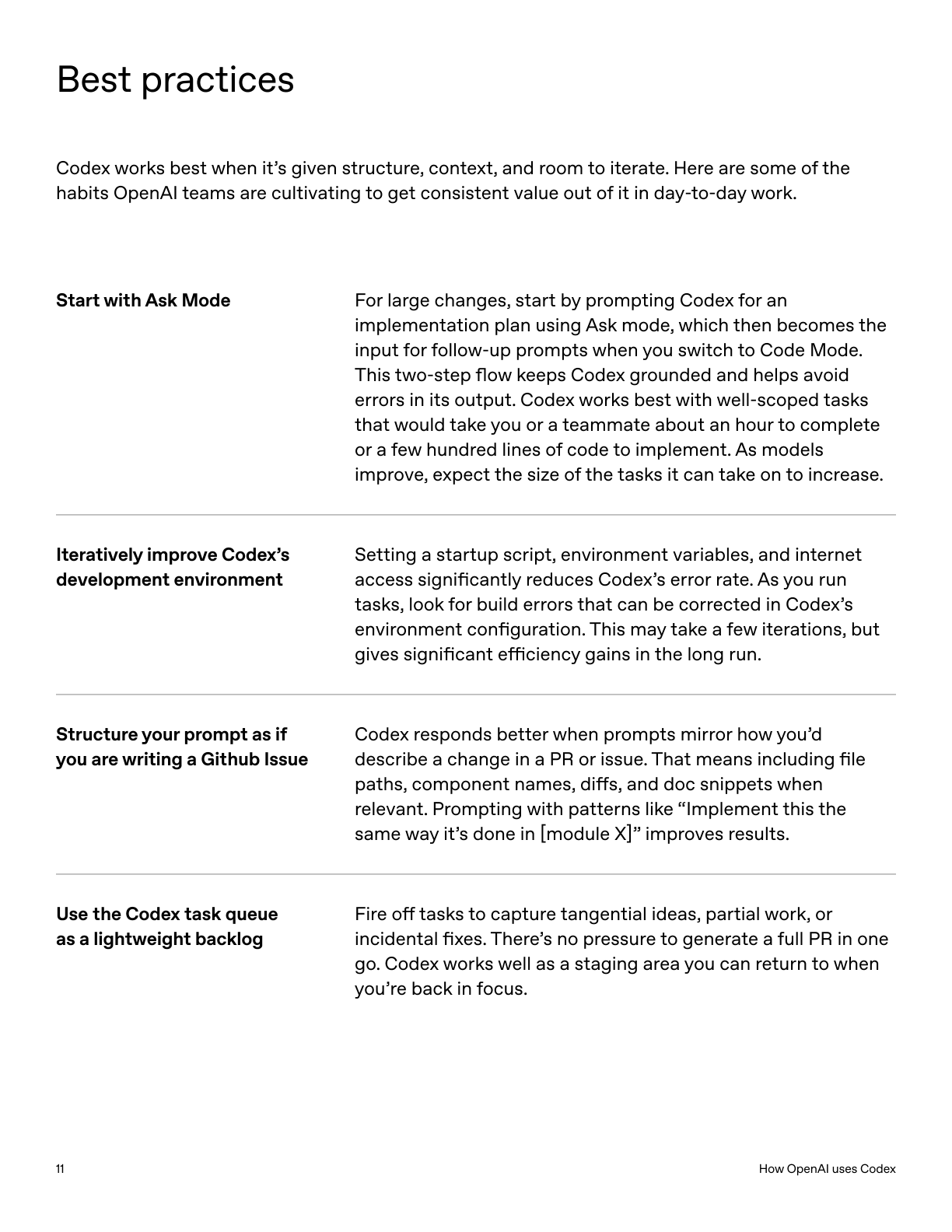
The most practical part of the PDF is the best-practices section. First, OpenAI recommends using Ask Mode to get an implementation plan before making a large change. The plan becomes the input for follow-up prompts, and only then does the workflow move into Code Mode. Second, OpenAI says Codex works best on tasks that a human teammate might finish in about an hour or with a few hundred lines of code. That sentence is one of the clearest task-sizing rules in the report.
Third, OpenAI tells teams to keep improving the Codex development environment. Startup scripts, environment variables, and internet access reduce error rates, according to the document. That puts responsibility back on the repository owner. Before blaming a model for failure, teams should ask whether the repository can be installed, tested, seeded, and mocked automatically. Missing install commands, hidden package registries, unavailable test data, and unclear network policy trap agents more often than they trap humans.
Fourth, OpenAI recommends writing prompts like GitHub Issues. File paths, component names, diffs, documentation snippets, and references such as "implement this the way module X does" give Codex better local context. This is more than a prompt-engineering tip. Coding agents need local conventions, and those conventions often live in working modules rather than a README. A useful prompt gives the agent both requirements and coordinates inside the existing codebase.
Fifth, OpenAI suggests treating the Codex task queue as a lightweight backlog. Tangential ideas, partial work, incidental fixes, and small follow-ups can be sent to the queue instead of being completed immediately. That phrase captures the document better than any single feature. AI coding is moving from inline autocomplete toward asynchronous management of small engineering jobs.
Sixth, the report recommends AGENTS.md as persistent context. OpenAI says it can hold naming conventions, business logic, known quirks, dependencies, and information Codex cannot infer from code alone. This repository uses the same pattern for editorial rules, image rules, build gates, and publishing workflow. As coding agents become normal, repositories will likely need both human-facing README files and agent-facing operating instructions.
Seventh, OpenAI points to Best of N: generate several responses for the same task and compare them. That treats agent output as a set of candidates rather than a single answer. For complex work, a reviewer may take parts of multiple diffs or choose the one with the least risky shape. Human engineers compare design options; agent workflows need room for the same kind of selection.
Read beside OpenAI's Codex safety article from the same period, the operational picture becomes clearer. Codex reads repositories, runs commands, and interacts with development tools. Organizations therefore need to decide what the agent can access, when human approval is required, and what telemetry explains the agent's behavior. The internal usage report is the productivity side. The safety document is the boundary around that productivity.
Community reaction around Codex is less uniformly optimistic than OpenAI's internal case studies. On Reddit's r/codex, users have asked whether quota is being consumed faster than expected, whether large projects make Codex output harder to manage, and why Linux desktop support appears behind Windows priorities. On r/OpenAI, one thread warned that search results were showing an advertising-style malicious site impersonating a Codex app. These reactions do not erase the internal examples, but they show what external users evaluate at the same time: cost, quality, distribution channels, and platform support.
That difference is expected. OpenAI's internal teams work close to the product builders, current features, product knowledge, and fast feedback paths. A normal engineering organization may start with legacy builds, private package registries, older CI, incomplete tests, and security approval steps. Copying OpenAI's workflow therefore starts before "install Codex." The first task is making a repository environment where Codex can fail less often and produce reviewable units of work.
For an engineering team, the immediate checklist is short. Pick backlog items that can be reduced to roughly one-hour tasks. Ask for a plan and test strategy before requesting a diff. Put build commands, test commands, naming conventions, banned patterns, and review criteria in AGENTS.md. Require agent PRs to include an impact summary and the commands that were run. Measure the workflow by review time, rollback reduction, and issue throughput rather than generated lines or number of PRs.
This PDF is not a new model announcement. For AI developers, however, it may be as useful as a release note. OpenAI is showing that the coding-agent race is shifting from "how smart is the model?" to "which tasks enter the queue, what context does the agent receive, and which verification gates decide whether the work merges?" The next bottleneck in AI coding is not a single better prompt. It is the backlog shape and PR size that a human reviewer can still understand.
OpenAI also still calls Codex a research preview, and that caveat should stay attached to the story. Internal use cases show what is possible in a favorable environment, not what every team will reproduce on day one. The direction is still clear. Codex is being positioned less as an extension of autocomplete and more as a development-operations tool for repo understanding, small PRs, test expansion, performance investigation, and asynchronous task queues. Teams preparing for that shift should invest less in memorizing clever prompts and more in repository context, reproducible setup, and verification gates that catch agent mistakes before they merge.