Meta Ships Muse Code, and Its 21x Cheaper Tier Trains on Your Repo
Meta opened the Muse Code terminal agent in beta on August 5. Muse Spark 1.2 lost to Claude Opus 5 on all four benchmark charts Meta published itself. What is actually new is a contributor tier at $0.20 per million output tokens.

- Meta opened
Muse Code, a terminal coding agent, in beta. - Muse Spark 1.2 trails Opus 5 on all four of Meta's own benchmark charts.
- The $0.20 output tier is priced that low because it trains on your code.
Meta Superintelligence Labs released Muse Code in beta on August 5, 2026. It is a program you install in your terminal. It reads the whole repository, plans what to change, writes the code, and runs the tests to check its own work. That is the same job Claude Code and Codex do. Installation is one line.
curl -fsSL https://dev.meta.ai/install.sh | bash
Muse Spark 1.2, the model that shipped the same day, was trained alongside that agent. Meta calls this co-training: execution traces from real Muse Code runs were filtered and fed back into training, and the Muse Code toolset was folded into the model. Through Muse Spark 1.1 in July, Meta had no agent of its own and benchmarked with the open-source mini-swe-agent harness. This is the first release where Meta owns both halves.
Look at the four benchmark charts Meta put on its own announcement page and Muse Spark 1.2 is first in none of them. Anthropic's Claude Opus 5 leads all four. What is actually new here is not a score, it is a price list. Meta now sells the same model under two names, and the cheaper one takes your code into its next training run.
Second or third on its own charts
Here are Meta's published Terminal-Bench 2.1 results. Each model was measured with its vendor's own agent: Opus 5 with Claude Code, GPT 5.6 Terra with Codex, Muse Spark 1.2 with Muse Code.
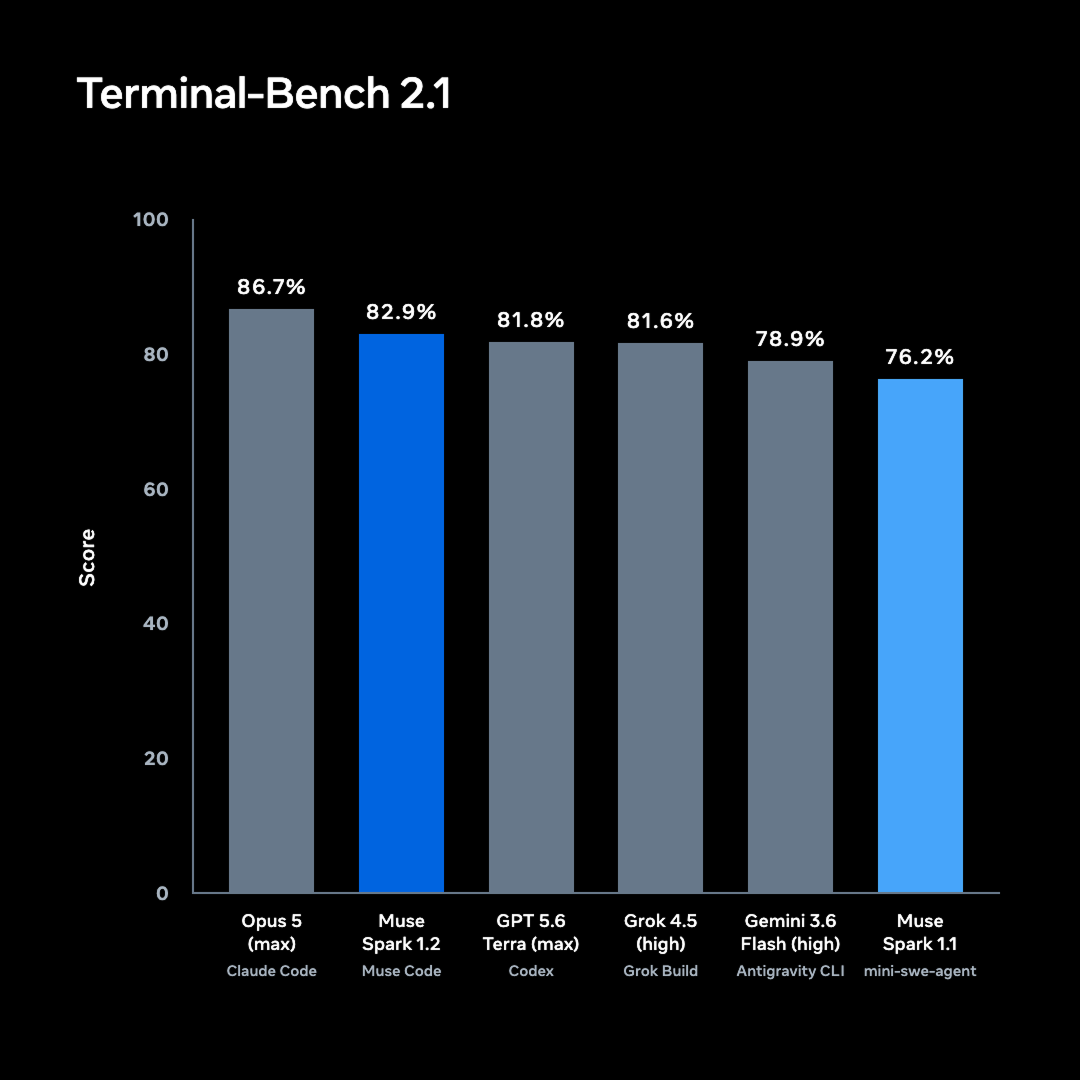
The other three land in the same place. On DeepSWE 1.1, Opus 5 takes 65.0% and GPT 5.6 Terra 64.8%, putting Muse Spark 1.2 third at 59.3%. On Meta's own Internal Coding Bench it is Opus 5 at 79.4% against Muse Spark 1.2 at 70.6%, and on the applied-work evaluation GDPVal-AA V2, Opus 5 scores 1852 to Muse Spark 1.2's 1631.
Few companies publish a table where their own model is not first. Before taking that table at face value, three things need filtering.
First, the OpenAI comparison is Terra. Meta benchmarked against GPT 5.6 Terra (max). Terra is the middle, balanced tier of the three OpenAI split out when it shipped GPT-5.6 in July; the top tier is Sol. On the public Terminal-Bench 2.1 leaderboard, OpenAI's best entry is Sol at 88.8%. That is why a Hacker News thread pointed out that Meta compared against Terra rather than Sol and still lost some of the benchmarks.
Second, the Opus 5 number does not match the public leaderboard. Meta's chart says 86.7%; the public Terminal-Bench leaderboard lists 89.1%. Gaps that size are ordinary when the harness and measurement conditions differ. The problem is that Meta shipped the charts as images with no methodology document attached.
Third, the generational gain includes a harness swap. In the same chart, Muse Spark 1.1 was measured with mini-swe-agent and 1.2 with Muse Code. Of the 6.7 point climb from 76.2% to 82.9%, nothing separates what the model contributed from what the agent contributed.
The Muse Code design does have parts worth reading closely. Every model call, tool run, approval, and edit is appended to a local event log in order, so a killed process resumes at exactly the point it stopped. Subagents stay alive for the whole session instead of being spawned per task. Large jobs are split across isolated git worktrees and run in parallel. Meta published a case study built on that structure: iteratively optimizing GPU kernels across more than 1,000 tool calls over as long as 24 hours, targeting KDA and MLA kernels for NVIDIA Hopper and beating a supplied baseline implementation.
One model, two price tags
The model list on Meta's developer site carries Muse Spark 1.2 twice. Same context window, same performance. The differences are a -contributor suffix and the data-use line printed next to it.
| Model ID | Prompt use | Input | Output |
|---|---|---|---|
| muse-spark-1.2 | Not used to improve products | $1.25 | $4.25 |
| muse-spark-1.2-contributor | Used to improve products | $0.10 | $0.20 |
| Reference: Claude Opus 5 | Standard API does not train | $5.00 | $25.00 |
Per million tokens. All three carry a 1M-token context window.
The standard $1.25 and $4.25 are the same numbers Muse Spark 1.1 carried in July. The row that first appeared on August 5 is the one below it. The contributor tier is 12.5x cheaper on input and 21.25x cheaper on output than the standard tier. Against Opus 5 it is 125x cheaper per million output tokens. Cached input runs $0.002 per million, 75x below the standard tier.
That is Chinese open-model territory. The Hacker News thread compared it to DeepSeek V4 Flash, which drew attention in late July for its Codex integration. The difference is that DeepSeek takes the money and Meta takes the data instead. That is what contributor in the model name means.
The stakes are more specific because this is a coding agent, not a chatbot. It is not just your prompts. Every file the agent reads, every patch it writes, every command it runs and the output that comes back travels through the API. Point the contributor tier at an internal repository and that repository's source is the payment. For a personal side project or code that is already public open source, the arithmetic is completely different.
Can you use it today
| Item | Detail |
|---|---|
| Who | Developers with a Meta Model API key, or an OpenRouter account |
| OS | macOS and Linux. No mention of Windows support, terminal only, no GUI app |
| Price | Muse Code installs free. Billing is per API token (table above) |
| Availability | Undisclosed by country. Meta wrote only "expanded global access" and published no country list |
| Alternate route | OpenRouter's meta/muse-spark-1.2 lists no regional restriction but has no contributor tier |
Country availability is the loosest item in this announcement. The July 9 public preview of the Meta Model API allowed account creation for US developers only, with no EU access. The August 5 post says the model is available today "on the Meta Model API with expanded global access" and names no countries. Hacker News also carried complaints that the login flow routes through Facebook.com, which corporate firewalls commonly block. That is worth testing before an internal rollout.
The workaround when a key does not come through is OpenRouter. meta/muse-spark-1.2 is listed there and requests go straight to Meta. Pricing is $1.25 input and $4.25 output, matching the standard tier. There is no contributor tier on that route, so the price advantage from this announcement disappears.
So the decision in front of you is not whether to run Muse Code, it is which tier to run it on. Pick one repository and check the license and any contracts covering it for whether this code may enter an external training run; if it is internal source or customer code, the standard tier or your existing tooling is the correct answer. For public open source or a personal project, running a single task through the contributor tier turns $0.20 per million output tokens into an actual number on an actual bill. If Meta API keys are still unavailable in your country, the moment to check again is when Meta publishes a documented list of supported countries for the Model API.