Preferred sources come to AI Search, and Google gives clicks a new button
Google is extending Preferred Sources and Highly Cited labels into AI Overviews and AI Mode. Here is what it means for AI search, publishers, and RAG product design.

- What happened: Google is expanding
Preferred Sourcesinto AI Overviews and AI Mode.- Links from sites a user has chosen can appear with a Preferred label inside AI answers.
- The numbers: Google says Preferred Source links were clicked twice as often and that users have selected more than 345,000 unique sources.
- Why it matters: AI search competition is shifting from ranking alone toward source choice, original reporting, and click attribution.
- Search and RAG products now need citation UI and publisher analytics as much as answer quality.
- Watch: A Preferred label does not guarantee traffic recovery.
- Publishers still argue that they cannot see enough exposure and click data across AI Search surfaces.
Google announced an AI Search update on May 27, 2026 that pulls sources back toward the front of the product. The update has three important parts. First, user-selected Preferred Sources can now appear inside AI Overviews and AI Mode responses. Second, fast-moving topics can show a more prominent carousel of articles and perspectives. Third, Google is expanding Highly Cited labels for original reporting that many other articles cite.
At the surface level, this is a convenience feature. A user who already trusts a site can make that site easier to spot in Search. In the context of AI search, the signal is larger. When search results move from a list of links into a generated answer, links do not disappear. They are given a new position. Their placement, label, citation card, and relationship to a user's explicit preferences become part of the new distribution layer.
Google framed the announcement around favorite sources and original content. That framing is fair, but it also tells publishers, blogs, communities, review sites, and documentation teams something practical: they now have to think about how they appear inside the AI answer itself. Traditional SEO was largely about reaching the top of a results page. Visibility in AI Search is becoming more like being invoked as a trusted source inside the answer layer.
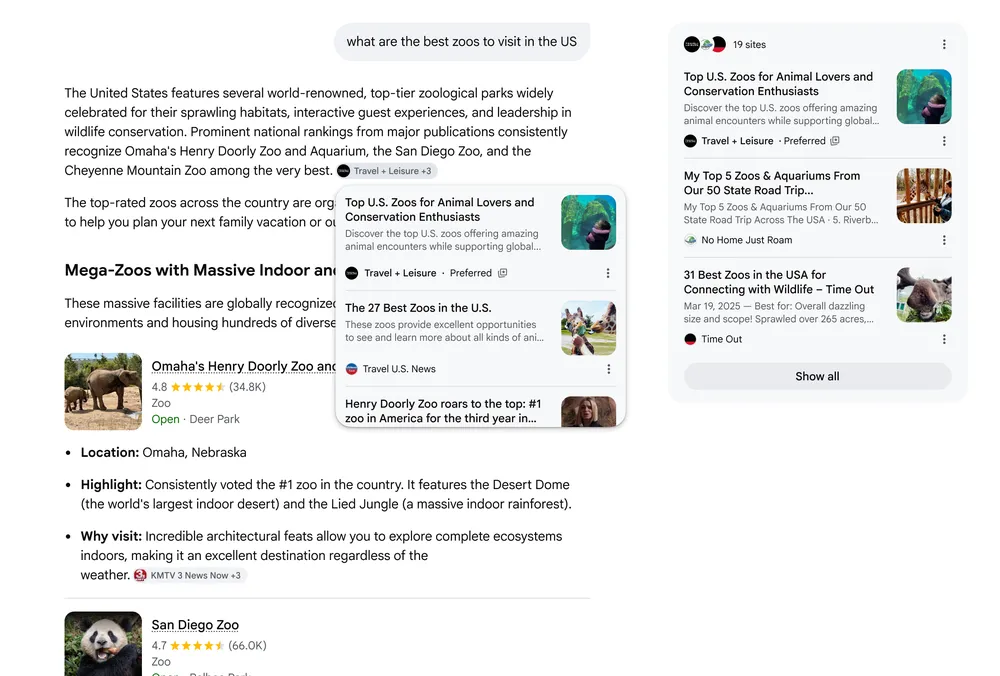
Preferred Sources moves into AI answers
Preferred Sources is not an entirely new idea. In Google Search, users can choose websites they like through source preferences, making those sources easier to see in surfaces such as Top Stories. The new part is that the preference can now show up in AI Overviews and AI Mode. Google says links from sources a user has already selected can be marked with a Preferred label inside AI responses.
That matters because it shows AI Search is not only moving toward hiding links behind summaries. Google is continuing to make the AI answer more capable, but it is also rebuilding explicit link surfaces inside that answer. For users, "this is a source I already said I trust" becomes easier to recognize. For publishers, getting readers to choose them as a preferred source becomes a distribution strategy in its own right.
The numbers Google shared are also revealing. The company said Preferred Source links were twice as likely to be clicked, and that people had already selected more than 345,000 unique sources. Those figures point in two directions at once. Labels can change user behavior. At the same time, survival in AI search may be less about ranking competition alone and more about audience relationship competition.
Google's Search Central documentation adds operational details. Preferred Sources is available globally in Top Stories across all languages where Google Search is available, and it can appear in AI Mode and AI Overviews where those experiences are available by language and region. Eligibility works at the domain and subdomain level. https://www.example.com/ and https://code.example.com/ can be eligible, but a subdirectory such as https://www.example.com/blog is not.
That distinction is practical for small technical blogs and company content teams. If a team blog lives under a main site's subdirectory, users may not be able to select that blog alone as a Preferred Source. Independent domains and subdomains give developer docs, newsletters, and communities a clearer source unit. As AI Search adds explicit source choice, URL structure and brand boundaries start to matter again.
The paradox of adding click buttons to AI answers
It is hard to read the announcement only as good news. Google is improving source visibility partly because AI search has already put pressure on the web's click economy. Pew Research Center reported that in a 2025 analysis of Google user behavior, traditional search result clicks happened on 8% of visits when an AI summary was present, compared with 15% when no AI summary appeared. In that data, pages with AI summaries produced roughly half as many traditional link clicks.
Other data points show the same tension. Search Engine Journal, citing Chartbeat data, reported that from 2024 through early 2026, search referral traffic declined 60% for small publishers, 47% for medium publishers, and 22% for large publishers. Not all of that decline can be assigned to AI Overviews. Discover changes, social traffic shifts, ranking updates, and subscription strategies all play a role. Still, publishers can reasonably see AI answers as a layer that uses their content as evidence while reducing the need to click.
Google's May 27 update does not directly concede that criticism. It answers at the product level instead. Let users choose sources. Label those sources inside AI answers. Put Highly Cited badges on original reporting. Show article carousels for developing topics. In other words, the direction is not "remove AI answers." It is "make the link surface inside AI answers more detailed."
That decision is natural from the Search product's point of view. AI Mode already sits between classic search and a chatbot. Google said on May 19 that AI Mode had passed one billion monthly active users worldwide in its first year and that AI Mode queries had more than doubled every quarter since launch. The same announcement said the average AI Mode query was three times the length of a traditional Search query. As users ask longer and more complex questions, summaries, comparisons, follow-up exploration, and grouped sources become more important than ten blue links.
The hard question is who gets the instrumentation. Digiday reported in February 2026 that several publishers complained they could not track the performance of Preferred Sources well enough. If publishers cannot see which users selected them, how often those surfaces appeared, or how many clicks came from AI Overviews and AI Mode, strategy becomes guesswork. A better click surface helps, but without a dashboard, publishers are still optimizing in the dark.
Highly Cited is a new interface for originality
If Preferred Sources is explicit user choice, Highly Cited is a signal from the web's citation graph. Google says it is expanding Highly Cited badges for original articles that many other articles cite, and it will also show when an article link explicitly references a Highly Cited source. The plain version is this: Search is trying to surface articles that are closer to the original reporting other coverage relies on.
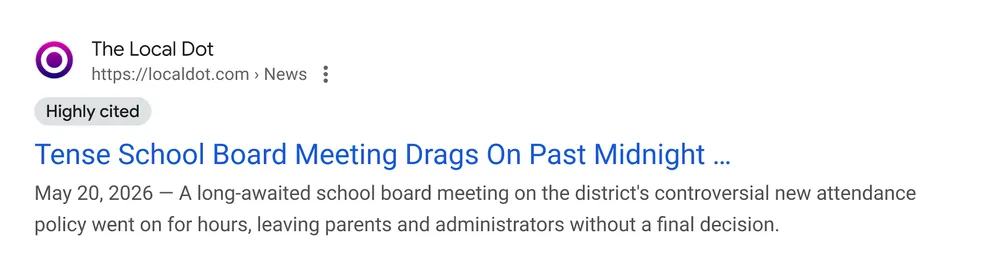
This is more than a news interface tweak. It is one way to explain source quality inside AI search. When a generative answer appears, users often inspect sources only after reading the answer. Even when citation cards are present, checking whether a card points to original reporting, a rewrite, a forum post, or a commercial comparison page requires another click. Highly Cited brings part of that judgment into the Search surface.
Citation count is not truth. A heavily cited article is not automatically the most accurate article. Breaking news can be corrected later, and industry coverage can turn a quickly rewritten press release into a citation hub. But in AI search, the question of which sources enter the answer layer is now central. By exposing citation relationships as a visible signal, Google is making its direction clear.
For developers, the same idea maps directly to RAG product design. In an internal search or knowledge base assistant, retrieving the top-k most similar documents is rarely enough. A product should know which documents are trusted by the user, which are current, which are original sources, which policy documents are referenced by many downstream pages, and which documents have formal approval authority. Google's separation of Preferred Sources and Highly Cited is a consumer-search version of a broader pattern: source signals need distinct meanings.
| Signal | Who defines it | Role in AI search |
|---|---|---|
| Preferred Sources | User | Makes personally trusted sites easier to identify in AI response links. |
| Highly Cited | Citation relationships across the web | Helps users find original reporting referenced by other coverage. |
| Article carousel | Google Search ranking and AI response composition | Creates a broader reading surface under answers about developing topics. |
| Inline links | AI response generation and Search systems | Places evidence links near answer text and lowers the cost of deciding whether to click. |
This is a source-product problem, not just SEO
Reading this as "add a Preferred Sources button" misses the bigger change. Sources are becoming part of the product interface. In classic search, source judgment lived inside result titles, domains, snippets, and the user's scan of the results page. In AI Search, the answer arrives first, and sources are reconstructed as cards, labels, carousels, hover previews, inline links, and preference markers.
Google had already moved in this direction on May 6, when it announced more ways to explore the web with generative AI in Search. AI responses can include article suggestions for deeper reading, subscribed labels for users with connected news subscriptions, public discussion previews, social media perspectives, inline links beside text, and desktop hover previews. All of those features point to the same model. AI Search is both an answer-generation engine and a source-routing interface.
That overlap changes the work for content and engineering teams. Content teams need enough direct trust for readers to select them intentionally. Engineering teams need stable feeds, structured data, canonical URLs, paywall and subscription integration, preview quality, and consistent site identity. Data teams need to ask whether Search Console is enough, whether referrals can be separated, and whether AI Search exposure and clicks are visible at all.
AI product teams should take the same lesson. A RAG application can benefit from letting users say which sources they trust more. A support assistant may need settings such as "prefer official policy documents," "prefer my team's wiki," or "prefer legal-approved documents." A research tool may need "prefer peer-reviewed papers," "prefer official docs," or "prefer material from the last 90 days." Those preferences can improve answer quality, but they can also create stale-source problems and echo chambers if the interface does not expose the trade-off.
Highly Cited-style signals can also work inside companies. A root policy referenced by many operations docs, a runbook connected to many incident reports, or an API spec cited by multiple product documents may deserve more evidentiary weight than a page with a high keyword score. The risk is that old documents often accumulate the most links. Source ranking therefore needs to combine personal preference, organizational authority, freshness, verification status, and ownership.
The open questions for publishers
Google's announcement sounds like an opportunity for publishers. If readers add a publication as a Preferred Source, its links may stand out inside AI answers. Highly Cited badges may make original reporting more visible. Developing-topic carousels can put multiple article links under a single AI summary.
But the difficult questions remain. First, how much referral traffic will these features actually restore? Google says Preferred Source links were twice as likely to be clicked, but the public announcement does not show the baseline or publisher-by-publisher effects. If overall clicks fall on pages with AI Overviews, a strong relative lift may still fail to offset an absolute traffic decline.
Second, source preference may favor already strong brands. Publications, newsletters, communities, and major brands with direct reader relationships can ask users to add them as a Preferred Source. Newer sites and smaller expert blogs that historically relied on discovery through Search may struggle. Users generally cannot prefer a source before they have found it.
Third, analytics remain a gap. Publishers want to know which links appeared with which labels, whether a click came from a Preferred Source surface, and whether Highly Cited badges changed click-through rates. Without that data, publisher strategy can collapse into little more than asking readers to press a button.
Fourth, originality and trust are not simple properties. Highly Cited may help users find original reporting, but citation popularity is not the same as depth, accuracy, or independence. AI answer layers could reduce source diversity, or they could filter out low-quality rewrites. The result depends on how Google's ranking, citation selection, query fan-out, and user preference systems combine.
What developers and AI teams should take from it
This is developer news because Google Search is one of the largest AI retrieval products in the world. When source labels, preference signals, and citation badges move to the front of Search, they reveal where AI product UX is going. The important question is no longer only whether the answer is right. It is whether the product shows which sources shaped the answer and why those sources deserve trust.
Teams building AI search or RAG should check at least four things. Can users adjust source priority? Do citations explain source type, freshness, authority, and ownership instead of showing only a URL? Does the answer layer provide a path back to the original source rather than trapping the user in a summary? Can content providers or internal document owners see exposure and usage analytics?
The enterprise version is sharper. When an internal AI mixes policy documents, customer contracts, runbooks, and codebase material, the preferred source must be explicit. A document a user reads often is not necessarily the latest legally valid policy. A widely linked runbook may not reflect the newest incident process. Google's Preferred Sources and Highly Cited labels are consumer features, but the design questions behind them apply directly to company AI systems.
The May 27 update does not settle the larger debate about whether AI Search will help or harm the web. It does show the direction. AI answers will keep expanding. Links will not disappear; they will be rearranged into labels, carousels, preference signals, and citation cards. Publishers need direct reader relationships as well as search visibility. AI product teams need to treat citation as a core interaction, not an appendix.
The most important sentence in Google's announcement may be the claim that users click Preferred Source links twice as often. Clicks are not dead in the age of AI answers. They are becoming less of a natural byproduct of a results page and more of an action created by explicit trust signals and interface design. That small Preferred label is not small. It is a sign that AI search is changing how the web's sources get packaged and chosen.
Sources
- Google, New ways to find your favorite sources and original content in AI Search
- Google Search Central, Guide to Preferred Sources in Google Search for Web Publishers
- Google, 5 new ways to explore the web with generative AI in Search
- Google, How AI Mode is changing the way people search in the U.S.
- Google, A new era for AI Search
- arXiv, Measuring Google AI Overviews
- Pew Research Center, Do people click on links in Google AI summaries?
- Search Engine Journal, Search Referral Traffic Down 60% For Small Publishers
- Digiday, Without transparency, publishers can't tell if Google's Preferred Sources feature benefits them