Google's Decisions API Bills $0 for Output and Costs 30% More Than Jev
Google opened Gemini Decision 1, a model that returns a probability per option instead of prose. Input runs $0.10 per million tokens, output is free, audio and video are accepted, and it leads 7 of the 9 benchmarks Google published. Running those evals still costs $0.88 against Jev at $0.68.
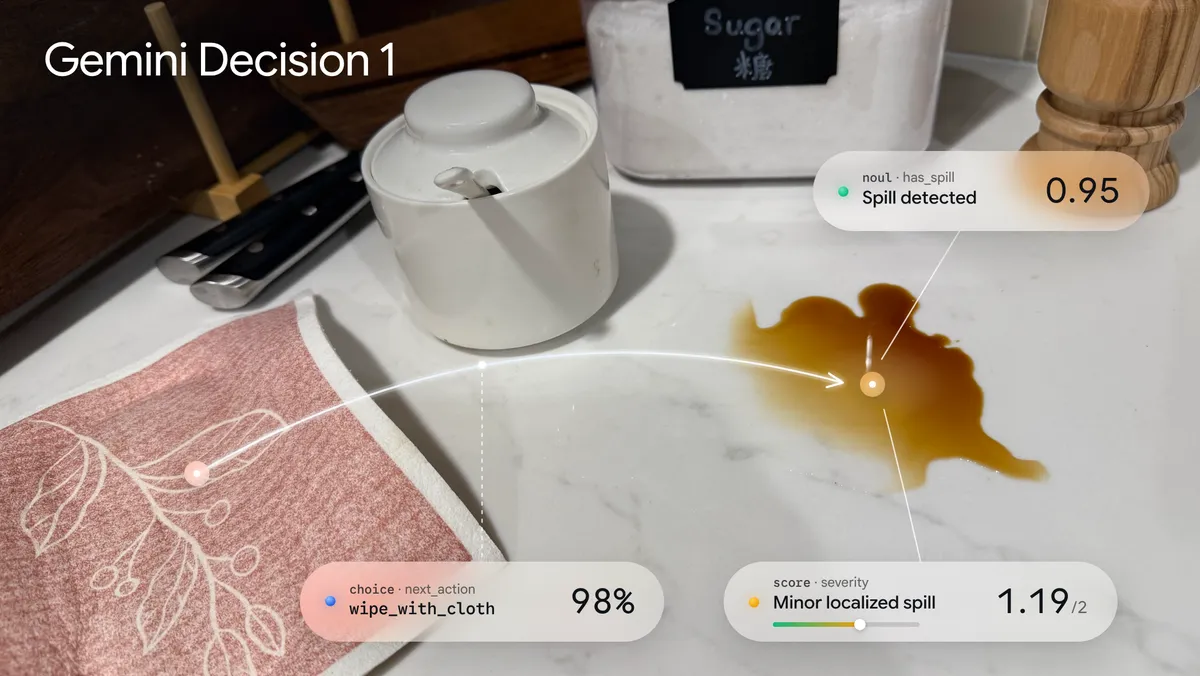
- Google opened a judgment-only Gemini Decisions API that returns probabilities, never prose.
- Input costs
$0.10per million tokens, output is billed at zero, and audio and video are accepted. - It leads 7 of 9 benchmarks, yet the same eval suite costs 30% more than Jev.
An AI model that renders verdicts without writing a sentence is now open to any developer with an API key. Google DeepMind published Gemini Decision 1 and the Gemini Decisions API that calls it on November 11, and made both callable from the Google AI Studio free tier the same day.
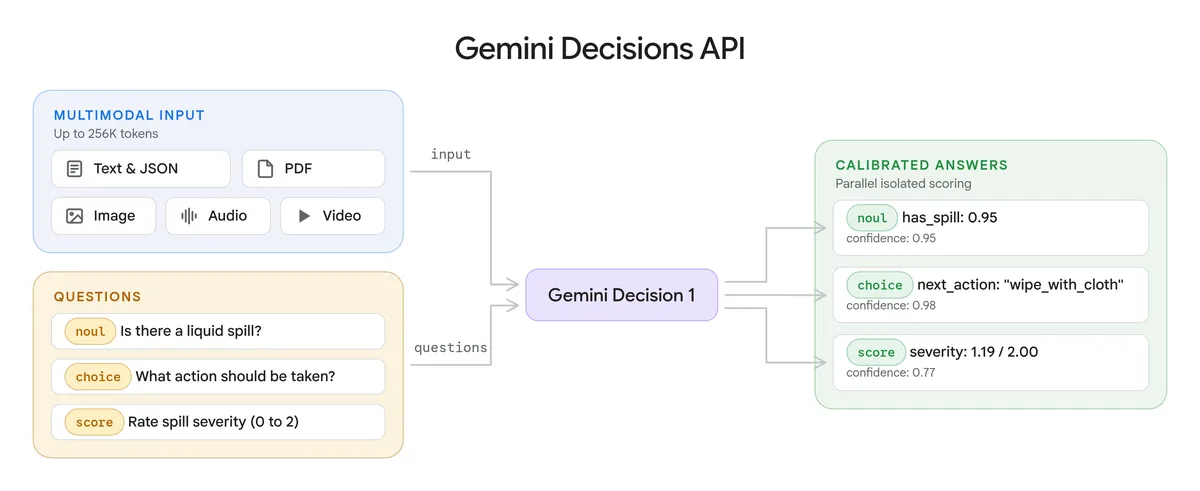
The model answers questions like "is there spilled liquid in this photo" or "should this ticket go to billing, technical, or sales" by attaching a probability to each option instead of writing out an answer. One request can carry up to 1,000 questions, and the input can be text, images, audio, video, or PDF. The industry calls this a decision model, a name that arrived when TypeSafe shipped Jev on September 15.
In the two months since Jev, the large vendors have shipped the same class of model one after another. On October 1, Cloudflare published the open-weight decision model Clef and the AWS Strands team released Strands Decider 2B. On October 6, OpenAI opened a Decisions API built on GPT-6 Luna in public beta. Google is the latest in.
What Changes Versus Prompting an LLM
Classification and yes/no judgment calls are mostly handled today by prompting a general LLM. An LLM generates even a short reply like {"team": "billing"} character by character, which means you pay output tokens, and a malformed response has to be retried. Google's blog says Gemini Decision 1 "scores candidate options in a single forward pass" rather than emitting an answer one token at a time.
The API accepts only three question types, the same set Jev and Clef use.
noul: returns the probability of "yes" for a yes/no question. The value is clamped between 0.01 and 0.99.choice: picks one of 2 to 255 options and attaches a probability to each.score: places the input on an ordered scale (mild, moderate, severe, for example) and returns a weighted average.
Every answer carries a confidence value between 0 and 1, and the response's usage.total_output_tokens is always 0. Reduced to the field names in the docs, a request looks like this.
from google import genai

client = genai.Client(http_options={"api_version": "v1beta"})

response = client.decisions.create(
    model="gemini-decision-1",
    input="Payments have been failing for every customer for the past hour.",
    questions={
        "urgent": {"type": "noul", "instructions": "Is this urgent?"},
        "team": {
            "type": "choice",
            "instructions": "Which team should own this?",
            "criteria": {
                "billing": "payments, invoices, refunds",
                "technical": "outages, errors, configuration",
                "sales": "plans and upgrades",
            },
        },
    },
)
print(response.answers)
Below 16K tokens of context, median model compute runs 50 to 100ms, and end-to-end latency including the network runs 150 to 250ms. Google says latency stays nearly flat whether a request carries 1 question or 100. It did not publish latency at 1,000 questions.
How It Compares to the Decision Models Already Out
This is Google's first decision model, so there is no predecessor to beat. The comparisons that matter are the method teams use today, prompting Gemini 3.5 Flash-Lite, and the two competing decision models. The table below is the one in Google's announcement. Every number is Google's own measurement, and refusals, safety blocks, and unsupported inputs were counted as wrong answers.
| Benchmark | Gemini Decision 1 | Jev 1.14 | GPT-6 Luna (OpenAI Decisions) | Gemini 3.5 Flash-Lite (prompted) |
|---|---|---|---|---|
| JevBench (public split) | 92.2 | 90.0 | 90.9 | 86.6 |
| Amazon ESCI (product search relevance) | 58.7 | 56.7 | 54.7 | 47.2 |
| New Yorker Caption | 79.7 | 72.0 | 68.4 | 73.7 |
| Mind2Web Multimodal | 86.2 | 86.8 | 81.8 | 78.0 |
| PubMedQA | 79.8 | 78.2 | 74.4 | 77.6 |
| Global-MMLU-Lite (non-English) | 86.0 | 85.0 | 79.6 | 78.8 |
| When2Call (tool-call judgment) | 79.9 | 82.0 | 70.4 | 60.9 |
| MMAU (audio) | 71.8 | no input support | no input support | 67.7 |
| Video-MME (no subtitles) | 69.1 | no input support | no input support | 63.3 |
| Top-1 ECE calibration error (lower is better) | 0.0250 | 0.0494 | 0.0721 | 0.2104 |
Gemini Decision 1 leads on accuracy, on audio and video input, and on how much the probabilities can be trusted.
- Accuracy. It ranks first on 7 of 9. The two it loses to Jev are web-screen action judgment (Mind2Web, by 0.6 points) and deciding whether to call a tool (When2Call, by 2.1 points).
- Audio and video. Jev 1.14 and OpenAI Decisions ran Mind2Web, which mixes in images, but could not accept audio (MMAU) or video (Video-MME) at all. Clef caps a request at 4 images. Gemini Decision 1 is the only decision model shipped so far that judges sound and video.
- Calibration. ECE measures whether answers given at 90% confidence turn out to be right about 90% of the time. At 0.0250, Gemini Decision 1 is about half Jev's error (0.0494) and one eighth of prompted Flash-Lite (0.2104). For a system that routes to a human based on confidence, this number can matter more than accuracy.
Hacker News pushed back immediately: vendor benchmarks always have the vendor in first place. Google wrote that Gemini leads by 2.2 points even on JevBench, the suite named after Jev, but no independent lab has published the same measurements under the same conditions.
The Price Matches OpenAI and Beats No One Else
Pricing is $0.10 per million input tokens and $0 for output. Images, audio, video, and PDF carry the same input rate, and shared input is billed once per request no matter how many questions ride along. Each question adds only the tokens of its own instructions and option descriptions.
That is the same rate as the OpenAI Decisions API. It is 2.4 times Jev's rate at the time of its September launch ($0.042). Measured as the total cost of running the 7 shared evals that exclude audio and video, the gap narrows.
| Approach | Input, per 1M tokens | Output | Total across 7 shared evals |
|---|---|---|---|
| Jev 1.14 | $0.042 | $0 | $0.68 |
| Gemini Decision 1 | $0.10 | $0 | $0.88 |
| GPT-6 Luna (OpenAI Decisions) | $0.10 | $0 | $0.93 |
| Gemini 3.5 Flash-Lite (prompted) | $0.30 | $2.50 | $4.14 |
Gemini Decision 1's $0.88 total is about 30% above Jev's $0.68 and about 5% below OpenAI's $0.93. Against the method teams use today, prompting Flash-Lite at $4.14, it is 4.7 times cheaper. That table is the basis for Google's claim of being "nearly 5x cheaper."
What swapping an LLM for a decision model does to a bill shows up in an Amazon case. According to a November 9 post on the Strands team blog, Amazon moved internal ticket sorting across 20 categories from Claude Sonnet 4.6 to its own decision model, Strands Decider E4B. Average call time fell from 4,215ms to 897ms, and output tokens per ticket fell from 170 to 1. Cost went from roughly $22,200 per million tickets to roughly $500. On accuracy, the post says only that it beat the Sonnet setup in production, with no numbers.
What It Cannot Do
The Decisions API does nothing but judge. These are the unsupported features listed in the docs.
- Free-form text generation, structured output, and thinking
- Tool calls, code execution, and search or URL grounding
- Passing conversation history as blocks. Prior turns have to be serialized into the text input
- Batch, Flex, and Priority tiers, and context caching. Judging the same long document repeatedly means paying full price every time
- YouTube URLs and
gs://URIs as input
Non-English performance is thinly documented. The Global-MMLU-Lite score of 86.0 in the table above is the only non-English figure Google published, with no per-language breakdown.
Access Conditions Today
There is no waitlist. If you have a Gemini API key, you can call it today.
| Item | Detail |
|---|---|
| Who | Developers, through the Gemini Developer API (v1beta) and Google AI Studio. SDK 3.2 or later |
| Price | $0.10 per 1M input tokens, $0 output. Input is free on the free tier |
| Free tier limits | 200 requests per minute, 50K tokens per minute, 10,000 requests per day |
| Paid Tier 1 limits | 1,500 requests per minute, 1M tokens per minute, 50,000 requests per day |
| Data use | Free-tier input is used to improve Google products. Paid-tier input is not |
| Regions | Singapore and the rest of APAC are on the Gemini API supported-regions list, with no Decisions-specific restriction |
| Google Cloud (Vertex AI) | Not yet supported. Google says only "soon" |
The region row answers whether you can call it, not where the data lands. Decisions is only on the Gemini Developer API so far, and Google has not published a region selector or data-residency commitment for it, so a team that has to keep processing inside a named Google Cloud region such as asia-southeast1 has to wait for Vertex AI support. The free tier adds a second constraint that matters under Singapore's PDPA, which permits an overseas transfer only when the receiving organization is bound to a comparable standard of protection: Google states free-tier input is used to improve its products, so customer data belongs on a paid key or nowhere. Google says LangChain, Vercel AI SDK, LiteLLM, and OpenRouter integrations are rolling out in sequence.
If you have an LLM call today that asks a yes/no or a classification question, pick one and replay a few hundred of last week's real inputs through the Decisions API with a paid AI Studio key. Compare the agreement rate against the existing LLM answers, then check whether the disagreements came back with low confidence. If they cluster below a threshold, you can route only the calls under that threshold to an LLM or a person, and the output-token line on that call disappears. For anything resembling customer data, use a paid key rather than the free tier.