Exa Puts a $250M Price Tag on Agent Search
Exa's $250M Series C shows how AI agent competition is moving beyond models into search, indexing, latency, and source-verification infrastructure.

- What happened: Exa announced a
$250 million Series Cto expand its search engine for AI systems.- The company says the round, led by a16z, values Exa at $2.2 billion.
- Key numbers: Exa claims more than 400,000 developers, 5,000-plus companies, and an index tracking over 500 billion URLs.
- Why it matters: Agent quality now depends on search quality, latency, token efficiency, and verifiable sources, not just model capability.
- Coding and research agents use web search as a repeated verification loop, not a one-time answer box.
- Watch: Exa's benchmark and market-size claims come mostly from Exa itself, so teams should validate them against their own workloads.
Exa announced a $250 million Series C on May 20, 2026. The company says the round was led by a16z and puts Exa at a $2.2 billion post-money valuation. At first glance, this looks like another large AI infrastructure financing. The more interesting signal is how explicitly Exa is positioning itself: not as a general search wrapper, but as "the search engine for AI." As models become more capable, search is not fading into the background. It is becoming one of the main ways agents check the outside world.
Human search and agent search are different workloads. A person types a query, opens a handful of results, and makes a judgment. An agent decomposes a goal into subquestions, gathers candidates, checks freshness, compares sources, and often searches again before calling a tool or writing an answer. A coding agent may loop through error messages, library documentation, GitHub issues, release notes, and example code. A research agent may revisit the same topic from several angles and filter conflicting claims. As those loops grow, a search API stops being a convenience feature. It becomes infrastructure that shapes runtime cost, latency, and output quality.
Exa's announcement frames this shift aggressively. The company argues that AI agents will perform more web searches than humans this year, and that LLM-generated search volume could eventually reach 1,000 times today's Google search volume. That forecast should be read as a view of the market, not as an established fact. The more durable point is about the character of search. It is moving from a results page viewed by a user to machine-facing infrastructure called repeatedly while an agent works.
The Numbers Exa Wants Builders to Notice
In its official announcement, Exa says it already serves customers including Cursor, Cognition, HubSpot, OpenRouter, and Monday.com. It also claims more than 400,000 developers and over 5,000 companies use the product. On the infrastructure side, Exa says its crawler tracks more than 500 billion URLs, its research team trains specialized embedding models, and the company built its own vector database to handle high-QPS agent workloads.
Those details matter because Exa is not presenting itself as an API that repackages search results. It is trying to be seen as a company building the lower layers of a search engine: crawler, index, embeddings, extraction, ranking, and serving latency. Many search APIs compose results from existing engines or combine crawling and extraction into a developer product. Exa's claim is that it owns more of the stack and can therefore tune search for agents rather than for human-facing search pages.
The company breaks down agent search needs by workload. Go-to-market agents need broad search over people and companies. Coding agents need complex search over public code and technical documentation. Chat agents need fast and cheap search plus text extraction. Exa says it has trained specialized embeddings for code search, built a sub-200ms search API, and created extraction models that can reduce LLM token use by more than 20x. The direction is clear: agent search is being treated as a set of task-specific products, not as one generic web-search attachment.
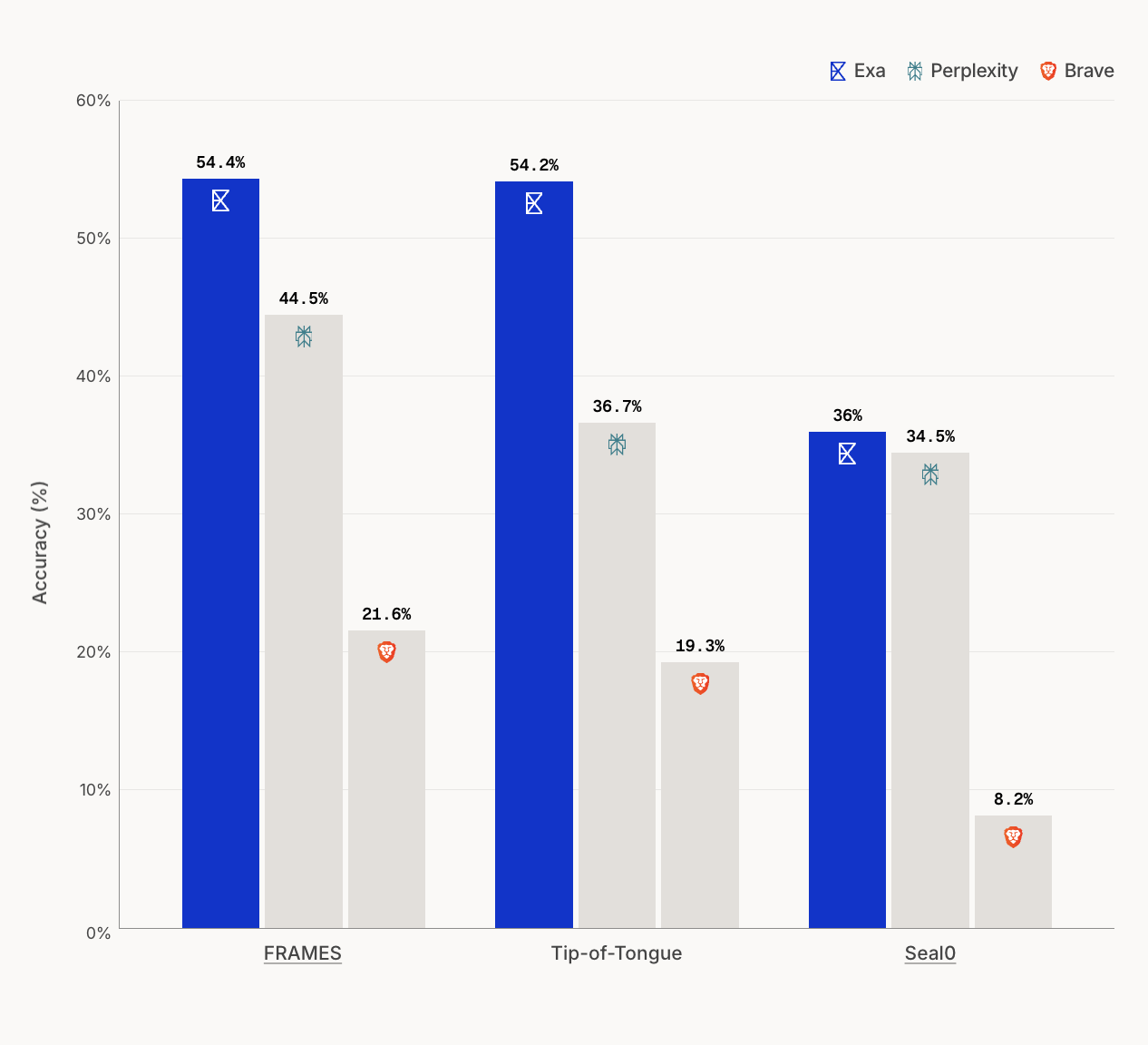
The chart above comes from Exa's own announcement and compares search quality on evaluations such as FRAMES, Tip-of-Tongue, and Seal0. Exa says it outperforms Perplexity and Brave on those tests. This is useful as a signal of the competitive axis Exa wants to emphasize, but it should not be treated as independent proof that Exa is better for every agent workload. Dataset selection, query mix, product versions, and call settings can all change the result.
Why Search Is a Bottleneck Outside the Model
When teams build LLM products, search is often described as "adding context." A user asks a question, the system retrieves relevant documents, those documents go into the model, and the model produces an answer. That description fit early RAG systems reasonably well. Agents make the role of search more demanding.
First, search is the channel for freshness. A model does not know information after its training cutoff, and a long context window does not automatically guarantee current web state. If an agent needs today's API behavior, a newly closed GitHub issue, a new pricing page, a security advisory, or a company acquisition announcement, it needs search or another live data connection.
Second, search is the channel for verification. An agent that trusts the first sentence it finds is fragile. It needs to distinguish official documentation from secondary coverage, current release notes from stale tutorials, and contradictory claims from corroborated facts. This is not solved by reasoning alone. The quality of the chosen URL, extracted body text, and retained citation determines whether the model has a defensible basis for its output.
Third, search is a cost channel. Pull in too many results and the model input grows. Pull in too few and the answer may become thin or wrong. Scraping a full page can be slow and expensive; relying only on snippets can erase the context that matters. That is why Exa emphasizes extraction and token reduction alongside ranking quality. Search quality is not just an accuracy problem. It is also a token-budget problem.
Fourth, search is a governance channel. When an agent searches the web and makes a decision, teams need to know which sources it used, when it accessed them, and whether the user or organization allowed that external lookup. In finance, healthcare, law, recruiting, security, and other high-consequence domains, search results are not just reference material. They become part of the audit trail behind the agent's action.
Exa, Parallel, and the New Infrastructure Layer
Exa is not alone in seeing this market. Parallel Web Systems announced a $100 million Series B in April 2026 and said it had reached a $2 billion valuation. Parallel also describes itself as infrastructure for how AI agents access and use the open web. TechCrunch grouped Exa, Parallel, Tavily, and TinyFish with the broader AI search transition being pushed by Google and OpenAI.
This competition is different from the fight over the search box. Google Search, Perplexity, and ChatGPT Search want to own the answer interface that users see directly. Exa and Parallel want to operate underneath that experience, selling search APIs, extraction, indexes, and research tooling that applications and agents call. One side wants to be the default entry point for users. The other wants to be the default search layer for agents.
| Category | AI search for users | Search infrastructure for agents |
|---|---|---|
| Representative players | Google, OpenAI, Perplexity | Exa, Parallel, Tavily, Brave Search API |
| Main buyers | Consumers, knowledge workers, search users | AI app developers, coding agents, research agents, SaaS platforms |
| Evaluation criteria | Answer quality, UI, citations, ad transparency | Accuracy, latency, extraction quality, API reliability, cost |
| Risk | Reduced clicks, source disputes, recommendation bias | Vendor lock-in, reproducibility, data freshness, call cost |
For developers, this distinction is practical. Using search inside ChatGPT or Gemini is different from attaching Exa, Tavily, Brave, SerpAPI, or another search provider to a custom agent. The first choice gives you a bundled model-and-search product experience. The second lets you design the search calls, cache results, store citations, and use the same search layer across models. This is not a simple question of which approach is better. It is a question of who controls the retrieval layer once agents become part of the product's core workflow.
Why Coding Agents Are a Strong Test Case
Cursor and Cognition are especially notable names in Exa's customer list. Coding agents are a demanding search workload. Code is sensitive to version drift, and the relevant environment changes constantly: frameworks, packages, runtimes, cloud APIs, build tools, and security settings all move quickly. If a model suggests outdated syntax, the build fails. If it misses a changed security default, the risk can become real.
Coding agents also use search results more strictly than a human reading documentation. Suppose an agent needs to understand how a caching API changed in a specific version of Next.js. It may need the official docs, release notes, GitHub issues, example code, and migration guidance together. An old tutorial ranking well on a general search page may be actively harmful. The agent needs freshness, version context, and source quality rather than popularity alone.
The cost curve grows quickly too. When a user says, "Fix this failing test," the agent reads local files, interprets the error, checks dependency documentation, searches for similar issues, writes a patch, and reruns tests. Web search may happen several times inside that single workflow. Search calls, page extraction, input tokens, and retries all accumulate. That makes search latency and extraction quality part of the user experience, not just backend plumbing.
Search Meets Agent Payments
One interesting adjacent signal is Coinbase's April 2026 note about making Exa search available through x402. The x402 idea uses HTTP 402 Payment Required so an agent can call an API, receive a payment requirement, inspect the price, pay, and continue. Coinbase's Exa example suggests that search could move from a developer-provisioned monthly API to a resource agents buy at runtime when they need it.
It is too early to say that this pattern is widely adopted. Still, the direction matters. If agents autonomously choose external tools, then search, crawling, database lookup, authentication, payment, and logging all sit in one execution path. If search APIs become services that agents buy on demand, pricing units and usage controls will look different from the current dashboard-and-API-key model.
That also pulls in security and governance questions. Which agents are allowed to buy which searches? How much can they spend? Can sensitive queries be sent to an external search provider? Where does the audit log live when a search result contributes to a business decision? Search infrastructure may become less about picking the most accurate API and more about designing the boundary where an agent transacts with the outside world.
How to Read the Benchmarks
Exa highlights quality and latency benchmarks in its announcement. It shows charts where Exa performs well on FRAMES, Tip-of-Tongue, and Seal0, and a quality-versus-latency comparison on HLE-Search. These materials are useful signals in a funding announcement, but teams should read them carefully.
Search benchmarks are sensitive to the query set and the evaluation method. A system can perform well on general questions and poorly on code questions, or the reverse. Search over people and companies is different from academic search, shopping search, news search, or release-note search. Strong performance on one dataset does not guarantee strong performance across every agent workload.
Real search quality also depends on post-processing. URL ranking, body extraction, duplicate removal, trust filtering, cache policy, freshness handling, and model-facing summarization all shape the final answer. Sometimes the relevant question is not "Which engine found the best URL?" but "Which provider returned material the agent could actually use without wasting tokens or hiding the evidence?"
Pricing is also broader than the search API bill. A fast search call can still become expensive if the extracted page body is long and pushes LLM input tokens higher. An aggressive extractor can save money but strip out the context needed for a reliable answer. Exa's emphasis on extraction and token reduction shows where the economics of this market are heading: the true cost is distributed across retrieval, extraction, model input, retries, and verification.
Questions Development Teams Should Ask Now
The narrow reading of this news is "Should we use Exa?" The more useful question is "How should we design our agent's search layer?" If an agent only searches internal documents, permission filtering and the internal index may matter more than open-web coverage. If a research agent depends on current public information, a team may need to compare Exa, Tavily, Brave, SerpAPI, Firecrawl, Parallel, and its own crawler. If a coding agent is the product, official documentation, code search, version freshness, and GitHub issue coverage may be more important than broad web ranking.
Practical design questions come first. Will raw search results go straight into the model, or will the system create an intermediate summary? Will the product store source URLs and access times? How long should search results be cached? What happens if the provider fails? Are sensitive queries allowed to leave the organization? Should the search provider be a replaceable adapter, or will the product depend deeply on one provider's ranking and extraction format?
Teams operating agent products should treat search logs as observability data. They need to know which queries were sent, which URLs were selected, which body text entered the model, and which decisions followed. Search is no longer an invisible helper function. A bad search result can turn into a wrong answer, a bad code patch, or a mistaken business decision.
The Next Cost Sheet in the Model Race
Exa's $250 million round is a search-company growth story, but it also points to the next cost sheet in AI competition. More agents do not only mean more model calls. They also mean more search calls, extraction work, source verification, caching, indexing, vector storage, payments, and audit logs. Search is the first layer where an agent meets the outside world, so it is one of the first non-model bottlenecks to attract serious capital.
Google and OpenAI are pulling search into model-centered user experiences. Exa and Parallel are trying to build the lower layer that any agent can call. It is not yet clear which structure lasts. What is already clear is that AI product teams can no longer treat search as something to bolt on later.
Good agents will not be built from good models alone. They will need deliberate choices about what to search, which sources to trust, how quickly to retrieve evidence, how much token budget to spend, and how to retry when the first pass fails. Exa's $250 million round is the market putting a price on that problem. In the agent era, bottlenecks live outside the model too, and search is becoming one of the first layers where that reality turns into a business.