DeepSeek Ships an Official Codex Setup Guide, at $0.28 per Million Output Tokens
DeepSeek moved the V4-Flash API into public beta on July 31, added native Responses API support, and published its own documentation for wiring the model into OpenAI Codex.
- DeepSeek moved the
V4-FlashAPI into public beta on July 31. - It published its own Codex setup guide, at $0.28 per million output tokens.
- No multimodal support, and community tests report noticeably higher token use.
A model vendor just wrote the documentation for plugging its own model into a competitor's coding agent. On July 31, DeepSeek's API release notes announced that the DeepSeek-V4-Flash API had entered public beta, and the company opened a Codex integration page the same day. The release notes put it plainly: the new build "natively supports the Responses API format and is specifically adapted for Codex."
The model itself barely moved. DeepSeek says V4-Flash-0731 "keeps the same model architecture and size as DeepSeek-V4-Flash-Preview, and was only re-post-trained." The 284B-parameter MoE with 13B active, the 1M-token context, and the MIT license all carry over from the April release. What changed is which tools you can drop the model into without writing glue code.
Eight lines of Codex config
Codex is OpenAI's coding agent, and the CLI, the ChatGPT desktop app, and the VS Code extension all read the same configuration. DeepSeek's approach is to register one more provider in that file.
model = "deepseek-v4-flash"
model_provider = "deepseek"
preferred_auth_method = "apikey"
forced_login_method = "api"
model_reasoning_effort = "high"
model_catalog_json = "~/.codex/models.json"

[model_providers.deepseek]
name = "deepseek"
base_url = "https://api.deepseek.com/"
wire_api = "responses"
experimental_bearer_token = "<your DeepSeek API key>"
The line that matters is wire_api = "responses". The Responses API is OpenAI's request/response contract, which keeps tool calls and reasoning state inside a single conversational turn. A provider that only speaks Chat Completions needs a translation shim sitting between it and Codex. DeepSeek removed the shim by conforming to the wire format directly.
You also need ~/.codex/models.json for the model metadata. DeepSeek shipped install scripts for macOS, Linux, and Windows that generate both files. Only deepseek-v4-flash is wired up today; the larger deepseek-v4-pro is expected in early August.
82.7 points at $0.28
Here are the agentic benchmarks DeepSeek published in the release notes. All are self-reported.
| Benchmark | Score | What it measures |
|---|---|---|
| Terminal Bench 2.1 | 82.7 | Terminal task completion |
| Cybergym | 76.7 | Security challenges |
| Toolathlon verified | 70.3 | Tool calling |
| DeepSWE | 54.4 | Software issue resolution |
| NL2Repo | 54.2 | Repo generation from natural language |
| Agent Last Exam | 25.2 | Hard agentic tasks |
That 82.7 on Terminal Bench 2.1 sits six to seven points off the top. On the Artificial Analysis leaderboard for the same benchmark, GPT-5.6 Sol (xhigh) scores 89.5 and Claude Opus 5 scores 89.1. The gap is harness-sensitive, though: Vals AI puts the same two models at 85.77 and 84.64.
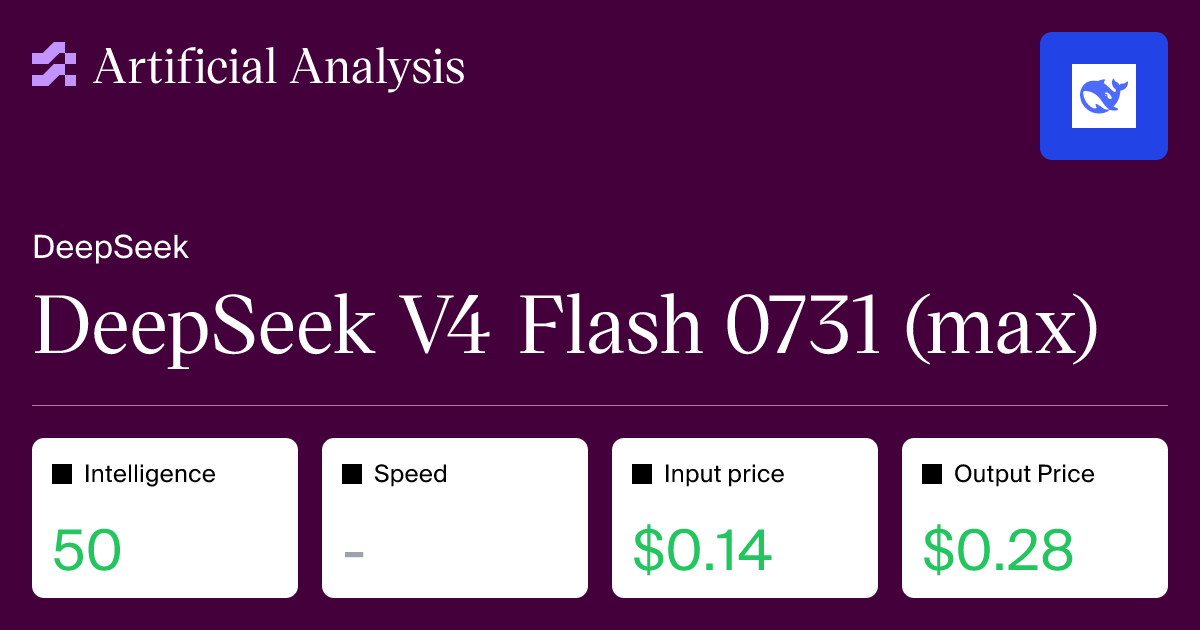
Aggregate independent evaluation ranks it higher. On the Artificial Analysis Intelligence Index, V4-Flash-0731 scores 50, third among 101 models, against a peer median of 25. Running the full evaluation suite cost $72.02.
Lined up against models in the same index band:
| Model | Input / 1M | Output / 1M | Weights |
|---|---|---|---|
| DeepSeek V4-Flash-0731 | $0.14 | $0.28 | MIT, open |
| GPT-5.6 Luna (July 30 cut) | $0.20 | $1.20 | Closed |
| Claude Opus 5 | $5.00 | $25.00 | Closed |
Cached input runs $0.0028 per million tokens, a 98% discount off list and the top spot in that category on Artificial Analysis. For a coding agent that re-reads the same codebase over and over, cached input is the line item that decides the invoice.
The two events landed within 24 hours of each other. On July 30, OpenAI cut GPT-5.6 Luna by 80%: input from $1.00 to $0.20 per million, output from $6.00 to $1.20. Terra got a 20% trim and the top-end Sol was left alone. OpenAI framed it as taking roughly a tenth off the cost of auto-approved bulk work. Even after that cut, DeepSeek's output price is a quarter of Luna's. Discounting only the budget tier while leaving the flagship untouched says something about where the price pressure is coming from, and it lines up with Chinese open-weight models taking a growing share of US enterprise token volume.
What the community pushed back on
Two Hacker News threads ran at once: 648 points on the release notes and 489 on the Artificial Analysis writeup.
Cost reports came with numbers attached. One user said they spent $4.55 over 30 days across 3,467 API requests and 323.18M tokens of coding work. Another argued that under-$10,000 hardware is enough to run it at home, and that open weights "don't vanish on a provider's whim." These are individual reports, not verified figures.
Local execution is possible because of how the weights ship. The Hugging Face model card shows the Instruct weights distributed with MoE experts in FP4 and the remaining parameters in FP8, so the 284B total is far smaller on disk than the parameter count implies. There are 117 quantized variants for llama.cpp, Ollama, LM Studio, and Jan, with the smallest working build landing around 81GB. The model card reports 2.92M downloads last month.
The objections:
- No multimodal. Text in, text out. Anything that requires reading a screenshot or judging a UI is out of scope.
- It talks a lot. The Artificial Analysis run consumed 210M output tokens, more than double the 100M peer median. Community testing puts it at roughly 3.6x the tokens Gemini Flash 3.6 uses on the same task. Cheap per token still means longer waits.
- Speed. Artificial Analysis could not measure output speed and left it as N/A. Reports via OpenRouter put it near 93 tokens per second, with pushback that Luna is two to five times faster per token. At maximum reasoning effort, one calculation puts cost per task around $0.03, which overlaps with Luna.
So the deciding factor is not the unit price but whether a human is sitting there waiting. For overnight batches, large refactors, and test generation you check in the morning, extra tokens still lose to the invoice. For work where you are watching the editor for a response, 93 tokens per second is something you feel. DeepSeek's own default of model_reasoning_effort = "high" assumes the former.
One practical thing changed with this release. Teams on Codex no longer have to switch tools to switch models. An open-weight model now sits in a competitor's agent config file, listed alongside the first-party providers.