Datasette Agent shows why narrow AI agents matter
Datasette Agent connects SQLite exploration with LLMs, plugin tools, permissions, and sandbox execution in a narrow but practical agent experiment.
- What happened: Datasette released the open source
Datasette Agentfor exploring SQLite data with an AI assistant.- Simon Willison described the May 21, 2026 release as the first alpha where Datasette and the
llmPython library are seriously joined together.
- Simon Willison described the May 21, 2026 release as the first alpha where Datasette and the
- Core design: Natural-language questions are mapped onto plugin tools for SQL, charts, image generation, background exploration, and sandboxed execution.
- Tool visibility is filtered through Datasette permissions, so an actor without access does not even expose that tool to the model.
- Why it matters: The agent race is moving from general-purpose assistants into narrower data workflows where permissions, provenance, and cost controls matter.
- Watch: This is still a
0.1a-series alpha, so production teams should inspect permissions, SQL review, usage limits, and sandbox boundaries separately.
Datasette Agent is not a giant model announcement. It is not a new frontier LLM, and it is not an enterprise control plane for every agent in a company. What Simon Willison and the Datasette team announced on May 21, 2026 is much smaller: an open source Datasette plugin that puts an LLM-powered agent inside a tool for exploring and publishing SQLite databases.
That small release is worth watching because it cuts against the dominant agent narrative. Much of the AI-agent market keeps reaching for the "do anything" assistant. Coding agents edit repositories. Browser agents operate websites. Enterprise agents cross CRM systems, email, documents, and payment flows. As the surface grows, so do the questions: which data did the agent see, which tools did it call, whose permission did it act under, and how far can the system roll back when something goes wrong?
Datasette Agent starts from the opposite direction. It narrows the domain to SQLite data exploration. The tools an agent can use are registered as Datasette plugins. Tool exposure is constrained by Datasette's existing permission model. The user asks in natural language, but underneath that chat are concrete software paths: SQL queries, chart rendering, background exploration, and sandboxed command execution. The important claim is not "a database now has a chat box." It is that a small data tool can show, in one place, the permission, plugin, cost, and execution boundaries that practical agents need.
Where Datasette meets LLMs
Datasette is a tool for exploring SQLite files on the web and publishing them as browsable data APIs. It has long appealed to data journalists, researchers, museums, local governments, scientists, and other teams that do not want to operate a large data platform but still need to inspect and share structured data. Its core workflow is direct: open a table, filter rows, run SQL, and share a link to the result.
Willison did not attach an LLM to that workflow overnight. First came llm, his Python library and CLI for working with many model providers through a plugin system. It gives local models and cloud models a shared command-line layer. Then came datasette-llm, followed by nearby plugins such as datasette-llm-limits for usage limits and datasette-llm-accountant for token accounting.
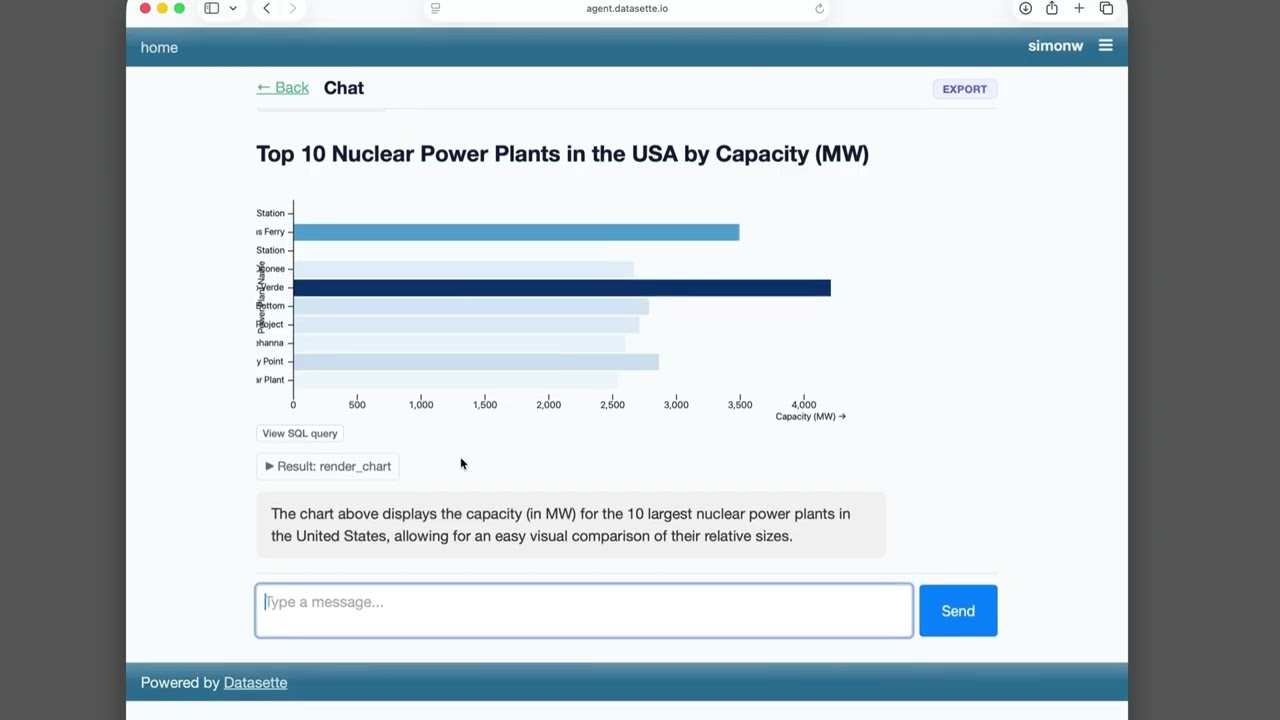
Datasette Agent is where those pieces meet inside the actual data-exploration UX. The official announcement frames it as the moment Datasette and LLM finally come together. A user opens an interactive assistant at /-/agent and asks questions about the database. The agent can inspect tables, describe schemas, run read-only SQL, and display results as tables or charts. From a database or table action menu, "Explore with AI agent" can also launch a background agent that examines the data and leaves a report behind.
The interesting part is that the design does not try to hide SQL completely. In the blog demo, a user asks when Simon most recently saw a pelican. The agent searches the blog_beat table for rows where beat_type = 'sighting' and the title or description contains pelican, sorted by recency. The final answer is natural language, but the SQL remains inspectable. The chart plugin was also improved to expose a "View SQL query" button. That small button matters in data agents. Before users decide whether they like an answer, they need to know which data was read and under what conditions.
Tool boundaries before model choice
Datasette Agent is not tied to one model. The announcement says it supports tool-calling models from frontier vendors such as OpenAI, Anthropic, and Google Gemini, as well as open-weight models that users run themselves. The blog examples include gpt-5.5, openai-codex/gpt-5.5 through Codex, and qwen3.5-9b served by LM Studio. The README configuration examples set a model through datasette-llm.default_model.
But the release is more about tool boundaries than model selection. The README describes three permissions registered by the plugin. datasette-agent controls access to the interactive assistant. datasette-agent-explore controls the database and table exploration menus and the exploration report routes. datasette-agent-background controls tools and APIs related to creating and checking background agents from chat. A root user may hold all of them, but ordinary actors can be granted only a subset.
The more important design appears in plugin tool permissions. Other Datasette plugins can register an AgentTool through the register_agent_tools hook. If a tool declares required_permission, the Datasette Agent harness checks whether the current actor has that permission before building the tool list. If the actor lacks access, that tool is not sent to the model at all. The model does not call the tool and receive "permission denied." It never sees the tool exists.
That is a practical security choice. Showing a dangerous tool description to an LLM and then saying "do not use this" leaves more room for prompt injection, model confusion, and accidental planning around unavailable capabilities. Reducing the tool surface before the model call is cleaner. In an application like Datasette, where data and permissions are already central, this feels natural. Before asking whether the model is smart, the product has to decide which data and which buttons the model can even see.
| Layer | Datasette Agent choice | What builders should inspect |
|---|---|---|
| Model | Multiple providers and local models through datasette-llm | Tool-calling quality, cost, and reasoning latency |
| Data access | Table descriptions and read-only SQL as the core path | SQL review, row-level access, and sensitive-column handling |
| Tool extension | register_agent_tools hook and AgentTool | Tool descriptions, input schemas, and side-effect scope |
| Permissions | Unavailable tools are not passed to the model | Actor-specific tool lists and audit logs |
| Execution | Command execution via the Fly Sprites sandbox plugin | Sandbox isolation, networking, files, and usage limits |
The plugin ecosystem becomes the agent body
Datasette has always leaned on plugins, and Datasette Agent follows the same route. The first release points to three companion plugins. datasette-agent-charts renders SQL results as Observable Plot charts. datasette-agent-openai-imagegen uses ChatGPT Images 2.0 to generate images. datasette-agent-sprites lets the agent execute commands in a Fly Sprites persistent sandbox.
That mix may look odd at first. Why should a SQLite data assistant need image generation or command execution? From an agent-product perspective, it is understandable. Data exploration rarely ends with reading a SELECT result. Users want to visualize findings, draft reports, run small transformations, and sometimes produce external artifacts. Until now, they moved manually between SQL, Python, chart libraries, and hosting environments. Datasette Agent tries to fold part of that loop into conversational tool calls.
The risk grows with the capability. An agent that only runs read-only SQL and an agent that can execute sandboxed commands have very different security surfaces. Image generation introduces cost and content-policy concerns. Background agents continue work after a user leaves the chat, so they need stop controls, status checks, permission separation, and usage limits. That is why the early emphasis on separate permissions and tool gates is not just implementation detail. It is the product boundary.
Good tool design for agents is not simply "make the agent do more." Builders need to decide which actor sees which tool, what input schema the tool accepts, how model-visible results differ from user-rendered HTML, and where to stop tools with side effects. Datasette Agent's handling of _html sits in this same category. Plugin tools can render rich HTML in the chat UI, but top-level keys beginning with _ are removed from the result that goes back into the model context. That small convention separates what the user sees from what the model reasons over.
Why SQLite is the right small surface
When teams talk about AI agents and databases, the obvious references are usually Snowflake, BigQuery, Databricks, Postgres, enterprise semantic layers, and BI assistants. SQLite can look too small. But that is exactly why it is a useful surface for agent UX.
SQLite datasets are files. They are easy to copy, easy to run locally, and relatively contained when something fails. Datasette already turns public datasets into browsable websites with linkable SQL results. Adding an agent exposes the core questions of "AI that reads a database" without needing a large warehouse rollout. How should schemas be explained? Which SQL did a natural-language question produce? How does a user validate the result? How does a chart or report preserve the query that produced it?
Large BI systems are solving related problems, but Datasette Agent starts from a more developer-friendly and file-friendly place. It can run with commands such as uvx --with datasette-agent datasette ..., install through datasette install datasette-agent, and accept new tools through plugin hooks. It keeps the lightweight feel that makes Datasette useful for small data apps.
That fits a broader AI-development pattern. Stronger models do not mean every useful agent must live inside a giant SaaS suite. Sometimes a small, clear tool makes a better agent surface. SQLite is not a universal data warehouse, but it is excellent for reproducible data files and local experiments. Datasette is not an enterprise dashboard platform, but it is strong at quickly opening and sharing structured data. Datasette Agent asks how useful a small agent can become when it sits on top of those strengths.
Cost and abuse controls are part of the product
The official demo is available at agent.datasette.io, but it requires GitHub login. The announcement cites abuse prevention. That may sound like operational housekeeping, but for AI features it is part of the product. LLM calls cost money. Tool calling consumes system resources. Sandbox execution can be abused. Even a public demo needs authentication and limits.
Recent Datasette LLM plugins point directly at that problem. datasette-llm-limits configures periodic usage limits. datasette-llm-accountant tracks LLM token usage for accounting. Datasette Agent itself does not mean the whole governance story is finished. It does show that when an agent is added to a data app, "does the model answer well?" sits beside equally important questions: who used it, how much did they use, which tools could they call, and how can a long background job be stopped?
Data exploration rarely ends after one prompt. Users revise the question, change the sort, adjust the grouping, and ask for charts. The agent may run several SQL queries. If results are large, it may summarize them or pass only part of them back into the model. Cost and accuracy become tangled. Passing too many rows to the model is expensive and risky. Passing too few can make the answer wrong. Products need designs that can show SQL results to users while giving the model a smaller, safer context.
That is why the alpha label matters. At the time of the Korean source article, PyPI listed datasette-agent as 0.1a4, datasette-agent-charts as 0.1a2, and datasette-agent-sprites as 0.1a0. The GitHub repository was also small, with datasette/datasette-agent at 48 stars and 3 forks. Those numbers do not make it insignificant. They make it an early design experiment with room to move quickly.
The community signal is small but clear
The Hacker News item "Show HN: Datasette Agent" appeared on May 21 and, at the time checked for the original article, had 5 points and one comment. The comment was Willison pointing to the live demo and code links. That is not a broad market reaction. But Datasette Agent is an alpha plugin aimed first at Datasette users and data-tool builders, not a mass-market AI app.
The more important signal is the language of the release. Many AI-agent products say they will do all work for the user. Datasette Agent uses a narrower vocabulary: inside this database, with this tool list, under this actor's permissions, this SQL was executed. That is often easier for developers to reason about. A wider agent can make a better demo, but it also expands the system's accountability. A narrower agent may feel less magical, but validation and permission management become more tractable.
Its competition is not only other text-to-SQL tools. Hex, Observable, Streamlit-based data apps, BI assistants, warehouse semantic layers, MCP servers, and LangChain or LlamaIndex internal data agents all touch nearby territory. Datasette Agent's differentiator is that it works inside an existing open source data tool. Data publishing, SQL links, plugin hooks, and a permission model already exist. The agent is added on top of that foundation instead of inventing the whole environment from scratch.
Questions builders should take from it
Even if a team never adopts Datasette Agent, the release raises useful product questions.
First, is the agent narrow enough? "Analyze all our data" is a tempting promise, but "use these tables and these tools to produce this report" is often safer and more useful.
Second, is tool permission reduced before the model call? Showing unauthorized tools to a model and denying them later increases the surface for prompt injection and confused plans. Building the tool list from actor permissions shrinks the space the model has to reason over.
Third, does the product show provenance? A data agent's answer should not end as polished prose alone. Users need the SQL, the rows, and the chart query behind the conclusion. A "View SQL query" button is not decorative. It is a baseline requirement for data AI.
Fourth, are plugins with cost and side effects governed separately? Chart rendering is close to a read operation. Image generation creates cost and policy questions. Sandbox command execution creates a security boundary. They may appear in the same agent UI, but they need different permissions and audit paths.
Fifth, can the team swap local and cloud models? Datasette Agent routes models through datasette-llm. In real systems, teams will want different models depending on data sensitivity, cost, latency, and tool-calling quality. Hardwiring model choice too deeply into code and policy makes long-term operation harder.
Narrow agents may last longer
Datasette Agent will probably not be remembered as the largest agent announcement of 2026. It is not a keynote feature from a hyperscaler, and it is not shipping immediately to hundreds of millions of users. But it is a useful counterexample. To become practical software, agents do not always need to get broader. Sometimes they need to get narrower.
Exploring a SQLite dataset sounds small enough. Yet inside that small job are model choice, SQL generation, result validation, chart rendering, background work, sandbox execution, user permissions, usage limits, and abuse prevention. It is a compressed version of the same problems general-purpose agents face. Datasette Agent is an experiment in handling that compressed problem inside an open source plugin ecosystem.
For AI builders, the lesson is direct. Agent value is not determined only by model generality. It increasingly depends on the tool the agent enters, the permission model it follows, the evidence it shows users, and the plugin boundaries through which it expands. Datasette's path is narrow, but that narrowness makes it instructive. Agents become products when they have good tool surfaces, not just magical answers.
Sources: Datasette official announcement, Simon Willison's post, Datasette Agent GitHub repository, PyPI datasette-agent, HN Show HN item.