CoreWeave turns agent training and inference into one loop
CoreWeave’s new W&B-integrated agentic AI platform ties Serverless RL, inference, Weave observability, Skills, and MCP into one operations loop.
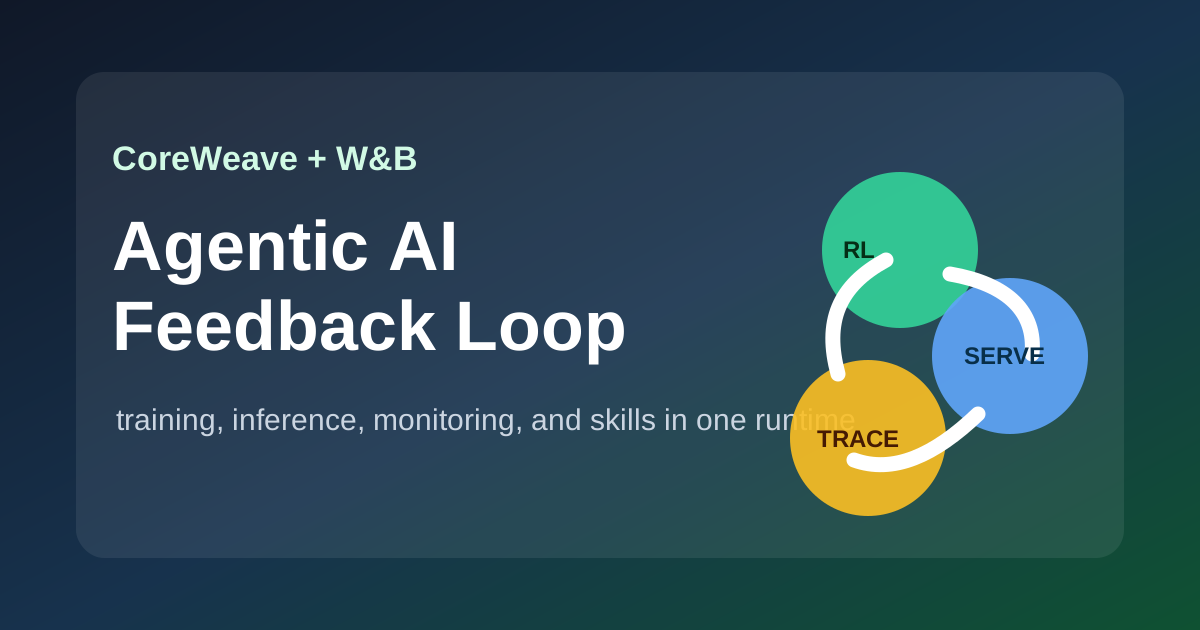
- What happened: CoreWeave announced an agentic AI platform integrated with W&B on May 28, 2026.
- The stack combines
Serverless RL, CoreWeave Inference, W&B Weave observability and evaluation, W&B Skills, and W&B MCP.
- The stack combines
- Why it matters: A GPU cloud provider is packaging the agent improvement loop, not just model hosting or raw accelerator capacity.
- Watch: CoreWeave described the integration path, but pricing, SLAs, data-retention terms, and real RL operating costs still need project-level validation.
- Agent teams should calculate cost per completed episode, not only token price or benchmark score.
CoreWeave announced an agentic AI platform through its investor site and product pages on May 28, 2026. The company framed the release around "closing the training-to-inference gap" for autonomous agent improvement. The platform brings CoreWeave AI Cloud inference, Serverless RL, W&B Weave, W&B Models, W&B Skills, and W&B MCP into a single product story. The news is less about a faster instance type and more about a GPU cloud provider selling the operational path from failed agent execution back into evaluation and reinforcement learning.
This is CoreWeave's first broad integrated agent message after acquiring W&B. W&B is best known for experiment tracking and model evaluation, while CoreWeave built its business around large-scale NVIDIA GPU infrastructure. The obvious post-acquisition pitch would have been "train with W&B, deploy on CoreWeave." This announcement is narrower and more specific. The target is not every ML pipeline; it is the autonomous agent with long execution paths, tool calls, approvals, retries, and production traces.

The separation between training and inference becomes a cost problem as soon as an agent leaves a demo. A chatbot can often be compared by looking at a single response. A coding agent, data-analysis agent, or operations agent is different. One natural-language request may trigger search, code execution, API calls, permission checks, retries, and failure handling. The user's sense of success depends on the whole episode: cost, latency, error recovery, auditability, and whether the task was actually completed.
CoreWeave is trying to own that full execution path. The first component in the announcement is Serverless RL. CoreWeave's documentation describes Serverless RL as a way to run reinforcement-learning workloads built on Ray and Kubernetes without managing a long-lived cluster directly. Developers define RL work and receive the GPU resources needed to run it. For agent systems, the bottleneck is often the manual path between inference logs and training jobs: converting real executions into reward signals, evaluation cases, or regression sets.
The second component is CoreWeave Inference. CoreWeave's inference docs emphasize OpenAI-compatible endpoints, a model catalog, Bring Your Own Weights deployments, traffic splitting, autoscaling, and budget alerts. BYOW matters for teams that operate fine-tuned or open-weight models rather than calling only a hosted frontier API. In agent products, the practical comparison is rarely just the average benchmark score of model A versus model B. The more expensive question is which version completes the actual workflow with fewer tool calls, lower failure rates, and less human repair.
Real agent execution: prompt, tool calls, approvals, failure logs
W&B Weave: traces, monitoring, human annotation, online evaluation
Evaluation sets and reward signals: success and failure criteria fixed as data
CoreWeave Serverless RL and inference deployment: validate new policies and models on limited traffic
The third component is W&B Weave. W&B's Weave documentation covers tracing, evaluation, production monitoring, and human annotation for LLM applications. Its production-monitoring docs describe tracking latency, cost, feedback, custom metrics, and online evaluations on real traffic. That maps directly to problems agent teams already face. A test dataset may show a high pass rate, while production runs fail because of internal API latency, permission errors, malformed tool schemas, or a user refusing an approval step.
W&B MCP and W&B Skills point in the same direction. The W&B MCP page says the server lets an LLM query W&B experiments, models, artifacts, and evaluation information as tools. That gives an agent a direct path to metadata it may need when evaluating its own runs or selecting the next experiment. W&B Skills are described as packaged domain tasks that an LLM can perform. The product language is not just "save a prompt." It is an attempt to wrap recurring work into executable units.
The precise infrastructure shift is that CoreWeave is expanding the commercial unit from GPU time to an improvable agent operations loop. Older cloud comparisons could stop at H100 availability, network bandwidth, hourly price, and reservation terms. Agent services add trace retention, evaluation automation, replay, traffic splitting, failure sampling, and human-annotation cost. The infrastructure decision starts to include whether the product can reduce a repeated agent mistake after it appears in production.
| Component | Role in the announcement | Question for development teams |
|---|---|---|
| CoreWeave Inference | OpenAI-compatible endpoint, BYOW, autoscaling, traffic splitting | Can model-version cost and failure rate be compared against the same trace? |
| Serverless RL | Separates reinforcement-learning jobs from direct GPU-cluster management | Is the path from production logs to rewards and eval sets actually automated? |
| W&B Weave | Traces, monitoring, annotation, online evaluation | Do tool calls, approval denials, and retries remain part of the evaluation record? |
| W&B MCP and Skills | Connect experiment, model, and evaluation knowledge to LLM tools and task units | Do permissions, audit logs, and team-level access controls satisfy product requirements? |
AWS, Google, and Microsoft are also trying to capture agent operations at the infrastructure layer. AWS has pushed Bedrock AgentCore components such as browser use, code execution, memory, and gateways. Google links models and workflows through Vertex AI Agent Engine, Gemini Enterprise, and Antigravity-related developer tools. Microsoft connects Azure AI Foundry, GitHub Copilot, and agent-development surfaces in the same ecosystem. CoreWeave's differentiator is its starting point as a GPU-specialized cloud provider and its ownership of W&B as an experiment and evaluation platform.
That difference creates both leverage and constraints. The leverage is clearest when the cost center of agent improvement is GPU training and GPU inference. A team running its own weights, switching inference endpoints, and evaluating traces in one place can understand the W&B integration quickly. The constraint appears when an enterprise agent starts touching Salesforce, ServiceNow, Jira, internal databases, and private approval systems. IAM, data governance, corporate approval policy, and audit responsibility do not disappear just because the GPU path is cleaner.
For developers, the immediate change is not just one more inference API option. Operating an agent product requires at least four logs. The first is the input and output. The second is the intermediate tool calls and failure causes. The third is user approval, rejection, correction, or feedback. The fourth is deployed model version and cost. CoreWeave and W&B are saying those signals belong in one improvement loop. Adoption should start by checking whether that loop meets the project's security requirements and data-retention policy.
Some parts of the announcement remain unquantified. CoreWeave described the platform direction and components, but it did not publish one universal price sheet for every part of the integrated loop. Serverless RL cost will depend on GPU type, episode length, rollout count, reward-model use, and checkpoint storage. Weave observability cost will depend on trace volume, annotation volume, and retention policy. "Closing the training-to-inference gap" is a compelling product phrase, but procurement has to calculate the cost per completed episode, not only the average token price or one-off task success rate.
W&B MCP also creates a security tradeoff. If an MCP server exposes experiments, artifacts, and evaluation data as LLM tools, an agent can retrieve experimental context quickly. It also creates a new access path to internal model records, failure logs, and traces that may include customer data. Teams need to inspect MCP tool scope, read-only permissions, project-level access controls, and the amount of context sent to external models. When an agent places sensitive artifact names or evaluation samples into a prompt "to choose the next experiment," the observability layer has become part of the execution authority.
The first metric product teams should watch is regression prevention, not a benchmark score. If a customer-support agent applies the wrong refund policy, the operating loop should collect the trace, label the failure, promote it into a new evaluation case, and deploy the revised prompt or model to limited traffic. If that process is scattered across Jira tickets, spreadsheets, and manual log exports, the improvement cycle slows down. CoreWeave's training-to-inference gap is that manual path. The practical value of the announcement depends on how much of that path the combined platform removes.
Two screening questions matter before a team experiments with this stack. First, does the product have a reason to operate custom or open-weight models? Teams that only call OpenAI, Anthropic, or Google APIs may not feel the full benefit of CoreWeave GPU inference and Serverless RL. Second, does the product generate enough agent failure data? For an internal assistant with a few dozen daily tasks, prompt cleanup, tool-schema fixes, and approval UX may be cheaper than a full RL loop. For coding, analysis, support, or operations agents that run thousands of episodes, trace-based evaluation and limited rollout controls can change the cost curve.
CoreWeave did not announce a larger foundation model, a new benchmark leader, or a single model name. It asked a more operational question: after a model fails inside a real service, what data path and execution path are used to prevent the same failure from recurring? As agent AI moves from demos into production, that question becomes more common. A month of failure logs, cost records, approval history, and model-version changes can matter more than one polished answer.
The useful way to read the release is to follow the loop. CoreWeave Inference executes the workload. Weave observes it. W&B MCP and Skills expose experiment knowledge and task units. Serverless RL runs the improvement job. Each piece already has competition: LangSmith, Braintrust, Arize Phoenix, hyperscaler agent platforms, and self-managed Ray clusters are all plausible alternatives. CoreWeave's problem is not whether the feature list is long enough. It is whether these components remain connected when real production data, permissions, and cost constraints enter the system.
Agent infrastructure competition in 2026 is narrowing from "where do we send the model API call?" to "where do failures live, and how are they fixed?" CoreWeave's announcement is a statement that a GPU supplier can acquire observability and evaluation tooling and turn that into an agent operations platform. Development teams should not accept the product phrase at face value. They should put episode cost, failure labeling, MCP permissions, traffic-splitting criteria, and data-retention policy on the checklist, then test whether training and inference are truly operating as one loop.