When 65% of Teams Treat the IDE as Optional
Gartner and OpenAI show enterprise coding agents shifting from model benchmarks toward governance, cost control, and deployment architecture.
- What happened: Gartner formalized the expansion and competitive realignment of the
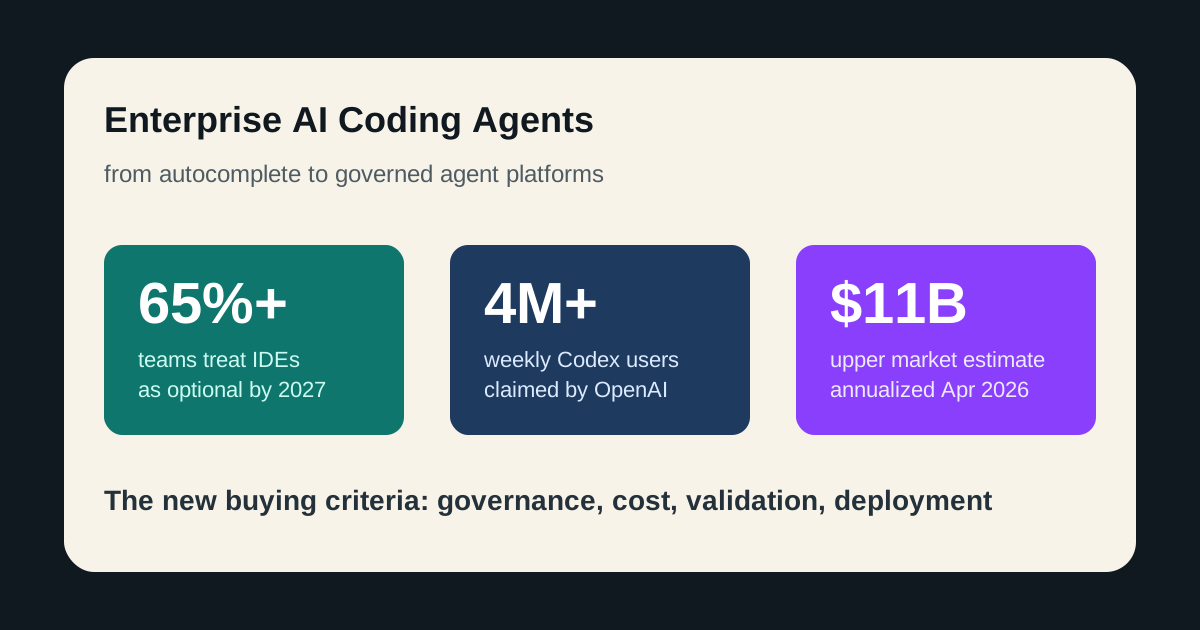
Enterprise AI Coding Agentsmarket.- OpenAI then said Codex was recognized as a Leader in that Magic Quadrant and is used by more than 4 million people weekly.
- Key number: Gartner expects more than 65% of agentic coding teams to treat the IDE as optional by 2027.
- Why it matters: The buying criteria are moving from raw model quality toward governance, cost, verification, and deployment control.
- Coding agents are becoming SDLC operating platforms, not just helpful features inside an editor.
- Watch: A Magic Quadrant is a purchasing reference, not an absolute product benchmark.
OpenAI announced on May 22, 2026 that Codex had been named a Leader in Gartner's Magic Quadrant for Enterprise AI Coding Agents. On the surface, that can look like vendor news: a company highlighting a favorable analyst report. But when you read it together with Gartner's market framing from the same week, the bigger signal is harder to miss. Enterprise AI coding agents are solidifying into a buying category of their own. More precisely, a market once described as "tools that write code well" is becoming a market about where development work runs, which permissions agents receive, how much they cost, and how their output is verified.
Gartner said on May 20, 2026 that the enterprise AI coding agent market had entered a new phase of expansion and competitive realignment. Its sharpest prediction is that by 2027, more than 65% of engineering teams using agentic coding will treat the IDE as optional, with control, governance, and verification moving into automated platforms. That does not mean editors disappear. Developers will still need places to read, modify, and debug code. The change is about the center of gravity. Work is moving away from "I write every line in my editor" and toward "I review and approve changes that multiple agents prepared in the background."
OpenAI's announcement points in the same direction. The company said Codex is used by more than 4 million people weekly and named enterprise users including Cisco, Datadog, Dell Technologies, and NVIDIA. It also described Codex as a system for understanding large codebases, using tools, preparing changes, running tests, and packaging work for human review. In isolation, that sounds like familiar product positioning. Put next to Gartner's market frame, it becomes more specific. The coding agent race is no longer settled by model benchmarks alone. Enterprises are starting to ask where the agent is sandboxed, whether approvals are enforced, whether RBAC and audit logs exist, whether usage costs can be predicted, and whether the product can run near hybrid or on-premises systems.
Gartner Is Describing the End of Autocomplete as the Main Story
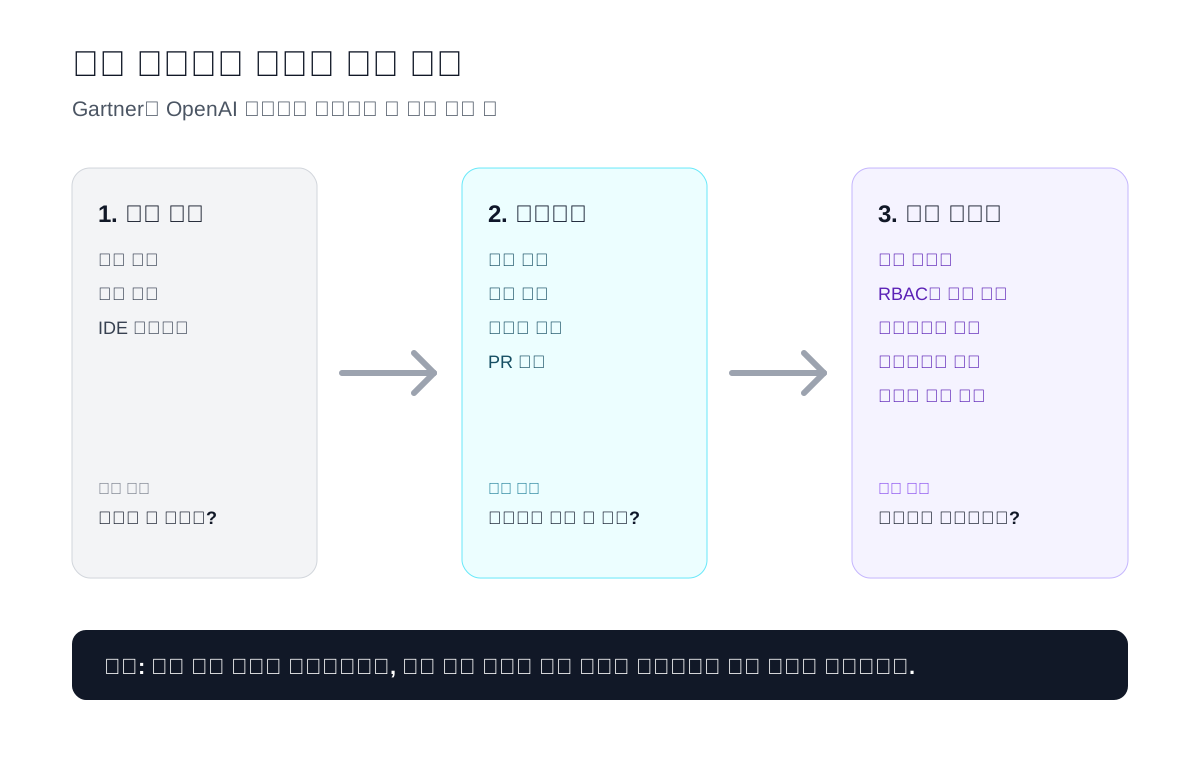
Gartner's language places the market on a path from AI-assisted development to agentic software development. Code completion and chat-based explanations still matter, but they are no longer enough to define an enterprise product. Gartner describes a category that spans planning, generation, and code review across the software development lifecycle. Its market guide places code completion tools, AI-native IDEs, terminal agents, and agentic platforms in the same competitive landscape.
That distinction has practical consequences for developers. The old questions were familiar: Does this model write TypeScript well? Can it fix tests? Does it understand my framework? Now another question joins the list: What gets recorded when the agent fails? Teams need to know which commands were run, which files were read, which permissions were used for external tools, when a human approved a risky step, and which project or team owns the resulting spend.
This matters because agents are spending more time outside the developer's direct hands. A short code completion has a small blast radius. If the suggestion is wrong, you ignore it. But when a background agent reads an issue, creates a branch, runs tests, updates documentation, opens a pull request, and drafts release notes, the unit of failure is larger. It is not one bad line. It is a whole task. Enterprise buyers therefore look beyond model intelligence and inspect the operating controls around the agent.
That is also why Gartner's emphasis on product maturity, commercial maturity, governance, pricing, workflow fit, support, and market viability is not dry analyst vocabulary. Those words become real bottlenecks when a team moves from occasional experimentation to organization-wide deployment. An agent used once a day as a personal tool is different from an agent with repository access, CI access, secrets, network calls, and enough autonomy to run for hours.
OpenAI's Signal Is Less About Rank Than Deployment Surface
OpenAI said Codex was recognized as a Leader in Gartner's report. The more interesting part is what OpenAI chose to present as strength. The announcement points to agentic software development, enterprise governance, sandboxing, and flexible deployment options. It also emphasizes a broad developer surface: the Codex app, IDE extensions, CLI, SDKs, and cloud-based orchestration. Approval gates, RBAC, custom policies, OS-level sandboxing, and auditable workspace governance sit in the same list.
That list connects to OpenAI's recent Codex updates. On May 14, 2026, OpenAI previewed Codex in the ChatGPT mobile app. Users can see active threads, inspect output, review diffs and test results, and approve or redirect work from mobile. In the same update, Remote SSH became generally available, hooks became generally available, scoped programmatic access tokens were added for CI and internal automation, and HIPAA-compliant local use became available for some Enterprise workspaces.
Those features look scattered if you read them as separate product bullets. Mobile, SSH, hooks, tokens, and HIPAA appear to solve different problems. Together, they describe one direction. If Codex is to become an execution layer for organizational work rather than a local developer helper, humans must be able to intervene from different surfaces, agents must run only in approved environments, and automation must operate through scoped tokens and policies. OpenAI's Gartner announcement is therefore not just a medal. It is a message that the company wants to be seen as an enterprise agent operations vendor, not only a model provider.
OpenAI and Dell's May 18, 2026 collaboration announcement fits the same pattern. OpenAI described connecting Codex with hybrid and on-premises environments such as Dell AI Data Platform and Dell AI Factory. The pitch is not that all enterprise work moves into a new cloud editor. It is that Codex can be deployed closer to the data, systems, and workflows enterprises already run. In that announcement, OpenAI said Codex is used for code review, test coverage, incident response, and reasoning across large repositories, but also for non-development workflows such as product feedback routing, report preparation, and follow-up writing.
That point connects to devlery's recent coverage of why Codex is moving beyond coding. The focus here is narrower: broader usage changes enterprise buying criteria. Once a coding agent touches documents, data, security workflows, customer conversations, and internal reporting, the security team, legal team, and platform team join the table. At that moment, tool selection stops being only a developer preference.
The 4 Million User Number Matters Less Than Workflow Density
OpenAI says Codex has more than 4 million weekly users. That is a large number, but it does not tell us enough by itself. Weekly usage can include lightweight experiments and deep task delegation in the same bucket. The more important questions are how many threads each user runs, how often work runs in parallel, how failed tasks are recovered, and whether human-reviewed changes actually reach production.
Gartner's emphasis on cost and ROI follows from that difference. Enterprise AI coding agents are harder to price and manage than simple seat-based SaaS. When agents run in the background, split work into parallel tasks, repeat tests, open browsers, and call external tools, the consumption profile changes. Gartner's market guide warns that usage-based pricing can increase cost variability, while parallel execution and background processing can increase consumption. The central issue is not whether productivity gains exist. It is how efficiently a team can turn those gains into reliable output.
For engineering teams, this becomes an operating model question. Can anyone start a long-running agent session? Does each repository have a budget? How many automatic retries are allowed after a failing test? Which external API keys can be injected, and at what scope? What labels and review rules apply to agent-created pull requests? Are failed agent sessions later reused as evaluation data or training material for internal practices? Without answers, agent adoption can create a productivity bump at first and then reappear as a cost and trust problem.
The definition of developer experience changes here. In the autocomplete era, good DX meant fast suggestions, natural chat, and accurate code. In the agent era, visibility and control are also DX. Developers need to see where the agent is stuck, redirect it mid-task, block risky commands before approval, and inspect diffs and test output even when they are away from the desk. The developer becomes less like a prompt writer and more like a task supervisor and verifier.
Vertical Integration Meets Model-Neutral Platforms
Gartner also points to a structural change: frontier model providers are now competing directly with application-layer vendors. That sentence puts OpenAI, GitHub, Anthropic, Google, Cursor, JetBrains, Coder, and others on the same map. Model providers no longer sell only APIs. They bundle apps, CLIs, IDE extensions, cloud execution, mobile approval surfaces, and enterprise policy controls. Application-layer tools respond by emphasizing model choice and workflow integration.
Both approaches have real advantages. A vertically integrated product can optimize the model and agent experience together. One company can tune for tool-call patterns, sandbox constraints, approval UI, and task orchestration. A model-neutral platform can reduce vendor lock-in and make it easier to switch models by team, task type, or cost profile. In a market where model prices and capabilities change quickly, that flexibility matters.
Gartner's point is that the balance remains unsettled. If frontier model performance keeps climbing quickly, integrated products may keep an advantage. If cheaper models become good enough for many everyday engineering tasks, differentiation may move toward workflow orchestration, enterprise controls, and developer experience. That matters in practice. Whether a company chooses Codex, Copilot, Claude Code, Cursor, an internal platform, or a mix, the evaluation should include switching costs and operational control, not only a leaderboard.
Individual developers face the smaller version of the same tradeoff. If one agent accumulates all task history, prompt habits, repository memory, hooks, and approval policies, switching becomes harder. If a team changes tools and models constantly, it becomes difficult to build a shared operating standard. That tension will likely intensify as agents gain more context and more permissions. Tool selection starts to look like choosing a work operating system.
What "The IDE Is Optional" Actually Means
The 65% figure is strong, and that makes it easy to misread. Gartner is not saying developers will abandon editors. IDEs are likely to remain essential. The point is that the IDE may no longer be the starting point and ending point of every development action. A developer might launch an agent session directly from an issue, approve a diff from mobile, let tests run on a remote devbox, have a cloud agent open a pull request, and review the result in GitHub or Slack.
In that workflow, task decomposition becomes more important than manual code writing. A good request is not merely "fix this function." It is closer to: reproduce this bug, add a failing test, make the smallest passing change, avoid risky migrations, and explain the reasoning in the pull request. A good review is not only reading the resulting code. It also checks which evidence the agent used, which tests were actually run, and which commands required approval.
This is not the same as saying junior developers disappear. The more realistic shift is that teams need people who can define work clearly, verify agent-generated changes, and explain system boundaries. The amount of time spent typing code may decline, but responsibility for the code does not vanish. Agent-written code still becomes product outages, security vulnerabilities, maintenance debt, or reliable shipped software.
The Practical Checklist for Engineering Teams
For startups and enterprise engineering teams, this news is less "use Codex" and more "rewrite the adoption checklist for coding agents." The old checklist covered model quality, IDE support, price, and security terms. The new checklist needs to be more concrete.
First, inspect the execution environment. Does the agent run only locally, in a cloud sandbox, or against an internal remote devbox? Can it operate near private networks or hybrid infrastructure when needed? Second, define permission boundaries. File system access, network access, secrets, deployment commands, and database access should all have clear approval paths. Third, require auditability. The team should be able to trace changes, execution logs, approvals, and cost records after the fact.
Fourth, model the cost. A seat price is not enough if the real workflow uses parallel agents, background processing, repeated test runs, and browser automation. Fifth, build an evaluation loop. More pull requests are not automatically success. Teams need to see whether review latency falls, incidents stay under control, test coverage remains stable, repetitive work shrinks, and developers spend more time on design and verification.
Gartner's reported productivity numbers are encouraging, but they are not portable guarantees. A team with strong test suites, clear ownership, and disciplined review may gain more than a team with fragile CI and ambiguous boundaries. Coding agents amplify workflow quality. They do not magically repair the absence of one.
The Remaining Question Is Responsibility, Not Capability
The most practical conclusion is that responsibility becomes clearer as coding agents mature. Smarter models can take on more work. The more work they take on, the larger the cost of failure. That is why the market is moving toward sandboxes, approval gates, policies, audit logs, hybrid deployment, and cost control.
OpenAI's Codex Leader announcement is good news for OpenAI. The more important news for builders is that Gartner is now treating enterprise AI coding agents as a distinct category. Coding agents are becoming engineering operations infrastructure, not just preference-driven developer tools. IDEs still matter, but the orchestration surface outside the IDE is becoming more important.
The next year of competition is unlikely to be explained only by who scores a few more points on SWE-bench. The better questions are operational. Who can safely parallelize more work? Who can make costs predictable? Who can move close to enterprise data and development environments? Who can reproduce and verify failed agent work? The company that answers those questions may win a platform role, not merely a coding tool slot.