The 41-Commit Illusion: Claude Code and the Developer Frontier
A new arXiv paper finds broader language and repository activity after Claude Code adoption, but the causal story is still unresolved.
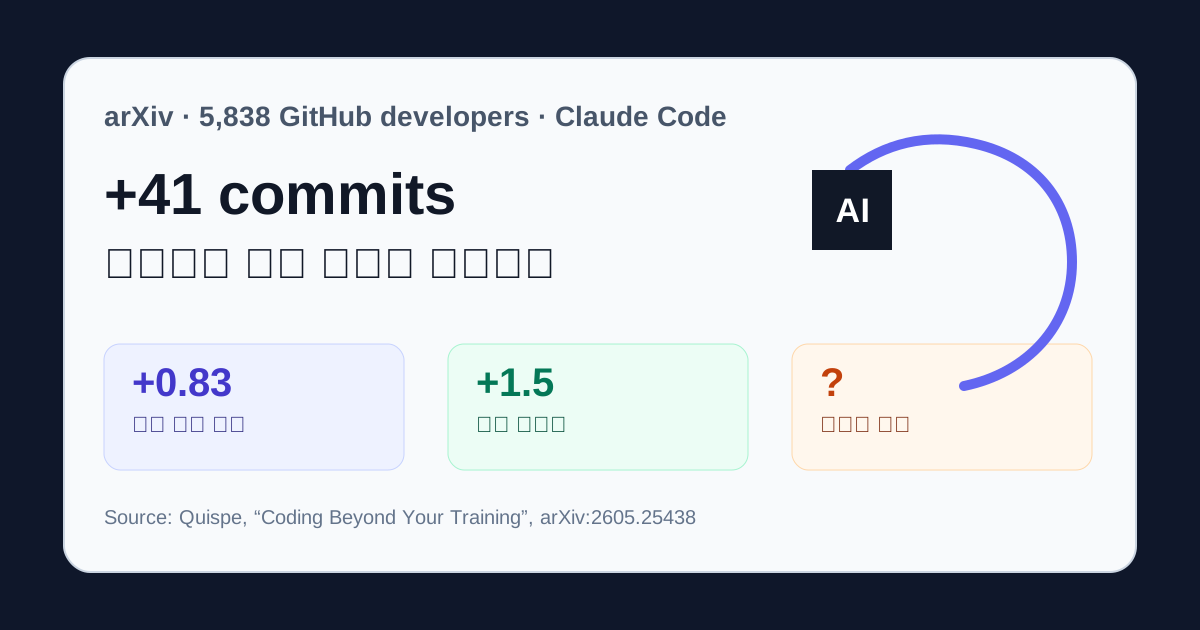
- What happened: a new arXiv paper analyzes 28 months of public GitHub activity from 5,838 developers who adopted
Claude Code.- Around the adoption month, the paper reports roughly +41 monthly commits, +1.5 repositories, and +0.83 programming languages.
- Why it matters: the signal is not only about faster coding. It suggests coding agents may expand the set of languages and repositories developers are willing to touch.
- Watch: the paper does not prove causality. Developers may have turned on Claude Code because they were already moving into unfamiliar projects.
- The safest reading is a large behavioral shift around adoption, not proof that Claude Code alone created the shift.
- Team impact: lower language-entry costs make review, testing, ownership, and long-term maintenance more important rather than less important.
A paper posted to arXiv on May 25, 2026 changes the question around AI coding agents in a useful way. The title is Coding Beyond Your Training: Claude Code and the Technological Frontier of Software Developers. Written by Alexander Quispe of Caltech, the preliminary paper does not simply ask whether AI coding tools make developers faster. It asks whether they expand the technological frontier of what developers appear willing to work on.
The headline numbers are large. Using public GitHub data, the paper tracks 5,838 developers who adopted Claude Code and compares activity around the month when a developer first produced a Co-Authored-By: Claude commit. In the main estimates, monthly commits rise by about 40.7, contributed repositories by 1.5, monthly programming languages by 0.83, and newly used languages by 0.31. In the paper's framing, AI appears to move the developer's "technological frontier."
But those numbers should not be read as "Claude Code made developers 191% more productive." The paper is more careful than that. Claude Code adoption was not randomly assigned. A developer may have started a new job, taken on a new client, opened a side project in Rust or Swift, and then adopted Claude Code precisely because the new work was unfamiliar. In that case, the observed language expansion would not be purely caused by Claude. It would partly reflect the shadow of a project decision that the data cannot directly observe. The interesting part of this paper is exactly that tension: the behavioral signal is clear, and the causal gap is clear too.
Why the frontier matters more than speed
The first wave of AI coding-tool debate was built around speed. GitHub Copilot experiments asked how much task completion time fell. Corporate field studies tried to measure developer productivity gains. Studies such as METR's 2025 work with experienced open-source developers complicated that story by showing that real expert workflows can fail to receive the speedup people expect. At this point, "does AI make coding faster?" depends heavily on the tool, task, user, workflow, and evaluation method.
This paper looks along a different axis. Why does a strong Python developer hesitate to write production Rust? Why does a data scientist comfortable in R and SQL not suddenly ship an iOS Swift app? General problem-solving skill transfers, but each language and ecosystem carries grammar, build tools, package norms, debugging instincts, deployment paths, and social expectations. A developer's technical portfolio is sticky because those frictions are real.
The paper's model is intentionally simple. Developers are more confident about languages where they know their own productivity, and less confident about unfamiliar languages. Risk-averse developers avoid moving into high-uncertainty languages. AI coding tools can act as a free signal channel about unfamiliar technology. A Python developer can ask for Rust examples, Swift build-error explanations, Go project structure, or TypeScript type patterns before becoming deeply fluent. The tool lowers the cost of the first move.
That lens changes how the coding-agent market looks. Autocomplete products competed on how well they predicted the next line. Agents compete on how safely they can help users enter environments they do not fully know yet. Cursor, Claude Code, Codex, Copilot coding agent, Jules, and similar tools are not only code generators. They are becoming brokers that reduce the switching cost between languages, repositories, and toolchains.
What the paper actually measured
The paper searches public GitHub event streams for Claude co-author trailers. According to the PDF, it detects 7,786,771 Claude co-authored commits and 185,517 authors from January 2025 through January 2026. The final analysis sample is narrower: developers who adopted in Q2-Q3 2025 are compared with developers who adopted later in Q4 2025-Q1 2026. The resulting panel contains 5,838 developers observed monthly from January 2024 through April 2026, or 28 months.
The treatment month is the month of a developer's first Claude co-authored commit. The comparison group is not "people who never use AI coding tools." It is developers who have not adopted Claude Code yet but will adopt later. That choice matters. Comparing early adopters to people with no interest in AI coding tools would blend the tool effect with differences in taste, job type, public activity, and willingness to experiment. Future adopters are an imperfect comparison group, but they at least share some propensity to use the tool.
The outcomes are also broader than raw commit count. The paper tracks monthly commits, monthly contributed repositories, the number of primary languages used in a month, Shannon entropy of the language distribution, newly used languages in that month, and cumulative lifetime languages. In other words, the study is not just asking whether more commits appear. It asks whether developers place their feet in more repositories, across more languages, with more diverse language mixes, and with more first-time language usage.
The results point in one direction. In the main sample, adoption-month estimates are +40.708 monthly commits, +1.497 repositories, +0.830 languages, +0.138 language entropy, +0.308 new languages, and +0.507 cumulative languages. The paper describes this as a "sharp, persistent shift." The phrase is useful because it avoids a stronger claim than the design can prove. A meaningful change is observed around adoption. Why that change happens is the harder question.
The signal survives stricter samples
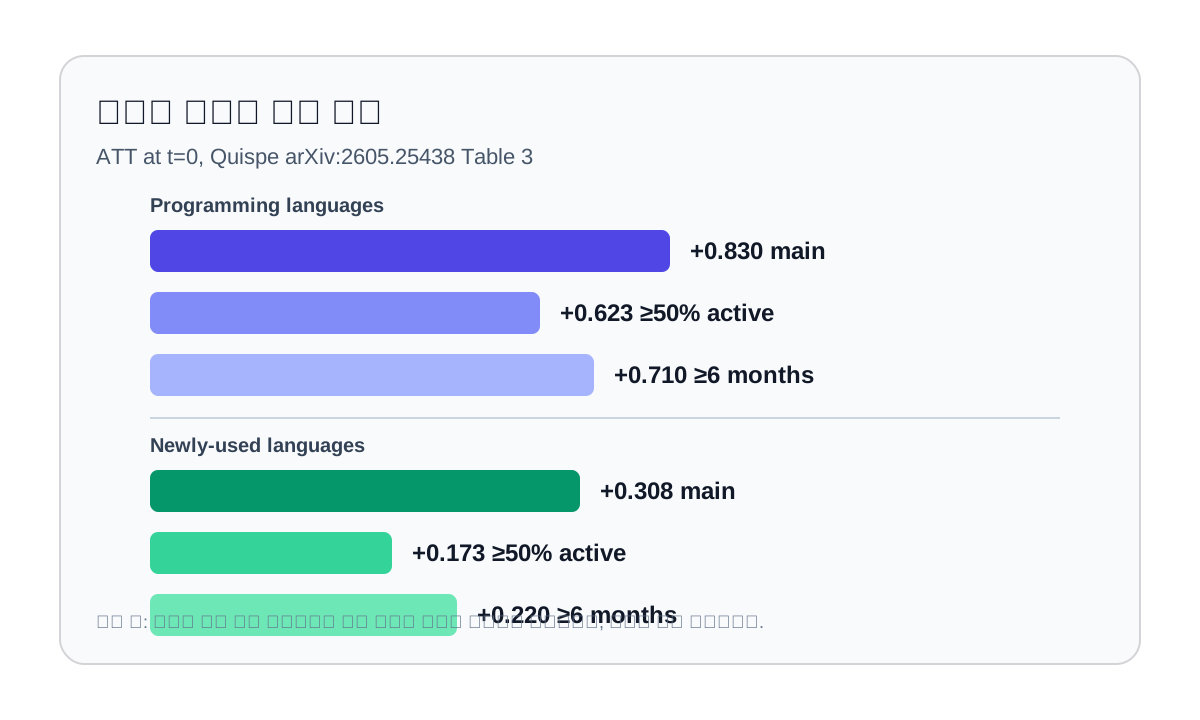
The stronger part of the paper is its robustness work. If the sample contains many developers with very little prior public activity, then a large level shift could appear simply because a quiet account starts a new public project while trying Claude Code. To test that concern, the paper reruns the analysis on developers active in at least 50% of the pre-period and developers active in at least six pre-treatment months.
The effects shrink, but they do not disappear. The monthly language effect falls from +0.830 in the main sample to +0.623 in the >= 50% pre-active sample and +0.710 in the >= 6 pre-months sample. Newly used language effects decline from +0.308 to +0.173 and +0.220, but the direction and statistical significance remain. Cumulative lifetime languages weaken more, which the paper interprets as a mechanical level component becoming smaller under stricter balance conditions.
That matters for practitioners. If Claude Code only made previously inactive accounts look active, the language and repository signal should mostly vanish among developers with sustained prior activity. In this paper, at least, a version of the signal remains. That leaves open the possibility that AI coding tools are being layered on top of existing developer expertise to help experienced builders touch new languages and repositories.
It does not mean every developer suddenly becomes a polyglot. A +0.83 estimate can sound like each person adds nearly one language per month, but it is an average treatment effect across people, timing, activity levels, and project contexts. Some developers may open one new repository that uses two languages. Some may not change much. Others may already be multilingual. The safer article-level interpretation is not "Claude Code makes everyone multilingual." It is that the observed language frontier moves around adoption.
Reverse causality is the central gap
The paper does not hide the explanation that most weakens its own claim. A developer may adopt Claude Code because an unfamiliar-language project has already arrived. Imagine a Python backend engineer assigned to a Rust infrastructure project at a new company. The engineer installs Claude Code because Rust is unfamiliar. The first Claude co-authored commit and the first Rust commit happen in the same month. In the data, the developer's language portfolio expands after adoption. In the real story, the new job assignment may be the source of both adoption and expansion.
The paper calls this "selection on time-varying unobservables." Staggered difference-in-differences can reduce some problems around cohort heterogeneity, already-treated comparison units, and common calendar trends. It cannot fully observe the decision inside a developer's head: "I am about to start a new kind of project." Without that decision, it is difficult to separate the Claude effect from the new-project effect.
That is why the conclusion is cautious. The results are quantitatively consistent with an AI-as-signal model, but a stricter causal claim would require more exogenous variation. The paper points to examples such as regional free-tier rollouts, price changes, or institutional subscription cutoffs that affect Claude access independently of a developer's project choice. Another path would be richer pre-period covariates that make conditional parallel trends more credible.
This caution should shape the way we talk about the finding. "Claude Code made developers better" is too far. "Claude Code adoption coincided with a broader developer language frontier" is more defensible. The distinction may look small, but it is the main difference between reading AI productivity research carefully and turning it into vendor copy.
Community anecdotes point in the same direction
The community stories around Claude Code fit the paper's model surprisingly well, even though they are not proof. A Hacker News discussion titled "An industrial piping contractor on Claude Code" centered on a non-traditional software user building real work software with Claude Code. The comments were not pure optimism. One interpretation was that this is not "everyone becomes a developer," but a case where someone with developer-like persistence received a much lower barrier to entry. That maps closely to the paper's switching-cost argument.
Another thread, "Tell HN: I'm 60 years old. Claude Code has re-ignited a passion", describes a user who had lost the habit of coding and found that Claude Code made modern web stacks feel approachable again. Again, the main story is not only speed. It is the reduced burden of catching up with frameworks, package norms, build systems, and error messages. The tool creates a feeling that re-entry is possible.
The negative reactions matter just as much. Claude Code discussions on Reddit and Hacker News often return to cost, reliability, attribution, long-session degradation, and the risk of merging code that the user does not really understand. As language boundaries get lower, developers can attempt more work. They can also create more code they are not prepared to own.
That is the practical two-sided message. First, the cost of entering a new language or repository may really be falling. Second, a lower entry cost is not a lower responsibility cost. The wider a developer's frontier becomes, the more teams need tests, review, observability, security review, and explicit ownership. AI can make the first step into an unknown language easier. It does not automatically provide the next year of maintenance context.
What teams should measure now
For engineering teams, the paper suggests three useful questions.
First, should AI coding-tool adoption be measured only by commit volume? The paper reports a large commit increase, but the more interesting signals are languages, repositories, and newly used languages. A team adopting coding agents should ask not only whether throughput rose, but whether developers entered parts of the codebase they previously avoided. Legacy languages, internal SDKs, infrastructure code, data pipelines, and niche build systems may be the real places where the frontier moves.
Second, what guardrails should apply when a developer enters a new area with an agent? Claude Code, Codex, or another tool can scaffold code in an unfamiliar language, but that does not mean the user understands that language's runtime norms, security pitfalls, package ecosystem, or deployment behavior. A "first PR in a new language" might deserve stronger review, owner approval, test requirements, and deployment limits. The better policy is not a simple allow-or-ban rule for AI. It is detecting when the technical frontier moved and increasing verification around that move.
Third, what should developer education emphasize? If AI lowers syntax and boilerplate costs, training may shift from memorizing language details toward reading unfamiliar codebases, understanding failure modes, designing tests, and recognizing system boundaries. The paper's free-signal channel is not only for beginners. Experienced developers can also reduce the first ten hours of learning a new ecosystem. Whether the agent can replace the next hundred hours is a different question.
Why AI coding research is getting harder
This paper also shows why research on AI coding tools will become more difficult. The tools change quickly. Models change. Prices, limits, and default behaviors change. Developers mix multiple tools in the same workflow. Public GitHub data captures commits that remain visible, but not abandoned local attempts, private repositories, corporate review steps, or code that was generated and then discarded. The Co-Authored-By: Claude trailer is useful, but users can disable, remove, or alter attribution.
That makes public-data research a tradeoff. It offers scale, but it cannot see everything that matters. Measurement gaps and selection bias are hard to avoid. A large panel can identify a striking pattern, but the most important unobserved decision may still be why a developer opened Claude Code at that moment.
The research is still worth doing because coding agents are no longer only personal utilities. They are entering organizational workflows. GitHub Copilot is moving through cloud-agent and usage-based billing surfaces. OpenAI Codex is expanding across desktop and mobile control surfaces. Anthropic has made Claude Code and MCP central pieces of its developer platform. In that competition, the question is no longer only "who gives the best autocomplete?" It is "who expands the set of work a developer can credibly attempt?"
The paper's broader labor-market implication is also more nuanced than replacement. If AI tools expand an individual worker's task set, the effect is not simply machines replacing people. It may be that one person can be redeployed across more areas than before. Returns to language-specific specialization could weaken in some contexts, while returns to general problem solving, domain knowledge, and system ownership could rise. In open source, the map of which contributors connect to which projects and languages could change.
For now, the finding is better treated as a strong question than a final answer. Did Claude Code expand developers' frontiers, or did developers who were already about to cross a frontier adopt Claude Code? The paper needs cleaner identification before that answer is settled. But it leaves a useful warning for builders: the real change from coding agents may show up first not in a speed chart, but in the portfolio map of what developers are willing to touch. As that map expands, the map of responsibility expands with it.