Cerebras Ships CS-4, but Never Says Which GPU the 4,400 Tokens/s Beat
Cerebras unveiled CS-4 on August 18, packing three wafers into one rack. It claims 4,400 tokens per second per user on gpt-oss-120B and up to 30x faster than GPUs, without naming the GPU product it measured against.
- Cerebras unveiled CS-4 on August 18, three wafers in a single rack.
- The 30x-faster-than-GPU claim rests on one measurement Cerebras ran itself.
- Today's third-party numbers show 4.6x over Azure at 10x the token price.
Cerebras unveiled the CS-4 AI inference accelerator on August 18, 2026. The press release headline is the claim itself: up to 30 times faster than GPU-based solutions.
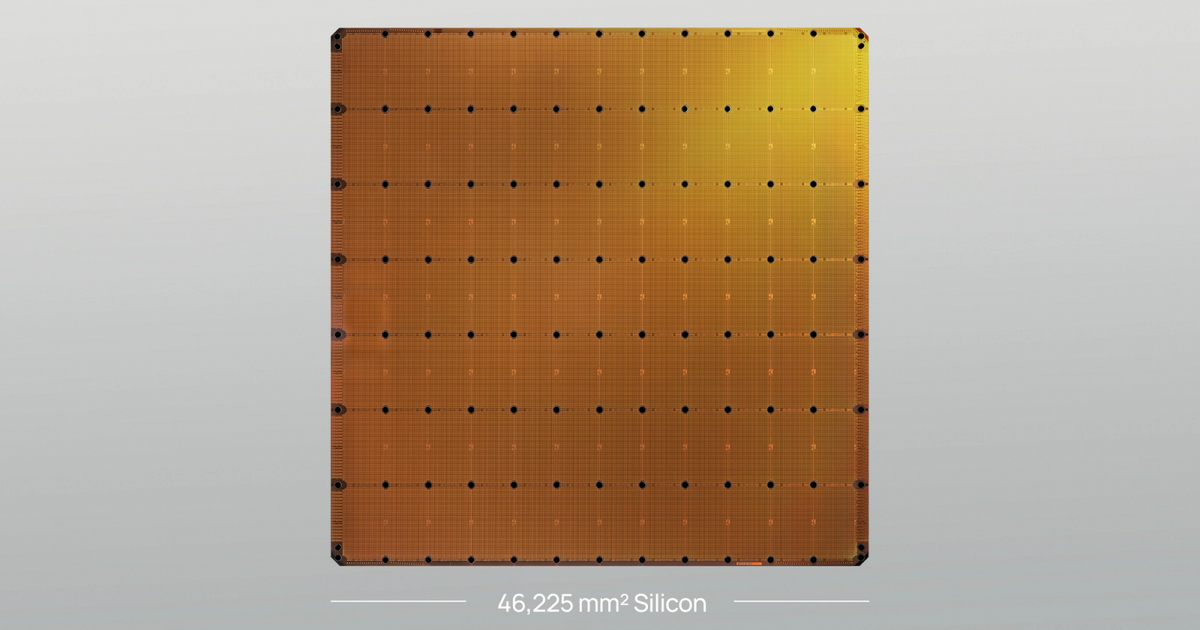
The claim only parses once you understand wafer-scale. A normal chip fab cuts dozens of chips out of a single 300mm silicon disc. Cerebras skips the cutting and uses the whole disc as one chip. The processor inside CS-4, the WSE-3 Turbo, spans 46,225 mm² of silicon carrying 4 trillion transistors and 900,000 AI cores. Memory sits on that same slab as 44GB of SRAM rather than in separate chips alongside it. Memory bandwidth is what sets tokens per second in inference, and that is where Cerebras's entire speed pitch comes from.
CS-4 is the first product to bundle three of these wafers into one rack. First shipments are in Q3 2026. Pricing was not disclosed.
The 2x performance gain is a clock bump
WSE-3 Turbo has the same core count and the same SRAM capacity as the previous WSE-3: 900,000 cores and 44GB, unchanged. It is built on the same TSMC 5nm process. Yet compute went from 125 PFLOPS to 250 PFLOPS per wafer, and memory bandwidth from 21.6 PB/s to 43.2 PB/s. Both doubled.
What changed is clock speed. The Next Platform's analysis puts it at 1.4GHz rising to 2.8GHz. Running the same circuits twice as fast means feeding them twice the power and removing more than twice the heat. That is why Cerebras shipped a rack design alongside the processor rather than the processor alone.
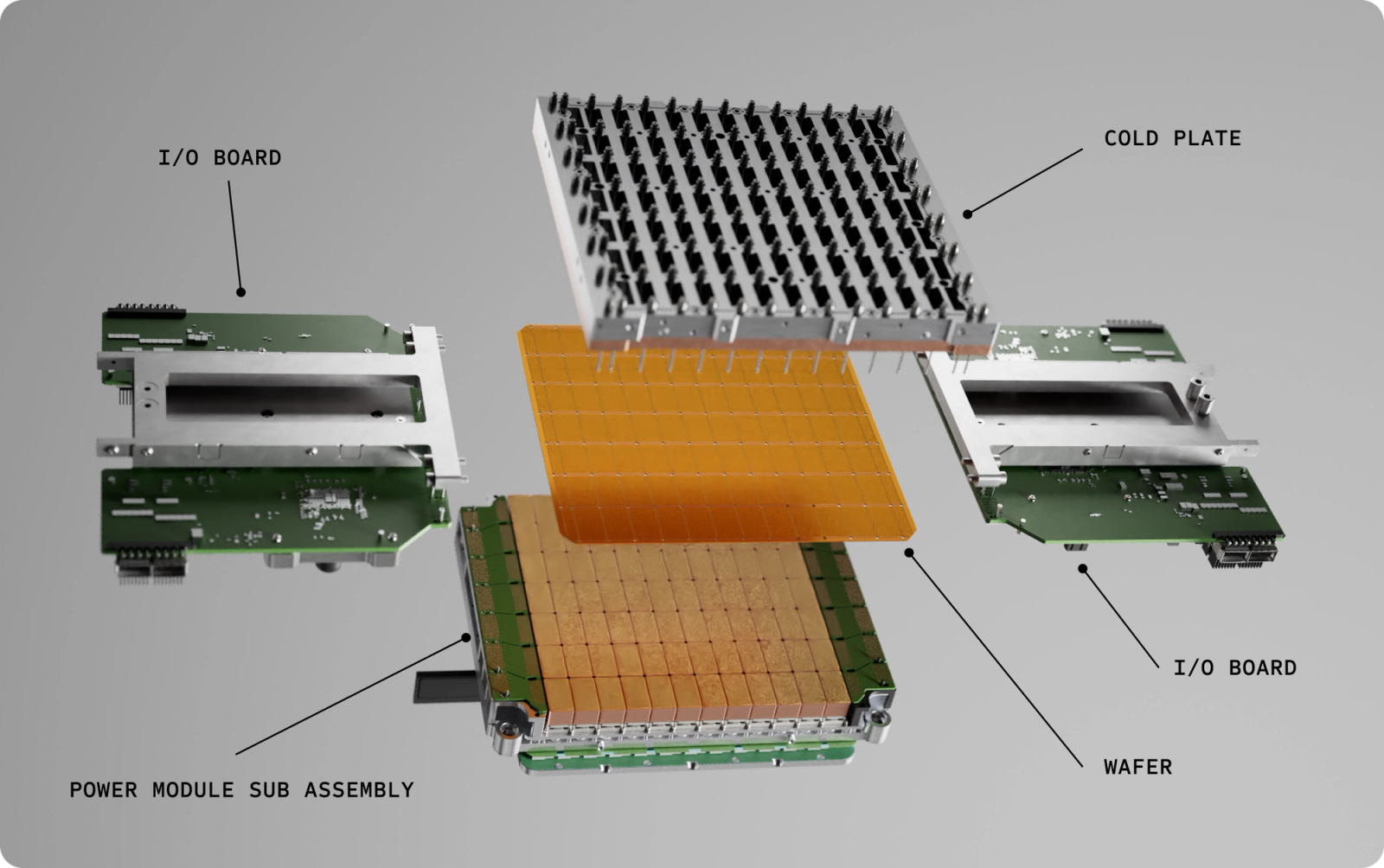
The critical change is where power conversion happens. On a typical GPU board, the power conversion stage sits roughly 50mm from the processor. CS-4 pulls that distance down to about 0.5mm. Cerebras says eliminating nearly all board-level loss is what let it push twice the power into the wafer under the same conditions.
The compute section was pulled out into a module that clips onto the back like a backpack. Cerebras calls it the Wafer-Scale Backpack: a self-contained assembly that folds power conversion, direct liquid cooling, high-speed I/O, and control electronics around the wafer in three dimensions. It uses half the part count of the previous generation, with 60% more of the manufacturing automated, cutting deployment from days to hours.
At the rack level, here is how CS-4 splits from the single-wafer CS-3.
| Spec | CS-3 (1 wafer) | CS-4 (3 wafers) |
|---|---|---|
| AI compute | 125 PFLOPS | 750 PFLOPS |
| Memory bandwidth | 21.6 PB/s | 129.6 PB/s |
| System I/O bandwidth | 1.2 Tbit/s | 7.2 Tbit/s |
| I/O latency | 5 microseconds | 2 microseconds |
Wafers connect to each other over what Cerebras calls Direct Wafer Links, a switchless direct connection that works both inside a rack and between racks, with wafer-to-wafer latency as low as 2 microseconds. Cerebras claims that chaining them this way supports models above 50 trillion parameters. Because the network is standard RoCE v2, you can also split the work: another vendor's hardware handles prompt processing while Cerebras handles token generation. The press release names AMD Helios and AWS Trainium as the partners for that split.
What exactly is the 30x measured against
The press release offers one line of evidence. Given the same prompt on gpt-oss-120B, CS-4 produced more than 4,400 tokens per second per user, which it calls up to 30x a GPU solution. Missing from that line is the comparison target. No vendor, no GPU model, no serving configuration appears anywhere in the release. The footnote only says actual throughput varies with model architecture, context length, precision, and serving configuration.
The 250 PFLOPS figure carries conditions too. ServeTheHome notes it is a sparse FP16 number. An independent analysis cited by implicator.ai estimates roughly 25 PFLOPS dense FP16, about a tenth of the marketing figure. Sparsity optimizations generally do not buy much in LLM inference.
Who ran the measurement matters as well. implicator.ai reported that Cerebras measured the CS-4 side itself and pulled only the GPU baseline from the third-party measurement service Artificial Analysis. CS-4 has not shipped, so nobody outside the company has touched one.
So what gap can you actually verify today? Here is what Artificial Analysis measured for the same model across providers.
| Provider | Hardware | Output speed | Blended price per 1M tokens |
|---|---|---|---|
| Cerebras | Wafer-scale | 1,551 tok/s | $0.39 |
| SambaNova | Custom silicon | 702 tok/s | Not listed |
| Groq | Custom silicon | 474 tok/s | Not listed |
| Azure | GPU | 334 tok/s | $0.07 |
| CoreWeave | GPU | Not listed | $0.04 |
Azure, the fastest of the GPU-based providers, runs 334 tokens per second. Cerebras, on the current CS-3 generation, runs 1,551. That is 4.6x. Even taking the claim that CS-4 doubles CS-3 at face value, you land near 9x. Getting to 30x requires a GPU baseline around 150 tokens per second, and Cerebras never says which provider produces that number.
The cost of the speed is the price. On the same table, Cerebras charges $0.39 per million tokens blended; the cheapest, CoreWeave, charges $0.04. That is roughly 10x. Paying 10x per token to get responses 4.6x sooner only pencils out for workloads where tokens per second directly drives the product experience.
The capacity constraint is also unchanged. The 44GB of SRAM per wafer is the same as WSE-3. Models whose weights run into the hundreds of gigabytes have to be split across multiple wafers. The Next Platform argues this means frontier-model inference could require dozens of CS systems, and that stacking SRAM in three dimensions will eventually become necessary. It is the same reason Cerebras added direct wafer-to-wafer links this generation and cut latency by more than half: chaining wafers is the assumption, not the exception.
What you can use through the API today, and what you cannot
CS-4 hardware ships first in Q3. Pricing is undisclosed, and the only purchase path is a sales inquiry. The Cerebras inference API, by contrast, is open right now, and what runs behind it is the current CS-3 generation, not CS-4.
| Item | Details |
|---|---|
| Who can use it | Any developer with an account. An API key is required |
| Plans | Free Trial gives $5 in credit at signup; Developer starts at $10 self-serve with 10x the free rate limits; Enterprise is a sales inquiry |
| Regional availability | Neither the pricing page nor the press release lists any country restriction. Beyond direct signup, access is also documented through AWS Marketplace, OpenRouter, Hugging Face Hub, and Vercel. No region is called out specifically either way |
| Models served | gpt-oss-120b, the Gemma 4 31B family, GLM-4.7. Up to 131k context, with function calling and JSON mode |
| CS-4 hardware | First shipments Q3 2026, price undisclosed, sales inquiry only |
Cerebras's own revenue mix is shifting from boxes to cloud. In Q2 results announced August 12, inference cloud revenue grew nearly fourfold year over year while hardware revenue fell. The $20 billion multi-year OpenAI agreement, the 750MW deployment plan, and the Amazon Bedrock integration with AWS all sit on the cloud side. Far more readers will meet Cerebras through an API than will ever buy a CS-4.
If model response time is the bottleneck in your agent loop, the fastest way to check the 30x claim is to spend the $5 credit running gpt-oss-120b against your own prompts at your own context length and measure tokens per second yourself. Put that number next to the token price of whatever model you run today and the 4.6x-speed-for-10x-price trade either works for your workload or it does not. CS-4 itself is worth revisiting once it ships in Q3 and CS-4-backed endpoints show up on third-party measurement pages like Artificial Analysis.