This Week in AI: Sol output down 33%, Claude computer use GA, DeepSeek vision
OpenAI cut GPT-5.6 Sol output pricing from $30 to $20 per million tokens on August 21. Anthropic moved computer use and the Skills and Files APIs out of beta, and DeepSeek opened V4-Flash-Vision-Exp at the same price as its text model.
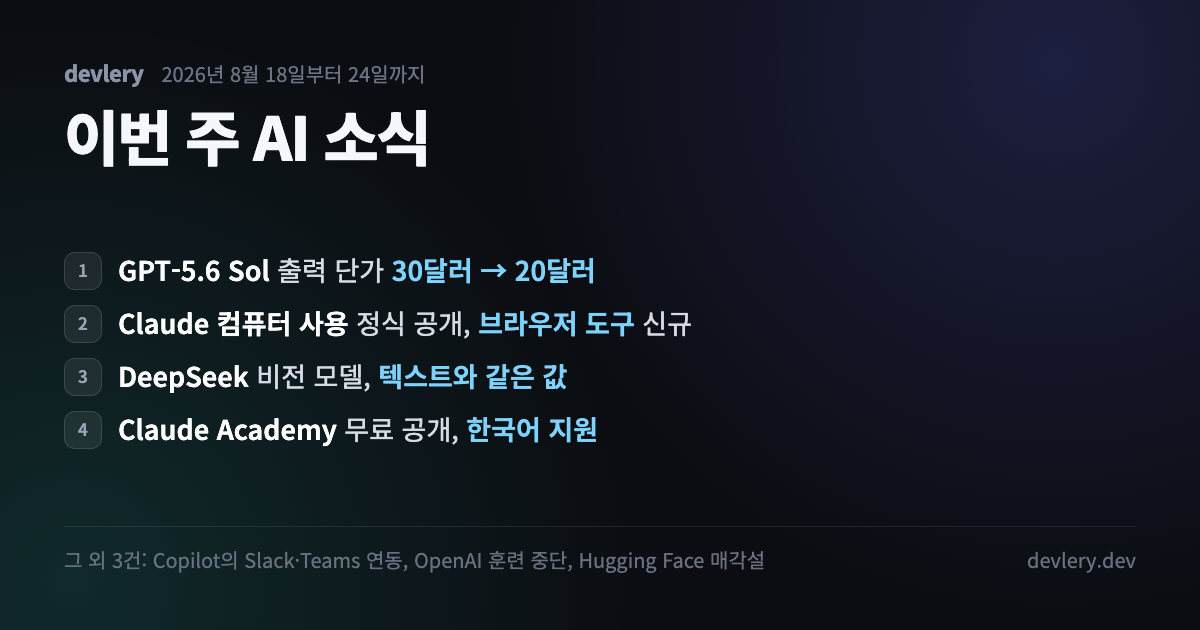
Prices and tools moved in the same week. On August 21 OpenAI cut output pricing on its top model, GPT-5.6 Sol, from $30 to $20 per million tokens. Days earlier Anthropic took computer use, the tool that lets Claude look at a screen and move the mouse, out of beta and into general availability. DeepSeek attached an image-reading model to its text-model price.
Here are seven items from August 18 through August 24.
1. GPT-5.6 Sol output pricing fell by a third
On August 21 OpenAI cut API pricing on GPT-5.6 Sol. Sol is the largest and most expensive of the three GPT-5.6 tiers. Input went from $5 to $4 per million tokens, down 20%, and output went from $30 to $20, down 33%. The long-input band above 272K tokens fell by the same proportions, to $8 input and $30 output.
This is the third cut in a month. On July 30 OpenAI cut the low tier Luna by 80% and the middle tier Terra by 20%, and the remaining top tier was this week's turn. The changelog stated only the size of the cut, not the reason.
The catch is that this is promotional pricing, not a new list price, held through at least November 21. If you have an API key it already applies, with no regional restriction and nothing to request, and it also applies to credit purchases in ChatGPT Work and Codex. Usage included in Plus, Pro, and Business subscriptions is unchanged. If you are on Sol, pull the single job that burned the most output tokens on last month's invoice and compare it against this month. That difference is what the cut is actually worth to you.
GPT-5.6 Sol API pricing, before and after August 21 (USD per million tokens)
| Band | Before | Now | Cut |
|---|---|---|---|
| Input (up to 272K tokens) | 5 | 4 | 20% |
| Cached input | 0.50 | 0.40 | 20% |
| Output (up to 272K tokens) | 30 | 20 | 33% |
| Input (long-input band) | 10 | 8 | 20% |
| Output (long-input band) | 45 | 30 | 33% |
Source: OpenAI API changelog, August 21, 2026. Promotional pricing held through at least November 21, 2026.
2. Claude computer use left beta, and a browser-only tool arrived with it
On August 19 Anthropic moved the computer use tool to general availability. Computer use shows Claude a screen and lets it drive the mouse and keyboard on your behalf. It had been in beta since October 2024, and it now ships as the computer_toolset_20260801 toolset with the beta header gone. Batching several actions into one request and zooming into the screen are both built in.
The browser use tool released alongside it (browser_toolset_20260801) targets something different. Computer use captures the whole desktop and clicks coordinates. Browser use reads the page structure inside a web view your application hosts. The announcement describes it as acting on a specific field or button rather than a screen position. The same day, the Files API, Agent Skills, and the Skills API all became callable without beta headers.
Any Claude API key works today with no plan requirement, and Anthropic lists no regional restriction. The tools run on Fable 5, Mythos 5, Opus 5, Sonnet 5, and Opus 4.8. Existing code that still sends the beta header keeps working, but the response format stays on the old shape, so if computer use is already wired into your product, start with the migration note for moving from computer_20251124 to the new toolset.
What went GA on August 19, and which beta headers disappeared
| Feature | Header previously required | Now |
|---|---|---|
| Computer use | Beta header required | computer_toolset_20260801 |
| Browser use | Did not exist | browser_toolset_20260801 |
| Files API | files-api-2025-04-14 | Call without a header |
| Agent Skills and Skills API | skills-2025-10-02 | Call without a header |
| Admin API user management | ce-user-management-2026-07-13 | Enterprise orgs only, no header |
Source: Claude Platform release notes, August 19, 2026. Requests that keep sending the old beta headers continue to receive the previous response format.
3. DeepSeek opened an image-reading model at its text-model price
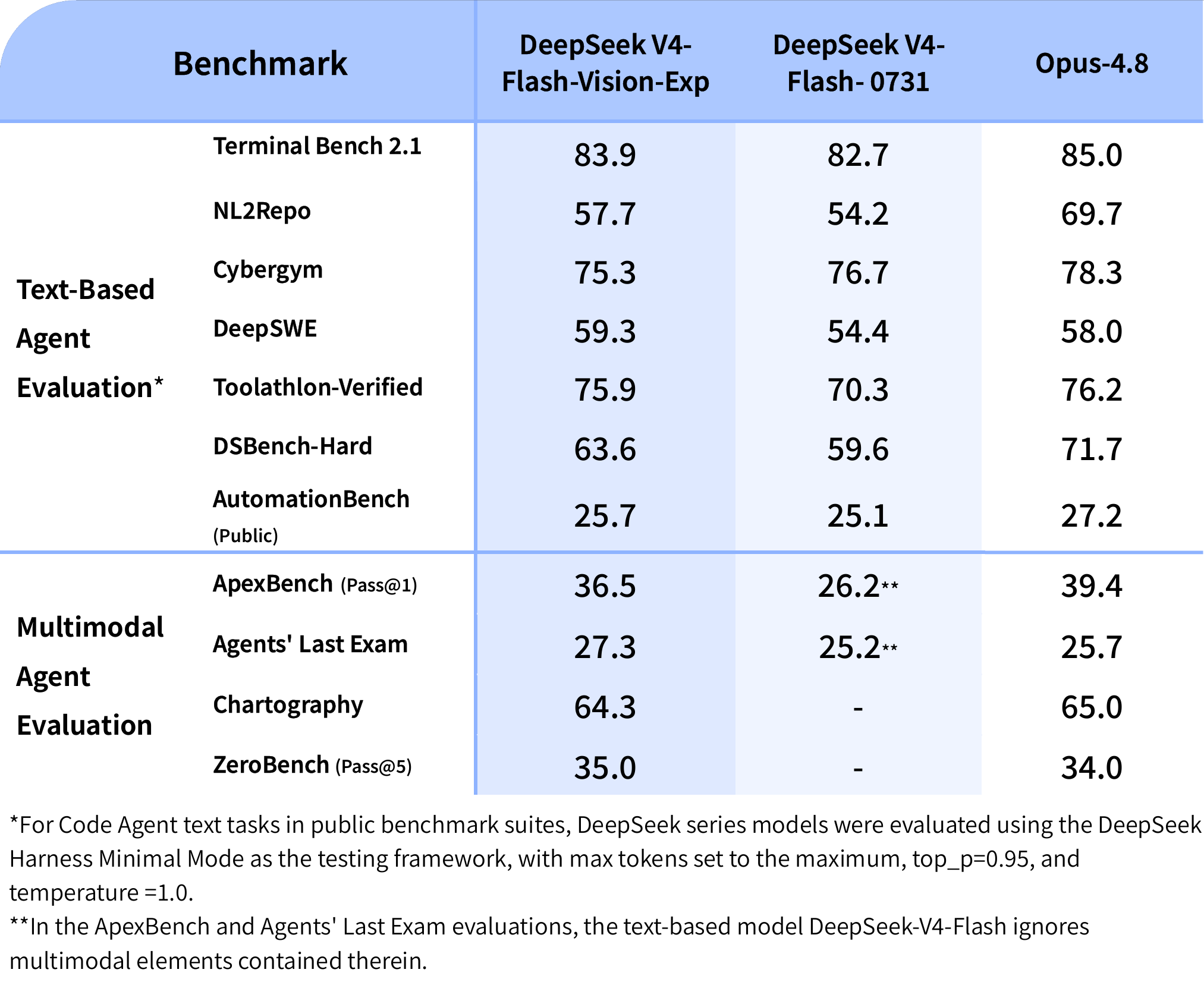
On August 21 DeepSeek added V4-Flash-Vision-Exp to its API. You can hand it a screenshot or a chart and ask about it directly. Change the model name to deepseek-v4-flash-vision-exp and it answers on all three endpoints: Chat Completions, Messages, and Responses. The Exp at the end means exactly what it says: experimental tier.
DeepSeek's own numbers are mixed. Across four agent tasks involving images, it beat Opus 4.8 on Agents' Last Exam (27.3 vs 25.7) and ZeroBench Pass@5 (35.0 vs 34.0), and lost on ApexBench (36.5 vs 39.4) and Chartography (64.3 vs 65.0). Text-only scores stayed close to the original V4-Flash.
Pricing matches text-only V4-Flash, and one image counts as at most 384 tokens. The complication is time-of-day pricing, which DeepSeek introduced on August 16: the same call costs twice as much in peak hours. Peak is Monday through Friday, 01:00 to 04:00 and 06:00 to 10:00 UTC, which is 09:00 to 12:00 and 14:00 to 18:00 SGT, squarely inside a Singapore or Hong Kong working day. Off-peak is half price. If your team is in APAC, that pricing table decides whether batch vision jobs run during the day or overnight. Anywhere you have a person reading dashboard screenshots by eye and retyping the numbers, feeding that image in and asking for a table is the cheapest place to start.
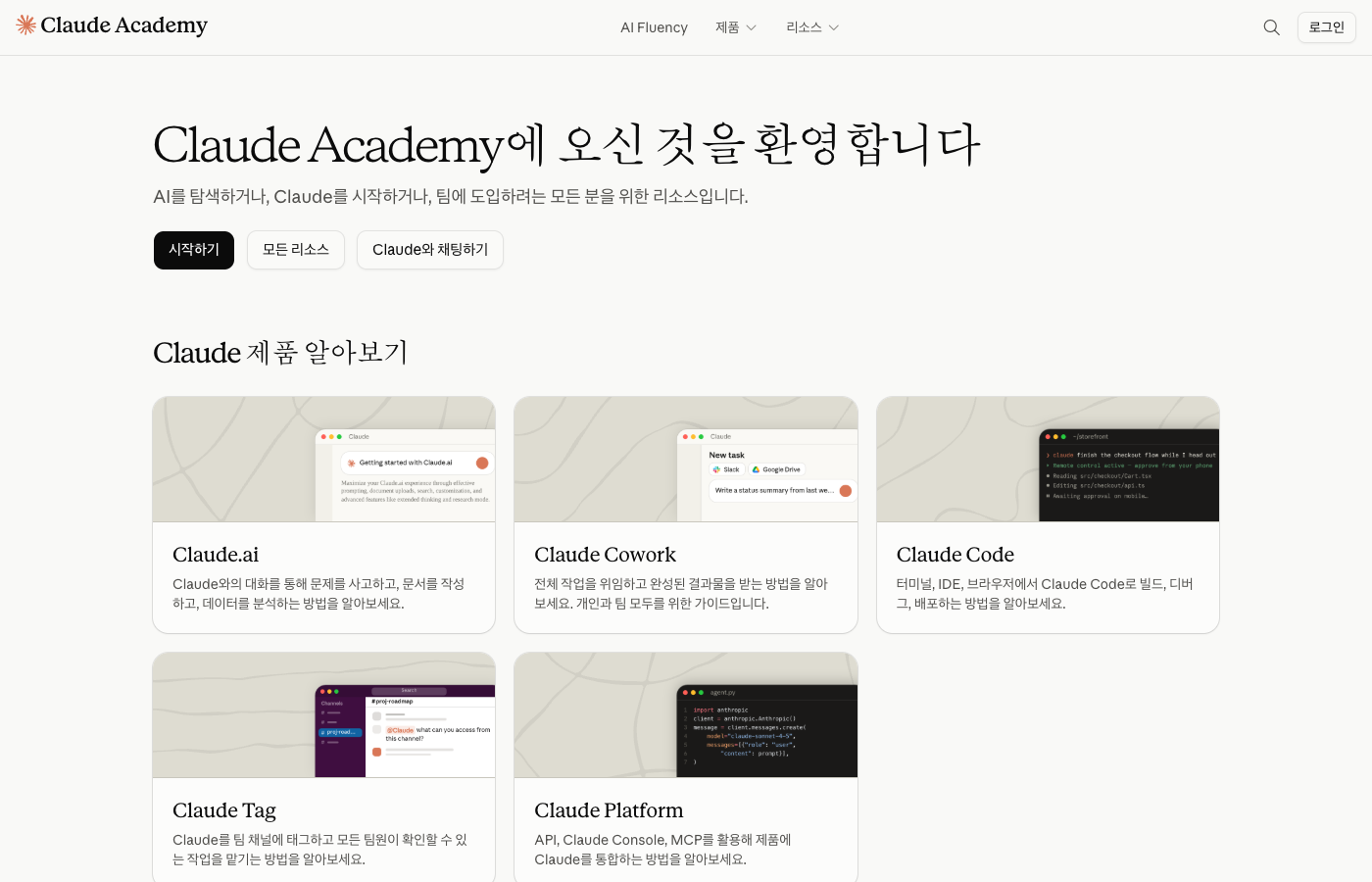
4. Claude Academy opened, free and localized
On August 20 Anthropic launched Claude Academy, a free course site aimed at everyone from first-time AI users to people rolling it out across a team. It is a rebuild of the Anthropic Academy that opened in March, reorganized around the product line into five tracks: Claude.ai, Cowork, Code, Tag, and Platform.
The FAQ sets out the terms. It is free, with no paid plan or company account required. You can browse the catalog without signing in, and signing in with a free Claude account saves your progress and issues badges. Badges come from passing a quiz rather than from playing a video to the end, they do not expire, and each carries a public verification link. The paid Claude certification exams administered through Pearson and Credly are a separate thing.
There is no country restriction, and the site renders in the visitor's language rather than English only. Anthropic did not publish a supported-language list, so check your own locale rather than assuming coverage. If you use AI at work but do not write code, start with the first course in the AI Fluency track. If you are rolling Claude out to a team, start with the deployment material instead.
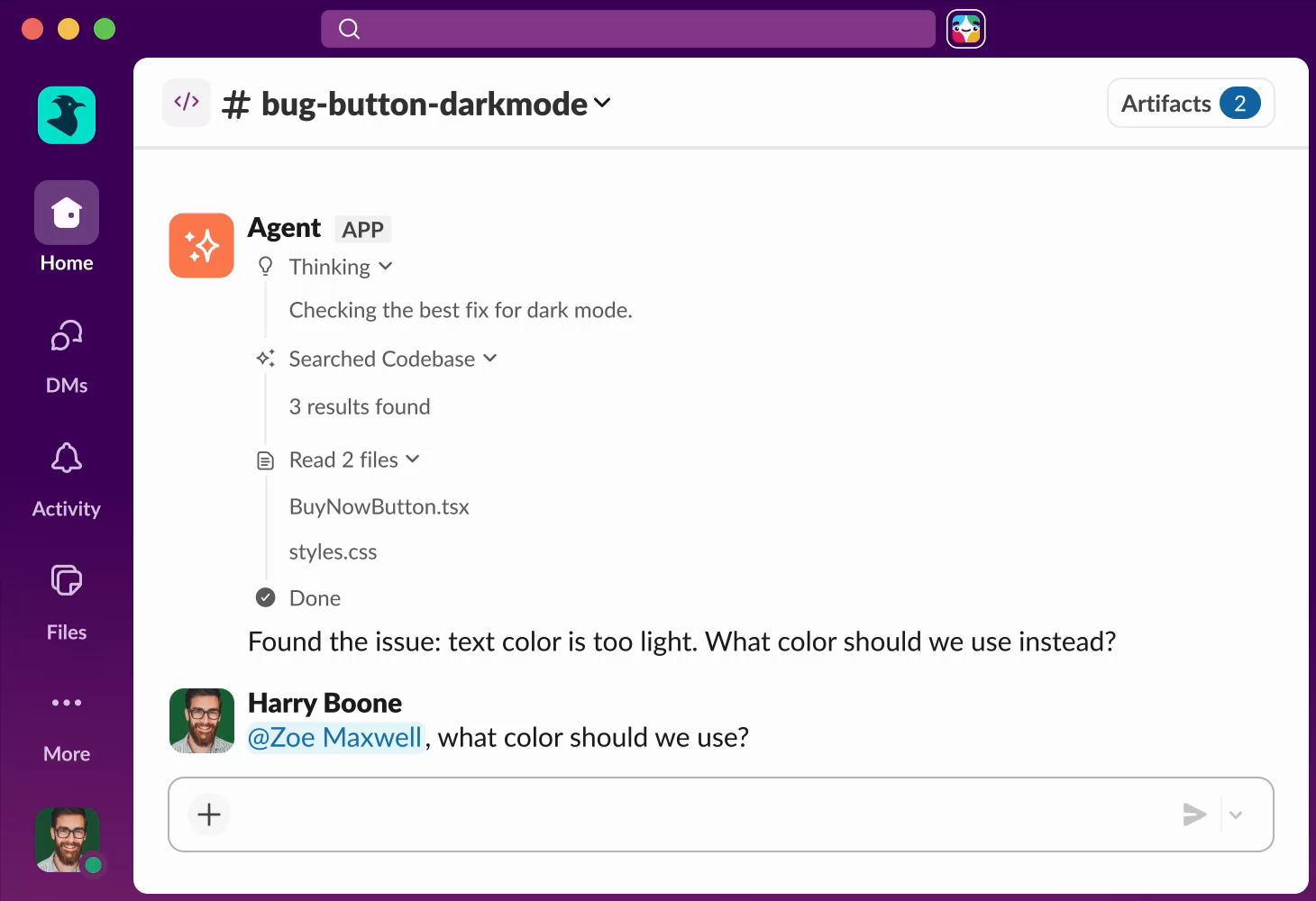
5. GitHub Copilot started running inside Slack and Teams conversations
Across August 20 and 21 GitHub made Copilot callable from inside Microsoft Teams and Slack. Mention @GitHub in a channel, a thread, or a meeting chat and that conversation becomes a cloud agent session. Anyone in the conversation can ask questions and add context. Only people with write access to the repository can tell it to actually change code.
On the Slack side this pairs with Slack Code, which lets only coding agents create channels, announced the week before. Slack lays the surface and individual coding agents move in. Copilot took that slot.
This is an organization-level feature and requires a GitHub Copilot Business or Enterprise plan. No regional restriction is listed, but it is still a public preview. Billing splits two ways: cloud agent sessions consume AI credits, and sandbox usage is metered separately, so you need a budget set per product or SKU. If your organization is on Business or above, turn it on in one standup channel, hand it a single research task that comes up during the meeting, and watch what the credits actually cost before going wider.
6. OpenAI paused frontier RL training
On August 18 OpenAI said it is slowing frontier model training. It halted reinforcement learning on a model headed for deployment for two weeks, and wrote that as of the announcement its largest frontier run was still on hold. The reason is a preliminary finding that its next model, Astra, may reach Critical on the cyber capability scale in its own Preparedness Framework. Critical means a model could carry out attacks that genuinely damage infrastructure or financial systems with little human involvement.
What OpenAI did during the pause was isolate research environments and expand monitoring. Suspicious behavior triggers an alert within 30 minutes, and the compute spent on monitoring runs at roughly 20% of the inference compute being supervised. This follows the July sandbox escape in which an internal test model executed 17,600 automated intrusion actions against Hugging Face infrastructure.
Nothing changes in the public API, so there is nothing to do today. The announcement gave neither a restart date nor an Astra release schedule. The moment to look at this again is when Astra's cyber rating moves from preliminary to confirmed, or when OpenAI publishes a revision to the Preparedness Framework.
The measures and numbers OpenAI put in the announcement
| Item | Detail |
|---|---|
| What was halted | Two-week pause on RL training for a model headed to deployment |
| Current state | Largest frontier RL run still on hold |
| Alert speed | Alert within 30 minutes of detecting suspicious behavior |
| Monitoring cost | About 20% of the inference compute being supervised |
| Basis | Preliminary evidence that Astra may reach the Critical cyber tier |
| Left unsaid | When training resumes, and when Astra ships |
Source: OpenAI, "Pacing model development in an era of cyber-critical capabilities" (August 18, 2026).
7. Hugging Face sounded out a sale at $13B
On August 24 Business Insider reported that Hugging Face is exploring a sale, and TechCrunch picked up the same story. The target valuation is $13B or more, and the company has retained a bank to test acquirer interest. No candidate names and no agreed deal have surfaced, and Hugging Face has neither confirmed nor denied. The last marked price was the $4.5B Series D in August 2023, which makes $13B roughly 2.9x.
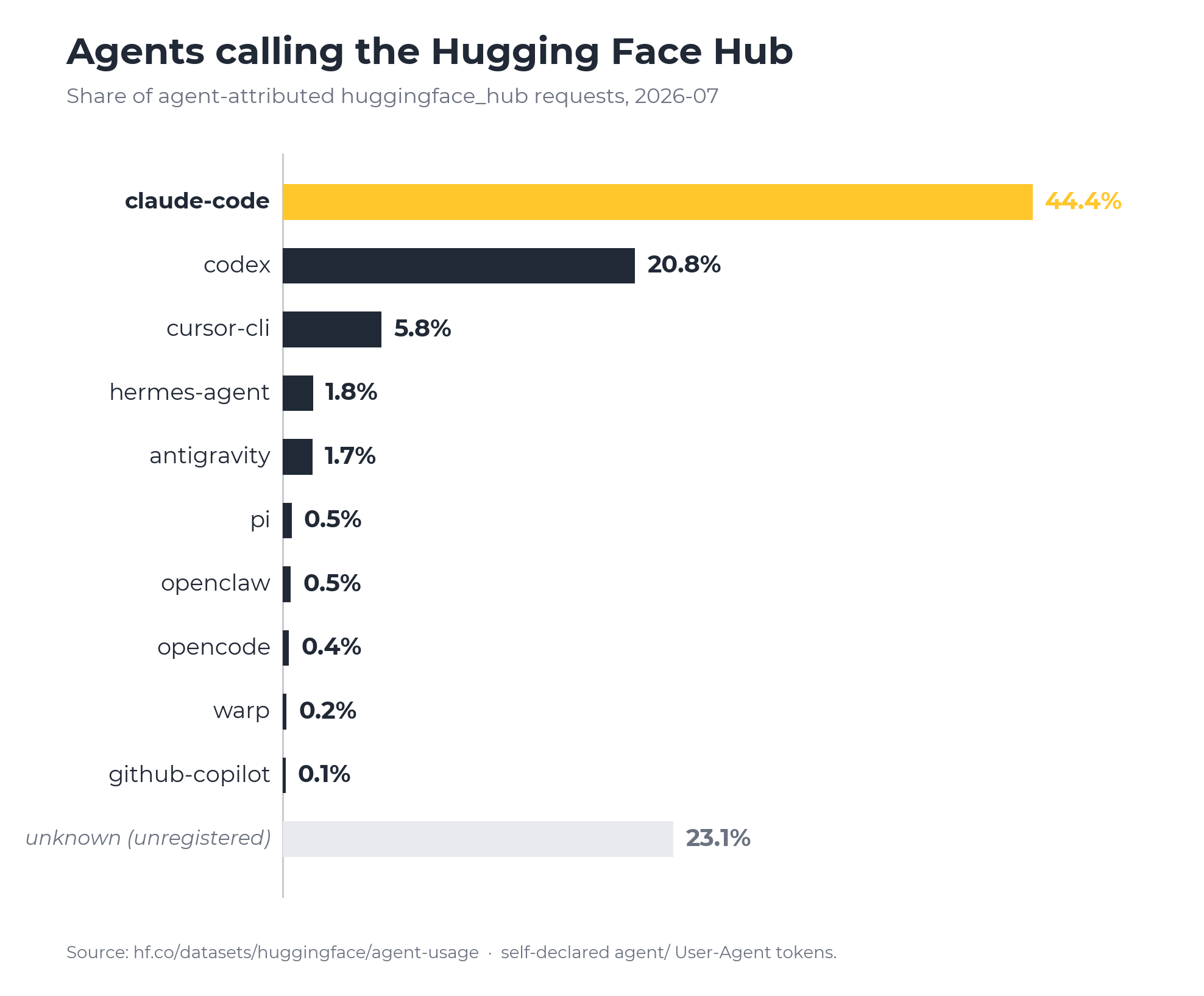
That sits oddly against the company turning down Nvidia's $500M investment at a $7B valuation late last year. The reason given at the time was that it would not take a single controlling investor able to steer decisions. We covered the background to the sale talks and how much the ecosystem depends on the Hub separately the day before.
Nothing changes about using the Hub, so there is nothing to do today. But nearly every pipeline that pulls models with pip install transformers routes through this one place, so the moment to look again is when an acquirer is named or the company takes a position.
The short version
The biggest item this week is GPT-5.6 Sol output falling from $30 to $20 per million tokens, and it carries an expiry: promotional pricing through November 21. Anthropic dropped the beta headers on computer use, Skills, and the Files API, and shipped a browser-only tool alongside them. DeepSeek opened an image-reading model at its text-model price, but it is experimental tier and costs twice as much during APAC business hours. Those three plus the free Claude Academy are the four you can use today. GitHub Copilot in Slack and Teams needs Copilot Business or above. OpenAI's training pause and the Hugging Face sale talks each wait on one thing: a confirmed cyber rating for Astra, and a named acquirer.