A2A Joins the Foundation That Hosts MCP, but Real Usage Has Not Moved
The Agentic AI Foundation accepted Google Agent2Agent as a growth-stage project on August 17. A2A now sits under the same neutral governance as MCP, but its 8-seat TSC and its thin production usage next to MCP are unchanged.
- AAIF accepted A2A on August 17, putting it under the same roof as MCP.
- The GOVERNANCE.md in the A2A repo still describes the same 8-seat TSC and never mentions AAIF.
- The spec and six SDKs are
Apache 2.0and free, with no regional gate.
The Agentic AI Foundation (AAIF) announced on August 17, 2026 that it had accepted the Agent2Agent (A2A) protocol as a growth-stage project. A2A is a spec Google published in April 2025 that lets AI agents built by different companies talk to each other directly. With this move, A2A sits under the same foundation as Anthropic's MCP, Block's goose, and OpenAI's AGENTS.md.
The announcement itself is small. A2A's code, its spec, and every deployment already running are unchanged. What changed is one line about who administers the project. It is worth separating what that line does buy from what it does not.
MCP connects tools, A2A connects agents
These two protocols are easy to confuse, but they occupy different slots. MCP is how a single agent reaches outward to tools and data. When Claude reads Notion or GitHub, that path is MCP. A2A is what an agent uses when it hands work to an agent running at another company, on another framework.
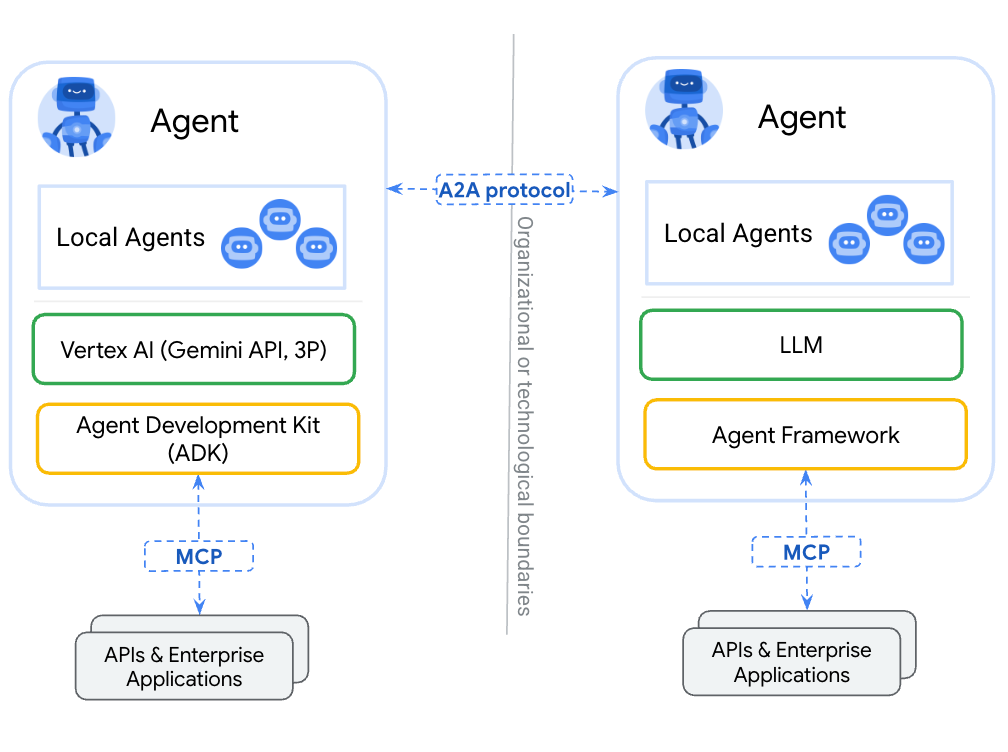
The vertical line in the diagram is an organizational or technology boundary. The dotted lines below it are MCP; the dotted line crossing it is A2A. Your team's agent telling a partner company's agent "verify this invoice" is the case A2A aims at.
A2A reached its stable v1.0.0 spec on March 12, 2026. The data model is AgentCard, AgentSkill, Task, Message, Part, Artifact, and Extension. It is specified in Protocol Buffers and published as JSON Schema 2020-12. Transport defaults to plain HTTP with JSON-RPC 2.0 semantics, and streaming results use WebSocket and Server-Sent Events. The starting point is the AgentCard, a published file where an agent states its name, what it can do, and where to reach it. The agent on the other side reads that card and decides whether to delegate.
The foundation changed, the decision-making did not
Reading this as "Google just released A2A to the community" gets the order wrong. Google Cloud donated A2A to the Linux Foundation back on June 23, 2025, at Open Source Summit North America. A2A has been Linux Foundation property since then, it simply sat at the foundation's top level rather than inside a sub-foundation. MCP, by contrast, became an AAIF project the moment AAIF launched in December 2025. This announcement is not a new donation. It is housekeeping that moves A2A next to MCP inside the same Linux Foundation.
Google publishes A2A with 50-plus launch partners including Atlassian, Box, Intuit, LangChain, MongoDB, and Workday
AAIF launches. MCP becomes an AAIF project while A2A stays at the Linux Foundation level
AAIF accepts A2A as a growth-stage project, under the same governance as MCP, goose, and AGENTS.md
AAIF runs a two-layer structure: a Governing Board that owns strategy, budget, and membership policy, and a Technical Committee that owns project approval and technical review. The foundation has grown from fewer than 40 members at its December 2025 launch to more than 250 today, including Google, Microsoft, Amazon, Anthropic, OpenAI, Bloomberg, Shopify, Block, and Cisco. AAIF CTO Manik Surtani said in the announcement that "A2A represents an important step toward an open, interoperable future for AI agents."
Open the governance document in the A2A repo, though, and nothing has moved. GOVERNANCE.md in GitHub's a2aproject/A2A still describes an eight-seat Technical Steering Committee, with one seat each for Google, Microsoft, Cisco, AWS, Salesforce, ServiceNow, SAP, and IBM. The document does not mention AAIF at all. It states that during the startup phase each organization appoints one voting member, and that the "steady state" composition will be decided by the TSC 18 months after inception. As of the announcement, technical authority over the A2A spec still sits with those eight companies. Changing the nameplate on the foundation and changing who edits the spec are separate things.
AAIF is also the foundation that approved the 2026-07-28 MCP revision that dropped sessions for a stateless design. From here, revisions to both protocols pass through the same Technical Committee. That is the concrete outcome of this move. We covered why competing vendors gathered under one foundation separately.
The distance between 250 supporters and production
The AAIF announcement lists several real A2A deployments. Huawei HarmonyOS adopted A2A as a standard. Tencent's WeChat uses it to interoperate with device-maker assistants. Google Cloud, Microsoft Azure, and AWS Bedrock all support A2A agents. By Linux Foundation's count, supporting organizations passed 150 on April 9, 2026.
That number is not an adoption rate. "Supports A2A" spans everything from putting a logo on a page to running it in production. MCP has thousands of public servers as of mid-2026, and its developer usage is countable through tools like Claude Desktop, Cursor, and Windsurf. A2A has a supporter count and GitHub stars. There is no metric showing how many teams actually run it in production.
Developer objections are specific. Adopting A2A means maintaining two protocols, the compatibility surface between them, and an A2A-specific communication layer on top. The complaint repeated through this year is that MCP connected Claude to Notion, Jira, and GitHub in ten minutes, while A2A requires days of learning agent orchestration concepts before you hand-build the communication layer. MCP already covering long-running tasks, stateful communication, enterprise-grade security, and agent discovery narrowed A2A's differentiation further. The sharpest version of the criticism: most A2A demos use three agents to do what three function calls would handle.
Joining the foundation does not touch that gap. Neutral governance reduces the risk that one vendor bends the spec toward its own products. It does not lower the cost of adopting it.
Can you use it now
A2A has almost no gating. There is no account approval, no waitlist, and no price.
| Item | Condition |
|---|---|
| Who | Every developer. No approval, no waitlist |
| Price | Free. Spec and SDKs are all Apache 2.0 |
| Regional availability | No restrictions. It is an open spec with no regional gate. A2A integration features inside Google Cloud, Azure, and AWS Bedrock still follow each cloud's own region availability |
| Requirements | One of six SDKs. Python is |
| Governance participation | TSC meetings are public on Linux Foundation platforms, Discord community is open |
The roadmap lists the A2A Inspector and a Technology Compatibility Kit in the three-to-six-month bucket. Both are tools that check whether an agent you built actually conforms to the spec. The roadmap document itself has not been updated since March 10, 2026.
If you run agents built on several different frameworks and need to connect them, the useful thing to do this week is not to decide on A2A. It is to write down where MCP alone falls short today. If no scenario on that list involves handing work across an organizational boundary to another company's agent, you do not need A2A yet. If one does, stand up a single AgentCard with a2a-sdk and confirm the other side can read it, which settles the question before you spend days on the learning curve. A change in foundation membership is not an adoption signal. The moment worth revisiting is when the TCK actually ships, because then you can count how many of the 150 organizations that put their name on the list pass a conformance check.