Alphabet raises $80B for AI compute as Gemini demand becomes a balance sheet problem
Alphabet announced $80B in equity offerings for AI compute expansion. The financing shows what Gemini APIs, agents, and Google Cloud capacity now cost.
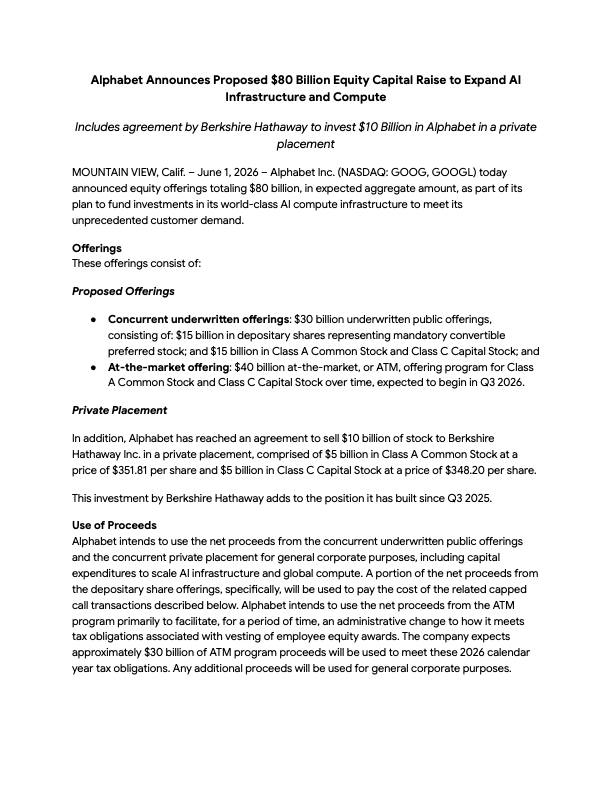
- What happened: Alphabet announced $80 billion in equity offerings on June 1, 2026 to expand AI compute infrastructure.
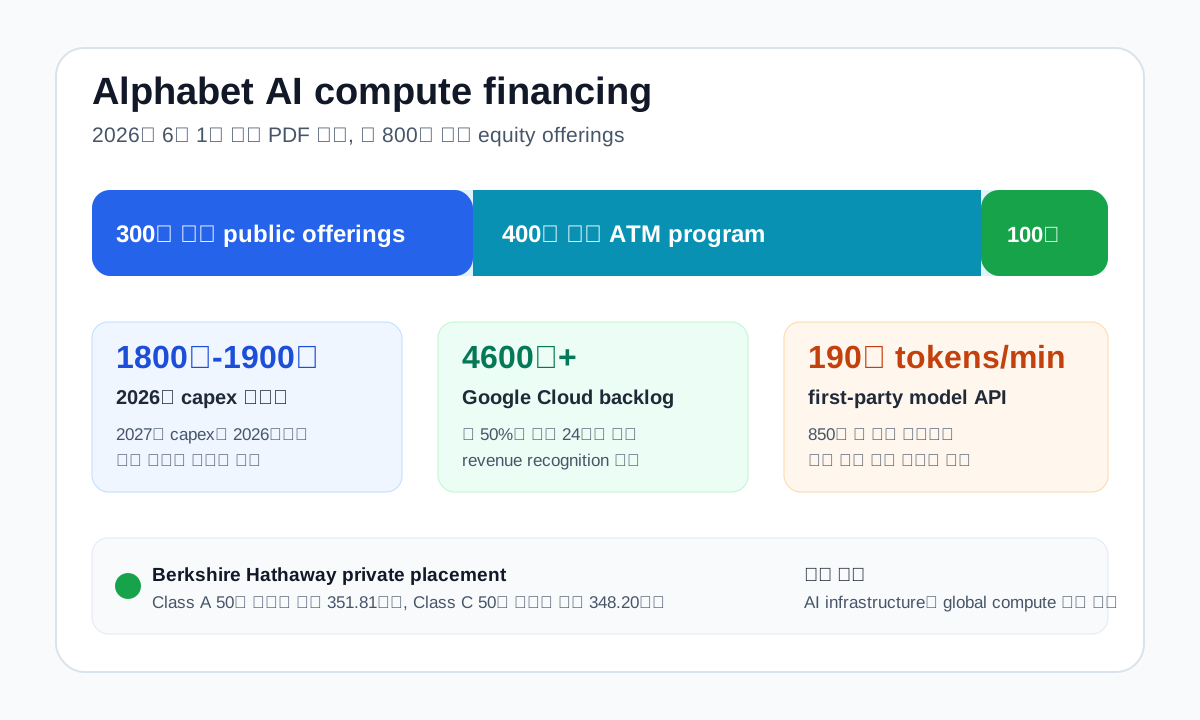
- The package combines $30 billion in public offerings, a $40 billion ATM program, and a $10 billion Berkshire Hathaway private placement.
- Developer signal: Google disclosed more than 8.5 million monthly model developers and 19 billion tokens per minute through first-party model APIs.
- Watch: Roughly $30 billion of the ATM proceeds are earmarked for employee equity tax handling, so the full $80 billion should not be read as new GPU purchasing power.
Alphabet announced an $80 billion equity capital raise to expand AI compute infrastructure on June 1, 2026. The press release reads like a capital markets filing, but the developer-facing story is the cost of supplying Gemini APIs, Vertex AI, Google Cloud AI products, and agent workloads. In the same PDF, Google reported more than 8.5 million monthly model developers, 19 billion tokens per minute through first-party model APIs, and more than $460 billion in Google Cloud backlog.
The raise is not a single common stock sale. According to Alphabet's official PDF, the company bundled three instruments: $30 billion in concurrent underwritten public offerings, a $40 billion at-the-market offering program, and a $10 billion private placement to Berkshire Hathaway. The public offerings include $15 billion of depositary shares representing mandatory convertible preferred stock and $15 billion of Class A and Class C common stock.
Berkshire Hathaway's terms are spelled out in the release. Berkshire agreed to buy $5 billion of Class A Common Stock at $351.81 per share and $5 billion of Class C Capital Stock at $348.20 per share. Alphabet said the investment adds to a Berkshire position that began building in the third quarter of 2025. AI infrastructure competition has moved beyond venture funding headlines; it is now a recurring capital markets event for the largest public technology companies.
The full $80 billion should not be described as a new data center budget. Alphabet said net proceeds from the concurrent underwritten offerings and the private placement will be used for general corporate purposes, including AI infrastructure and global compute expansion. The $40 billion ATM program has a narrower accounting function: Alphabet expects to use roughly $30 billion of its 2026 ATM proceeds to handle tax obligations tied to employee equity award vesting after changing how those obligations are settled.
The release still belongs in AI infrastructure coverage because Alphabet repeated its capex trajectory in the same document. The company said it expects 2026 capital expenditures of $180 billion to $190 billion, following comments from its Q1 2026 earnings call, and that 2027 capex should increase significantly from 2026. In 2024 and 2025, the AI infrastructure question often sounded like "how many GPUs did this company buy?" In 2026, the question is how a platform company finances compute at a scale that can absorb consumer products, enterprise contracts, and long-running agent workloads at once.
Alphabet also disclosed the cash flow and debt base underneath the raise. For the 12 months ended March 31, 2026, operating cash flow was $174 billion. Over the prior year, Alphabet issued more than $85 billion in debt across six major currencies and markets, bringing total debt above $100 billion. The combined use of equity-like financing, debt, and operating cash flow makes the point plainly: AI compute is no longer just an R&D line item. It has become a balance sheet problem.
Developers should watch the Cloud and model API figures first. Alphabet said Q1 2026 revenue grew 22% year over year to $110 billion, while Google Search & Other revenue grew 19%. Google Cloud revenue grew 63%, and Cloud backlog nearly doubled quarter over quarter to more than $460 billion. Alphabet expects about half of that backlog to be recognized as revenue within the next 24 months.
For teams building on Gemini API or Vertex AI, backlog is not just an accounting metric. As Cloud commitments grow, Alphabet has to secure compute, networking, storage, and energy contracts before revenue arrives. API latency, quota, regional availability, and reserved enterprise capacity are all downstream of that physical infrastructure. A SaaS team that wants to put Gemini 3-class models inside an agent workflow cannot evaluate the platform only by the published model price table.
The developer metrics are more direct. Google said more than 8.5 million developers are building new experiences with its models on a monthly basis. It also said first-party model APIs process 19 billion tokens per minute, up 6x year over year. That number fits Google's strategy of distributing Gemini across consumer apps, Cloud APIs, Android, Workspace, AI Studio, and Antigravity-like developer surfaces at the same time.
Nineteen billion tokens per minute is another way to describe the developer experience. When an agent reads code, drafts a plan, calls tools, runs tests, and interprets logs again, one user request does not end with a single completion. Search, file context, retries, validation, and long-running execution all multiply token demand. As Google pushes Antigravity, AI Studio, Gemini API, and Google Cloud as a connected stack, the first bottleneck may not be benchmark quality. It may be token serving capacity and execution runtime.
This context also explains why the coding-agent race is now inseparable from compute contracts. Anthropic has tied Claude Code usage limits, Opus API throughput, and long-term compute deals directly to product experience. OpenAI is spreading Codex and frontier model API capacity across Microsoft, AWS, Oracle, CoreWeave, and other supply routes. Google has TPUs, first-party data centers, Search, Android, YouTube distribution, and Google Cloud sales, but the $80 billion announcement shows that vertical integration still needs financing.
The Hacker News reaction captured that tension. As of June 2, 2026, the HN discussion had reached the front page, with 165 points and 149 comments after roughly 10 hours. The top comment highlighted the Berkshire Hathaway private placement terms. The rest of the thread split across three arguments: Google is underestimated because it owns YouTube, Search, Android, and data distribution; Search advertising creates an internal conflict with answer-style AI products; and Gemini may gain share through distribution and price even when developers prefer Claude Code or Codex in daily workflows.
Developers in the thread also discussed Gemini CLI and Antigravity CLI. Some users argued that Google's coding-agent tooling still feels less polished than Claude Code or Codex. Others said the tooling improved after moving to Antigravity CLI. The comments show the gap between model benchmark tables and real developer workflow. Even if Alphabet secures more compute, developer preference will still be shaped by CLI reliability, IDE integration, permission handling, failure recovery, and how the tool behaves during multi-step work.
The Korean GeekNews front page added a useful adjacent signal. Around the same time, items about Google SRE AI Operator, ChatGPT for Google Sheets prompt injection, MiniMax M3, and NVIDIA RTX Spark were visible. Alphabet's equity raise was not itself the dominant Korean developer-community item, but the surrounding topics were already about agent runtimes, local AI PCs, security, and model cost. The financing announcement ties those scattered concerns to one ledger: the cost of serving and running AI.
Investors will read the release through dilution, mandatory convertible preferred stock, capped call transactions, and the ATM program. AI builders should read it through a different set of questions. Can Gemini API provide more predictable quota and regional capacity? Can Google Cloud serve Anthropic and OpenAI workloads while reserving enough compute for Gemini? Can Antigravity-style agent products run long jobs reliably without turning every failure into a quota, latency, or permission issue?
Google Cloud also sells more than Gemini. Cloud customers buy Vertex AI, TPUs, Kubernetes, data warehouses, and security products as a single operating base. One HN argument was that even if developers prefer another frontier model, Google Cloud can still monetize the compute layer by selling capacity to Anthropic, OpenAI, and enterprise AI workloads. From that angle, Alphabet's AI infrastructure investment is broader than the success of one model brand. Cloud becomes a compute marketplace for model providers and enterprise workloads at the same time.
The relationship between Search revenue and AI answers is still unresolved. Alphabet said Search & Other revenue grew 19% in Q1 2026, which blocks the simple claim that AI has already broken search economics. But AI answers, Gemini app usage, Android assistants, and YouTube summarization can change query behavior, ad inventory, and user intent over time. Alphabet's plan to raise 2026 and 2027 capex is both a cost of defending the search business and a cost of preempting the next interface for information work.
Practical teams can turn the announcement into three checks. First, if Gemini API or Vertex AI is entering a core workflow, evaluate quota, region, peak latency, and enterprise capacity options alongside price. Second, for agent workflows, separate the token budget from the tool-execution budget; retries, file scans, and validation loops behave differently from chat completions. Third, as teams go deeper into Google's ecosystem, Antigravity, AI Studio, Cloud IAM, and Workspace permissions become one operating surface, so model selection and access design belong in the same architecture discussion.
Alphabet did not simply say it is "investing in AI." A company already guiding for $180 billion to $190 billion in 2026 capex is now adding equity financing to meet AI compute demand. For developers, the question is no longer just whether Gemini is better than Claude or Codex on a benchmark. The more operational question is which platform can provide predictable quota, latency, price, and permission controls when agent workloads scale. Alphabet's $80 billion raise puts a number on the competition happening outside the model card.