This Week in AI: Free Gemini 4 Hydrogen Outscores Paid Argon, Decision Models Cut Costs 98%
Gemini 4 Hydrogen, the first Gemini 4 model on the free tier, scores 51 on the Artificial Analysis index against paid-only Argon's 50, and Amazon replaced Claude Sonnet 4.6 with Strands Decider for internal ticket classification at 98% less per ticket.
Two models that write nothing, and only attach probabilities to a fixed list of choices, opened within two days of each other. On November 9, two Amazon engineers published what happened when they pulled Claude Sonnet 4.6 out of internal ticket classification and put Strands Decider in its place: 98% less cost per ticket. Two days later Google opened the same kind of model as the Gemini Decisions API. And on November 12, Gemini 4 Hydrogen, which anyone can use on the free tier, passed paid-only Argon on the Artificial Analysis intelligence index.
Here are seven items from November 9 through November 15.
1. Free-tier Gemini 4 Hydrogen passed paid Argon
Google introduced Gemini 4 Hydrogen on November 12. It takes over the fast, cheap work that Gemini 3.8 Flash handled, and it is the first model in the Gemini 4 line to reach the free tier. On Terminal-Bench 4.1, which measures finishing a job by chaining terminal commands, it scores 57% against 3.8 Flash's 18.2%, and Google says it works 2.5 times faster.
The token price moved the other way. Input runs $1.50 per million tokens and output $7.50, double the $0.75 and $3.75 that 3.8 Flash launched at. The total cost of the work Artificial Analysis ran to score it still came down, from $7.77 on 3.8 Flash to $3.16 on Hydrogen (Hydrogen at xhigh, 3.8 Flash at high). The index itself went from 31 to 51, past the 50 that paid-only Argon scores. 3.8 Flash moves to the same $1.50 and $7.50 on January 1, 2027.
The free tier covers it inside the rate limits. Singapore is on Google's list of countries where the Gemini API is available, along with Japan, India, Australia, Indonesia, Malaysia, the Philippines, Thailand, and Vietnam; Hong Kong, Macau, and mainland China do not appear. If you call 3.8 Flash from the API, run a few dozen of your usual jobs through Hydrogen and price the per-job total before the launch rate expires on December 31. The migration notes say temperature is ignored and explicit caching is gone.
2. Claude Fable 5.2 costs 20% less than the model it replaces
Anthropic released Claude Fable 5.2 and Mythos 5.2 on November 9. These are models tuned to carry a job that takes a person several days all the way to the end without stopping to ask. The number the announcement leads with is the share of remote work tasks completed end to end, up from 18% on Fable 5.1 to 41%, with output generation up to 30% faster.
The price came down too. Fable 5.1 billed $10 per million input tokens and $50 per million output; Fable 5.2 bills $8 and $40. Every line is exactly 80% of the previous model. We covered how one base model splits into a safeguarded version and an unsafeguarded one, and the extra limits each plan gets separately.
It works for every API customer and on claude.ai paid plans (Pro, Max, Ultra, Team, Enterprise), but not on Free. Neither the announcement nor the support docs name a country restriction, and Singapore, Japan, India, and Australia are on Anthropic's supported countries list, where Hong Kong does not appear. The one hard gate is that you must accept 30-day data retention, which rules out organizations on a zero data retention (ZDR) contract. If you have code calling Fable 5.1, change the model ID to claude-fable-5-2 and compare the cost of the same job.

3. Amazon took an LLM out of ticket classification and cut cost 98%
On November 9, two Amazon engineers published the results of pulling Claude Sonnet 4.6 out of an internal ticket classification system and putting Strands Decider in its place. Decider is a small model that cannot write. Give it a situation and a list of choices and it returns only a probability and a confidence figure for each choice. It takes over the work where the answer is already somewhere in the list, such as filing an incoming ticket into one of roughly 20 categories.
The post does not put a number on accuracy, saying only that Decider beat the Sonnet already in production on a held-out set of tickets. It names two limits of its own. It cannot stand in when the choices are not a fixed list, or when you need the reasoning behind a classification in writing. And when the same content was sent with the JSON keys in a different order, the output probabilities moved by as much as 0.19.
It is Apache 2.0 with weights on Hugging Face, so neither money nor geography gates it: the repository and docs name no regional restriction. pip install strands-decider gets it, and it runs on a laptop CPU; the Gemma 4 based E4B build used in this case study is not on PyPI yet, so that one installs from the main branch. If you have thousands of calls a day where an LLM only classifies or routes, feed it the same list of choices and count how often the answers match.
| Per ticket classified | Bedrock Sonnet 4.6 | Strands Decider E4B |
|---|---|---|
| Cost | about $0.0222 | about $0.0005 (98% less) |
| Cost per million tickets | about $22,200 | about $500 |
| Average call latency | 4,215 ms | 897 ms (78% faster) |
| Tokens (input plus output) | 6,724 | 2,010 (70% fewer) |
Source: Strands Agents blog (2026-11-09). Figures use us-east-1 on-demand pricing, and the Decider cost is calculated at the SageMaker ml.g5.xlarge rate of $1.408 per hour.
4. The Gemini Decisions API judges 1,000 questions in one request
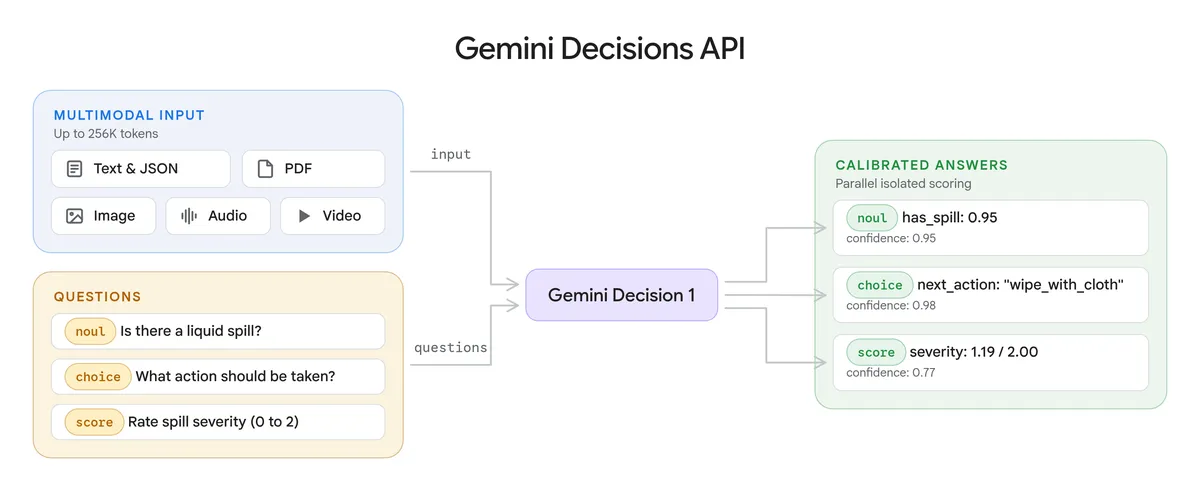
Two days later, on November 11, Google opened the same kind of model as an API. The Gemini Decisions API calls Gemini Decision 1, which generates no text and instead scores a fixed set of choices with probabilities. Where it parts ways with Strands Decider is scale. One request can carry up to 1,000 questions, and the inputs it accepts include text, images, audio, video, and PDF.
Input costs $0.10 per million tokens and output is free. In Google's own table it places first on 7 of 9 shared benchmarks, and it has the lowest calibration error, the measure of how closely the probabilities it assigns match how often it is actually right. We covered why running all seven of those evaluations cost 30% more than on the rival Jev 1.14 separately.
A Gemini API key is all you need, and on the free tier the input is free as well. Singapore appears on the same Gemini API region list as in the first item, and there is no Decisions-specific regional gate. It does not run on Vertex AI yet, so it requires the Gemini Developer API at v1beta and SDK 3.2 or later. If you have a call that classifies or screens text your users submit, send the same input through the free tier and check the probabilities that come back against your existing results.
5. Claude now joins the meeting, with a whiteboard and a spreadsheet
On November 10, Anthropic opened Claude Whiteboards and Claude Sheets in beta and Claude Data in general availability, and two days later put Claude Meetings into beta. Whiteboards is a shared board a team works on with Claude; Sheets is a spreadsheet Claude builds and edits alongside you. Data entered beta in October under the name Claude Dashboards, and the company renamed it on the grounds that how a company uses data is broader than a dashboard.
Meetings puts Claude into a video call as a visible participant, following the conversation and writing notes and action items. You can ask it something out loud during the call or type into the chat. It does not store audio, keeping only the transcript, the summary, and descriptions of what was on screen, and it posts a join notice in the call chat. Google Meet is the only platform supported so far.
All four are paid-plan only, on web, desktop, and mobile. The defaults differ per feature, which the table below lays out. Neither announcement names a country or language restriction, so a team in Singapore or anywhere else in APAC is on the same footing as one in San Francisco. If you are on a Team plan and a person is still writing the minutes, put Claude in the next Google Meet call and compare its notes against the human ones.
| Feature | Status | Team | Enterprise |
|---|---|---|---|
| Whiteboards | Beta | On by default | Off by default |
| Sheets | Beta | On by default | Off by default |
| Data | Generally available | On by default | On by default from November 20 |
| Meetings | Beta | Available by default, admin can turn it off | Admin must turn it on |
Source: two official Claude announcements (2026-11-10, 2026-11-12). The settings live under Artifacts in Organization settings. Data needs a connector such as a warehouse or CRM, and during the beta Meetings is unavailable to organizations on zero data retention (ZDR), a HIPAA configuration, or customer-managed encryption keys (CMEK).
6. Notion told users to rotate any password they pasted into Notion AI
On November 10, Notion disclosed that Notion AI chat logs left the company through a breach at an outside AI vendor. The vendor is Fireworks AI, the inference provider Notion had handling classification work for its Insights feature. Fireworks says it detected unauthorized use of internal credentials on October 6, and that a second intrusion on October 23 and 24 affected further customer data.
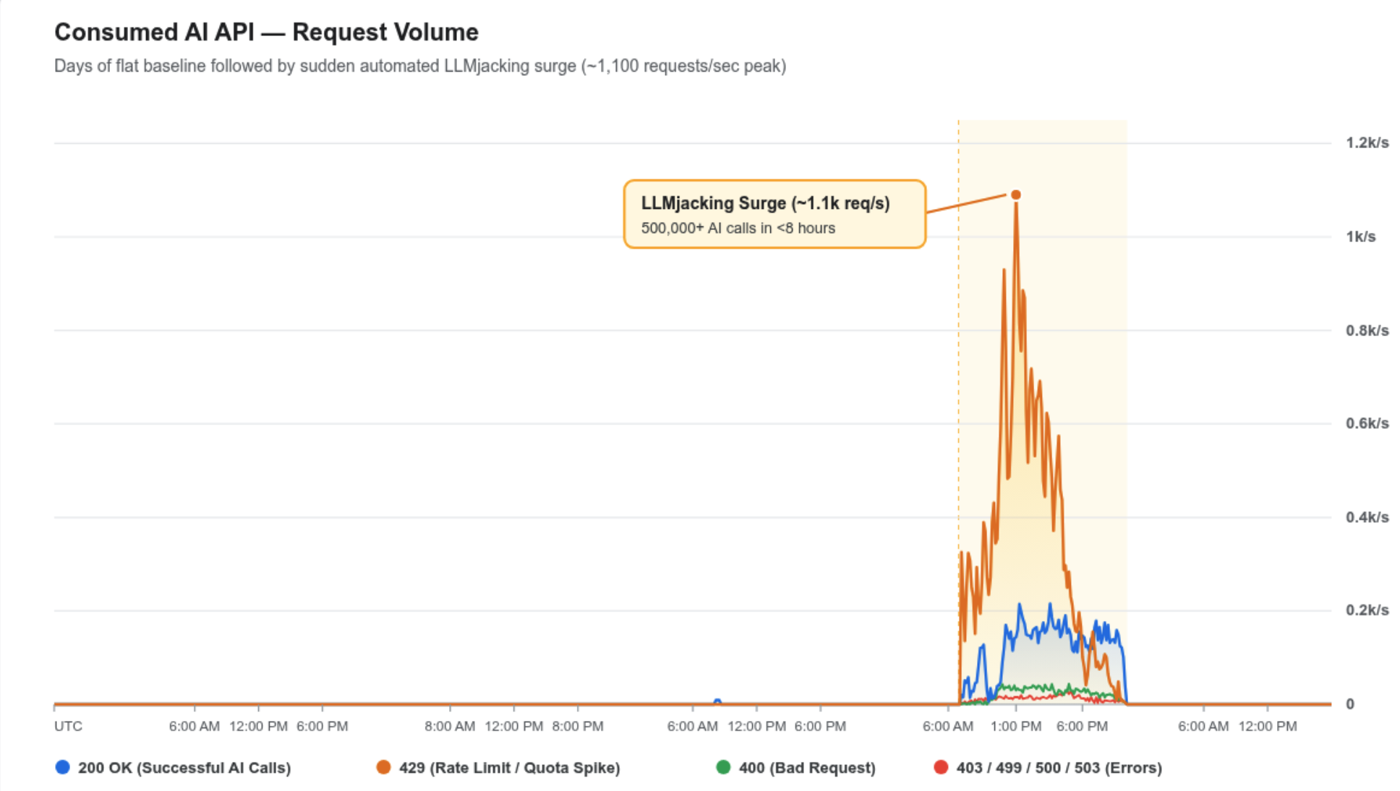
Notion was notified on November 6 and confirmed a new dataset on November 8. What left were Notion AI chat logs with no indication of who wrote them; content pulled from Notion pages through tool calls is not in the set. The scale is under 1% of Notion workspaces. We covered how the Fireworks breach spread in two stages, and the LLMjacking market that resells stolen keys separately.
No plan tier or region limits who is affected, and Notion contacts affected workspaces directly. If no message arrived, there is nothing to do. To check, open ? in the desktop browser sidebar and go to Security incident review; it is not available on mobile. If you have ever pasted a password or an API key into a Notion AI window, rotate it at the source. Notion said to treat those values as exposed.
7. More than 24,000 Lovable-built apps served database records with no login
An investigation finding that 24,664 web apps built with Lovable served their own database records to anyone who asked spread on November 14, reaching 985 points on Hacker News. The report comes from German security firm Crissy Field, which scanned 159,041 Lovable projects with the newspaper Handelsblatt and updates that paper's November 2 story. Of the 34,545 projects that connected Supabase, 24,664 sent database records the moment the page loaded, with no login and no other interaction.
What came out includes some 80,000 profiles and 200,000 chat messages from a German community forum, and about 1,000 identity verification records held by a service company, carrying passport numbers, expiry dates, and nationality. The report does not publish the access method, and warns against reading the 30% of sites with email-bearing records as a confirmed leak rate. It does not point at a specific setting such as Supabase row level security, saying only that database integrations in Lovable follow recurring patterns, which made many apps easy to sweep at once.
No Lovable plan or country condition applies: any app with Supabase attached is in scope. If one of yours holds real customer data, open it in a logged-out browser and look at whether table contents arrive in the network response. If that data belongs to people in Singapore, an open table is also a PDPA notifiable-breach question.
| Stage of the scan | Count |
|---|---|
| Lovable projects examined | 159,041 |
| Apps with Supabase connected | 34,545 |
| Served database records with no login | 24,664 |
| Apps where records contained email addresses | 7,403 (10,560 tables) |
Source: Crissy Field research report. The data was collected from Common Crawl between December 2025 and September 2026, and the report states it downloaded only portions of the datasets rather than pulling them whole.
The short version
The biggest item this week is Gemini 4 Hydrogen landing on the free tier. Its token price is double what 3.8 Flash launched at, yet it passed paid-only Argon on the Artificial Analysis index, and 3.8 Flash moves to the same price on January 1. Two decision models, which write nothing and only score a list of choices, opened in the same week, and Amazon used one to cut ticket classification cost 98%. Claude Fable 5.2 costs 20% less than Fable 5.1, and Claude gained whiteboards, spreadsheets, and a seat in your Google Meet calls. If you have ever pasted a password or an API key into Notion AI, rotate it today, and if you have a Lovable app with Supabase attached, open it in a logged-out browser. On Enterprise plans, Claude Data switches itself on on November 20.