YouTube Will Auto-Label AI Videos as Detection Moves to the Platform
YouTube is moving AI-generated video labels onto the player surface and adding automatic detection for realistic AI media. Here is what changes for creators, viewers, and AI product teams.
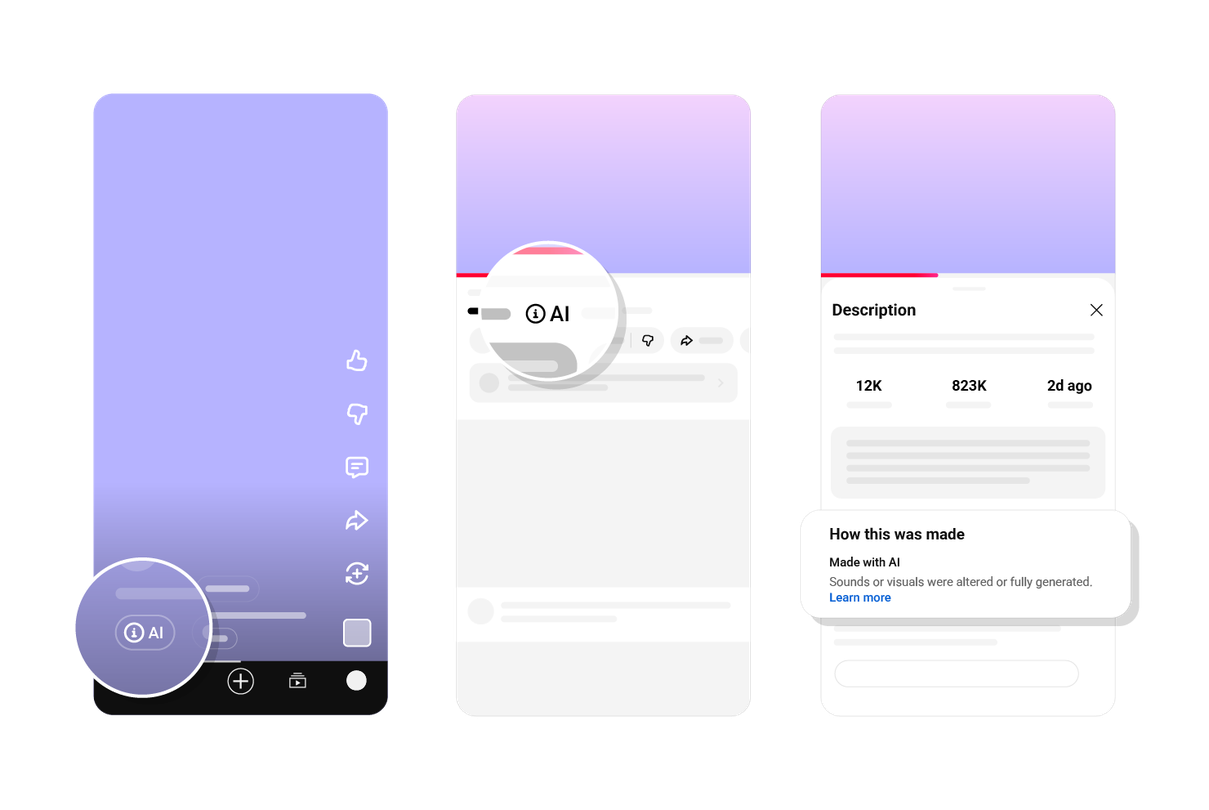
- What happened: YouTube will show more visible labels on realistic AI-generated or AI-altered videos and start applying some labels automatically.
- Long-form videos can show the label below the player, while Shorts can show it as an overlay on the video itself.
- Responsibility shift: The 2024 creator self-disclosure flow is now paired with platform-side detection for undisclosed realistic AI use.
- Exception path: Labels tied to
Veo,Dream Screen, orC2PAmetadata for fully generated AI content may not be removable.- YouTube says the disclosure label alone will not change recommendation treatment or monetization eligibility.
- Builder impact: AI media products now need label UI, provenance metadata, false-positive correction, and creator appeal flows in the same design.
YouTube said on May 27, 2026 that it is changing how viewers see AI-generated video labels. The short version sounds like a product polish update: labels for photorealistic and meaningfully AI-altered or AI-generated content will appear closer to the viewing surface. In long-form videos, the label can sit directly below the player and above the description. In Shorts, it can appear as an overlay on the video. YouTube also says that, starting in May 2026, its systems will use new internal signals to identify significant photorealistic AI use and apply labels even when a creator has not selected the disclosure manually.
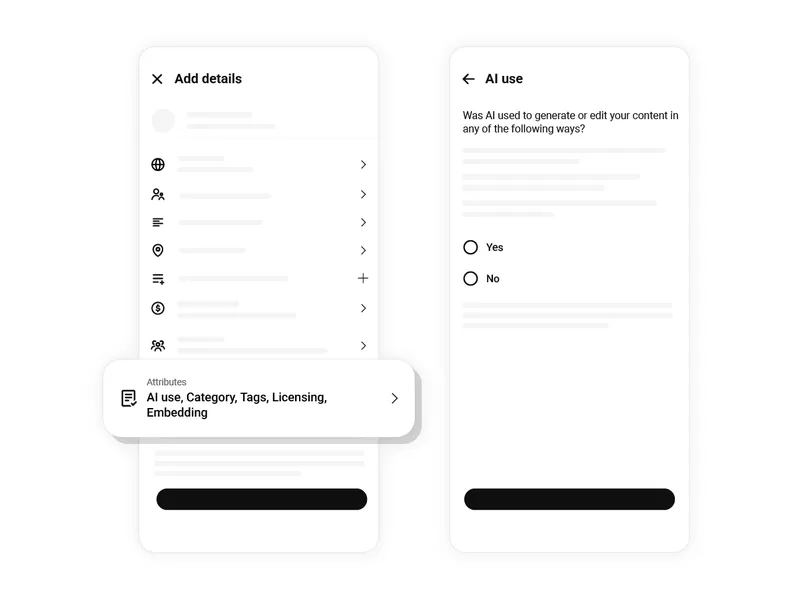
That makes the update larger than a label placement change. YouTube introduced an altered or synthetic content disclosure flow in Creator Studio in March 2024, asking creators to disclose realistic people, places, scenes, or events that could be mistaken for real footage. The 2024 model leaned on self-reporting, with YouTube reserving stronger intervention for content likely to mislead viewers on sensitive subjects. The 2026 update fills part of the self-reporting gap with platform-side detection.
For AI product teams, this is the part worth watching. A media platform can no longer treat "AI used" as a single boolean field. Generative media may touch the script, voice, background, music, thumbnail, captions, upscaling, editing, or the core video frames. The product question is not just whether AI appeared somewhere in the workflow. It is which part was generated, which signal proves it, where the viewer sees the disclosure, and who can correct the system when it is wrong.
 .
.
The label moves from the description to the player surface
The most visible change is location. YouTube describes a single label format for photorealistic and meaningfully AI-altered or AI-generated content. Long-form videos can show it just below the video player, above the description. Shorts can show it directly over the video. Less realistic content, animated content, and minor AI edits may still be surfaced in the expanded description instead of the main player surface.
That placement matters because the old disclosure surface was easy to miss. If a viewer needs to open and scan the description before they understand whether a realistic clip was generated, the label behaves more like a post-view notice than a viewing-context signal. In Shorts, where the interface is optimized for fast swiping, description-based disclosure is even weaker. Moving the label onto or near the player gives the viewer context before the clip has already done its work.
The harder design decision is label strength. A realistic AI-generated disaster clip, health claim, financial advice segment, or political scene needs a different level of disclosure than a stylized background, storyboard helper, or color correction pass. YouTube is still trying to separate realistic and meaningful AI changes from non-realistic or minor edits. That split is necessary because if every small AI assist receives the same high-friction warning, users learn to ignore the label.
Self-disclosure now has platform detection behind it
The second change is automatic labeling. YouTube says it is rolling out new internal signals to identify AI-generated content. If a creator does not indicate AI use but YouTube detects significant photorealistic AI use, YouTube can apply the label itself. The company is not removing the creator disclosure requirement. It is adding a platform decision layer for cases where the disclosure is missing.
Creator control does not disappear, but it changes shape. YouTube says creators who believe a label is incorrect can update the disclosure status in YouTube Studio. Two categories are treated differently: content made with YouTube's own AI tools such as Veo or Dream Screen, and content carrying C2PA metadata indicating fully AI-generated media. For those cases, YouTube says the disclosure label will remain permanently.
| Scenario | How the label is applied | Can the creator change it? |
|---|---|---|
| Creator discloses realistic AI use | YouTube displays the single AI label format. | Managed through the upload disclosure state. |
| Creator does not disclose, but internal signals detect AI use | YouTube applies the label automatically. | Creators can update the status in YouTube Studio if they believe it is wrong. |
| Veo or Dream Screen is used | Use of YouTube's own AI tools keeps the label attached. | The announcement describes this label as permanent. |
| C2PA metadata indicates fully AI-generated content | The label is applied based on provenance metadata. | The announcement describes this label as permanent. |
The C2PA detail is especially important. YouTube's help documentation says generative AI content may include a signed C2PA manifest, and other platforms can read that metadata to understand origin and authenticity. YouTube's decision to tie some non-removable labels to C2PA shows provenance becoming an input to policy enforcement, not just an archival note. A label can now be driven by a mix of upload declarations, internal platform signals, tool logs, and file metadata.
Recommendations and monetization are not changing, at least from the label alone
YouTube adds one sentence that matters for creators: the disclosure label alone will not affect how a video is recommended or whether it can be monetized. That is a stabilizing signal. If adding an AI disclosure automatically reduced reach or blocked ad revenue, creators would have a strong incentive to avoid disclosure. YouTube is positioning this label as viewer information, not as a punishment mechanism.
Viewers may read that differently. In a Hacker News discussion on May 27, 2026, many users said they wanted to filter or block AI-generated music, AI voice narration, AI thumbnails, or mass-produced AI videos. YouTube's announcement does not include a viewer-side AI content filter or recommendation preference. The label provides context, but it does not give viewers a direct control to see less of that category.
That gap will define the next policy fight. Platforms often describe labels as information. Viewers often expect labels to become choice. If recommendation and monetization systems stay unchanged, the label does not sharply alter the creator economy. If it later connects to personalization settings, ad suitability, YouTube Kids eligibility, search ranking, or topic-level demotion, AI-generated channels will receive a very different economic signal. YouTube did not make that connection in this announcement.
Voice, editing assistance, and filters remain harder to classify
The difficult part of an AI label is not the phrase "AI was used." It is deciding which use crosses the disclosure threshold. YouTube's 2024 guidance said creators generally did not need to disclose productivity uses such as generating script ideas or using automatic captions. It also excluded minor visual adjustments such as color correction, lighting filters, background blur, vintage effects, and beauty filters. The 2026 update keeps a similar distinction by separating realistic, meaningful AI changes from non-realistic, animated, or minor edits.
Voice is where the boundary gets messy. YouTube already has channels built around AI narration, AI music, AI-made background tracks, or synthetic presenters. The automatic detection language in this update is tied to "significant photorealistic AI use." Read narrowly, that phrase centers realistic visual content, not audio-only synthetic content. The announcement does not settle how YouTube will label AI voice, AI music, or AI thumbnails when the core video frames are not photorealistic AI.
For builders, this is a schema problem. A content record needs more than aiGenerated: true. At minimum, the platform needs separate fields for generated visuals, face synthesis, voice synthesis, music generation, script assistance, automatic captions, editing filters, upscaling, and first-party tool usage. The user's concern changes by context. In a news clip, the authenticity of the scene may matter most. In a music video, the source of the vocal, composition, and performance matters. In an educational video, the accuracy of the explanation may matter more than whether the narration voice was synthetic.
Child and education content pressure sits in the background
YouTube's post does not center YouTube Kids, but the timing is hard to separate from external pressure in spring 2026. On April 1, Fairplay and other child and consumer advocacy groups sent a letter to Google CEO Sundar Pichai and YouTube CEO Neal Mohan arguing that AI-generated videos targeting children were spreading across YouTube and YouTube Kids. The letter asked YouTube to clearly label all AI-generated content, ban AI-generated content from YouTube Kids, and stop recommending AI-generated content to users under 18.
The letter also argued that YouTube's existing altered and synthetic content label could be hidden inside the description, and that YouTube Kids did not show the same label. YouTube has not adopted the advocacy groups' full proposal here. The May 2026 update focuses on label visibility and automatic detection, not a ban on AI-generated children's content or a recommendation block for minors.
That difference reveals YouTube's policy choice. Google operates generative video tools such as Veo and Dream Screen, so it is not trying to push generative AI content off the platform. It is choosing a transparency path: make realistic AI content easier to see, then use internal detection and provenance data to catch undisclosed cases. Advocacy groups asked for restriction and recommendation limits. YouTube is starting with disclosure infrastructure.
False positives and misses are the first operational risk
Automatic labeling has two failure modes. A false positive puts an AI label on human-shot or human-edited footage. YouTube says creators can update the disclosure state in Studio, but the announcement does not describe the review process, the deadline, or the evidence standard. For a channel that gets most views shortly after publication, even a few hours of incorrect labeling can become a reputation problem.
A false negative leaves AI-generated media unlabeled. Detection becomes harder when C2PA metadata is stripped, a file is re-encoded, an external tool removes provenance data, or generated segments are composited into human-shot footage. As generative video models improve, visual artifacts become a weaker detection signal. YouTube's phrase "internal signals" likely covers more than a model classifier: upload paths, first-party tool logs, provenance metadata, account behavior, and content patterns may all contribute. The official post does not disclose the exact inputs.
Teams building similar systems need an appeal log and an audit trail from the beginning. The system should record which signal caused the label, what evidence a creator provided to dispute it, how the correction was decided, and how the same asset should be handled if it is uploaded again. A label backed by C2PA metadata is operationally different from a label backed by an internal model score, even if the viewer sees the same AI disclosure text.
Creator upload and manual disclosure
YouTube internal signals, first-party AI tool logs, and C2PA metadata
Player-adjacent label or Shorts overlay
False-positive correction, except for permanent labels from Veo, Dream Screen, or fully generated C2PA content
Trust UI is becoming part of AI infrastructure
The signal for AI developers is direct: trust UI is no longer an accessory for generative media products. A model launch or API endpoint is not the full product surface. The system also needs to decide which outputs receive which labels, how provenance metadata survives export, how false positives are corrected, and whether labels affect ranking, monetization, search, or user controls.
YouTube's special treatment of first-party AI tools and C2PA metadata also puts pressure on generation tool providers. If a tool writes durable provenance metadata, platforms can use that information for disclosure. If a tool writes no metadata, or makes it easy to strip, platforms fall back to visual detection and behavioral signals. C2PA, SynthID, watermarking, content hashing, and classifier-based detection are not perfect substitutes. In practice, large platforms will combine them.
Enterprise AI has the same governance problem at a smaller scale. Internal training videos, marketing clips, support demos, and synthetic voice guides need more than an "AI-generated" sticker. A company may need to know which segment was synthetic, who approved it, what source material was used, whether edits are logged, and whether the asset is approved for external distribution. YouTube's consumer-scale policy mirrors the questions enterprise content systems will face.
What creators should check now
Creators should start with the upload flow. YouTube's 2024 disclosure tool still matters. If a video realistically changes a person's face, uses a synthetic voice to make someone seem to say something, or generates a scene that could look like a real city, building, disaster, or political event, it may fall into the disclosure category. Script ideation, automatic captions, color correction, lighting filters, and background blur have been described as exceptions when they behave like production assistance rather than realistic synthetic media.
The second check is the toolchain. Content made with Veo or Dream Screen can carry a permanent disclosure label. Files from external generative tools that include a C2PA manifest can also trigger policy treatment. Re-encoding or editing a file should not be treated as a guaranteed way to erase provenance risk. YouTube says it uses internal signals, and it has not listed the complete set of signals used for final decisions.
The third check is audience communication. YouTube says the label alone will not change recommendation treatment or monetization eligibility, but viewer trust is separate from platform economics. If AI voice, AI music, or AI video synthesis is central to a channel's production method, the creator can explain in the description, pinned comment, or channel page which parts are generated and which parts are human-produced. The official label may say "AI used"; the creator can explain where and how.
Viewers still do not get a real control surface
The viewer benefit is easy to understand. If a realistic AI label appears close to the player, or as an overlay on Shorts, more people will see it before they make a judgment about the clip. For news, health, finance, education, and crisis footage, the first few seconds matter. Label location can change whether a viewer treats a scene as evidence or as synthetic media.
The missing piece is control. Some viewers may want to reduce AI-generated videos, hide AI voice narration, flag AI thumbnails, or separate AI music channels from human performances. YouTube has not announced those controls. The label tells the viewer something; it does not reduce the amount of labeled content the viewer sees.
There is also a trust problem around label accuracy. If automatic detection is imperfect, an unlabeled video may still be AI-generated and a labeled video may be wrongly labeled. Creators can dispute labels, but viewers cannot see the dispute process. Over time, confidence in the label will depend on how clearly YouTube explains accuracy, false-positive handling, correction history, and enforcement standards in sensitive categories.
Why this small label is a larger platform event
YouTube's May 2026 update compresses the operating model for generative media platforms. Creation tools are spreading inside and outside the platform. Viewers have a harder time separating human-shot media from generated media. Creators use productivity tools and synthetic media tools in the same workflow. In that environment, "please disclose it yourself" is not enough. YouTube is adding automatic detection, moving labels closer to the viewing surface, and making some provenance-backed labels permanent.
At the same time, YouTube is not tying the label to recommendations or monetization. That keeps the immediate creator-economy impact limited, but it also leaves viewer choice mostly at the awareness layer. The update is not the restrictive policy that child-safety advocates requested. It is a visible piece of trust infrastructure.
Teams building AI media products should treat this as a design prompt. They will need to decide where labels appear, how metadata survives export, how classifier errors are corrected, and whether users get filters or ranking controls. The hard part may not be model quality. It may be the operating contract around the generated asset. YouTube's small label below the player is a sign that responsibility is moving from creator self-reporting toward platform systems.
Sources
- YouTube Blog, Improving AI labels for viewers and creators.
- YouTube Blog, How we're helping creators disclose altered or synthetic content.
- YouTube Help, Optimize text & image posts.
- Hacker News, YouTube to automatically label AI-generated videos.
- Fairplay and partner groups, YouTube Letter: AI-Generated Content for Kids.
- Ars Technica, YouTube to begin automatically labeling AI videos.
- TechCrunch, YouTube will now automatically label AI videos.