OpenRouter Raises $113M as Model Routing Becomes AI Infrastructure
OpenRouter raised $113M after reaching 25T weekly tokens, 8M+ developers, and 400+ models. The round turns model routing into an infrastructure question.
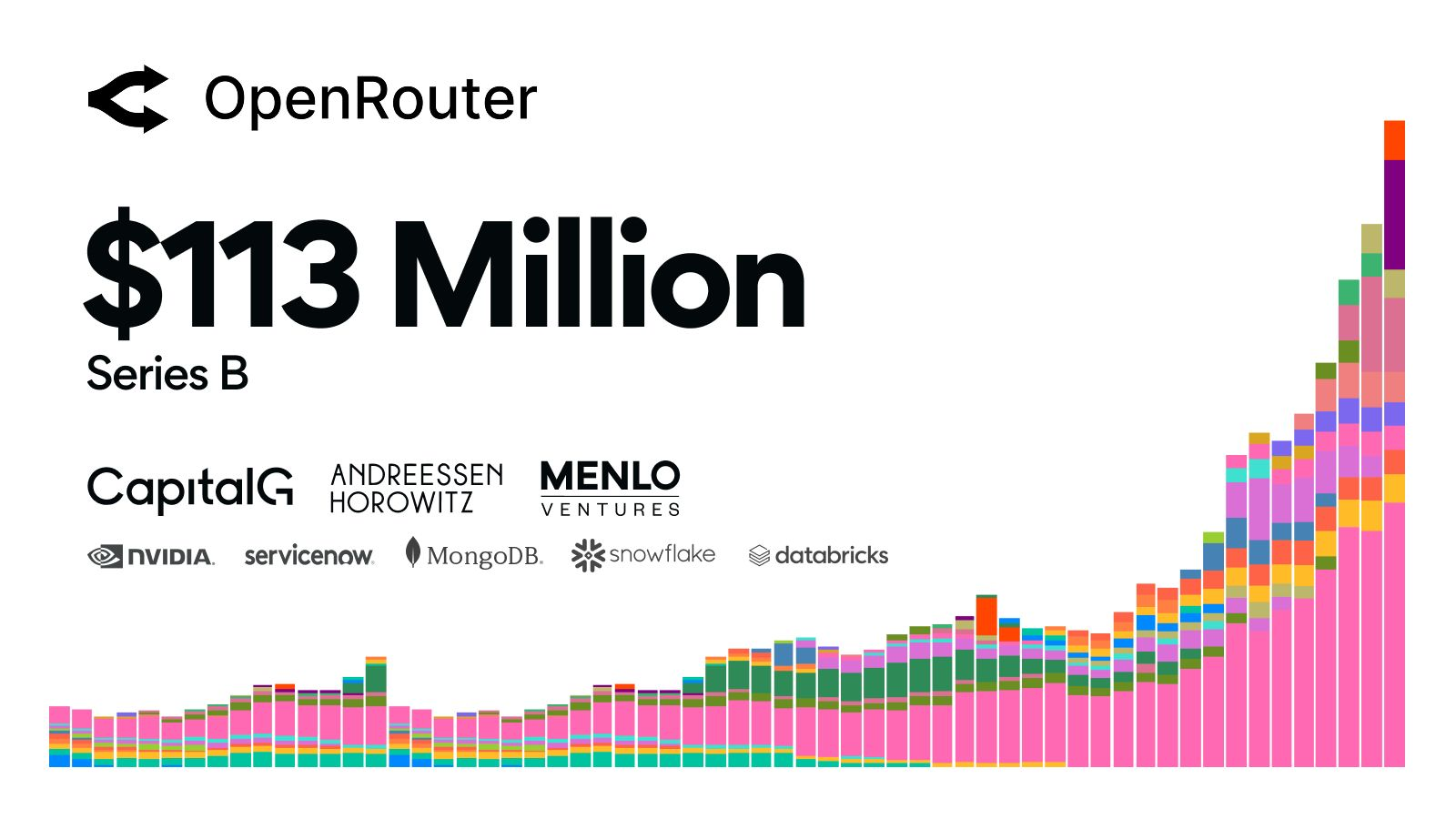
- What happened: OpenRouter raised $113 million in a Series B led by CapitalG.
- The company also reported 25 trillion weekly tokens, 8M+ developers, and access to 400+ models.
- Why it matters: Model choice is becoming an operating layer for
routing, cost caps, failover, caching, and compliance. - Watch: Hacker News users praised billing caps and experimentation speed, then debated direct provider calls, cache hit rates, and data boundaries.
- Agent traffic carries prompts, tool outputs, code diffs, and long context, so gateway selection becomes part of the security design.
OpenRouter announced a $113 million Series B on May 28, 2026. The lead investor is CapitalG, Alphabet's independent growth fund. Other participants include NVentures, ServiceNow Ventures, MongoDB Ventures, Snowflake Ventures, Databricks Ventures, AMP PBC, Pace Capital, and existing investors Andreessen Horowitz and Menlo Ventures. The amount raised is only part of the story. OpenRouter said its weekly throughput grew from 5 trillion tokens to 25 trillion tokens over the previous six months. It also said it is on pace to process more than one quadrillion tokens this year, with more than 8 million developers using more than 400 models.
This is narrower than a generic "AI API aggregator gets funding" story. OpenRouter sits between applications, agents, and model providers such as OpenAI, Anthropic, Google, xAI, DeepSeek, and Mistral. It gives developers one interface for trying, comparing, and switching models without wiring separate accounts, billing flows, SDKs, rate limits, and fallback paths for every provider. OpenRouter's announcement describes the company as sitting between "agents and model providers" because that is where the operational pressure now lands. Once an agent calls models repeatedly, which provider receives each request and where the request goes after failure becomes a product-quality and cost decision.
Modern AI applications increasingly look like batches, routers, caches, and fallback trees instead of one model call. A coding agent may use different models for repository search, planning, patch generation, test failure analysis, and review comments. A support agent may use a cheaper model for intent classification, a stronger model for refund policy decisions, and a transcription model for voice input. A research agent may split search summarization, long-document comparison, and final report writing. In those systems, "the best model" is less actionable than the cost and failure boundary for each step.
The investor list reinforces the company's message. CapitalG brings Alphabet-linked growth capital, and NVentures is NVIDIA's venture arm. ServiceNow, MongoDB, Snowflake, and Databricks are tied directly to enterprise workflows, databases, and cloud data platforms. OpenRouter described these investors as infrastructure and platform companies that enterprises already depend on. That sentence is promotional, but the direction is clear. A model router is being sold less as a consumer-chatbot convenience feature and more as a control surface for enterprise AI workloads.
OpenRouter highlighted three product areas in the announcement. The first is multimodal inference beyond text. The company mentioned support for image, audio, speech, transcription, embedding, and video models. The second is enterprise controls, including Workspaces, spend management, guardrails, and a zero-data-retention policy. The third is intelligent routing, including provider-level failover, cost and latency optimization, and quality-aware routing. All three categories are operational. The pitch is no longer only that many models are available in one catalog.
The timing is visible in the 25 trillion weekly token figure. Tokens are the meter for AI workloads. They are a rougher measure than revenue or active usage, but they expose the combined effect of inference cost, context length, retries, cache behavior, and agent loops faster than simple user counts. Growth from 5 trillion to 25 trillion weekly tokens in six months does not only imply more signups. It likely includes longer prompts, more tool calls, more automation, and longer agent sessions. OpenRouter connected the growth to production apps and agents, not only experiments.
That is where the practical question for development teams begins. Calling model providers directly gives a team more exact control over provider-specific features, pricing, and contracts. Using a router makes it easier to test multiple models and centralize keys, billing, and fallback. The right answer depends on traffic volume, compliance needs, vendor agreements, latency targets, and incident response. Small teams and fast-moving product groups get a real benefit from one account and spending caps. Teams spending billions of tokens per month may prefer direct provider contracts, reserved capacity, dedicated endpoints, or their own gateway.
The Hacker News reaction showed both sides. The May 30, 2026 thread about OpenRouter's Series B reached 355 points and 172 comments after eight hours. Simon Willison wrote that he initially did not understand why someone would put a proxy in front of an LLM. He later pointed to low-friction model experimentation, billing caps for public services, and model popularity signals in rankings as useful reasons. Other commenters said consolidated billing helps enterprise teams get through internal bureaucracy.
The objections were also practical. One user argued that at scale, moving to first-party APIs can be better for price and direct integration. Another part of the thread focused on provider-specific prompt cache hit rates. One comment said Kimi K2.6 through the Cloudflare route often showed cache rates in the 80 to 90 percent range. Replies questioned whether other model combinations showed close to 0 percent cache and whether DeepSeek V4 had caching problems. Agents repeatedly send long conversation history, tool descriptions, and repository context, so cache hit rate can change the bill. A router's quality includes whether it preserves prefix caching, not only whether it returns a successful response.
Data boundaries came up as well. Some Hacker News users worried that inputs and outputs sent through free models or aggregator routes could end up in training databases. Others argued that OpenRouter traffic mixes many end users, system prompts, and model calls, making it less immediately useful as training material. Another reply pointed out that distillation or usage analytics could still make the data valuable. This is not a question about OpenRouter alone. An AI gateway is where prompts, responses, tool outputs, code snippets, and search results pass through the system.
App and agent requests
Model router: cost caps, failover, cache, policy
Security teams should pay attention to API-key blast radius. One key that can reach more than 400 models simplifies developer experience. It also expands the impact if the key leaks into a frontend bundle, log stream, or CI secret. That is why OpenRouter's spend management and Workspaces are not just convenience features. They are risk controls. Without per-team key scope, monthly budgets, per-key caps, model allowlists, and audit logs, a model gateway can become a wide door through which all AI spending leaves the organization.
Privacy cannot be reduced to a zero-data-retention label. Teams need to verify what OpenRouter stores, what upstream providers receive, and which policy applies to which route. Abuse monitoring and billing analytics may retain metadata even when prompts and outputs are not stored. Enterprise workspaces and free model routes may also have different constraints. Teams handling customer PII, medical or financial data, source code, or unpublished research need to separate "the model provider does not train on this" from "the gateway does or does not log this." Agents make that distinction larger because they paste tool outputs and internal documents into model calls.
Billing caps drew positive comments because metered APIs can create large bills quickly. If an agent gets stuck fixing the same failing test, expands duplicated retrieval results, or loops through a browser automation task, token usage can climb overnight. Per-key limits and refill policies are closer to incident containment than developer-experience polish. If the benefit of OpenRouter is a single endpoint, that endpoint also needs to be a budget circuit breaker.
Caching and routing form the next cost axis. Prompt caching lowers the cost of repeated long system prompts, repository summaries, tool schemas, and policy documents. But cache behavior depends on provider, model, stable prefixes, and request routing. If a router sends each request to a different upstream instance or provider, cache hit rate may fall. If a router uses provider state and cache information well, it may choose a better path than direct calls. The Hacker News discussion focused on cache hit rate because the difference shows up as real money, not as an abstract architecture preference.
Feature compatibility needs the same scrutiny. An OpenAI-compatible API helps tools and SDKs connect quickly, but model providers differ in tool calling, structured output, reasoning controls, image input, audio output, safety refusals, and token accounting. Sending the same schema does not guarantee the same behavior. A code review agent that must return valid JSON may fail if the fallback model's structured-output reliability is weaker. A support agent making refund decisions may change business behavior if a fallback model applies policy differently.
OpenRouter's Series B also sharpens the competitive category around Vercel AI Gateway, LiteLLM, Portkey, WaveSpeed, and cloud-provider gateways. The starting points differ. Cloud providers already have compute, identity, network, and compliance contracts. Vercel attaches model access to web app deployment and AI SDK usage. LiteLLM is strong as an open-source proxy and self-hosted gateway. WaveSpeed is bundling LLM and generative-media models into one platform. OpenRouter is strongest as a marketplace with ranking, multi-provider billing, and low-friction model switching.
This market will not be decided only by model count. Model catalogs become commodities quickly. Longer-lasting criteria include latency distribution, upstream outage handling, per-model feature parity, enterprise logging, and data-retention options. Budget guardrails, cache efficiency, and pricing transparency belong on the same list. Teams learn more from outages than dashboards. When an Anthropic API path slows down, which model received the fallback request? Did the fallback break tool calls? What was rejected when the budget cap was reached? Those behaviors determine product trust.
OpenRouter's phrase "quality-aware routing" should therefore be read carefully. Quality cannot mean a generic benchmark score alone. For coding agents, quality means test pass rate, patch size, reviewability, and adherence to repository conventions. For support agents, quality means escalation rate, refund errors, policy violations, and average handling time. A router can only be genuinely quality-aware if it receives evaluation signals that match the team's own work. Otherwise, routing decisions collapse into an abstract score for "good model."
The practical conclusion for builders is clear enough. First, model routing is no longer just a side-project convenience layer. The 25 trillion weekly token figure is evidence that aggregator paths are carrying production traffic. Second, AI architecture reviews need a model-gateway section. Which data crosses the gateway? Which key can call which models? Where are cost limits enforced? How are fallback results validated? Third, direct provider contracts and gateway usage are not mutually exclusive. High-risk or high-volume paths can go direct, while experiments, long-tail models, and comparative evaluation can run through a gateway.
OpenRouter's Series B is a vote for a routing company, not a model lab. That vote says the bottleneck in AI infrastructure has moved from "can we reach a model?" to "can we use many models safely, cheaply, and without outages?" For teams building agent products, the funding number is less important than the operating layer behind it. Cost overruns, provider incidents, cache misses, and data-retention questions will increasingly appear behind model choice. OpenRouter's $113 million round is a current marker that this layer is becoming an independent market.