AI Broke an Erdos Conjecture, and the Real Story Is the Verification Loop
OpenAI’s unit-distance counterexample shows that AI research automation depends less on answer generation than on proofs experts can inspect.
- What happened: OpenAI says an internal general-purpose reasoning model disproved a long-standing Erdos unit-distance conjecture.
- The result gives an infinite construction that beats the old
n^(1+o(1))expectation from the 1946 problem.
- The result gives an infinite construction that beats the old
- Why it matters: The model connected a discrete-geometry problem to algebraic number theory, then external mathematicians reviewed the proof.
- Watch: OpenAI has not disclosed the internal model name or full chain of thought, so the durable signal is the verification workflow, not a replacement narrative.
OpenAI made a strong claim on May 20, 2026: an internal general-purpose reasoning model had disproved a long-standing conjecture around Paul Erdos's 1946 unit-distance problem in the plane. The problem sounds almost elementary. If you place n points on a plane, how many pairs of points can be exactly distance 1 apart? The question has been a representative problem in combinatorial geometry for nearly 80 years.
OpenAI's claim is not merely that a model guessed a clever answer. The company says the model found an infinite family of point configurations with more unit-distance pairs than the lattice-style constructions long believed to be essentially optimal. It also says external mathematicians checked the proof, and that a separate companion note was released to explain the context. The official post includes comments from mathematicians such as Noga Alon, Tim Gowers, Arul Shankar, and Jacob Tsimerman. Gowers, in particular, framed the result as a milestone for AI in mathematics.
This matters for AI builders because the interesting part is not the headline version, "AI solved math." The more important signal is where research automation is moving. A model produced a long argument, the work was packaged in a form experts could inspect, and human mathematicians then clarified, reviewed, and refined its meaning. As with coding agents, where tests, logs, and code review are now part of the product surface, science and math agents will be judged by the quality of their evidence trails.
What Was Broken
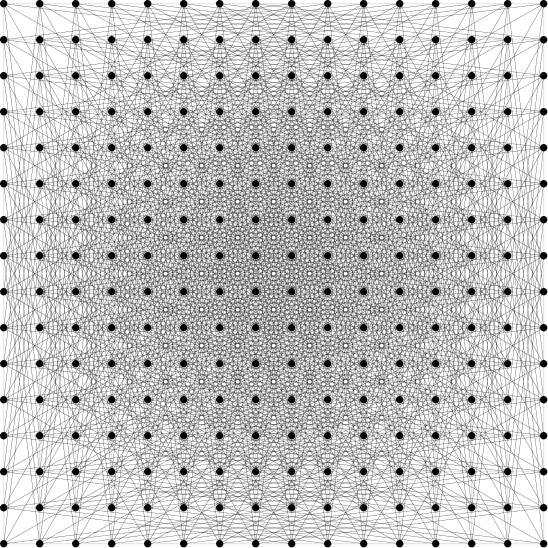
The planar unit-distance problem defines u(n) as the maximum number of pairs at distance 1 among n points in the plane. If you put the points in a line, you can get roughly n-1 unit-distance pairs. If you use a square grid, you get about 2n. Erdos's classical constructions and later variants did a little better, and for a long time many mathematicians believed these lattice-like constructions were close to the right answer.
Technically, the expected upper bound had the shape n^(1+o(1)). The term o(1) goes to zero as n grows. In plain language, the number of unit-distance pairs might grow slightly faster than linearly, but not by a fixed positive exponent. OpenAI says the new proof gives, for infinitely many n, at least n^(1+delta) unit-distance pairs. The original AI proof did not provide an explicit value for delta, but OpenAI says Princeton's Will Sawin later refined the argument to allow delta = 0.014.
That number can look tiny from outside mathematics. It is not tiny in the structure of the claim. A vanishing extra exponent and a fixed positive exponent are qualitatively different. If the old intuition was "lattices are basically the ceiling," this result says deeper number-theoretic structure can push beyond the lattice picture.
Why Algebraic Number Theory Appears
One reason the OpenAI post is interesting is the shape of the counterexample. The unit-distance problem looks like elementary geometry: place points, measure distances, count pairs. The new proof, however, uses algebraic number theory. OpenAI explains that Erdos's original lower bound can be understood through Gaussian integers, numbers of the form a + bi, which naturally map onto the plane lattice.
The new proof extends that intuition into more complex algebraic number fields. OpenAI specifically mentions infinite class field towers and Golod-Shafarevich theory. These are known tools in algebraic number theory, but they were not obvious candidates for improving a discrete-geometry construction in the plane. The mathematicians' reactions focus on that bridge: the work is not just a brute-force search over configurations, but a proposal to connect two areas that did not seem so close.
That is the important AI-research-automation angle. Many people imagine AI contributing to science through literature search, calculation, or proof-assistant workflows. In this case, OpenAI makes a stronger claim: a general-purpose reasoning model, not a math-specialized model or problem-specific proof-search scaffold, produced the route for one problem from an Erdos problem set. If that description holds, the model is acting less like a tool caller and more like a research-hypothesis generator.
This is also where caution matters. OpenAI has not published the internal model name, training details, or the complete chain of thought. What is public is the official explanation, the proof PDF, the companion remarks, and a shortened reasoning trace. Outsiders can inspect whether the published proof is mathematically valid and whether the verification process means what OpenAI says it means. The exact discovery path inside the model remains only partially visible.
Verification Is the Main Event
"AI solved a math problem" is an easy headline to overstate. The more durable part of this announcement is the verification structure. OpenAI released the proof and a companion note, and says external mathematicians reviewed the argument. The companion note gives context that the raw proof alone would not provide. Thomas Bloom, in the companion discussion, asks whether the result improves our understanding of discrete geometry and answers in a cautious but positive direction.
That structure resembles good coding-agent practice. A patch from an agent is not the end of the story. You still run tests, read the diff, inspect logs, and ask reviewers to check the intent. In mathematics, the corresponding machinery is proof review, explanatory notes, expert assessment, and follow-up refinement. For an AI-generated result to become useful knowledge, it has to survive human-readable inspection.
General-purpose reasoning model proposes a counterexample and proof path
OpenAI publishes a proof PDF and shortened reasoning trace
External mathematicians review the proof and write companion remarks
The mathematics community rechecks meaning, limits, and possible generalizations
The same principle applies to AI products outside mathematics. As model outputs become stronger, "the model said so" becomes a weaker form of evidence, not a stronger one. Teams need to know what problem definition the model received, what tools or documents it used, which candidates were rejected, who reviewed the result, and where the model's contribution ends and human cleanup begins. OpenAI's announcement is interesting less as a victory lap for answer generation than as a format for folding AI output into public knowledge.
What the Community Is Debating
The reaction mixes surprise with caution. On the mathematics side, people are reading the proof and companion remarks to understand the construction itself. Discussions have focused on how Golod-Shafarevich ideas and class field towers enter the unit-distance problem, what role the original AI proof played, and how Sawin's refinement changes the explicit bound.
The machine-learning community is asking different questions. What exactly does "general-purpose reasoning model" mean here? How can outsiders evaluate the claim that there was no problem-specific search scaffold? Could related ideas have appeared in training data? How much of the final result came from the model, and how much from human mathematicians who reviewed and refined it? TechCrunch also framed the story against earlier AI-math claims that looked impressive before verification became shakier, while noting that this time mathematicians appear to agree with the result.
That caution is not cynicism. It is the procedure the field needs. AI-generated scientific results create new provenance problems. Who is the author? How much of the internal reasoning should be disclosed? If a human cleans up the proof, how should the original model contribution be represented? Coding agents already raise a version of this problem: an organization remains responsible for a patch even when an agent wrote it. In mathematics and science, the same issue expands into authorship, verification, and public record.
The Google DeepMind Comparison Changes Too
In AI mathematics and science, the most obvious comparison is Google DeepMind. DeepMind has invested in systems such as AlphaGeometry, AlphaProof, AlphaEvolve, and Co-Scientist. Google's approach often emphasizes search, formal reasoning, experimental loops, and tools that are specialized for particular scientific or mathematical domains. OpenAI, in this announcement, puts the emphasis on a general-purpose reasoning model producing an important result without a specialized scaffold.
That difference may become a central axis of competition. One path is specialized research systems: formalize the problem, attach strong checkers, and search the space systematically. The other path is general reasoning: connect knowledge across fields and propose directions humans did not anticipate. In practice, serious products are likely to combine both. A general model can propose candidates, while specialized verifiers and human experts filter them.
For developers, the competition is less about a single smarter model and more about a better research runtime. In mathematics, that runtime might include proof checkers, literature graphs, problem databases, and expert-review workflows. In life sciences, it adds experimental data, safety review, wet-lab validation, and regulatory checks. In software, it includes tests, CI, sandboxes, security policy, and code-owner review. Agent performance will increasingly be measured as a coupling between model and verification environment.
"AI Replaces Mathematicians" Is the Wrong Reading
The weak version of this story is "AI beat mathematicians." The public structure points somewhere more useful. The model produced a strong idea. Human mathematicians read it, evaluated it, contextualized it, and refined it into a more explicit statement. This raises the possibility that AI can be a meaningful discoverer, but it also shows that discovery only becomes community knowledge through human judgment.
Mathematics is a good testbed for AI reasoning because claims are, at least in principle, checkable through proof. That same checkability also raises the standard. If the public proof is wrong, the headline collapses quickly. If it withstands expert scrutiny, the model's contribution becomes much easier to discuss with precision.
This is the broader lesson for AI agents. Stronger agents will produce more drafts: code, proofs, experiment plans, investment analysis, legal documents, and security reports. The bottleneck shifts from generation to verification. Who reviews the output? What evidence must be attached? Which logs are preserved? What happens when the output is wrong? These are not secondary governance questions. They are product questions.
What Builders Should Take Away
First, AI products in high-stakes domains need verification interfaces more than answer interfaces. OpenAI did not only publish a claim; it published proof artifacts and surrounding commentary. Products that ask users to trust important outputs need comparable evidence paths: sources, intermediate judgments, rejected alternatives, reviewer notes, and limits.
Second, the boundary between general models and specialized tools is being redrawn. OpenAI's framing stresses the general-purpose model, but the reason the result is credible is the combination of public proof and expert review. Generality becomes practical value only when it is paired with domain-specific verification.
Third, AI research automation changes expert work rather than eliminating it. People may spend less time generating every candidate from scratch and more time selecting questions, reviewing more candidates, and deciding which results have meaning. That is not easier work. It raises the value of strong reviewers.
Finally, this is an AI safety story too. A mathematical proof is a relatively safe form of powerful reasoning. Move the same capability into biology, cybersecurity, materials science, or financial strategy, and the consequences become more complicated. OpenAI's own framing stresses that human judgment still matters. As models become more creative research partners, disclosure norms, verification procedures, and access controls have to mature with them.
The most accurate reading is not that AI defeated mathematicians. It is that an AI system proposed a counterexample to an Erdos conjecture, and mathematicians turned that proposal into inspectable knowledge. The next phase of AI research automation will be judged by how reliably that loop can scale.