Google Scored Gemini 4 Neon's Cyber Risk With Argon, a Model 10 Points Weaker
Gemini 4 Neon shipped on November 18 scoring 60 on Artificial Analysis, 10 points above Argon, at half the time per task. Google ran no new critical capability evaluations and carried the cyber risk verdict forward from Argon, and the full safety report missed launch day.
- Gemini 4 Neon scores 60 on Artificial Analysis, 10 points above Argon, at half the time per task.
- Google ran no new risk evaluations and carried Argon's cyber verdict forward to Neon.
- The API runs
$3and$15per million tokens, 25% under Argon's December price.
Google shipped a model it calls state of the art at finding and exploiting software vulnerabilities, and did not run new critical capability evaluations on it. The Gemini 4 Neon model card, published with the model on November 18, says the cyber risk verdict was carried forward from Gemini 4 Argon, a model that sits 10 points below Neon on the Artificial Analysis intelligence index. The full Safety and Security Report did not ship on launch day; the model card says only that it is coming "in the coming days."
Google's own announcement led with a 32% lower cost per task and a third-place overall ranking. The carried-forward verdict is in the model card, not the blog post.
What Improved Over Argon
Neon is the middle tier of the Gemini 4 family. It sits between Carbon, built for the hardest long-horizon work, and Hydrogen, built for light everyday requests, and it replaces Argon in the Gemini app. The model card describes Neon as "adapted from Gemini 4 Carbon."
Compared at the same high thinking level, Neon scores higher than Argon and finishes faster. The figures below were read from the Artificial Analysis model pages on November 20.
| Model (thinking level) | AA intelligence index | Time per task | Output speed | API price (from Dec 1) |
|---|---|---|---|---|
| Neon (high) | 60 | 14.8 min | 101 tokens/sec | $3 / $15 |
| Argon (high), the predecessor | 50 | 29.2 min | 66 tokens/sec | $4 / $20 |
| Carbon (high), the top tier | 60 | 37.5 min | 55 tokens/sec | $4 / $20 |
API prices are per million input and output tokens. Argon and Carbon run at a discounted $2 and $10 through November 30. Sources: Artificial Analysis model pages, Google AI Studio pricing
- Neon matches top-tier Carbon's 60 while spending about 40% of Carbon's time on a task. Google puts the cost per task 32% below Carbon's.
- Raise the thinking level to xhigh and the score is 61. Google's announcement calls that "#3 overall," while the Artificial Analysis page ranks it 6th of 95 models. First place is Claude Fable 5.2 at 65.
- Google's benchmark table compares Neon only against Claude Opus 5.5 and GPT-6.2 Sol. On AutomationBench, which measures multi-step work automation an agent handles on its own, Neon scored 56.3% against Opus 5.5 at 42.5% and Sol at 41.3%. It lost narrowly to Opus 5.5 on the terminal-work benchmark Terminal-bench 4.1 (65.2% to 65.8%) and on the code-writing benchmark FrontierCode 2.0 (46.2% to 47.3%).
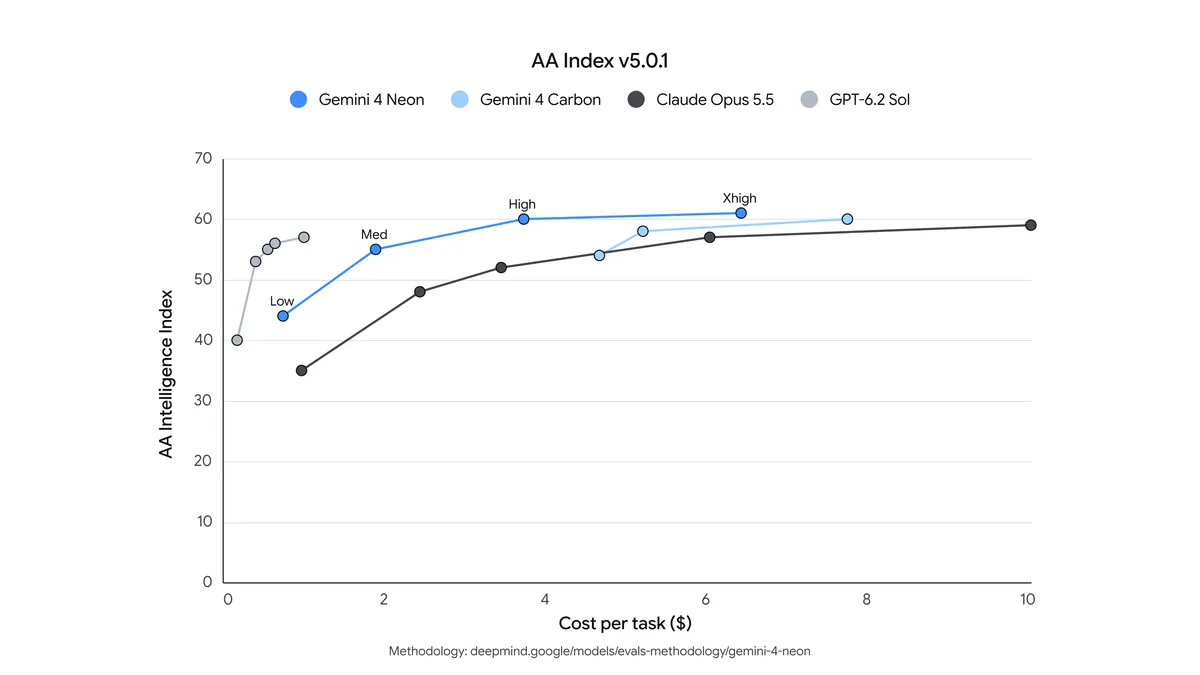
On price, Neon is not the cheap option. In Google's own chart below, GPT-6.2 Sol finishes a task for roughly $1 and scores 57. Neon's 60 at the high thinking level costs about $3.70 per task. Whether three index points are worth more than triple the cost per task depends on the workload.
Why the Risk Verdict Came From Argon
When Google ships a frontier model, it separately tests whether the model's capabilities in areas such as bioweapons and cyberattack have crossed a danger threshold. That process is the Frontier Safety Framework. The framework allows skipping the full battery when the new model is judged not to be meaningfully more capable than the last model that went through it. That judgment is the material capability change (MCC) assessment.
The sequence recorded in the Neon model card runs like this.
- The last model to receive full critical capability evaluations was identified as Argon.
- The MCC assessment comparing Neon against Argon concluded that general capability had increased but stayed below the threshold.
- So the critical capability evaluations were not run, and Argon's determinations were carried into every category, marked "carried forward from Argon."
Among the carried-forward determinations, the cyberattack category reads "CCL cannot be ruled out," meaning Google cannot rule out that the model has reached a critical capability level. The bioweapons category and the category covering whether a model could evade oversight and weaken human control read the same way. The verdicts are not reassuring ones that were reconfirmed. They are warning-level verdicts from Argon that were not measured again.
The awkward part is that security capability is what Google put at the front of the same launch.
Google calls Neon state of the art on all three, and says that on ExploitGym, which runs full attack scenarios, Neon reached top-tier results using half the tokens Carbon needs. A Fairwind program that gives security organizations early access to Neon starts within days. Offense and defense draw on the same capability, so these scores are exactly the input a cyber risk determination works from. That determination was measured on a model 10 points behind.
Google did not break its own process. The framework permits the skip, and the model card says launch-stage safeguards against cyber and biological misuse were strengthened. But the 10-point gap over Argon, and the parity with top-tier Carbon, are Google's own marketing numbers. No published document yet shows the reasoning that put that gap below the threshold. The Neon-specific safety report that would carry it had still not appeared as of November 20, two days after launch.
Can You Use It Today
The API is open now in Singapore and across most of APAC. Google's supported-countries list for the Gemini API and AI Studio includes Singapore, Japan, Australia, India, Indonesia, Malaysia, Thailand, Vietnam, the Philippines, Taiwan, New Zealand, and South Korea, along with the EU member states and the UK. Hong Kong and mainland China are not on it. Neon itself is paid-tier only; the single Gemini 4 model still callable on the free tier is Hydrogen.
| Route | Who and how much | Conditions |
|---|---|---|
| Gemini API | $3 input, $15 output per million tokens. Batch is half price | Paid tier only, model ID gemini-4-neon |
| Gemini app | Google AI Pro and Ultra subscribers | The announcement names no country restriction |
| GitHub Copilot | Pro+, Max, Business, Enterprise | Generally available, billed at provider list pricing under usage-based billing. Free and Pro excluded |
| Google Antigravity | Paid AI Pro and Ultra subscribers | Desktop app, CLI, IDE extension |
| Google Cloud Agent Platform | Verified enterprise accounts | Locations are global, us, and eu only. No Asia region |
The enterprise route is where location matters most for APAC teams. The Agent Platform model page lists Neon in global, us, and eu only, with ML processing in the multi-region us and eu. There is no asia-southeast1 or any other Asia region, so requests from Singapore are served and processed outside the region. Teams whose prompts carry personal data have a cross-border transfer question to answer under Singapore's PDPA before they route production traffic through it, and the same applies to anyone who moved to Argon in an Asia region and now has to set location to one of the three Neon supports.
A few places where code breaks when you move from Argon. This part applies to developers only.
- Sampling values such as
temperatureandtop_pare ignored and fixed, and passingthinking_budgetorthinking_level="MINIMAL"returns an HTTP 400 validation error. - The default thinking level rose from Argon's MEDIUM to HIGH. Thinking tokens bill as output tokens, so the same request can cost more than it did.
- The context limit is a unified 1,048,576 tokens covering input and output together, with output including thinking and function calls.
If you run Argon through the API, its price doubles to $4 input and $20 output on December 1. Before then, pick about 100 of the jobs you currently send to Argon and run them through Neon high as a batch. Put the cost per task and the wall-clock time next to your Argon invoice and the decision answers itself. If the plan is security work such as vulnerability scanning or penetration testing, the safer order is to wait for the Neon safety report Google promised and check whether it shows the reasoning behind the MCC determination before you bring the model in.