Anthropic Mathematician Claims Riemann Proof With Claude: 17.4M Lines No One Has Read
Levent Alpöge says he and Claude found proofs of the Riemann Hypothesis and the Generalized Riemann Hypothesis, and published them only as 17.4 million lines of Lean. There is no human-readable paper, and the independent verification build is about a third done with the axiom check still pending.
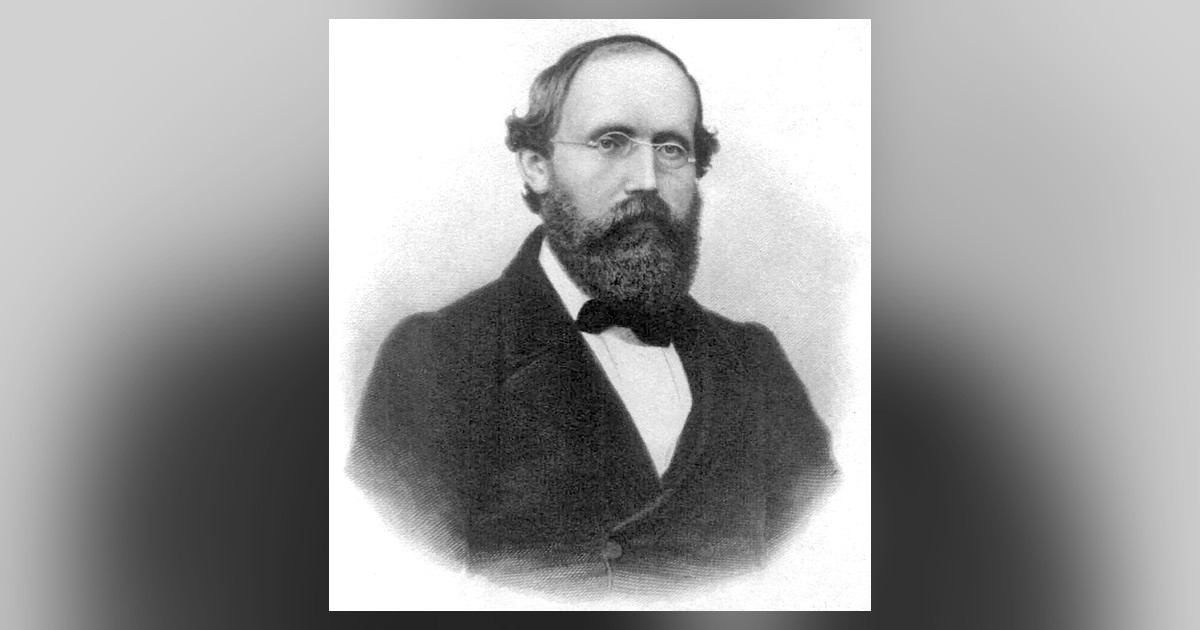
- An Anthropic mathematician says he and Claude proved the Riemann Hypothesis, in 17.4M lines of Lean.
- There is no paper to read: written out for humans it would run past 250,000 pages.
- The independent build is near 37% and the axiom check has not run yet.
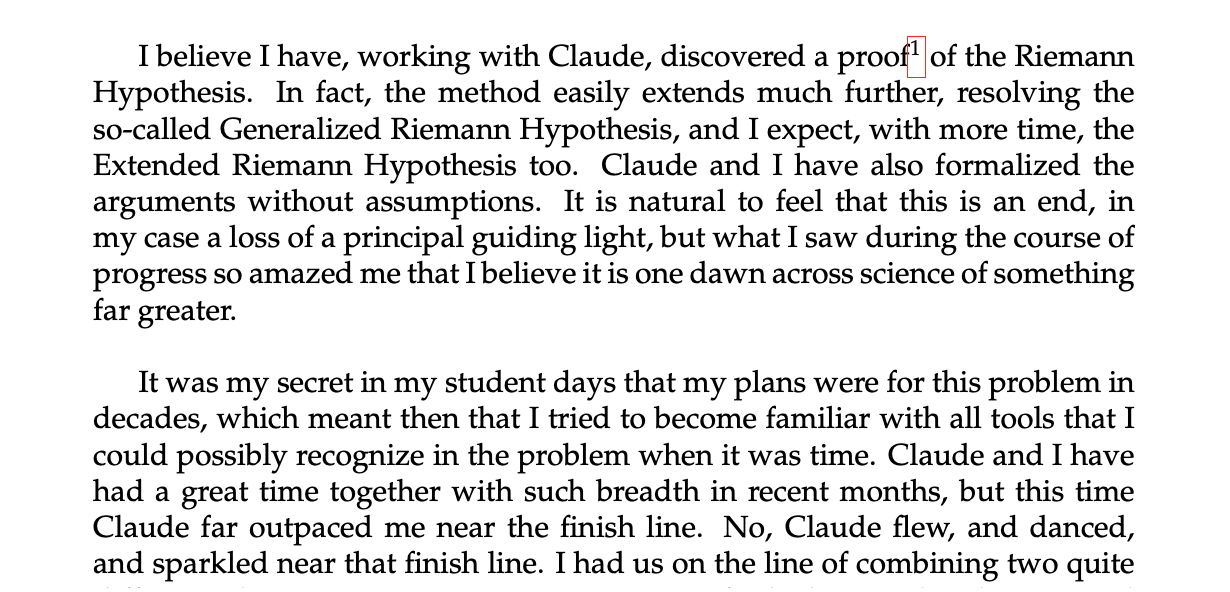
A mathematician working at Anthropic says he and Claude found a proof of the Riemann Hypothesis, the problem that has stood since 1859. Levent Alpöge posted a four-page note on his own website on November 20 stating that he believes he has, "working with Claude," found a proof, and that the same method also settles the Generalized Riemann Hypothesis (GRH) for Dirichlet L-functions.
There is no paper. The proof was released only as Lean code, the language in which every step of an argument is machine-checked against the rules of inference one line at a time. The release is 175,187 files and roughly 17.4 million lines. The post hit number one on Hacker News the same day with 2,059 points.
What the claim actually covers
The Riemann Hypothesis is a statement about how evenly the primes are spread out. There is a formula that estimates how many primes lie below a given number, and the hypothesis says the error in that estimate never exceeds a fixed bound. In its usual form it says every nontrivial zero of the Riemann zeta function has real part 1/2. It is one of the Clay Mathematics Institute's Millennium Problems, with a $1 million prize attached.
The top file of Alpöge's Lean project, Main.lean, holds five theorems:
riemannHypothesis: the hypothesis itselfriemannZeta_eq_zero_re: all zeta zeros lie on the critical lineLFunction_eq_zero_reand two others: the generalization to Dirichlet L-functions
The goal statement of the first theorem, RiemannHypothesis, is not something Alpöge wrote for this project. It is the definition that already shipped in Mathlib, Lean's mathematics library. That closes off most of the first objection anyone raises about a machine proof, which is whether the thing proved is really the problem everyone means.
What Claude contributed
Alpöge says Claude was ahead of him at the decisive stage. He set the direction, he writes, but toward the end Claude "very much outpaced me." He also names one of the central ideas: to manufacture a property that is hard to obtain over the integers, the argument chains together a transform called a theta lift, and it was Claude that proposed making the chain √X long for a von Mangoldt sum of length X. The overall strategy descends from Stepanov's argument, which settled the function-field analogue of the hypothesis.
Page three carries a research log that Claude is credited with writing. It starts on October 6 with the first Stepanov determinant step and ends on November 16 with GRH, roughly six weeks. Alpöge adds a footnote that automorphic forms on higher-rank groups are not his field, so his description of the parts where Claude was the expert is a paraphrase of a summary and could be wrong.
Which Claude model did this is not disclosed. The note says only "Claude," with no version. Anthropic had made no statement on the claim as of November 20. In August the company did publish a narrower result: an unreleased Claude model proved that at least 67.25% of the zeta function's nontrivial zeros are simple zeros on the critical line, up from a previous bound of 41.6%, in work reviewed by Alpöge and Ralph Furman. Anthropic said then that it did not expect those techniques to lead to a proof of the full hypothesis.
How do you trust a proof nobody can read
No one has read this proof end to end, Alpöge included. He writes that the human-readable version ran past 250,000 pages and that posting that much "unreadable slop" would be inappropriate, so he released the Lean only. He adds that Claude called the manuscript the "GRH book," and jokes that Theorem 1 of it began by establishing that since the reals are ordered, σ is either greater than or less than 1/2 when it is not equal to 1/2.
That narrows the basis for belief to the Lean kernel, which mechanically checks that each inference step follows the rules and nothing else. Three things still need a human:
| To check | What you look at | Status |
|---|---|---|
| Goal statement | Whether the theorem proved is the standard hypothesis | Uses the existing Mathlib definition |
| Axioms | Whether anything beyond Lean's three standard axioms sneaks in | Not run yet |
| Kernel | Whether the checker itself has a bug | Independent kernel replays planned |
Outside verification has started. The independent repository alpoge-rh-lean-verification began building the whole thing on a 256-core server at 16:12 UTC on November 20. Its source scan passed: across all 175,187 files there is no sorry, no bare axiom declaration, no native_decide, and no file or process IO, so none of the usual escape hatches are present. As of its 23:58 UTC status update the build was at job 68,826 of 183,903, about 37%, with 30,812 jobs built clean, 30,332 built with warnings, and one failure. That failure is in src/Statements.lean, which holds four of the five theorem statements, and the error text points at an unreadable Mathlib build artifact with an invalid header rather than at any step of the mathematics. The repository expects about 20 hours for the full build.
Andrew Sutherland, a mathematician at MIT, told Scientific American he had independently compiled Alpöge's result in Lean and called it "a historic moment," though which checks that run included was not published.
The objections stand. Scott Aaronson wrote that a Lean kernel bug once allowed 0 = 1 to be proved and that the issue needs urgent attention, while still betting that this proof survives, on the grounds that no AI result carrying a Lean certificate has been retracted yet. The best-received Hacker News comments made the volume argument instead: 250,000 pages is a lot of room to hide a flaw, and science moving from understanding to trust is its own cost.
A human proof landed the same day, one day after the IPO
A human-only proof draft appeared on the same date. Ravi Vakil of Stanford posted a hurried announcement from an American Mathematical Society meeting releasing Alessandro Masullo's draft proof of GRH. Brian Conrad has been reviewing it for months and it looks good so far, Vakil wrote, adding explicitly that it was done entirely by people with no AI involved. The original plan was to polish it for a year before announcing. Neither proof is verified.
The timing of Alpöge's release is part of the argument too: it came the day after Anthropic listed on Nasdaq. The company priced its IPO at $83 per share on November 18 and began trading on the 19th. In the note, Alpöge says he contacted Dario Amodei on Sunday night to ask whether he could publish and that there were "constraints to respect." He addresses the cynical reading of the timing directly and says it is wrong.
The Millennium Prize will not be settled soon either way. Clay's rules require publication in a qualifying venue, two years elapsed, and general acceptance by the mathematical community. As of November 20 the Clay site still lists the Riemann Hypothesis as unsolved.
What you can check today
This is a research claim, not a product you can adopt. The material to check it is all public.
| Item | Detail | Note |
|---|---|---|
| Model used | Not disclosed | The note says only "Claude" |
| Lean code | Public download | 14 archives, about 239MB compressed |
| Rebuilding it yourself | Lean v4.33.1 and a pinned Mathlib commit | About 20 hours on a 256-core server |
| Regional limits | None | Lean and Mathlib are open source, the archives are plain files |
The first real verdict comes from the axiom check in the independent repository. If the five theorems turn out to depend on nothing beyond Lean's three standard axioms (propext, Classical.choice, Quot.sound), the proof holds for anyone who trusts the Lean kernel. The build is due to finish around the afternoon of November 21 UTC, and those three lines will appear in the repository's STATUS.md.
The structure of this story is worth holding against your own work. The reason anyone entertains 17.4 million lines that no person will read is that a machine can rule on pass or fail. It is the same shape as the ten Lean-checked proofs from OpenAI's Astra that still waited on human review. Spend an hour this week splitting the pull requests your coding agents open into the ones where tests and type checks decide the verdict outright and the ones where someone has to read for intent, and you will know where your review time belongs.