OpenAI Adds Live Vote Counts to Election Answers
OpenAI outlined its 2026 election safeguards, combining AP vote counts, voting information, Codex Security, SynthID, usage policy, and political bias evaluations.
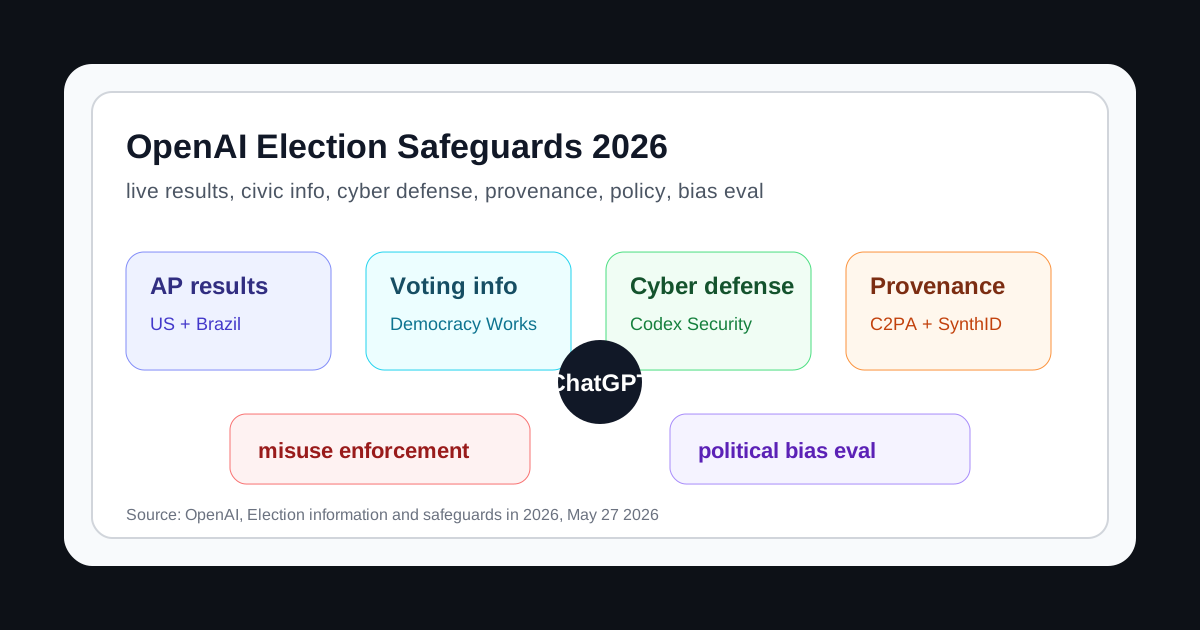
- What happened: On May 27, 2026, OpenAI published its ChatGPT safeguard plan for elections around the world.
- During election nights in the United States and Brazil, ChatGPT is expected to surface AP live vote counts; in the U.S., it will also use Democracy Works for voting logistics.
- Builder takeaway: The important story is not only politics. It is a trust stack for high-risk AI products.
- Source-of-truth data, cyber defense access,
C2PA/SynthID, usage policy, and bias evaluation are being treated as one product boundary.
- Source-of-truth data, cyber defense access,
- Watch: Provenance signals and policy enforcement are not sufficient by themselves to stop deepfakes or election misuse.
- OpenAI does not treat the absence of a signal as proof that an image is authentic or safe; it frames provenance as part of a broader integrity system.
OpenAI has put election-season ChatGPT operations back on the public roadmap. The surface story in its May 27, 2026 announcement is politics and elections. For people building AI products, the more durable point is different: once ChatGPT answers election questions, answer quality alone is not enough. The product has to account for where the information came from, who supplies live data, how generated images are verified, which campaign uses are allowed, and whether the model nudges users toward a political position.
OpenAI calls 2026 the second major global election year since generative AI went mainstream. That phrasing is not just corporate framing. During the 2024 cycle, the question "Will AI damage elections?" mostly centered on deepfakes, bots, fake audio, and automated propaganda accounts. In 2026, the question is wider. If hundreds of millions of people ask an AI assistant about polling places, registration deadlines, candidate claims, vote counts, or news interpretation, that assistant becomes part search engine, part news app, part election information portal, part content verification tool, and part policy enforcement system.
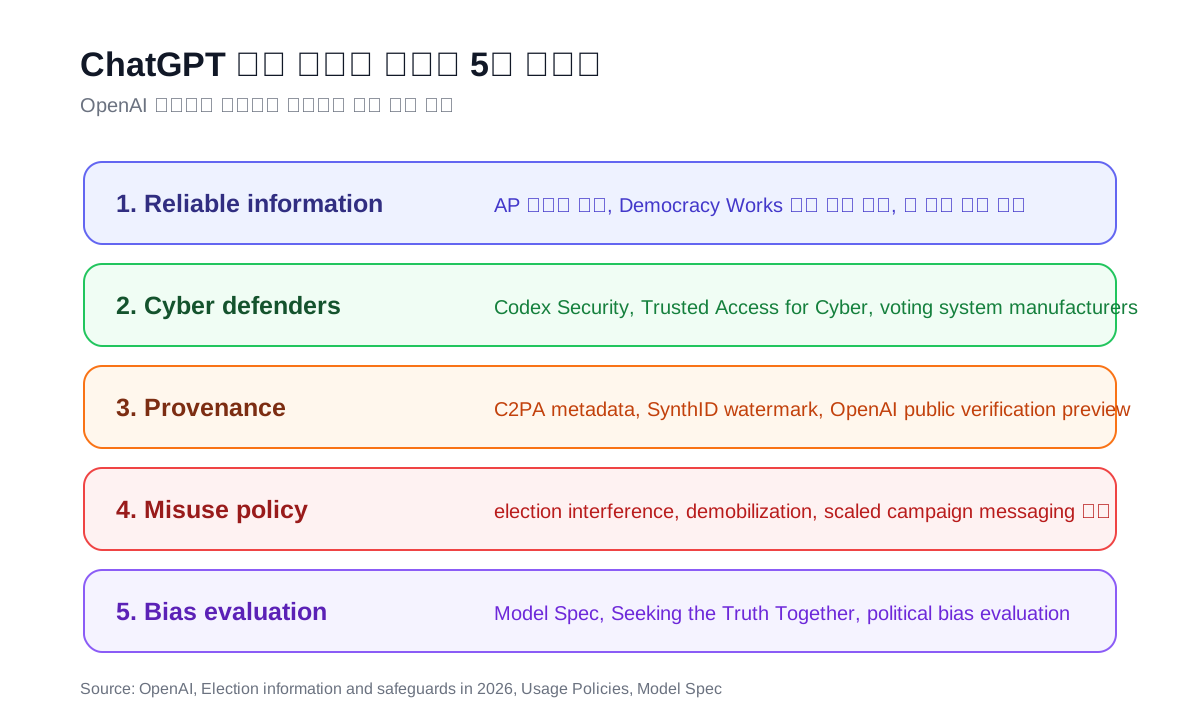
The announcement has five main pieces. First, ChatGPT is expected to provide AP live vote counts on election nights in the United States and Brazil. Second, in the United States, OpenAI is working with Democracy Works to show information about voting locations, registration, and election logistics. Third, OpenAI connects Daybreak, Codex Security, and Trusted Access for Cyber to election infrastructure defense. Fourth, images generated by ChatGPT, Codex, and the OpenAI API are tied to C2PA and Google SynthID provenance signals, with a public verification tool preview. Fifth, usage policy and Model Spec-based political bias evaluation are presented as safeguards against election interference, demobilization, scaled campaign advocacy, and political advertising misuse.
Read separately, those pieces can look like a standard safety update. Read together, they show how an AI platform's trust layer is being assembled. The question is no longer whether a model can generate a correct-sounding answer. It is which data partners are trusted, which security capabilities are opened to which organizations, which content signals survive distribution, which uses are blocked, and which evaluations monitor the model's default stance.
What AP Vote Counts Inside ChatGPT Mean
The most concrete product changes are AP and Democracy Works. According to OpenAI's announcement, ChatGPT is expected to provide AP live vote counts on election nights in the United States and Brazil. In the United States, OpenAI says it will work with Democracy Works to show information such as voting locations, the registration process, and election logistics. Globally, it says web search will continue to be refined so useful information appears with source links.
This is not a claim that ChatGPT will simply "know" election information on its own. It is closer to the opposite. In a high-risk domain, model memory and general web search are not enough, so OpenAI is attaching authoritative data sources. Vote counts change quickly by time, jurisdiction, reporting method, and local process. Old model knowledge is useless here, and arbitrary blends of web pages are risky. A product has to separate two jobs: the language model understands the user's question and composes the explanation, while official or authoritative sources supply the live numbers and procedural facts.
For developers, this pattern is not limited to elections. Medical scheduling, bank accounts, tax filing, legal procedure, package tracking, and disaster response have similar properties. Once the model becomes the natural-language interface, "Can it generate a good answer?" matters less than "What source of truth is attached?" It is easy to collapse this into the broad label of RAG, but real products need source freshness, jurisdiction awareness, licensing, update latency, fallback copy, uncertainty UX, and audit logs.
Adding AP vote counts is a signal that OpenAI does not want to treat election answers as ordinary knowledge Q&A. In domains where errors are expensive, the model should not perform confidence. Data partnerships and product policy have to stand in front of the generated prose.
Why Voting System Vendors Get Codex Security
The second pillar is cyber defense. OpenAI references Daybreak and says it has offered Codex Security and Trusted Access for Cyber to U.S. registered voting system manufacturers. It also says it is working with NASS and NASED so state election authorities can understand current cyber capabilities and defensive tools.
The interesting part is that election safeguards are not presented as content policy alone. Elections are an information-space problem, but they are also an infrastructure problem. Voting system manufacturers, election offices, public websites, registration data, and results reporting systems are all software. If generative AI can raise attacker productivity, defenders need stronger analysis, threat modeling, vulnerability validation, and patch support.
OpenAI describes Codex Security as an agentic security tool for finding, validating, and remediating vulnerabilities in developer code. Trusted Access for Cyber gives verified defenders access to stronger frontier model capabilities under the assumption of defensive purpose and authorized environments. Their appearance in an election announcement matters. It suggests that "AI election safety" is no longer only about labeling generated images or restricting political ads.
There is also an obvious tension. More capable cyber models can help defenders, but if access control fails, they can help attackers too. That is why OpenAI uses restricted-access language: registered manufacturers, verified individuals, and authorized environments. For developers, this points to a likely future for high-risk AI features. The stronger the capability, the more identity, authorization, audit, and use-case review become part of the product itself.
C2PA Alone Does Not Solve Deepfakes
The third pillar is content provenance. In the election post, OpenAI connects back to its recent content provenance announcement. The company says images created through ChatGPT, Codex, and the OpenAI API will include Google DeepMind's SynthID watermark, continue to use C2PA Content Credentials, and be checkable through a public verification tool preview for images generated by OpenAI tools.
Two details matter. The first is OpenAI's framing of C2PA and SynthID as complementary. C2PA can carry richer metadata and cryptographic signatures, but it can be stripped during platform uploads, conversions, or editing workflows. SynthID embeds an invisible watermark signal in the image itself and is designed to survive screenshots and some transformations, but it does not explain the full generation context on its own. Combining them gives the system different failure modes.
The second is OpenAI's acknowledgement that provenance tools are not a complete answer to election-related deception. That is the realistic part. If an image has a provenance signal, a verifier can make a better judgment about whether it came from an AI system. But no signal does not mean the image was made by a person. Another generator may not attach the signal. Metadata may have been removed. The detector may not support the format. Conversely, a valid signal does not prove that the image is being shared honestly. A real photo can still circulate with a false caption.
The product lesson is UX language. A verification tool should not say "not AI." It should say something closer to "no supported provenance signal found." Moderation pipelines should not reduce provenance to a single boolean either. A C2PA manifest, watermark detection, upload source, account reputation, user reports, perceptual hashes, and publication context are all signals that need to be read together.
Where Election Misuse Policy Draws the Line
OpenAI's Usage Policies place political campaigning, lobbying, election interference, and demobilization activities in restricted categories. The election announcement makes that more concrete. OpenAI says it may restrict or terminate access when it identifies attempts to use its tools for election interference, discouraging participation, deceiving people about the origin of AI-generated content, or coordinated deceptive activity. It also says it prohibits generating or distributing scaled campaign messages for candidates, parties, or ballot measures.
That does not mean every political use is blocked. OpenAI says political campaigns can use its tools for responsible, human-directed work such as internal briefings, planning, everyday writing, translation, compliance, and administration. This distinction is hard to operate in practice. The difference between an internal briefing and scaled campaign messaging depends on the recipients, distribution scale, automation level, and targeting context. When a user asks an assistant to sharpen a candidate's message, the product has to decide whether that is ordinary writing support or persuasion automation.
This is a familiar AI policy problem. The same feature can support lawful, low-risk work and prohibited use. Translation can improve voter access, or it can localize propaganda at scale. Summarization can support policy review, or it can produce attack material against an opponent. Enforcement cannot rely only on blocked keywords. It needs context-aware classification, rate limits, workflow review, human escalation, and abuse investigation.
OpenAI's decision not to allow political advertising on the ChatGPT platform during this cycle fits the same logic. Advertising adds targeting, amplification, measurement, and money flow. Once the platform becomes a distribution layer, integrity risk becomes more complex than simple text generation. Closing political ads does not remove political misuse, but it reduces the risk of OpenAI directly operating the amplification surface.
Political Bias Evaluation Is a Product Feature
The final pillar is political bias. OpenAI points to the "Seeking the Truth Together" principle in the Model Spec and cites its 2025 work on defining and evaluating political bias in LLMs. The goal is to evaluate whether models answer political questions objectively by default, avoid unfairly pushing or hiding the user's viewpoint, and avoid unsupported refusals.
Bias evaluation is less visible than election information retrieval. Users can check AP vote counts or polling place guidance. It is harder to see how a model frames an issue, which counterarguments it omits, or how much it validates a user's strong political claim. Conversational AI is also more persuasive than a list of search results. Political neutrality is therefore not only an abstract value. It is product behavior.
There are limits. Political bias cannot be fully compressed into one score. What counts as balance versus false balance, how fact-checking and value judgment should be separated, and how language and national context should be handled are all hard questions. OpenAI's internal evaluations are a useful signal, but they are not a substitute for independent audits or user research.
For developers, the change is clear anyway. In sensitive domains such as elections, model behavior is not just "prompt quality." It becomes a regression-test target. Every model update can change answers about political issues, breaking news, policy debates, candidate comparisons, or election procedures. Safety evaluation and product evaluation start to overlap.
The Trust Stack Becomes the Default
If you read OpenAI's post only as an election response, the scope feels narrow. Read more broadly, it shows the basic structure high-risk AI products will need. First, they need official data partners or verified sources of truth. Second, features that touch critical infrastructure need defensive AI capabilities and access control. Third, generated content needs provenance and verification workflows. Fourth, usage policy has to distinguish prohibited and allowed behavior at the workflow level. Fifth, the model's default stance and bias need continuous evaluation.
That structure applies beyond elections. A medical AI assistant needs guideline sources, clinician escalation, patient-data provenance, prohibited-advice policy, and bias evaluation. A financial assistant needs live account data, fraud defense, document provenance, suitability policy, and fairness evaluation. AI coding agents are similar: repository source of truth, dependency security, generated patch provenance, destructive-action policy, and evaluations for overconfidence or review bias.
"Adding an LLM" is now too small a description. Real products have to design the trust layer around the LLM. OpenAI's election safeguards are a public example of that layer. Live vote counts, voting guidance, security agents, watermarking, metadata, policy enforcement, and political bias evaluation belong to different internal teams, but to the user they appear as one ChatGPT answer.
The Unresolved Questions
There are still many unknowns. The announcement does not show exactly how AP vote counts or Democracy Works information will appear in the UI. It does not fully explain how ChatGPT will respond when sources conflict, or how it will prioritize local election authority pages against web search results. Those details matter because trust is often won or lost in fallback states and edge cases.
The Codex Security and Trusted Access for Cyber programs also need more operational clarity. OpenAI says access has been offered to U.S. registered voting system manufacturers, but the announcement does not spell out which organizations use it, under what terms, or how discovered vulnerabilities and patches are coordinated with election authorities. The idea is important, but the governance layer is where the risk lives.
Provenance remains a distributed-systems problem. C2PA and SynthID signals may or may not survive social media uploads, messaging apps, CDNs, screenshots, and re-encoding pipelines. Even if OpenAI's verification tool detects OpenAI-origin SynthID or C2PA, it does not solve the entire web's AI image problem. That is why OpenAI says it is working with social media companies. The creator has to attach the signal, distributors have to preserve it, browsers and search surfaces have to read it, and users have to see language that does not overstate what verification means.
Policy enforcement also needs transparency. Bans on election interference and scaled campaign messaging are clear in principle, but real conversations are ambiguous. Civic education, internal campaign administration, news summaries, satire, activism, persuasion, and spam can sit close together. Automated enforcement will keep moving between under-blocking and over-blocking.
Election Answers Are a Platform Test
Elections are a difficult test for AI assistants. Information changes quickly, stakeholders are numerous, and mistakes have high costs. Users ask simple questions, but the product has to account for official data, source links, policy limits, image provenance, abuse investigation, and bias evaluation. That is why OpenAI's announcement matters. It is not mainly a story about smarter models. It is a story about the operating system around the model getting thicker.
For builders, the lesson is straightforward. When you build high-risk AI features, ask "What trust path produces this answer?" before asking whether the model can answer. Answers without sources, defense without authorization, generated content without signals, policy without enforcement, and neutrality without evaluation are product debt. OpenAI's election safeguards are an attempt to pay down that debt, and they offer a checklist for AI platforms as they become social infrastructure.
Whether this succeeds will be visible in election-night responses, preservation of provenance signals, abuse response speed, and transparency around bias evaluation. But the direction is clear. In a world where ChatGPT answers election questions, model performance alone cannot earn trust. Real-time data, security, provenance, policy, and evaluation have to move together. That is the real news in this announcement.