BlueField-4 STX puts agent memory security into silicon
NVIDIA added DOCA Vault, Argus, and Flow security controls to BlueField-4 STX, moving AI agent data policy into storage and DPU paths.
- What happened: NVIDIA announced
DOCA Vault,Argus, andFlowsecurity capabilities for Vera BlueField-4 STX.- The May 31, 2026 GTC Taipei announcement targets files, context memory, and network paths used by agentic AI workloads.
- Numbers: NVIDIA claims runtime threat detection up to 1000x faster than traditional agentless approaches and policy enforcement up to 800Gb/s.
- Why it matters: Agent security controls are moving from prompt filters and application logs into storage processors, DPUs, and the
data path.- Platform teams now need threat models that include KV cache, file access, network segmentation, and multi-tenant isolation.
NVIDIA announced new DOCA security capabilities for Vera BlueField-4 STX at GTC Taipei on May 31, 2026. The target is not a model API or a chatbot surface. NVIDIA is aiming at the storage, context memory, and network paths that AI agents use when they read files, preserve intermediate state, call tools, and move data between services. The company says DOCA Vault, DOCA Argus, and DOCA Flow can enforce policy inline through BlueField-4 silicon as agents interact with data.
This update should be separated from the broader Vera Rubin platform story. devlery has already covered Vera CPU delivery to AI labs, DGX Station for Windows, RTX Spark, and Alpamayo 2 Super. This announcement is narrower and more operational: as long-context and tool-using agents become production workloads, the security boundary moves below the chat UI and into the storage and networking substrate. An agent that edits code, searches documents, writes temporary files, and stores task memory leaves a larger trail than a one-shot model call.
 .
.
NVIDIA's newsroom post frames storage as a real-time control point. Agents need fast access to proprietary data and context memory, but they also read, write, and share information without a human approving every step. Traditional security tools often inspect application logs, endpoint telemetry, API gateways, or agent runtime events after the workload has already acted. BlueField-4 STX is designed to place enforcement closer to file access and network flow, where a storage processor and DPU can see the movement of data itself.
The performance claims are aggressive. NVIDIA says DOCA on Vera BlueField-4 STX can provide runtime threat detection up to 1000x faster than traditional agentless runtime solutions and enforce network and file access policy at up to 800Gb/s. Those are vendor numbers, not independent benchmarks. They still show the direction of the argument: agent security cannot be treated only as a text moderation or prompt-injection problem. It has to run inside storage I/O and packet-processing budgets.
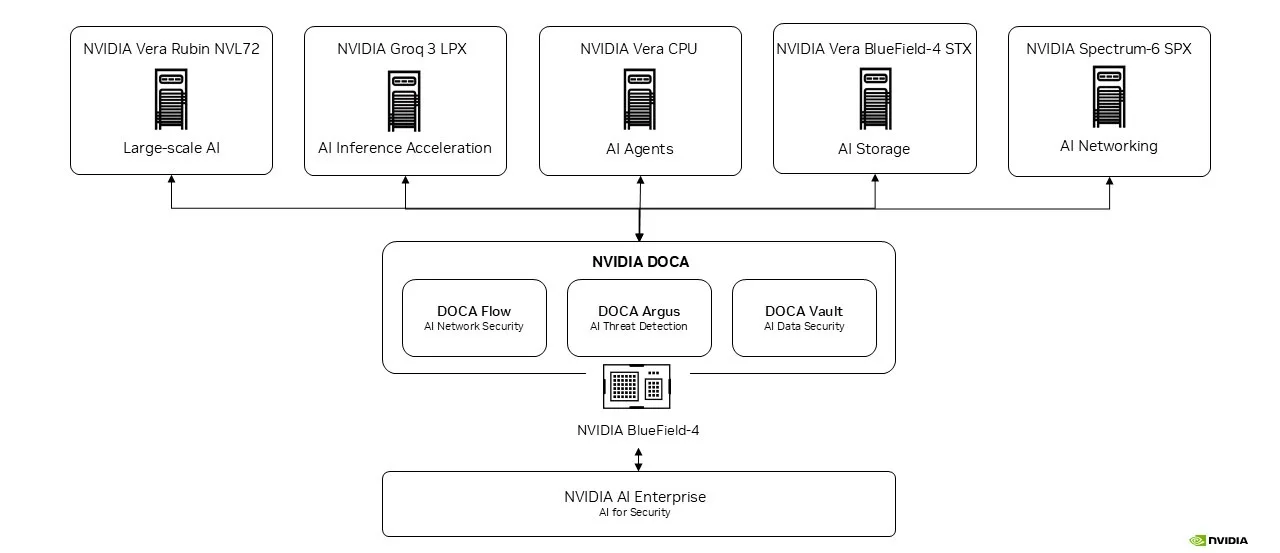
The announcement names three security components. DOCA Vault is a set of microservices meant to ensure that approved AI workloads access only the right files and permissions. DOCA Argus provides visibility into agent behavior, AI workload activity, and runtime integrity. DOCA Flow runs a packet-processing pipeline on BlueField processors for traffic isolation, segmentation, and policy enforcement in multi-tenant AI environments. NVIDIA's technical blog describes the combination as runtime visibility, zero-trust data protection, and accelerated network enforcement.
| Capability | Control target | Question for platform teams |
|---|---|---|
| DOCA Vault | Files, models, datasets, and context memory access | Which agent workload can create, read, or reuse which files? |
| DOCA Argus | Agent behavior, workload activity, and runtime integrity | What is the baseline for a normal plan, tool call, and file access path? |
| DOCA Flow | Network traffic, segmentation, and packet inspection | Where should communication between tenants, agents, and storage services be blocked? |
BlueField-4 STX did not appear from nowhere. NVIDIA introduced STX at GTC in March 2026 as an AI-native storage reference architecture. That earlier announcement focused on a bottleneck: long context and KV cache can put pressure on GPU HBM and conventional CPU-mediated storage paths. Tom's Hardware summarized the architecture as a way for BlueField-4 to handle NVMe SSDs, data integrity, and encryption directly instead of routing everything through host CPU memory and NVMe paths. NVIDIA claimed at the time that STX could deliver 5x token throughput, 4x energy efficiency, and 2x page ingestion versus CPU-based storage architecture.
The May 31 security release adds an enforcement story to that performance story. Long-running agents leave state behind. Retrieval results, reasoning artifacts, tool outputs, session memory, KV cache, file diffs, and generated patches can all become inputs to the next action. If those artifacts are exposed or reused incorrectly, prompt injection can escalate from answer contamination to document leakage, context theft, or tenant-to-tenant data mixing.
NVIDIA's use of the phrase "context memory" is not only marketing language. In transformer inference, KV cache stores key and value tensors for tokens the model has already processed so the model can generate later tokens more efficiently. As context windows grow and agents share state across longer tasks, cache and memory management become infrastructure issues rather than purely model-internal details. STX raises storage into the agentic AI path because not all long-context state can remain cheaply inside GPU memory.
 .
.
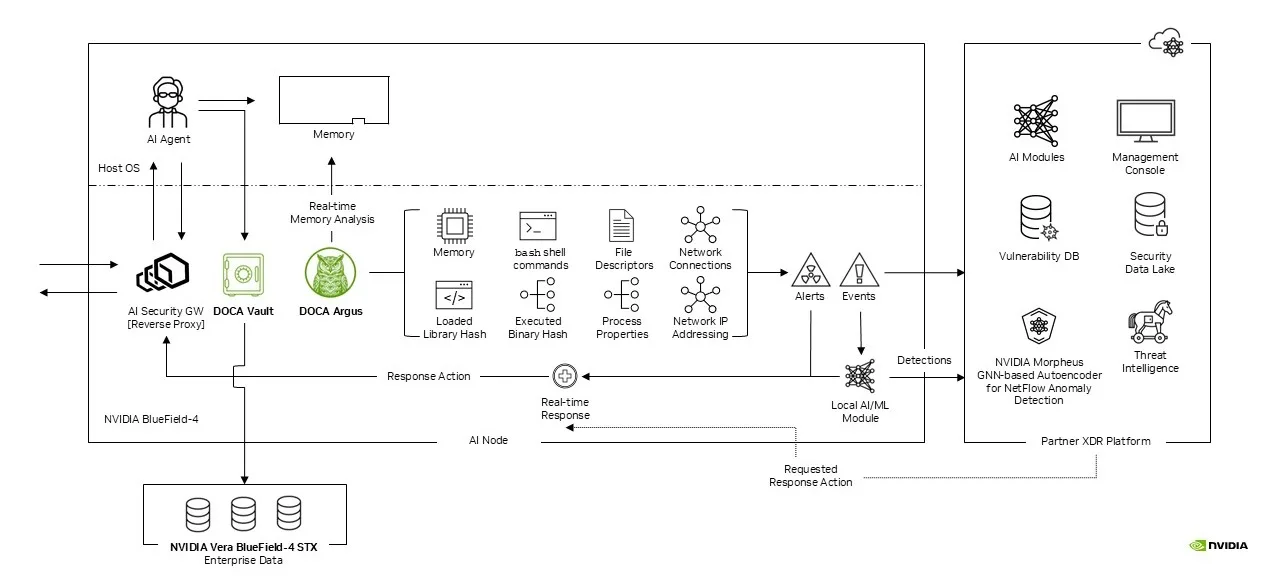
From a security perspective, KV cache and file storage look different, but they ask the same access-control question: which workload can read which context? Can one agent reuse a file created by another agent? What happens when a container tries to create a file outside policy or send model weights to an external destination? DOCA Vault addresses that problem as file-oriented AI-native storage authorization, while DOCA Argus focuses on workload behavior and runtime integrity signals.
NVIDIA's technical blog says Vault goes beyond traditional authorization by enforcing runtime integrity controls. The examples include blocking unauthorized file creation, restricting program execution, limiting runtime drift, and preventing model or data exfiltration. That points to a lower layer than an agent permission prompt. A UI can ask whether a tool should run, but a storage processor can still enforce whether the resulting workload is allowed to touch a file at line rate.
DOCA Flow handles the network side. NVIDIA's DOCA materials describe Flow as a packet inspection, segmentation, policy enforcement, threat mitigation, and accelerated encryption path. In an AI factory with multiple tenants, models, storage services, and agent runtimes, lateral movement becomes a practical risk. If one agent is compromised through a vulnerable connector, the next question is whether it can move across the rack, pod, or storage fabric into another tenant's data.
The approach is not unfamiliar to cloud security teams. DPUs, SmartNICs, and infrastructure processing units have long been used to isolate networking and storage from host CPUs. The difference is that AI agent workloads make the need easier to see. A conventional web service often follows a predictable request, database query, response path. An agent plans, searches, executes code, retries after failure, writes files, and hands artifacts to other tools. Policy has to follow workload behavior and data movement, not only API endpoints.
The partner list shows how NVIDIA wants this to land. Security partners named in the announcement include Akamai, Armis from ServiceNow, Check Point, Cisco, CrowdStrike, EQTY, F5, Fortinet, Palo Alto Networks, TrendAI, Xage Security, and Zscaler. Storage and data platform partners include DDN, Dell Technologies, HPE, Hitachi Vantara, IBM, MinIO, NetApp, Nutanix, Pure Storage, VAST Data, and WEKA. NVIDIA is not presenting a standalone agent security product so much as an enforcement substrate that security and storage vendors can build on.
For application developers, the direct impact is not "start writing DOCA code." Most product teams will not program BlueField DPUs directly. The impact is architectural. When a team deploys long-running agents on enterprise data, it has to decide whether access control lives only in application middleware or also in the storage platform and network fabric. Teams running customer documents, source code, embedding stores, and KV cache on shared AI clusters need tenant isolation that extends beyond the model gateway.
Teams operating MCP servers, coding agents, retrieval agents, or browser agents should write more concrete threat models. Consider an agent that reads an internal Git repository, stores test logs, writes an issue tracker comment, and patches a branch. The protected assets are not only the prompt and final answer. They include the checked-out source tree, dependency cache, tool stdout, temporary patch files, vector index, and long-context cache. BlueField-4 STX treats those intermediate artifacts as part of the storage security problem.
Not every organization needs this level of infrastructure. A small SaaS product or internal automation may be well served by managed IAM, object storage policies, audit logs, endpoint security, and careful tool permissions. BlueField-4 STX and the DOCA stack are more directly relevant to AI factories, multi-tenant inference platforms, storage vendors, and security vendors. The limited community reaction so far reflects that. Reddit discussions around BlueField-style DPUs often describe them as specialized infrastructure for scale, isolation, encryption, and offload rather than something most developers casually adopt.
The wider developer question is still important: how much of an agent should security observe? Is recording tool calls at the API gateway enough, or should the system also enforce file creation and reads in the storage layer? Is prompt-injection mitigation mainly an input-filtering problem, or should the reachable file set and network segments be reduced with hardware-enforced policy? NVIDIA is pushing the answer inward, into the data path.
Cost and operational complexity remain. DPU-based enforcement can reduce performance overhead, but it does not define the policy by itself. Teams still have to classify sensitive files, identify trusted agent runtimes, decide which partner XDR receives Argus signals, and define how incidents are escalated. A wrong allow rule is still a wrong allow rule even when BlueField-4 enforces it quickly. DOCA's claimed advantage is enforcement location and speed, not automatic organizational judgment.
Benchmark interpretation also needs caution. The 1000x runtime detection and 800Gb/s policy enforcement claims come from NVIDIA's announcement and technical blog. Real results will vary with workload type, storage stack, security vendor integration, encryption mode, cluster topology, and policy granularity. Agent latency includes retries, tool latency, model latency, and retrieval quality. A line-rate number in one layer does not automatically become end-to-end speed for an agent workflow.
Community reaction is still narrow. I did not find a major Hacker News discussion, and Reddit mentions were mostly Computex summaries or links to NVIDIA's announcement. That supports a conservative reading: this is closer to data center, storage, and security vendor news than a general developer tool launch. But if production agents become a standard workload, terms such as DPU, KV cache storage, runtime integrity, and in-silicon policy enforcement may move from infrastructure vendor language into platform-team procurement checklists.
Recent AI security discussion has focused on prompt injection, MCP server permissions, coding-agent shell access, and browser-agent data exfiltration. NVIDIA's BlueField-4 STX announcement adds storage and context memory to that list. As agents run longer and touch more files, the basic security question shifts from "was the answer safe?" to "was this workload allowed to read this data through this path?" That shift is less visible than a new model benchmark, but it can turn into budget and architecture decisions faster in enterprise agent deployments.
Sources
- NVIDIA Newsroom, NVIDIA Vera BlueField-4 STX Brings Agentic AI Storage Processing With In-Silicon Security
- NVIDIA Technical Blog, Advancing AI Infrastructure for Agentic AI with NVIDIA DOCA In-Silicon Security
- NVIDIA, DOCA Software Platform
- Tom's Hardware, Nvidia launches BlueField-4 STX storage architecture for agentic AI at GTC 2026