Nvidia 550B Beat the Top Human at IOI 2026, and Retrying Did More Than Training
Nvidia Nemotron-3-Ultra-CC scored 535.4 at IOI 2026, above the 498.27 of the best human contestant. The paper breaks the score down, and most of it came from a test-time loop that resamples 200 candidates rather than from post-training.
- Nvidia's 550B scored 535.4 at IOI 2026, against 498.27 for the top human.
- Most of the gain came from a five-round loop resampling 200 candidates, not from training.
- No checkpoint is released yet, and the live run used up to 760 GB300 GPUs.
A 550B model built by an Nvidia research team scored 535.40 out of 600 on the International Olympiad in Informatics (IOI) 2026 problem set. Among the 368 contestants who solved the same problems, the top scorer, Qiwen Xu of China, finished at 498.27, and the gold medal cutoff was 361.12. The paper calls it the first time "an AI system has surpassed the highest-scoring human contestant on an IOI problem set."
The source document is Post-Training Language Models for Gold-Medal Performance in Coding Competitions, posted to arXiv on September 2 under CC BY 4.0 by Aleksander Ficek and four co-authors at Nvidia. The competition ran August 9 to 16 in Tashkent, Uzbekistan, and the system ran live during the contest, before the problems were public. As the paper states in the same section, it was not an official entrant and the run was not supervised by IOI.
How much the specialized models gained over their base
The team built two models tuned for competitive programming: Nemotron-3-Nano-CC at 30B and Nemotron-3-Ultra-CC at 550B. Both start from the Nemotron 3 models released on Hugging Face on June 4 and were retrained on 22,000 competitive programming problems.
Scored on IOI 2025 with one attempt per problem (Score@1):
| Model | Base | After specialization |
|---|---|---|
| 30B (Nano) | 21.7% | 48.5% |
| 550B (Ultra) | 45.5% | 50.7% |
Specialization did little for the large model. The small one more than doubled, from 21.7% to 48.5%. The 550B moved 5.2 points, from 45.5% to 50.7%. The 535.40 at IOI 2026 is not a number that came from here.
Most of the score came from retrying
The paper calls its procedure GenCorrect. Instead of solving a problem once and stopping, it generates many solutions, has them scored, and solves again with those results in hand.
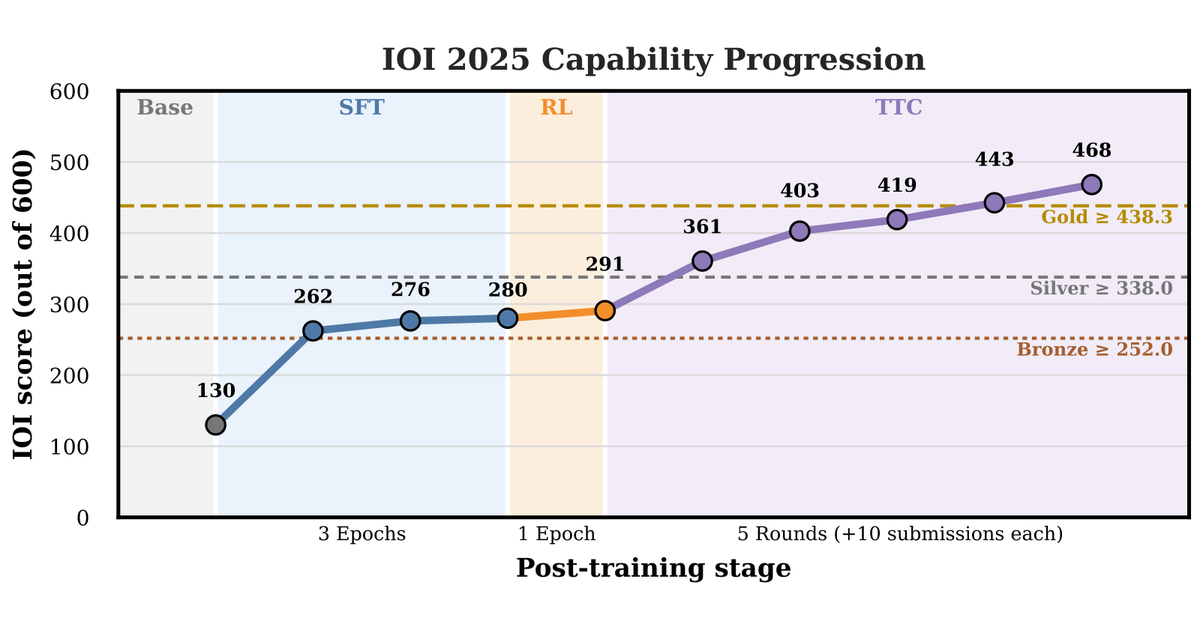
Here is the IOI 2025 score for the 30B Nano-CC as it passes through supervised fine-tuning (SFT), reinforcement learning (RL), and then GenCorrect:
| Stage | Score | Gain |
|---|---|---|
| Base model | 130 | |
| SFT, 3 epochs | 280 | +150 |
| RL, 1 epoch | 291 | +11 |
| GenCorrect, 5 rounds | 468 | +177 |
The loop moved it the most. The two stages that changed the model added 161 points combined; the stage that left the model alone and tried repeatedly added 177. That 468 clears the IOI 2025 gold cutoff of 438.3, and what cleared it was the final loop, not the training.
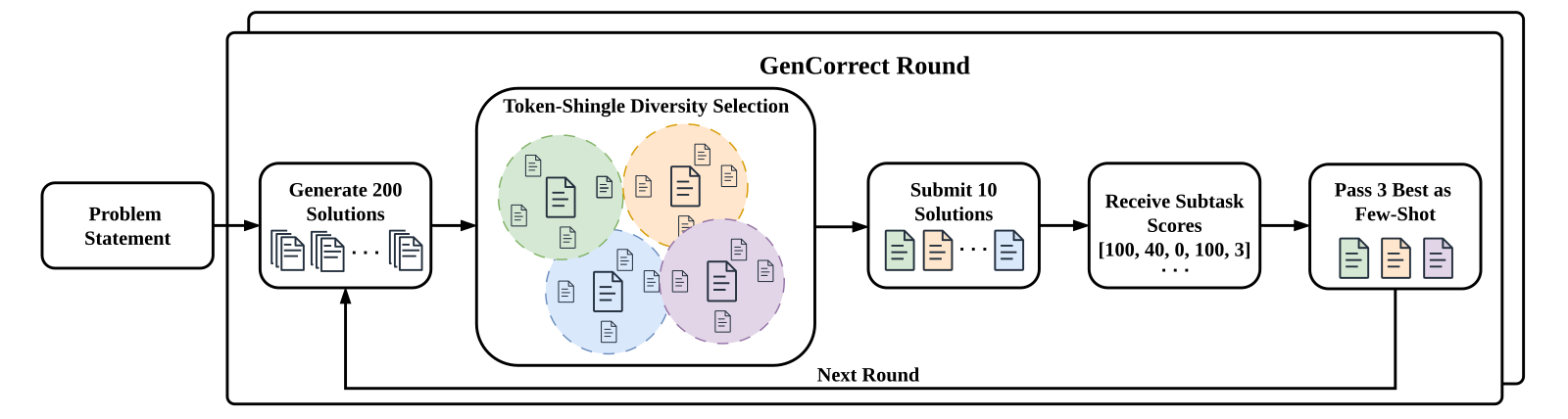
A single round works like this:
- Generate up to 200 candidate solutions for one problem (1,000 in the final IOI 2026 round).
- Without looking at any score, cluster the code at the token level and pick 10 distinct representatives.
- Submit those 10 to the official contest grader and receive per-subtask scores.
- Accumulate the best result for each subtask and pass the top 3 forward as few-shot examples for the next round.
- Repeat for 5 rounds, 50 submissions total, matching the submission limit IOI allows human contestants.
The scoring signal here is not a test the model wrote for itself. It is the per-subtask score returned by the official IOI grader. On ICPC problems the same loop runs on a binary pass or fail signal. What comes back from execution steers the next generation.
One-shot scores reverse the ranking
Ultra-CC is not the strongest competitive programming model available. Table 1 of the paper puts several models that were never specialized for this above it on IOI 2025 Score@1:
| Model | Score@1 | ICPC Pass@1 |
|---|---|---|
| GLM-5.2 | 66.0% | 65.7% |
| DeepSeek-V4-Pro | 56.8% | 69.6% |
| DeepSeek-V4-Flash | 55.3% | 65.8% |
| Ultra-CC | 50.7% | 57.4% |
| Nano-CC | 48.5% | 51.0% |
| gpt-oss-120b | 40.7% | 45.8% |
The order holds when each model draws 200 candidates (Score@200) too. In raw points, Ultra-CC reaches 505 while GLM-5.2, from the GLM line released under MIT, reaches 564.
The contest system was fine-tuned on reasoning traces generated by GLM-5.2. The teacher scores 66.0% and the student trained on its output scores 59.4%. The paper justifies that trade with output length: GLM-5.2 averages 85,927 tokens per generation, while DeepSeek-V4-Flash, used for the general pipeline, averages 120,456. Shorter output means more candidates inside the same inference budget.
The same arithmetic drove the quantization choice. Dropping to NVFP4 costs 6.6 points of Score@1, from 59.4% at BF16 to 52.8%, and buys 3.7x throughput, from 199.1 to 736.8 tokens per second per GPU. The contest system sold accuracy for throughput.
The method needs a grader to exist
GenCorrect only runs where something grades the candidates. IOI provides an official grader that returns partial per-subtask credit immediately, and the paper's loop depends entirely on that signal. The authors write that their "results may not generalize beyond competitive programming."
The cost is contest-scale as well. The live inference deployment was allocated up to 760 NVIDIA GB300 GPUs at peak. The paper asks readers to read the result "as a system-level comparison under matched time and submission limits, not as a resource-matched comparison against human contestants."
Comparing the two years side by side needs care too. In 2025, an internal OpenAI reasoning model scored 533.29 at IOI 2025, placing 6th out of 330. The number looks close to 535.40, but the problem sets differ. The IOI 2025 gold cutoff was 438.30 against 361.12 in 2026. The 2026 problems were harder and the entire human score band dropped, which is also where the top human score of 498.27 sits.
You cannot download this model today.
| Item | Detail |
|---|---|
| Who it is for | Developers. The Ultra-CC and Nano-CC checkpoints are unreleased |
| Price | Paper and method are free under CC BY 4.0. The base model Nemotron-3-Ultra-550B-A55B runs $0.625 per million input tokens and $3.125 output on OpenRouter, with a free tier available |
| Regional availability | Worldwide. Neither Hugging Face nor OpenRouter geo-restricts these models, so APAC including Singapore is covered, and the paper names no regional carve-out |
| Requirements | The contest checkpoints are planned for release in the NeMo-Skills repository. The full training corpus stays private because of third-party redistribution limits |
As of September 7, Hugging Face carries no Nemotron-3-Ultra-CC or Nemotron-3-Nano-CC. Only the two base models published in June are there.
What you can port without waiting for a checkpoint is the loop. It has one prerequisite: something that scores candidate solutions automatically and returns partial credit. If you work in a repository whose tests are split into separable groups, wire a two or three round loop onto one issue. Have the model you already use produce several candidates, then feed the best result per passing test group back as few-shot examples for the next attempt, and compare the pass rate against drawing a single candidate. On work with no grader, this paper's result does not transfer.