Mistral Vibe now reaches PRs, physics AI, and its own inference site
Mistral AI Now Summit bundled Vibe agents, industrial physics AI, and a 10MW inference data center into one enterprise AI stack.
- What happened: Mistral used its May 28, 2026 AI Now Summit to present Vibe, industrial physics AI, and a 10MW inference data center as one stack.
- Le Chat becomes Vibe, while Work Mode and Code Mode split long-running office work, coding tasks, VS Code, CLI, and remote sessions across one product surface.
- Developer impact: Vibe Code Mode combines GitHub connection, isolated sandboxes, diff review, PR creation, a VS Code extension, and
/teleport. - Industrial bet: Airbus, BMW Group, ASML, and the Emmi AI acquisition show Mistral aiming beyond generic LLM APIs into manufacturing, aerospace, and semiconductor engineering.
- Watch: The Vibe name and early product polish drew mixed community reactions, while physics AI still needs customer-specific error, workflow, and verification data.
Mistral AI packaged three announcements together at its Paris AI Now Summit on May 28, 2026. The first was a product rebrand and expansion: Le Chat becomes Vibe, and long-running work plus coding tasks move into a broader agent surface. The second was industrial physics AI, presented with Airbus, BMW Group, ASML, and the recent Emmi AI acquisition. The third was a 10MW inference-focused data center in Les Ulis, Essonne, scheduled to open in Q3 2026. Mistral's summit post described the package as full-stack AI solutions for enterprises and governments.
This was not a single-model release. Mistral is trying to connect the user-facing agent interface in Vibe, the app and model-building surfaces in Studio and Forge, industrial physics models for manufacturing customers, and direct control over inference capacity. For developers, the most immediate part is Vibe Code Mode and the new VS Code extension. For enterprise buyers, the larger claim is that Mistral can provide the agent surface, domain models, connectors, and compute footprint under one European vendor.
From Chat to Work
The first word Mistral changed is "chat." In the May 28 product post, the company said Le Chat becomes Vibe, while existing conversations, settings, and plans remain available in Chat mode. Vibe is described less as an answer bot and more as a long-running task agent. Work Mode builds plans from the user's knowledge, apps, and tools, asks for approval, calls connectors, and carries work forward. Mistral listed Google Workspace, Outlook, SharePoint, Slack, GitHub, custom connectors, and libraries as supported examples.
The Work Mode feature list mixes office automation, knowledge work, and data tasks. Vibe can search enterprise knowledge, analyze databases or spreadsheets, draft Canvas-based reports, schedule recurring tasks, and use preset or custom skills. Mistral also says each tool call and reasoning chain can be expanded to inspect inputs and outputs. That detail matters because agent products are shifting from "better answers" toward approval, tracing, repeat execution, and permission boundaries.
The coding surface is more direct. Vibe Code Mode is a new coding workspace inside the web app. Users can connect GitHub, manage projects, start sessions, and let the agent proceed toward a pull request. Mistral says sessions run in isolated sandboxes, sensitive operations remain user-controlled, and users can review diffs while the agent writes code. That puts Vibe in the same market pattern as GitHub Copilot coding agent, OpenAI Codex, Claude Code, and other products built around delegated work followed by PR review.
The VS Code extension follows the same direction. Mistral describes it as a side panel that can read and edit the whole project and run commands. Open files are automatically attached as context, selections can be passed with line ranges, and @ mentions can pull in files or directories. Because the extension uses the same harness as the CLI, Mistral says the feature set carries across unit and integration test generation, README and inline-comment documentation, refactors, language migrations, and GitHub, GitLab, Jira, and Linear context.
The CLI update contains several details that developers actually encounter when operating agents. Skills turn repeated workflows into / commands. Custom modes and subagents route specialized work inside a session. Agent plans can be edited before execution, and the agent can ask multiple-choice questions mid-run. Permissions can be set per session as always, never, or ask, with overrides for files, commands, and directories. /teleport moves a live session between terminal and cloud while preserving history and approvals.
| Surface | Mistral announcement | What teams should verify |
|---|---|---|
| Work Mode | Email, documents, Slack, GitHub, databases, spreadsheets, scheduled tasks | Connector permissions, audit logs, and recurring-task failure handling |
| Code Mode | GitHub connection, isolated sandbox, diff review, PR creation | Test reproducibility, runner authority, and secret access controls |
| VS Code | Side panel, open-file context, line ranges, @ mentions | Local command approvals and context quality in large repositories |
| CLI | Skills, custom modes, subagents, plan editing, /teleport | Preservation of approval records and change history during session moves |
Pricing also shows where Mistral is trying to place the product. Vibe is split into Free, Pro at $14.99 per month, Team at $24.99 per user per month, and Enterprise. Mistral describes Pro as the tier for complex tasks, deeper reasoning, and all-day coding. Team adds shared workspace, admin controls, and more storage. The company is keeping a consumer chat app alive, but it is also putting enterprise seats and coding-agent usage under the same brand.
Industrial AI Is the Other Half
The second axis of AI Now Summit was industrial physics AI. Mistral describes Mistral for Industrial Engineering as an integrated AI stack that combines advanced physics models, engineering expertise, and robotics. The Airbus collaboration spans commercial aircraft, helicopters, defense, and space. BMW Group is named as a central partner in the Large Industry Model initiative. ASML appears through semiconductor equipment use cases such as high-performance component design optimization, surrogate models, and control loops.
That customer list is not just a logo slide. Airbus operates in aerospace manufacturing, where certification and safety requirements are high. BMW brings crash simulation and complex vehicle-development workflows. ASML represents lithography equipment where thermal, optical, mechanical, and control systems are tightly coupled. By placing office agents and industrial physics AI in the same event, Mistral is saying that agents are not only for documents and tickets. The company wants them near design, simulation, operations data, and engineering approval loops.
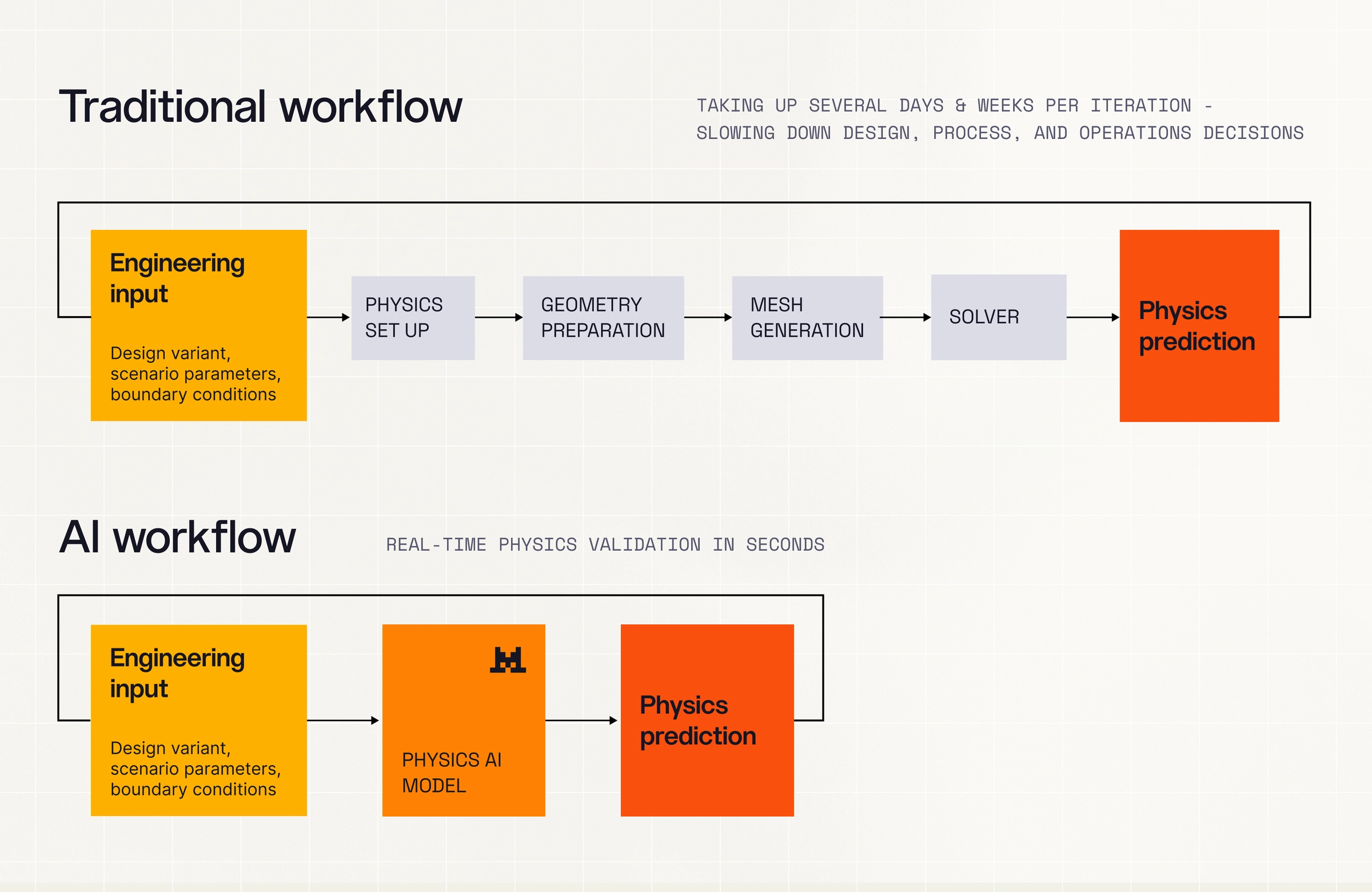
Mistral's physics AI post names the traditional CFD and FEM workflow directly: CAD geometry preparation, meshing, boundary conditions, HPC cluster queues, and waiting. The company says one design variant can still take hours to weeks in 2026. That forces engineers who should explore thousands of variants to iterate over only a handful, and late-stage surprises become expensive.
The physics AI described by Mistral is not an LLM trained on simulation text. The company defines data-driven physics AI as a class of models that learns from solver output and predicts physical behavior from geometry, boundary conditions, and measurement data. The product goal is a full physical field generated by a forward pass in seconds on a single GPU. Mistral is careful to frame this as a throughput change for design loops, not a total replacement for first-principles solvers. Traditional solvers remain for verification and edge cases.
The Emmi AI acquisition, announced on May 22, 2026, adds research depth to that strategy. Mistral said Emmi's co-founders and more than 30 researchers and engineers joined its Science and Applied AI team. The acquisition post mentions expanding the capability to understand and model physics, and enabling AI agents to use existing engineering tools. That connects Vibe and industrial physics AI more tightly than a simple product lineup would. A future workflow could start from an engineer's intent, call specialized tools, compare results, and route outputs into verification steps.
The named application areas are aerospace, automotive, electronics and semiconductors, energy and utilities, and industrial equipment. Aerospace includes external aerodynamics, structural analysis, thermal management, propulsion, and aeroelasticity. Automotive includes vehicle aerodynamics, crashworthiness, battery thermal management, and motor design. Electronics and semiconductors include chip and package thermal analysis, signal and power integrity, data-center and rack cooling, and lithography optics. This is engineering-software language, not model-card language.
Compute as a Product Claim
Les Ulis is the third piece. Mistral's summit post describes the Essonne site as a 10MW facility dedicated to inference, scheduled to open in Q3 2026. The company says it wants direct control over capacity, security, and transparency as training and inference hardware converge. That is a different posture from a model vendor that only sells APIs on top of hyperscaler infrastructure. Mistral is trying to answer enterprise and government customers when they ask where the workload runs.
The announcement also fits the European AI sovereignty story. Cohere emphasized sovereign agentic capabilities in Command A+ on May 20, and Google announced sandbox execution APIs for Gemini API Managed Agents on May 19. Mistral packages the theme differently. The user surface is Vibe. The development surface is Code Mode, VS Code, and CLI. The industrial surface is physics AI. The operating surface is the Les Ulis inference facility. That looks less like a single model launch and more like an architecture bundle for enterprise procurement.
For developers, three verification questions come first. The first is whether Vibe Code Mode produces clean diffs and useful test results in real repositories. Mistral lists unit and integration tests, documentation, refactors, and translations, but PR quality still depends on repository conventions and reproducible test environments. The second is the permission model. File, command, and directory overrides plus ask, always, and never settings are useful only if team policy, audit export, and secret masking are practical. The third is session mobility. /teleport is valuable if it preserves approvals and working context accurately across local and cloud execution.
Enterprise AI teams need a different test plan. Physics AI has to move beyond a phrase like "seconds on a single GPU" and show error bounds for a specific product family, geometry class, and sensor-data regime. Because Mistral leaves traditional solvers in the loop for verification and edge cases, physics AI is best understood as high-throughput candidate exploration rather than a final source of truth. Manufacturers will need AI prediction, solver verification, engineer approval, and links to PLM, MES, SCADA, or other existing systems to fit into one governed workflow.
Community reaction mixed interest with discomfort. In the r/MistralAI announcement thread, some users welcomed the integration of deep research, reasoning, and coding modes. Others said the name Vibe sounded lightweight for enterprise use and missed the Le Chat brand. A separate community thread said the app felt noticeably smarter, but that is user experience rather than an official benchmark. Earlier Vibe CLI posts also mentioned limits, polish issues, and repeated attempts. Mistral raised expectations with this announcement; the next evidence has to come from real pull requests and real engineering workflows.
Reading this only as a competitor to OpenAI Codex or GitHub Copilot misses half the signal. Vibe Code Mode clearly enters the coding-agent market, but Mistral placed it next to Airbus, BMW Group, ASML, Emmi AI, and Les Ulis. The company is selling more than a faster chatbot. It wants to sell a controllable agent execution environment, domain models, connectors, and infrastructure. Developers may experience that as a tool choice. CIOs and manufacturing engineers will see data sovereignty, approvals, simulation cost, and GPU-capacity contracts.
The practical meaning of AI Now Summit is scope expansion. Vibe is the surface where a user delegates a morning's work. Code Mode is the surface where repository changes move toward review. Physics AI is the surface for design variants and operational assets. Les Ulis is Mistral's statement that those surfaces should not depend only on someone else's GPU queue. The product name may or may not age well, but the 2026 agent market is making one thing clearer: model quality alone is no longer enough. The winning product has to control work, tools, verification, permissions, and compute in the same story.