Claude Opus 5 Doubles Coding Scores at Opus 4.8 Prices, Aimed at Long-Running Agents
Anthropic shipped Claude Opus 5 on July 24 at the same $5/$25 per million tokens as Opus 4.8, claiming more than double the coding score of the previous generation and near-Fable 5 results at half the cost. Every number is Anthropic-measured.

Claude Opus 5keeps Opus 4.8 pricing at $5 in / $25 out per million tokens.- Anthropic's own agentic coding chart puts it at 44% against Opus 4.8's 19%, above frontier Fable 5.
- Two API betas keep the prompt cache alive across tool swaps and reroute classifier-blocked calls.
Anthropic released Claude Opus 5 on July 24, describing it as a step change in the Opus tier that powers long-running agents. The price stayed exactly where Opus 4.8 sat: $5 per million input tokens and $25 per million output tokens. On the company's own coding benchmarks, it lands close to the higher Fable 5 tier and beats it on several. The API model ID is claude-opus-5.
Two things changed. Performance went up without the price moving, and the target workload is now coding and knowledge-work agents that run unattended for hours. TechCrunch characterized Opus 5 as strong at verifying its own work and iterating carefully until a task succeeds.
Same price, higher position in the lineup
The price sheet is identical to Opus 4.8. What moved is the score and where the model sits in the product lineup.
Opus 5 is now the default model on Claude Max and the strongest model selectable on Claude Pro. It is live in Claude.ai, Claude Code, and Claude Cowork, and available through the API. Paying subscribers get a stronger default at no extra cost, and API users get a higher score at the same unit price.
Fast mode trades money for latency: roughly 2.5x faster responses at 2x the price. The intended split is Fast for interactive work where waiting hurts, standard speed for bulk jobs where cost dominates.
Benchmarks: more score per dollar
Anthropic's pitch is the cost-to-score ratio rather than the absolute number. The chart below comes from the official announcement and shows Frontier-Bench v0.1, an agentic coding benchmark. The horizontal axis is the cost of solving one task on a log scale, the vertical axis is the score. At the same height, further left means the same capability for less money.
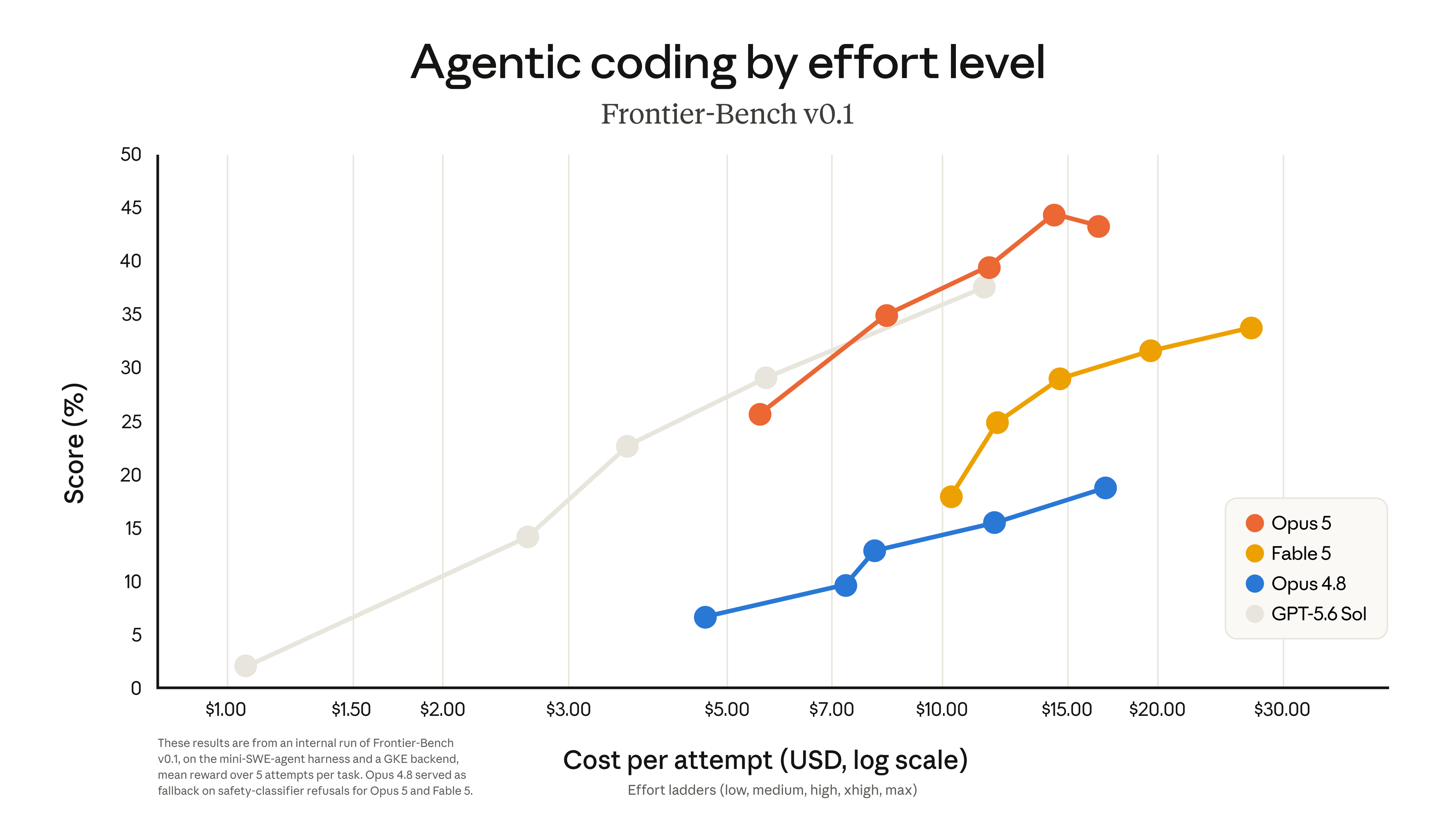
Red is Opus 5, yellow is the higher Fable 5 tier, blue is the previous-generation Opus 4.8, gray is GPT-5.6 Sol. At the maximum effort setting Opus 5 tops the curve at roughly 44%, while Opus 4.8 stops near 19%. That is more than double the score of the model it replaces in the same tier. Fable 5 reaches about 34%, and it reaches it further right on the axis, meaning at higher cost.
The other benchmarks point the same direction. On CursorBench, a coding-tool evaluation, Opus 5's top score lands within 0.5% of Fable 5 at roughly half the cost. On OSWorld 2.0, a computer-use evaluation, Anthropic says Opus 5 exceeded Fable 5's best result at a third of the cost. It reports about 3x the second-best model on the ARC-AGI 3 reasoning evaluation and about 1.5x the pass rate on Zapier AutomationBench. On science tasks, organic chemistry is 10.2 points above Opus 4.8 and protein-related work is 7.7 points above.
Every one of those figures is Anthropic-measured. The Frontier-Bench footnote states the scores come from a mini-SWE-agent harness on Anthropic's own backend, averaging reward over five attempts per task, with Opus 4.8 used as a fallback whenever the safety classifier refused a request. TechCrunch noted that launch-day coverage rested entirely on Anthropic's announcement, with no independent third-party verification available. How it feels in a real, messy coding session is a question for after external benchmarks accumulate.
Two new developer betas
The release shipped two API betas aimed at developers running agents for long stretches. Both target the moments where an agent stalls or gets expensive mid-run.
| Feature | What it does | Why it matters |
|---|---|---|
| Mid-conversation tool changes | Swapping the tool set available to Claude during an active conversation no longer invalidates the prompt cache | Cuts the cost and latency of refilling the cache in long agents that change tools between phases |
| Automatic fallback | Requests blocked by the safety classifier route to another available model instead of returning an error | Stops a single classifier false positive from killing an entire pipeline |
Mid-conversation tool changes address a prompt-cache problem. Normally, editing the tool list breaks the cache and the earlier context has to be recomputed, costing both money and time. An agent that uses one tool set while planning and a different one while executing pays that penalty repeatedly. Opus 5 keeps the cache valid across the swap.
Automatic fallback changes what happens when the safety classifier blocks a request. Previously the call returned an error and the agent run stopped there. Now the blocked request can be handed to a different model so execution continues. The catch is that the routing sometimes lands on a weaker model, so for quality-sensitive steps you need to check what actually served the request.
"Why does Opus 5 exist if Fable 5 is stronger?"
That was the most-upvoted question in the community right after launch: why ship a new model one tier below the strongest one available. The answer is price and subscription coverage.
| Item | Opus 5 | Fable 5 | Opus 4.8 |
|---|---|---|---|
| Tier | Top everyday model | Frontier | Previous generation |
| Price (input / output) | $5 / $25 | About 2x Opus | $5 / $25 |
| Included in Claude Pro | Yes, as the top option | No | Former default |
Fable 5 costs roughly twice as much and is not part of a Claude Pro subscription. Opus 5 delivers close to Fable 5 performance at half the price and is included in Pro. For the coding and knowledge work people repeat every day, price-per-capability usually decides the model, and that is the slot Anthropic filled.
Reactions split. On X, the mid-effort setting's quality and token efficiency drew favorable notes. Reddit and Hacker News were more cautious about usage limits, fatigue from frequent model swaps, and how the safety fallback behaves in practice. Some early reviews called it a benchmark leader that is still hard to love.
What to do with it
Opus 5 is not a new strongest model. It is a repriced one: the same rate card as Opus 4.8, more than double the score on Anthropic's own coding benchmark, and near-Fable 5 results at half the cost. Mid-conversation tool changes and automatic fallback both exist to stop hours-long agent runs from stalling or ballooning in cost.
What remains unverified is straightforward. Every published number is Anthropic-measured, and neither third-party benchmarks nor real-session experience has caught up. The "frontier capability at half the price" message also arrives while reports place Anthropic on an IPO track this year. If you are already on Anthropic, the concrete move is to switch your default to claude-opus-5 and measure it on your own harness, watch the fallback behavior on anything quality-sensitive, and reserve Fast mode for interactive sessions where the 2x price buys you something.