Circle Agent Stack gives AI agents a wallet
Circle introduced Agent Stack for agent wallets, x402, and USDC nanopayments. The real story is payment infrastructure moving into the agent runtime.
- What happened: Circle introduced
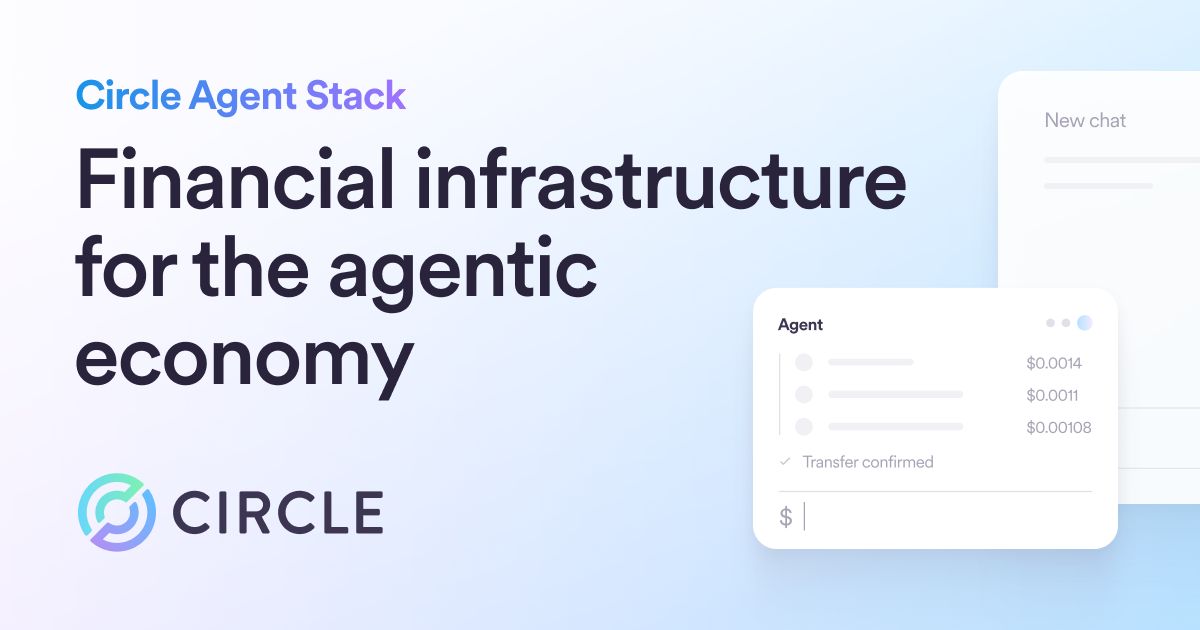
Circle Agent Stack, a toolkit that lets AI agents hold USDC and pay for services under policy controls.- The bundle includes Agent Wallets, Agent Marketplace, Circle CLI, Gateway-powered nanopayments, and Circle Skills for implementation.
- Why it matters: Agent payments are moving away from checkout pages and into HTTP 402 flows, wallet policy, CLI control surfaces, and per-API pricing.
- Watch: Once agents can spend money, limits, sanctions screening, audit logs, recovery paths, and liability matter more than convenience.
Circle introduced Circle Agent Stack on May 11. At first glance the name sounds like one more tool in the crowded agent infrastructure category, but the target layer is different. This is not a model that makes agents reason better, write better code, or chat more naturally. It is financial infrastructure for agents that need to hold money, discover services, pay at the API-call level, and transact autonomously inside user-defined policies.
The announcement has five main pieces. Agent Wallets are policy-based wallets that let agents hold and transfer USDC and other tokens. Agent Marketplace is a directory of paid services agents can discover. Circle CLI wraps wallet creation, policy management, and payment execution in a command-line interface. Nanopayments powered by Circle Gateway is a rail for very small USDC payments at machine speed. Circle Skills are implementation patterns for adding Circle infrastructure through AI coding tools.
The interesting part is not the familiar consumer story of "AI goes shopping for you." It is the more operational problem underneath agent software. Agents that actually do work need to access other services. A research agent may need paid data APIs. A coding agent may need test infrastructure, deployment services, or observability tools. A sales agent may combine CRM access, email verification, company databases, and social analytics. Today's payment stack was not built for that kind of machine-to-machine workflow.
Humans can sign up, enter card details, choose a plan, copy an API key, and accept a terms page. For agents, every one of those steps is friction. The mismatch becomes worse when the work is measured in cents, milliseconds, or a handful of API calls. Subscriptions and prepaid credits are blunt instruments for small, composable transactions. Circle is trying to fill that gap with USDC, x402, wallet policy, and developer tooling.
Agents need policy wallets, not cards
Circle's documentation describes Agent Wallets as wallets that allow agents to autonomously hold funds and transact onchain while staying inside user-defined spending policies. The important word is not just "autonomous." It is "policy." The moment an agent can spend money, the first product question is not what it can do. It is how far the system can constrain it.
According to Circle, Agent Wallets can define spending limits, x402 payment limits, time-based restrictions, allowlists, and blocklists. Transfers are screened for sanctions before onchain submission. Key management is not framed as handing an agent a raw private key. Circle describes the wallet layer as built on user-controlled wallets with 2-of-2 MPC key management. The design goal is to avoid the simplest and riskiest version of agent payments: give the model a secret and hope it behaves.
That distinction matters for builders. The easiest payment-agent prototype is to put a key in an environment variable and let the model call a transfer API whenever it thinks it should. That pattern is dangerous in production. Prompt injection, bad tool calls, infinite loops, or attacker-crafted payment requests can all turn into real spending. If the wallet layer cannot restrict counterparties, amounts, timing, and payment types, model-level safety controls are not enough.
Circle's message is that the financial layer for the agent economy should not be a thin automation wrapper around ordinary payment accounts. It should be a wallet and policy engine designed for machine actors.
Why HTTP 402 is back
The other major piece of the announcement is x402. HTTP has had the 402 Payment Required status code for a long time, but it never became the center of web commerce. Payments moved into browser pages, card forms, account creation flows, and payment service provider checkouts. In a world where agents call APIs, 402 starts to look more natural again.
The x402 flow is simple. A client calls a paid API. If no payment is attached, the server returns a 402 response. The client reads the amount and payment terms, pays, and retries the same request. Once payment is verified, the server returns a 200 response and provides the service. That is cumbersome for a person, but it is a machine-friendly protocol between an agent and an API.
Circle's agents page shows a seller example using @circle-fin/x402-batching middleware. An Express route can attach a price, and Gateway handles the payment flow. The important part is that API sellers may not need to build a separate checkout page, account system, or subscription screen just to charge for a small service. They can price an endpoint.
app.get('/run', gateway.require('$0.01'), handler)
Real services are more complicated than one line of middleware. Authentication, abuse prevention, refunds, logs, tax, terms of service, data licensing, and regional regulation still exist. But once pricing moves down to the API endpoint, software packaging can change. A SaaS business that sells subscription bundles may start to expose smaller services that agents pay for only when they are used.
The numbers are early, but the direction is clear
Circle's blog says x402 processed $24.24 million in payment volume during the 30 days ending April 29, 2026, with 99.8% settled in USDC. The x402 site also showed 30-day metrics of 75.41 million transactions, $24.24 million in volume, 94.06 thousand buyers, and 22 thousand sellers. Compared with traditional payment networks, those are small numbers. For the early category of agent payments, they are still a useful signal.
The right interpretation is not that AI agent payments have already gone mainstream. They have not. The better signal is how the market is trying to price software work. A human may pay $20 per month for an app. An agent may call dozens of services during one task. One call may be worth $0.001, another may be worth $1. In that world, payment starts to look less like a plan screen and more like a protocol.
That is why Circle emphasizes nanopayments. Its press release says Gateway-powered Nanopayments support gas-free USDC transfers down to $0.000001. The smaller the unit of work becomes, the more payment fees and settlement latency become product constraints. API charging, data-fragment purchases, model routing, and agent-to-agent task delegation all push toward smaller, faster settlement rails.
The design questions change for developers
Circle Agent Stack is not something every AI application needs today. Most products will continue to work with ordinary payment systems, monthly subscriptions, API keys, and internal credits. But if you are building an agent that completes work by combining multiple external services, the design questions shift.
First, where does the agent's budget live? A product team has to decide whether the agent can use the user's existing payment method, whether each task gets a separate wallet, or whether budgets are set at the organization level. Payment credentials should not be exposed to model context, and spending authority should be separated from task reasoning.
Second, when should approval become automatic? If every payment requires human confirmation, the agent loses much of its value. If every payment is automatic, failures become expensive. Policies such as "this API domain can spend up to $5 per day," "this wallet address is blocked," or "this service is allowed only below $0.05 per call" become part of the product experience.
Third, how does the system handle failure? If an API fails after payment, who is responsible? How does the agent avoid paying repeatedly for the same failed request? How do task logs and payment logs reconcile? Agent errors are not just bad text once money is attached. They become actual cost.
Fourth, how should service discovery work? Agent Marketplace is Circle's answer to that question. If agents can discover, evaluate, and pay for services during a task instead of relying only on hardcoded integrations, the API market moves from searchable documentation toward an executable market. That also creates a trust problem. The system has to decide which sellers are reliable, how data quality is verified, and what price is reasonable.
How this differs from Visa and Shopify
devlery has already covered Visa's Agentic Ready program and Shopify's Agentic Storefronts. Those stories were centered on consumers and commerce: users delegating purchases to AI agents, and merchants or card networks deciding how to accept those requests.
Circle Agent Stack is aimed lower in the developer stack. The thing being purchased is less likely to be sneakers or hotels and more likely to be an API call, a data pull, compute, analytics, or another agent's work. That makes HTTP 402, CLI workflows, wallet policy, and marketplace discovery more important than consumer checkout. If Visa's frame is "let the agent pay at the store," Circle's frame is closer to "let the agent pay whenever it calls a software service."
That difference also changes the competitive map. Card networks and stablecoin companies are looking at the same broad direction, but they start from different strengths. Card networks have existing merchants, compliance processes, chargebacks, and consumer protection. Stablecoin-based protocols emphasize global settlement, small amounts, programmable wallets, and onchain composability. If agent payments grow, the two tracks may collide while still serving different use cases.
The biggest risk is that agents spend money
The most realistic sentence in Circle's announcement is not the product pitch. It is the warning that Agent Stack can allow an agent to initiate transactions under user-defined permissions, and those transactions may execute without real-time human review. That is both the value proposition and the risk.
Prompt injection is already a familiar agent security problem. An attacker can hide instructions in a webpage or email and steer an agent into leaking data or taking an unwanted action. Add a wallet, and the attack surface expands. A compromised instruction can trigger payment to the wrong service, repeated calls to unnecessary APIs, or spending that stays technically within a configured limit while still wasting money.
That is why agent payments are not primarily a model-quality problem. They need policy engines, audit logs, least privilege, user confirmation, seller reputation, payment recovery paths, and anomaly detection. Builders should not start from the assumption that a capable model will spend wisely. Money movement is always one of the most conservative parts of system design.
Circle's spending controls, allowlists, blocklists, and sanctions screening are a starting point. Real products will need more layers: per-task budgets, service-level price ceilings, duplicate-payment prevention, human-readable payment reasons, refund workflows, and organization approval paths. The UX of agent payments may end up being less about "pay faster" and more about "explain why this payment happened."
The agent economy may look more like packet exchange than an app store
If AI agents become a common interface for software work, parts of the software market may shift away from installing large applications and toward composing many small service calls. A research agent might call a company-data API once, use search twice, invoke a slide-generation service, and ask a fact-checking agent to verify the result. If every one of those steps requires a monthly subscription and manual signup, the workflow breaks.
Circle Agent Stack tries to make the money unit smaller and broaden the payer from humans to agents. Whether that succeeds is open. Stablecoin regulation, enterprise acceptance of onchain settlement, accounting, tax, user trust, and agent security are all serious obstacles. In many markets, direct USDC-based payments will not be an easy default.
Still, the announcement is important because agent infrastructure competition is expanding beyond models, IDEs, browsers, MCP, and orchestration into the payment layer. Agents that perform real work need more than language and code. They need permissions, tools, and sometimes money.
Circle Agent Stack is an attempt to turn that money layer into a software interface. It is early, and some of the surrounding language is predictably ambitious. But the practical point for builders is straightforward: in agent products, payment may stop being the final checkout screen and start becoming a runtime feature inside the task plan and permission model.