Claude Code doubles its limits as compute becomes the bottleneck
Anthropic doubled Claude Code five-hour limits after a SpaceX Colossus 1 compute deal. The AI coding agent race is shifting from model quality to infrastructure, quotas, and long-running reliability.

- What happened: Anthropic signed a compute partnership with SpaceX and doubled the five-hour
Claude Codelimit.- The change applies to Pro, Max, Team, and seat-based Enterprise plans, while peak-hour reductions for Pro and Max were removed.
- The numbers: Anthropic says it will gain access to more than 300 MW of capacity and over 220,000 NVIDIA GPUs within a month.
- Why it matters: AI coding agent competition is no longer just about model quality. It is also about compute supply, quota policy, and stable long sessions.
- Watch: Orbital AI compute is still a long-range infrastructure story, not a confirmed deployment plan.
Anthropic announced a compute partnership with SpaceX on May 6, 2026. The obvious headline is the SpaceX name and the figure of more than 220,000 NVIDIA GPUs. But the change developers will feel first is more specific: Claude Code's five-hour usage limit has doubled for Pro, Max, Team, and seat-based Enterprise plans. Anthropic also removed the peak-hour reduction that had applied to Pro and Max accounts, and it substantially raised Claude Opus API rate limits.
This is not just a capacity expansion story. It is a useful signal about where the bottleneck in AI coding agents is moving. In 2024 and 2025, much of the competition centered on whether a model could write better code, use tools more reliably, or sit naturally inside an IDE. In 2026, another axis has become just as visible: can the agent run long enough, often enough, and predictably enough to handle real work?
Anyone who has used Claude Code for extended sessions understands the difference quickly. For a small function change or a single-file refactor, model quality is the first constraint. Real engineering work is messier. The agent reads a large codebase, edits several files, runs tests, studies failure logs, tries another approach, and eventually writes a PR description. That loop burns time, tokens, and tool calls. Parallel sessions and subagents raise the burn rate even further.
That is why the most important part of the news is not simply "Anthropic bought SpaceX compute." It is closer to "the usable work envelope for Claude Code got larger." As AI coding tools move from toy workflows into daily engineering work, quota policy becomes part of the product experience. If a smart model keeps hitting limits, developers have to slice work into smaller chunks, wait for windows to reset, or route around the tool. If limits grow, the unit of work that can be delegated to an agent grows with them.
What changed
Anthropic's official post describes three immediate changes. First, Claude Code's five-hour rate limit doubled across Pro, Max, Team, and seat-based Enterprise plans. Second, the company removed peak-hour limit reductions for Claude Code on Pro and Max. Third, Claude Opus API rate limits increased materially.
All three changes took effect the same day as the announcement. The peak-hour change matters more than it may sound. Developers usually use their tools during work hours. If a service looks generous off-hours but constricts during the moment a team is actually trying to ship, the felt quality drops. A quota can be manageable when it is predictable. A quota that shifts right when a team most needs the tool becomes a planning risk.
The five-hour window is important for the same reason. Claude subscription limits often feel less like a daily bucket and more like a rolling work window. A developer may be deep in a debugging session, hit a stop sign, and then come back hours later. When human development rhythm and agent usage windows do not line up, the tool is no longer just reducing work. It becomes another variable in work planning.
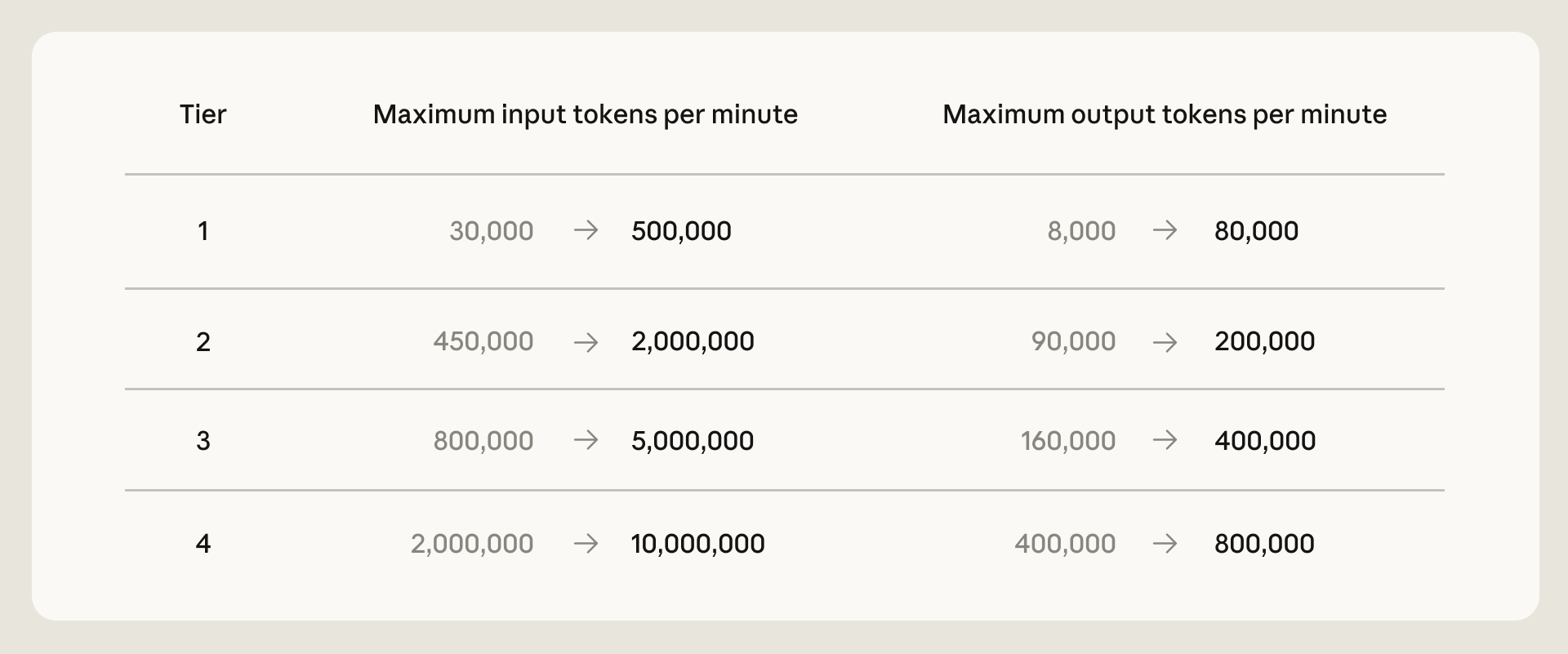
The API limit increase is not only a Claude Code story. Many teams use Claude inside internal agent frameworks, code review bots, documentation pipelines, customer support automation, and data analysis workflows. Opus-class models are expensive, but teams reach for them when a task needs deeper reasoning or complex judgment. Higher throughput makes it easier to send more work concurrently, reduce queueing during peak traffic, or design more aggressive batch workflows.
Higher rate limits do not solve everything. Model quality, tool-call reliability, context management, and cost control still matter. But limits are a more fundamental production constraint than they can appear from the outside. An agent is not a single request-response API. It is a system that thinks and acts repeatedly. If the ceiling on repetitions and concurrency is low, product design becomes conservative.
SpaceX Colossus 1 joins the stack
The background is Anthropic's compute agreement with SpaceX. Anthropic says it will use the full compute capacity of SpaceX's Colossus 1 data center, giving it access within a month to more than 300 MW of new capacity and more than 220,000 NVIDIA GPUs. xAI's announcement says Colossus 1 includes H100, H200, and GB200 accelerators.
The numbers are large. More interesting is how directly the capacity news translated into product policy. AI infrastructure announcements often remain long-range plans: a data center will be built, power will be secured, chips will arrive, and the capacity will eventually train or serve models. This announcement is different. Anthropic discussed the compute partnership and immediately raised Claude Code and Claude API limits.
That distinction matters in AI product competition. When a model company secures compute, it no longer means only that it may train a larger model later. It can affect session length, concurrency, queues, peak-hour throttling, and API rate limits for current users. For a developer, those are more tangible than benchmark points. Can today's task run without interruption? Can multiple teammates run agents at the same time? Can a critical batch job finish without hitting a ceiling?
Anthropic framed the SpaceX deal alongside earlier compute expansions involving Amazon, Google/Broadcom, Microsoft/NVIDIA, and Fluidstack. It has discussed up to 5 GW with Amazon, another 5 GW-scale effort with Google/Broadcom, $30 billion in Azure capacity with Microsoft and NVIDIA, and a $50 billion US AI infrastructure investment with Fluidstack. The SpaceX agreement is one item in a longer list, but it is unusually clear because it connects directly to usage limits.
The bottleneck in AI coding agents is changing
AI coding tools are often compared through benchmarks: SWE-bench, Terminal-Bench, internal evaluations, code review accuracy, bug-fix rates. Those numbers are useful. But a tool used every day by an engineering team has other important metrics. How often does it hit a limit? Does it keep context and a work plan through a long session? Can several jobs run at once? Does it behave predictably during peak hours or incidents?
Claude Code, OpenAI Codex, Cursor, GitHub Copilot, Gemini CLI, and related tools are all moving toward agentic workflows. The usage pattern is changing with them. Older autocomplete tools sent many small requests. Agentic coding tools take a larger objective and iterate. The prompt is less "complete this function" and more "clean up this authentication flow, update the related tests, and align the docs."
That kind of task is a workflow, not a single answer. The agent explores, reads files, plans, edits, verifies, and retries after failures. A human may redirect it midway. Every step depends on model quality, but it also depends on infrastructure quality. Without enough compute, even a strong model has to sit behind conservative limits.
This announcement is therefore a signal that Anthropic wants Claude Code to be treated as a long-running work tool, not just a demo-friendly coding assistant. Raising usage limits is a concrete product decision. It expands the task size a user can reasonably delegate and makes simultaneous work during business hours easier to support.
Why removing peak-hour reductions matters
Peak-hour limits make sense from an infrastructure operator's point of view. When demand spikes, a service needs to protect overall stability. But the experience can feel very different to a user. Development tools are not leisure products that can simply be used later. They are used during production incidents, release crunches, failing test runs, and customer escalations.
As AI coding agents become work tools, predictability becomes critical. If a long session worked yesterday morning but stops today morning because peak limits changed, teams will hesitate to put the tool on an important path. Developers can plan around a known quota. They have a much harder time planning around a quota that materially changes by time of day.
Removing peak-hour reductions for Pro and Max accounts addresses exactly that pain. For individual developers, it means long work can continue more consistently. For teams, it stabilizes the business-hour experience. For Team and Enterprise users, the doubled five-hour limit is the more direct change. Including seat-based Enterprise plans also signals that Anthropic is positioning Claude Code as an organizational tool, not only an individual power-user product.
API rate limits matter for agent platforms
The Claude Code quota increase is the visible change, but the Opus API limit increase may matter more to platform builders. Many AI product teams do not expose Claude directly. They build prompt routers, use Sonnet or Haiku for common tasks, and reserve Opus for the hardest judgment calls. In that architecture, rate limits become an architectural constraint.
Take a code review service that analyzes many pull requests at once. One PR may require reading dozens of files, inspecting test logs, separating security risks from type issues, and deciding which comments are actually worth posting. Even if Opus is used only at critical reasoning points, a low concurrency ceiling creates queues. Users experience that as slow AI review. The same pattern appears in internal batch jobs: overnight document analysis, repository migration planning, customer log summarization, or compliance review.
For these teams, the announcement is less "we can use more Claude" and more "we can place Claude inside production systems with fewer throughput constraints." AI APIs are not selected on model scores alone. Rate limits, latency, error rates, regional availability, data policy, pricing, and support all matter. Anthropic translating compute capacity into rate-limit changes shows that it understands this market.
How seriously should we take orbital AI compute?
The most futuristic phrase in the announcement is orbital AI compute. Anthropic said it had expressed interest in developing multiple gigawatts of orbital AI compute capacity with SpaceX, while xAI's announcement pointed to SpaceX's launch cadence, mass-to-orbit economics, and constellation operations experience. Read quickly, it can sound like data centers are about to move into orbit.
That deserves a cooler reading. "Expressed interest" is not a confirmed deployment plan. Power, cooling, launch cost, maintenance, latency, networking, orbital congestion, regulation, and failure handling are all major unsolved issues. Ground-based data centers are already difficult because of power and cooling. Space-based data centers change the category of difficulty rather than removing it.
Still, the phrase matters because it shows how large the imagination around AI infrastructure has become. A few years ago, GPU supply was the bottleneck everyone discussed. Now the bottleneck includes power, land, cooling, transmission, local regulation, data residency, and national security. Anthropic's comments about international expansion and in-region infrastructure for regulated industries sit in the same frame. Model companies are becoming infrastructure companies that must reason about energy, data centers, and geopolitics.
How engineering teams should read this
The first question for a development team is simple: where does your current AI agent workflow actually bottleneck? If the model still makes too many mistakes, larger quotas are less important than evaluations and guardrails. If cost is the main problem, smaller models, caching, and task decomposition matter more. But if the agent is useful and the current blocker is usage limits, this change can affect real productivity.
Teams using Claude Code can reconsider task size. Refactors, test expansion, and migration audits that once had to be split into short sessions may fit better into a longer run. That does not mean teams should loosen verification. Longer agent sessions often mean larger diffs. Planning, reviewing the git diff, running tests, and preserving a human approval boundary become more important, not less.
Teams using the API should treat higher rate limits as design space, not simply as permission to spend more. They can decide whether to reduce queues, enlarge batch jobs, use Opus more often in high-reasoning stages, or make retry logic more resilient. Higher limits create more architectural choices, but they also require cost control and observability.
There is a broader product lesson here. The user experience of AI features is not determined only by answer quality. Usage policy, latency, peak-hour reliability, regional infrastructure, data residency, and support all become part of the experience. Agent products are especially sensitive because their work is long-running and stateful. A user may not remember that the model produced three good intermediate observations. They will remember whether the job finished.
Community reaction is hopeful but cautious
GeekNews covered the announcement under the headline that Anthropic had doubled Claude usage limits through a SpaceX compute deal. Its summary centered on the official facts: doubled Claude Code five-hour limits, removal of Pro/Max peak-hour reductions, higher Opus API rate limits, and access to more than 300 MW of capacity and over 220,000 GPUs through Colossus 1. There were not enough comments to generalize strongly about the Korean developer community's reaction.
On Reddit threads around Claude Code and AI agents, the reaction was more experiential. Some users saw the limit increase as meaningful because long coding sessions had become a real bottleneck. Others expected the Opus API changes to help parallel agents and complex reasoning workflows. There was also a reasonable caveat: users want to see whether the higher limits hold over time and whether peak-hour behavior remains stable in practice.
That caution is justified. AI service limits can change again as supply and demand shift. Agentic tools also have a feedback loop: when limits increase, users delegate larger jobs. Larger jobs consume more tokens and tool calls. The long-term usage pattern created by this increase is still something to observe.
OpenAI and Google face the same pressure
This is not only an Anthropic story. OpenAI Codex, Google's AI coding tools, Cursor, GitHub Copilot, and others face similar pressure. The better agents become, the longer users want to run them. The longer they run, the more compute cost and quota policy become product differentiators. This is where model companies and IDE companies face different constraints. IDE companies can route across several model providers. Model companies must align their own infrastructure and product limits directly.
OpenAI is connecting its infrastructure story around Microsoft, Oracle, and Stargate-style capacity to Codex and other products. Google brings TPUs, its own data centers, and the Gemini ecosystem. Meta is expanding its own AI infrastructure. xAI and SpaceXAI put giant clusters like Colossus at the center of the narrative. By 2026, the AI race is no longer explainable through model cards and benchmark tables alone. The ability to provide inference and agent runtime quickly, cheaply, and reliably is a core variable.
AI coding sits near the front of that competition. Coding agents are token-heavy, tool-heavy, and retry-heavy. Productive users often consume more compute, not less, because they delegate more work. That makes AI coding one of the sharpest tests of a model provider's unit economics.
The agent's performance ends in the data center
Anthropic's SpaceX compute agreement can be read as a flashy infrastructure headline. For developers, the more important story is the doubled Claude Code limit and the removal of peak-hour reductions. To become real work tools, AI coding agents need strong models, reliable tool use, and enough infrastructure to survive long tasks.
This announcement puts the third condition in the foreground. Agent performance is not decided only inside a model file. Data centers, power, GPUs, rate limits, subscription policy, API throughput, and regional infrastructure all shape the performance users actually feel. Part of what developers experience as "intelligence" is really "it did not stop halfway through the job."
There is still plenty to verify. The higher limits need to remain consistent during peak demand. The Opus API increase needs to be understood alongside cost and latency. Anthropic also has to show how the unit economics of subscription Claude Code work over time. Orbital AI compute is intriguing, but today's practical change is still the five-hour limit and peak-hour policy.
The direction is clear, though. The next phase of AI coding agent competition is not only a better demo. It is the ability to take on longer tasks, run more sessions in parallel, and finish predictably during the hours when people actually work. Anthropic has widened that competition from models to compute infrastructure. The doubled Claude Code limit is the first visible sign of that shift on the user's screen.