Grok Build puts xAI into the coding-agent runtime race
xAI Grok Build Early Beta shows the coding-agent market moving from model benchmarks toward plans, approvals, extensions, parallel agents, and runtime control.
- What happened: xAI announced
Grok Build Early Betaon May 14, 2026.- It is a terminal-native coding agent for SuperGrok Heavy subscribers, with installation starting from
curl -fsSL https://x.ai/cli/install.sh | bash.
- It is a terminal-native coding agent for SuperGrok Heavy subscribers, with installation starting from
- Why it matters: The coding-agent fight is moving from raw model scores to runtime UX.
- Plan mode, reviewable diffs, plugins, hooks, skills, MCP, subagents, and headless mode are becoming the expected product checklist.
- Watch: Early-beta access and the SuperGrok Heavy requirement may shape adoption as much as model quality.
On May 14, 2026, xAI announced Grok Build Early Beta. The official framing is direct: Grok Build is a new coding agent and CLI for professional software engineering and complex coding tasks, initially available to SuperGrok Heavy subscribers. The install path is a single command.
curl -fsSL https://x.ai/cli/install.sh | bash
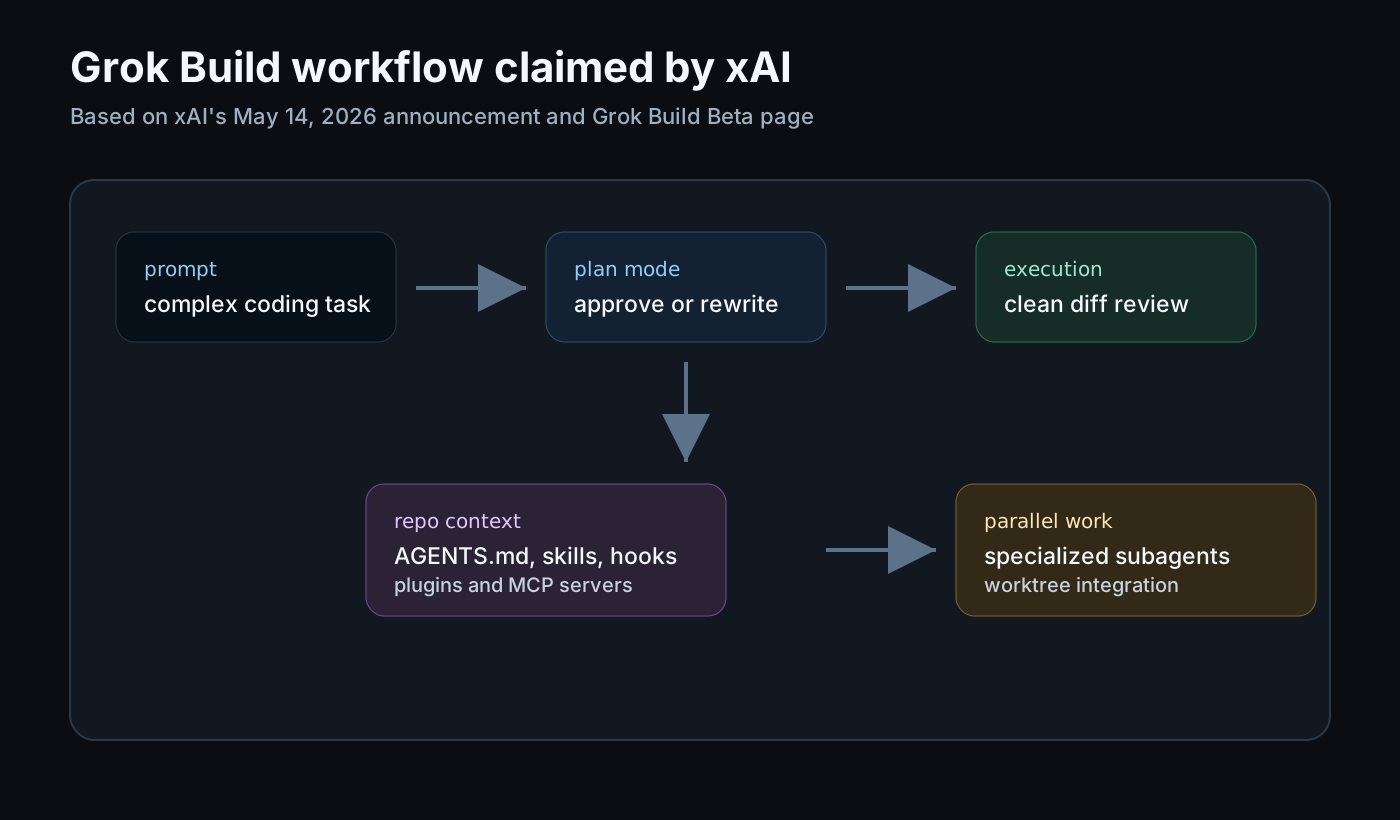
At first glance, this looks like a simple product expansion: xAI now has a coding CLI in the same broad category as Claude Code and OpenAI Codex. The more interesting signal is what xAI chose to emphasize. The announcement does not lead with a Grok coding benchmark. It leads with plan mode, review and approval, clean diffs, AGENTS.md, plugins, hooks, skills, MCP servers, parallel subagents, worktree integration, headless mode, and ACP support.
That makes Grok Build less a model launch than a runtime launch. AI coding tools are shifting from "which model is smartest?" toward "which system can keep an agent working longer, more safely, and more coherently inside a real engineering workflow?"
xAI enters a crowded field
The coding-agent market is already busy. Anthropic has Claude Code. OpenAI has Codex CLI, desktop and mobile surfaces, remote control, access tokens, and hooks. Cursor is weaving agents into IDE and pull-request workflows. GitHub is building Copilot agent workflows and the broader Agent HQ layer. JetBrains wants to put multiple coding agents behind one developer surface, and UiPath has connected Claude Code and Codex to enterprise automation.
In that context, Grok Build is a late entrant. Late entrants usually take one of two paths: invent a different interaction model, or rapidly adopt the usage patterns the market has already validated. Based on the announcement, xAI is closer to the second path. Grok Build does not appear to be proposing a wholly new development paradigm. It arrives with something closer to a 2026 checklist for a serious coding-agent CLI.
The first checklist item is planning and approval. xAI says complex work should begin in plan mode. The agent drafts a plan, and the user can approve it, comment on individual steps, or rewrite it. Once the plan is approved, changes appear as a clean diff. That flow is becoming mandatory as coding agents move beyond autocomplete. An agent that can change a repository needs to show intent before acting, pause for human judgment, and leave changes in reviewable units.
The second item is repository context. The announcement says AGENTS.md, plugins, hooks, skills, and MCP servers work out of the box. That short line matters because it suggests xAI is not trying to force every team into a new configuration vocabulary from scratch. It is absorbing rule files and extension points that are already becoming common in agentic development environments.
The third item is parallelism. Grok Build can break larger tasks into specialized subagents that run in parallel. It also supports worktree integration, including launching subagents in their own worktrees. This reflects a broader move away from a single developer chatting with a single assistant toward multiple agents splitting investigation, implementation, and review work.
The fourth item is automation. xAI says headless mode with -p lets Grok Build run inside scripts and automations, while ACP support enables bots and agent orchestration apps. At that point, Grok Build is not just a terminal chatbot. It becomes an execution component that can sit inside CI, internal bots, and recurring engineering workflows.
Convergence matters more than the feature list
Put Grok Build beside its rivals and a pattern emerges. Most of the vocabulary is now familiar: plan, approve, diff, instructions, hooks, skills, MCP, subagents, worktrees, headless automation. The same words keep appearing around Claude Code, Codex, Cursor, JetBrains, and GitHub.
| Operating pattern | Grok Build | Market convergence |
|---|---|---|
| Plan before execution | plan mode, approval, rewrite | Long tasks need to expose intent and scope before code changes |
| Reviewable changes | clean diff after approved plan | Agent output has to enter pull-request and code-review workflows |
| Repository rules | AGENTS.md, skills, hooks | Repo-local policy, not just prompting, governs behavior |
| Tool connections | plugins, marketplaces, MCP servers | Coding agents need standard interfaces to external tools |
| Parallel execution | specialized subagents, worktrees | Research, implementation, and review should not be trapped in one serial chat |
| Automation | headless mode -p, ACP support | The CLI is both a human UI and an automation runtime |
This convergence cuts both ways for developers. The upside is lower learning cost. Concepts learned in one product carry over to another. Repository rule files such as AGENTS.md, hooks, skills, and MCP servers may outlive any single vendor's UI. If the repository can keep its operational knowledge and policies while teams swap models or agents underneath, tool choice becomes less brittle.
The downside is that differentiation becomes harder. When every product says plan, diff, hooks, plugins, and subagents, the real competition moves to implementation quality. How small and reviewable are the plans? How safe are the diffs? How predictably do hooks run? How finely can MCP tool permissions be limited? How well do parallel subagents avoid stepping on each other? Shared feature names do not make the products equivalent.
xAI wants the developer workflow
xAI already has a consumer and social distribution surface through Grok. Coding agents are a different market. Developers care less about whether a model can produce a witty answer and more about whether it can handle a repository reliably, run tests, leave small changes, follow organizational security policy, and recover from long-running work.
That explains the terminal choice. The working surface for professional developers is still the shell, git, editor, test runner, issue tracker, and CI. Asking a browser chatbot for code hits a limit quickly. If an agent needs to read and write files, execute commands, interpret failing tests, and leave a diff, it has to move into the development environment. That is why Claude Code, Codex, and now Grok Build all care about CLI and local or remote execution contexts.
xAI also has a distribution constraint. Based on the official announcement, Grok Build is an early beta and starts with SuperGrok Heavy subscribers. Developer tools spread through experimentation, demos, blog posts, open-source workflows, and repeated daily usage. A high-access tier may produce serious early feedback, but it can slow broader adoption if developers cannot try it cheaply or easily.
Early community reaction appears sensitive to that point. In one Reddit discussion, a user argued that routing Grok through OpenRouter into another coding agent could be cheaper than subscribing for Grok Build. In r/grok, some comments expressed distrust of xAI paid-product experiences. Reddit is not a reliable market forecast by itself, but coding agents are daily-use tools. Price, rate limits, stability, refunds, and support can matter as much as model capability.
Plugins and MCP compatibility are the strategic line
The most interesting sentence in the Grok Build announcement may be: "Your AGENTS.md, plugins, hooks, skills, and MCP servers all work out of the box." Read strategically, that is xAI acknowledging the emerging common grammar of coding-agent ecosystems.
MCP has spread quickly as a standard way to connect agents to external tools and data. It began with a strong Anthropic association, but OpenAI, Google, IDE vendors, SaaS tools, and internal platforms are all absorbing MCP or MCP-like tool layers. For a late entrant, supporting MCP servers is pragmatic. If Grok Build ignored the tool servers and internal context that developers have already built, it would start from a weaker position.
Hooks and skills play a similar role. Hooks are a control layer around agent execution. A team can block commands that appear to expose secrets, require tests in specific directories, or write summaries and verification results at the end of a run. Skills package recurring work knowledge into files. They let teams keep knowledge such as "how this repository ships a release," "which UI rules this team follows," or "which tests this API change requires" outside any one chat transcript.
That is a sign that coding agents are moving from one-off assistants into a layer of development operations. The important unit is no longer just a clever prompt from one person. It is the team-managed policy, toolchain, and procedure an agent reads before it acts. If Grok Build adopts that grammar, xAI is competing for developer workflow ownership, not just model attention.
Parallel subagents are both promise and risk
xAI says Grok Build breaks large tasks into specialized subagents that run in parallel. The announcement's example splits a latency-regression investigation across deployment diffs, slow endpoints, slow query plans, and cache hit rates. That is a reasonable pattern. Real engineering problems often require checking several hypotheses at once, and a serial agent can spend too long trying them one by one.
Parallelism is not free. More subagents can mean more cost, more context drift, and more integration work. If two subagents edit the same file, merge conflicts appear. If they investigate with different assumptions, the final conclusion can become inconsistent. If one subagent follows a bad path for too long, it burns time and tokens without improving the answer. That is why worktree integration matters. Putting parallel agents in separate worktrees reduces collision risk, makes results easier to compare, and makes failed branches easier to discard.
A good parallel coding-agent product is not just many model calls launched at once. It has to design task decomposition, intermediate result formats, conflict detection, final integration, and branch disposal. Grok Build's early beta will need real user cases before the market can judge how well xAI implemented that layer.
Headless mode opens the enterprise door
The announcement's closing section mentions headless mode with -p and ACP support. That may sound like a small detail, but it matters for enterprise use. A tool that works only while a human watches the terminal is different from a tool that can run repeatedly inside scripts, CI, and internal bots.
Consider release-note drafting, failed-test log triage, dependency-update PR review, or preparing security-patch candidates for a review queue. Those tasks are closer to automation than to someone manually typing a prompt every time. Headless mode is the path into those recurring workflows. ACP support signals that bots and agent orchestration apps may be able to treat Grok Build as one component in a larger system.
In this layer, security and auditability become product quality. If a headless agent can read and write code and execute commands, teams need clarity on which authority it runs under, which secrets it can reach, where execution logs are stored, who approves failures, and how cost is tracked. xAI developer documentation already includes areas such as API release notes, cost tracking, rate limits, mTLS, and regional endpoints, but the enterprise-control details specific to Grok Build still appear early.
What Grok Build still has to prove
Grok Build's first impression is that xAI knows the required vocabulary: plan mode, diffs, plugins, hooks, skills, MCP, subagents, headless mode. Those are nearly all of the expected words in the 2026 coding-agent market. But success will depend on operational quality, not vocabulary.
First is coding reliability. Grok may be visible in consumer chat and the X ecosystem, but making safe changes in a large codebase is a different test. Coding agents are judged by long-task failure rates, test recovery, refactoring consistency, and security judgment, not only by benchmark position.
Second is price and access. Starting with SuperGrok Heavy subscribers may help xAI gather feedback from committed users. The broader developer-tool market, however, rewards cheap and wide experimentation. Claude Code and Codex keep adjusting subscriptions, API access, team plans, and credit systems because usage can explode when agents become useful. At that point, pricing is part of the product experience.
Third is real compatibility. The announcement says AGENTS.md, plugins, hooks, skills, and MCP servers work out of the box. Teams will need to see how smoothly existing Claude Code or Codex-oriented setup carries over, where semantics differ, and how the security model behaves. Compatibility is easy to claim and hard to deliver without breaking existing toolchains.
Fourth is review quality. Humans still review agent output. If plans are vague, diffs are noisy, summaries are weak, or test results are hard to interpret, the agent may save writing time while increasing review time. For a product aimed at professional software engineering, "writes a lot of code" matters less than "produces changes people can review."
Coding agents are becoming runtime operating systems
Grok Build is a late entrant, but that is why it is useful evidence of where the market has arrived. Coding agents are no longer well described as one model plus one chat window. They increasingly require the local file system, remote devboxes, worktrees, hooks, MCP, plugins, skills, plan and review interfaces, headless automation, access control, and cost tracking.
That bundle increasingly resembles a small operating system for software work. A developer gives a goal in natural language. The agent runtime plans the work, connects tools, creates execution units, asks for permissions, leaves diffs, runs tests, and recovers from failure. OpenAI Codex, Anthropic Claude Code, Cursor, GitHub, JetBrains, and now xAI Grok Build are each trying to own that runtime position.
So the core of this announcement is not merely that xAI can now "do coding." The core is that xAI has accepted the standard grammar of the coding-agent runtime. If model companies are all moving in the same direction, developer teams should prepare less by pledging loyalty to one product and more by making their repositories agent-readable: clear rules, safe tool permissions, small-diff review culture, and automated verification loops.
Whether Grok Build catches Claude Code or Codex immediately is still unknown. It is an early beta with narrow access. But xAI entering the market clarifies the next stage of competition. The winner will not simply be the company with the biggest model. It will be the company that can control the developer's real work loop safely, quickly, and with the least friction.