WaveSpeed’s 260-model LLM API moves model choice into the routing layer
WaveSpeed now exposes GPT, Claude, Gemini and 260+ LLMs through one OpenAI-compatible API. Here is what that means for multimodal agents, routing, cost, and trust boundaries.
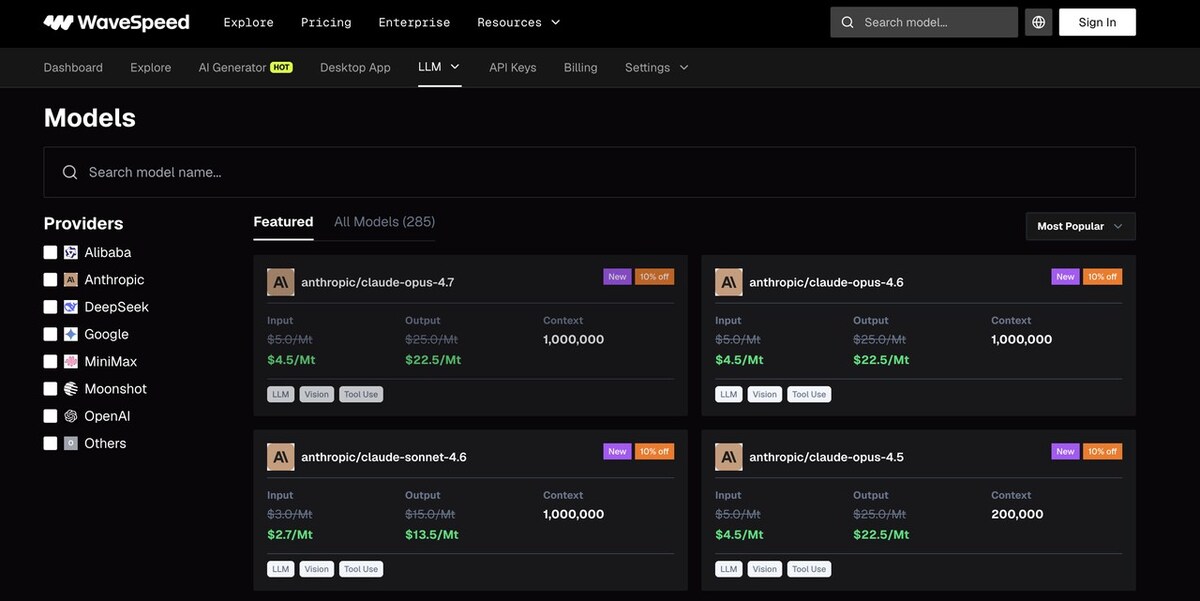
- What happened: WaveSpeed announced an expanded unified LLM API that exposes 260+ language models through one OpenAI-compatible endpoint.
- The same account also connects to a broader catalog of 1,000+ AI models across image, video, audio, 3D, avatar, and lipsync generation.
- Why it matters: For agents and multimodal apps, model selection is shifting from hard-coded SDK calls to
routing policy, cost observability, and fallback behavior. - Watch: A model router is convenient, but it also becomes a trust boundary for prompts, tool outputs, media assets, and operational logs.
- Teams should validate latency, fallback quality, log retention, data handling, and provider-specific terms before putting production agents behind a gateway.
WaveSpeed announced an expanded unified LLM API on May 17, 2026. The headline is straightforward: developers can call more than 260 language models, including GPT, Claude, Gemini, Grok, DeepSeek, Llama, Qwen, and Mistral families, through a single API. But the more interesting part is not the raw number of models. It is where WaveSpeed is trying to sit in the stack. The company was already closer to the generative media API side, bundling image, video, audio, 3D, avatar, and lipsync models. Adding LLM routing on top turns the platform into a candidate control layer for full agent and media-generation workflows.
This is not just a "larger model list" story. Modern AI applications are moving away from one fixed model call. A product might use an expensive reasoning model for planning, a cheaper model for classification, a vision model when a user uploads an image, and an image or video model for the final creative asset. Coding agents follow the same pattern. Some tasks fit Claude-style models, some are steadier on GPT-family models, and some are better served by self-hosted open-weight models. When a team manages every SDK, API key, billing account, rate limit, and outage path separately, the integration layer can become more complex than the product feature.
WaveSpeed is aiming at that integration layer. According to its announcement, the new LLM API uses a standard Chat Completions interface and supports streaming, JSON mode, tool use, and vision. WaveSpeed's quick start documentation sets the base URL to https://llm.wavespeed.ai/v1 and shows OpenAI SDK examples where developers mainly change base_url or baseURL. Model IDs use a vendor/model pattern, such as anthropic/claude-opus-4.6, while the request shape remains aligned with OpenAI Chat Completions.
That pattern is already familiar to developers. OpenRouter, LiteLLM, Portkey, and Vercel AI Gateway became more important as the number of model providers grew. WaveSpeed's position is slightly different, though. It is not only an LLM gateway. It claims to connect LLMs with image generation, video generation, audio and speech generation, 3D generation, avatar generation, and lipsync models under the same API key and billing account. The announcement says the full AI model catalog now exceeds 1,000 models. As AI apps move from text chatbots into multimodal production pipelines, that distinction matters.
Consider a marketing automation product. First, an LLM reads the campaign brief and drafts copy plus a scene structure. Then an image model creates product shots, a video model turns the scene into a short ad, and a voice model adds narration. If an agent also reads performance data and proposes the next experiment, the workflow already mixes several model categories. Treating the "LLM API," "image API," and "video API" as completely separate systems fragments authentication, cost tracking, logging, retries, and failure handling. WaveSpeed's pitch is that these calls should be part of one model stack.
| Category | LLM-only gateway | WaveSpeed-style unified model API |
|---|---|---|
| Primary scope | Routing for text, reasoning, and coding models | LLM routing plus generative media model access |
| Developer benefit | Model switching, fallback, and cost comparison | Model switching and simpler wiring for multimodal workflows |
| Operational risk | Prompts, responses, and tool-call logs pass through the gateway | Text context, generated outputs, and media spending concentrate in the gateway |
| Validation points | Latency, rate limits, upstream failures, and data retention | All of those, plus media quality, asset storage, copyright, and safety policy |
For developers, the most direct change is that model choice becomes less of a code decision and more of a configuration and policy decision. A team might call openai/gpt-5.5 today, switch an evaluation branch to anthropic/claude-opus-4.7 tomorrow, and route a low-cost path through deepseek/deepseek-v4 for repetitive tasks. WaveSpeed says models can be compared by capability tags such as price, context window, vision input, audio input, and tool use. In that world, the question is no longer "which single model is best?" It becomes "which model should handle this input, this risk level, and this product step?"
That also changes agent architecture. Agents usually move through planning, retrieval, tool calls, validation, summarization, and user response. Putting the most expensive model on every step breaks the cost model. Putting the cheapest model on every step can break reliability. Production agents increasingly need routing policy: use conservative models and human approval for high-risk decisions, use inexpensive models for repetitive transformations, and fail over to another provider when the primary model is down. A gateway such as WaveSpeed can become the execution point for those policies.
But this is exactly why the trust boundary matters. An LLM gateway is not just an HTTP proxy. Agent system prompts, user inputs, retrieved documents, internal summaries, tool outputs, code diffs, and logs may all pass through it. In a multimodal workflow, image prompts, generated asset URLs, speech synthesis requests, video metadata, and storage references can join the same path. Convenience comes from centralization, but so does risk. One key that can access many models also has a larger blast radius if it leaks.
So teams should not stop at "it works with the OpenAI SDK." First, classify what data crosses the gateway. Check whether customer PII, internal documents, source code, or logs containing credentials might be included. Then review provider-specific terms and data-retention policies. It also matters how the gateway transmits requests to upstream model providers, what is logged, and what can be disabled. Finally, test whether errors and fallback behavior change the product's meaning. Sending a failed request from model A to model B sounds simple, but safety policy, structured output behavior, and tool-call semantics can differ materially across providers.
Latency deserves separate measurement. WaveSpeed says its infrastructure is designed to reduce cold starts and provide low first-token latency. But router latency is not a single number. A full request includes time to reach the gateway, time for the gateway to select an upstream provider, upstream queue time, first-token latency, media generation duration, and any asset upload or retrieval time. Agents amplify these differences because one user-visible answer can contain many model calls and tool calls. A 500 ms gap in one call may look small, but across a 30-step agent loop it can change both user experience and cost.
Cost has the same problem. Per-token pricing and no subscription requirement lower the adoption barrier, but multimodal cost is not only token cost. Image generation depends on resolution and steps. Video generation depends on length and quality. Speech depends on duration. 3D generation depends on asset complexity. If an LLM plans poorly and asks for 20 unnecessary image candidates, media generation can become more expensive than the language-model routing itself. A router therefore needs to be more than a price-table abstraction. It needs budget guardrails and observability.
One of the more interesting use cases in WaveSpeed's announcement is "developer teams evaluating models." Real teams do not pick models from public leaderboards alone. They test on their own work: support ticket classification, SQL generation, code review, product image description, multilingual document summaries, and domain-specific extraction. A unified API can make it easier to send the same workload to multiple models and compare quality, speed, and price. If that works well, model selection becomes a continuous operations practice at the feature level, not a large quarterly decision.
That does not mean every team should immediately move to a third-party gateway. Companies with heavy regulation, sensitive customer data, or direct provider contracts may be better served by an internal gateway or a cloud-native AI gateway. Teams that need day-one access to the newest provider-specific features also need to check how quickly the intermediate layer exposes them. Features such as tool use, structured output, vision input, reasoning controls, and audio input vary by provider. "OpenAI-compatible" simplifies the developer experience, but it does not mean every model feature behaves identically.
The larger market signal is that AI infrastructure is splitting into three layers. The first layer is model providers: OpenAI, Anthropic, Google, xAI, DeepSeek, Meta, Alibaba, and Mistral. The second layer is model execution and hosting: inference clouds, serverless GPU platforms, managed endpoints, and batch infrastructure. The third layer sits closer to applications: routing, observability, policy, and governance. Developers will increasingly tune product quality at that third layer. WaveSpeed's announcement is less a claim that it will beat every model provider directly and more a move to control the space between multimodal model execution and application-level routing.
This connects to the agent operations stories devlery has been tracking. Coding agents compete on approval loops and harnesses. Enterprise agents compete on governance and observability. Security agents compete on permissioning and audit trails. Model routers sit underneath those systems and decide which model is called at which moment. That can sound like infrastructure plumbing, but in practice it shapes product quality, cost, and incident response.
WaveSpeed's promise is easy to understand. Models keep multiplying, and product teams do not have unlimited time to integrate every provider directly. Small teams are especially likely to have one engineer carrying model evaluation, billing, fallback, media generation, and API-key management at once. A unified API reduces that burden. But for the promise to hold in production, the platform cannot stop at a broad catalog. It needs routing logs, cost analysis, failure attribution, output diffs, policy-based blocking, scoped keys, team permissions, and data-retention controls.
That is why the right question is not whether 260 models is "enough." Model catalogs are already too large for developers to memorize. The sharper question is whether these many models can be used safely and predictably. Once model choice moves into the routing layer, an AI product can no longer be explained by one model name. Which requests go to which models, where failures are rerouted, what happens when cost crosses a budget line, and which paths are forbidden for sensitive data all become part of the product architecture.
WaveSpeed's unified LLM API is one scene in that shift. In the multimodal agent era, an LLM thinks, an image model draws, a video model moves, and a voice model speaks. What development teams need is not only code that can call all of those models. They need an operational layer that can explain when those calls happen, under which constraints, and with which responsibilities. If WaveSpeed can provide that layer reliably, the model router becomes more than a convenience wrapper. It becomes part of the core architecture of AI applications.