Veeam DataAI moves agent trust into the recovery layer
Veeam DataAI Command Platform extends AI agent governance into data sources, identity, backups, and precision recovery.
- What happened: Veeam introduced
DataAI Command Platform, positioning data, identity, AI agents, and backups as one enterprise trust layer.- The platform combines assets from Veeam's Securiti AI acquisition with its recovery portfolio and was announced at VeeamON NYC on May 12, 2026.
- Why it matters: Agent governance is moving beyond runtime controls and log collection into the
data sourceandbackup graph. - Operational impact: When an agent reads or changes sensitive data incorrectly, enterprises need not only blocking but impact analysis and precision recovery.
- Watch: Veeam's 82:1 agent-to-employee and 97% excessive-privilege figures come from a vendor announcement, so teams should check the definitions and sample before applying them.
Veeam is entering the AI agent conversation from a different direction. Most recent agent announcements talk about better models, longer autonomous runs, more tool calls, or smoother IDE integration. Honeycomb emphasized timelines for understanding what agents did in production. Endor Labs turned coding-agent commands and package installs into security events. UiPath tried to pull automations created by coding agents into enterprise orchestration and governance.
Veeam's DataAI Command Platform announcement looks at the same problem from the data and recovery layer. The core question is not only "what did the agent do?" It is also which data the agent could access, whether that data was sensitive, who else could touch it, which changes created real risk, and how far the business can recover without rolling back the entire system.
That distinction matters. Agent security has mostly been discussed at the runtime boundary. Which tools should be allowed? Should shell access be blocked? Should network access be restricted? Which commands require human approval? Those questions are necessary. But once agents begin operating on real enterprise data, runtime boundaries are not enough. Sensitive data is scattered across SaaS applications, file stores, databases, backups, mailboxes, collaborative documents, and log archives. Agents move across those boundaries.
Veeam moves the trust point to the data source
Veeam describes DataAI Command Platform as a single trust layer where data, access, identities, and AI meet. Its foundation is the DataAI Command Graph. According to the company, this graph uses more than 300 connectors across cloud, SaaS, and on-premises systems to understand where data lives, who can access it, and which changes create risky conditions.
Graph language is common in data-protection products. The important part of Veeam's announcement is that it wants to see operational data and backup data together. Security tools often inspect current permissions and exposure. Backup tools inspect recoverable copies. In the agent era, those views break down if they remain separate. If an agent changes data incorrectly, shares sensitive data, or triggers bulk automation, the current-state view can miss the recovery path. A backup-only view can miss why the change was dangerous.
Veeam's argument is close to this: do not attach agent governance only to the agent. DataAI Governance is described as policy enforcement at the data source. Whether an agent is approved, unknown, or rogue, access to sensitive data should be enforced where the data actually resides. This acknowledges a practical limit of proxy-only or wrapper-only approaches. Inside a large company, official copilots, custom agents, SaaS-native agents, automation scripts, and experimental workflows can all exist at the same time. It is hard to force every execution point into one agent runtime.
Six product names point to one operating model
Veeam's announcement contains a lot of branded feature names: DataAI Security, DataAI Governance, DataAI Compliance, DataAI Privacy, DataAI Precision Resilience, and the DataAI Command Graph underneath them. Strip away the product language and the structure becomes fairly clear.
| Layer | Veeam's claim | Meaning for agent operations |
|---|---|---|
| Command Graph | Connects data, identities, systems, and AI relationships. | Attaches agent behavior to files, permissions, and backup context. |
| Governance | Enforces policy at the data source instead of only at the agent. | Applies the same data policy to known agents and rogue agents. |
| Compliance | Creates evidence mapped to more than 100 regulatory frameworks. | Proves data access and auditability, not merely AI usage. |
| Precision Resilience | Restores impacted data precisely. | Treats agent mistakes as scoped recovery events rather than broad rollbacks. |
From a security-team perspective, DataAI Compliance is especially interesting. Veeam says it can generate auditable evidence mapped to more than 100 frameworks, including the EU AI Act, DORA, GDPR, HIPAA, NIST, and AI RMF. AI governance discussions often stop at model cards, policy documents, and user training. Audits eventually ask for evidence. Which data was sensitive? Who accessed it? Which policy applied? Were there exceptions? What recovery action happened after the incident?
That evidence becomes more important as agents do real work. When a person makes a mistake, organizations trace permissions, change history, and approval records. Agents need the same treatment. The difference is speed and scale. An agent can touch many files, APIs, SaaS objects, and database rows in a short time. A small-looking mistake can produce a large chain of consequences. Governance therefore has to include preventing action before it happens, explaining action after it happens, and reversing the right part of the action afterward.
Intelligent ResOps makes recovery part of AI operations
On the same day, Veeam also announced Veeam Intelligent ResOps. It is the first resilience offering built on DataAI Command Platform. The initial supported workload is Microsoft 365, with additional workloads planned later.
Microsoft 365 is a natural first target. Sensitive documents, email, meeting notes, financial files, customer information, contracts, and operating documents accumulate there. It is also one of the fastest surfaces for Copilot-style AI, document summarization, email drafting, scheduling, and agentic workflow automation. When something goes wrong in this layer, the problem is not simply restoring a server. A team has to know which SharePoint documents changed, which mailbox data was deleted incorrectly, which Teams files were externally shared, and which recovery point minimizes business damage.
Veeam says Intelligent ResOps combines data context and recovery. The key phrase is "restore only what's impacted." Traditional recovery often rolls back broad units. Agent-created problems can make broad rollback more harmful than the original incident. If an agent inserts a bad clause into 30 customer contracts, rolling back an entire document library may erase unrelated legitimate work. The useful capability is finding the affected files and versions, then restoring only that scope.
At that point, backup is no longer just insurance. It becomes an operations layer. As agents do more work, recovery strategy has to become more granular. "We have a backup" is not enough. The stronger claim is "we can identify the changes created by an agent, understand their cause, sensitivity, and blast radius, and restore the affected data without wiping normal work." Veeam is trying to turn that sentence into a product category.
Read the strongest numbers carefully
The most striking numbers in Veeam's announcement are that autonomous AI agents now outnumber human employees 82:1 and that 97% carry excessive privileges. The company also calls agentic AI the number one cyber threat. For a news curation post, those figures should be treated with context rather than repeated as universal facts.
First, the definition of "agent" matters. Inside an enterprise, an agent might be a conversational tool such as Copilot, a SaaS automation bot, an RPA workflow, or a service account operating through an API token. If the definition is broad, it is not surprising that automated or non-human actors outnumber employees. But the reader's mental picture of an autonomous AI agent may not match a vendor's counted set of non-human identities or automation subjects.
Second, excessive privilege needs a measurement method. Least privilege is already a hard problem for human accounts. Service accounts, API keys, and CI tokens are often even more over-permissioned. AI agents can amplify this old problem, but the meaning of a 97% figure depends on the sample and criteria. Veeam uses strong numbers to make the product problem visible. They are useful as directional signals, not as an average every organization should apply to itself without verification.
The maturity model is closer to an operations checklist than a buyer survey
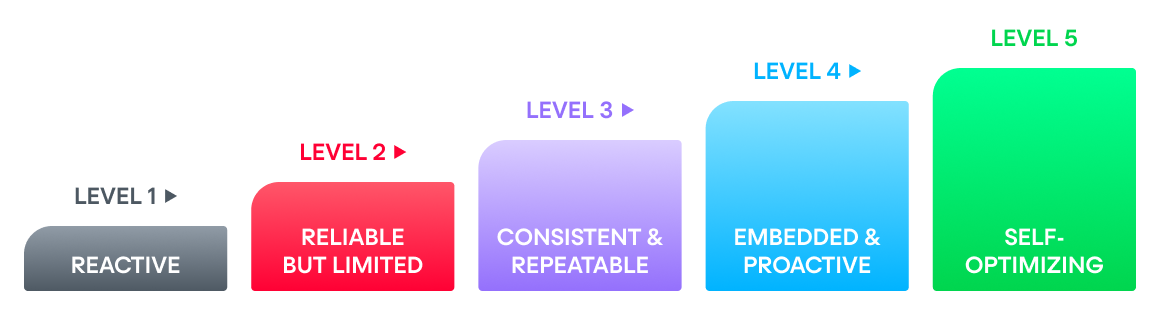
Veeam's Data and AI Trust Maturity Model sits in the same narrative. The page says that, based on insights from more than 300 security leaders, 80% feel confident about scaling AI safely, while 52% have scaled back AI initiatives because of issues, 68% are not fully ready for AI audits, and 43% name talent rather than budget as the leading barrier.
Those numbers are part of a product marketing page, but the questions are practical. AI readiness is not decided by whether a team has connected a model API. It depends on whether sensitive data is classified, permissions are appropriate, agent access and outputs are traceable, incidents are recoverable, and audit evidence can be produced for regulators or customers. Developers and platform teams need this lens too. Teams that look only at answer quality or latency for agent apps are likely to get blocked later in operations.
This is especially true for RAG and agent products, where data trust becomes product quality. Is the retrieved document stale? Did retrieval include a document the user should not see? Does deleted personal data remain in embeddings and backups? Did the agent leave sensitive content in a temporary file? Model benchmarks do not answer these questions. Veeam's trust-layer language is partly a repackaging of long-running data operations problems in the language of the AI era.
Veeam's differentiator is reversible AI
The market for agent operations is getting crowded. Microsoft Agent 365 talks about agent inventory and policy inside organizations. Endor AURI treats coding-agent prompts, commands, file access, and package installs as security surfaces. Honeycomb connects agent behavior to production telemetry so incidents can be reconstructed. UiPath brings automations created by coding agents into enterprise orchestration.
Veeam's differentiator is recovery. The company also talks about security, governance, privacy, and compliance. But the part it can argue most credibly is what happens after something goes wrong. Once AI agents have write access to real systems, enterprises have to design for failure. Good prompts and policies are not enough. Logs help, but response remains incomplete if the business cannot recover. If the impact scope is known and precision recovery is possible, the risk calculation for agent adoption changes.
For developers, this announcement does not have to be read only as a Veeam product story. The more durable lesson is architectural. If you are building a product where agents touch enterprise data, you should ask whether you can trace the data and evidence an agent used. You should know whether sensitive-data policy is applied consistently across retrieval, tool calls, and downstream APIs. If an agent changes an external system, the change unit and approval path should remain visible. If the change is wrong, the team should be able to separate it from normal user work and reverse only the affected scope. If an audit arrives, the system should produce evidence that a human can read.
DataAI Command Platform is still newly announced. Its real quality will be proven by connector coverage, expansion beyond Microsoft 365, classification accuracy, consistency between backup and operational data graphs, policy-conflict handling, and recovery scenarios. Veeam's strong market figures and "industry first" language should also be read as vendor positioning.
Even so, the direction of the news is clear. AI agent trust will not be solved only inside a chat window or an IDE plugin. Once agents read and write enterprise data, the unit of trust moves down to data sources, identities, access policy, audit evidence, backups, and recovery. Veeam's announcement is not simply an extension of a backup product. It is a signal that, in the agent era, being able to explain and reverse an action is becoming as important as being able to block it.