Salesforce Summer 26 makes enterprise AI a team sport
Salesforce Summer 26 puts Agentforce multi-agent orchestration and Tableau MCP at the center, moving enterprise AI from chatbots to workflow orchestration.
- What happened: Salesforce put Agentforce
Multi-Agent Orchestrationand Tableau MCP at the center of its Summer '26 Release.- The announcement landed on May 11, 2026, and the Summer '26 Release is scheduled to become available on June 15, 2026.
- Why it matters: Enterprise AI is shifting from single chatbots toward teams of work agents that move across CRM, Slack, Tableau, and service desks.
- Watch: Multi-agent systems only become useful when semantic data layers, permissions, observability, and human approval boundaries are designed together.
Salesforce announced its Summer '26 Release on May 11, 2026. The phrase Salesforce wants attached to this release is "Agentic Enterprise." This is not just another AI button inside a CRM screen. Salesforce is bundling Agentforce Multi-Agent Orchestration, Slack-first workflow, Tableau MCP, Agentforce Self-Service, Customer Engagement Agent, and Momentum into a broader claim: enterprise work is being reorganized around teams of collaborating agents.
According to the official announcement, the Summer '26 Release becomes available on June 15, 2026. The lead feature is Multi-Agent Orchestration in Agentforce. Salesforce describes it as a way for multiple agents to operate as one unified team and handle complex end-to-end workflows. For customers, the message is that they should not need to find a different bot for every channel. They should be able to start from one contact point while shared context moves with the work.
The interesting part is that Salesforce is treating enterprise AI as an orchestration problem, not merely an answer-generation problem. Much of enterprise AI in 2025 stayed close to knowledge search, document summarization, email drafting, CRM field suggestions, and helper features beside a human worker. The language in Summer '26 is different. Agents detect intent at customer touchpoints, move sales activity inside Slack, query Tableau's analytics engine, take specialist roles in a service desk, and connect workflows inside Salesforce. AI is climbing from an app that responds to a user's question into an execution layer that carries work forward.
From one chatbot to an agent team
The core idea behind Agentforce Multi-Agent Orchestration is distributed complexity. Real business work rarely fits into one prompt. A refund request can involve order history, payment state, inventory, shipping, policy, customer tier, support history, and follow-up campaigns. An employee reporting an access problem may touch HR systems, identity management, security policy, a service catalog, and ticket priority. A sales rep managing a large account has to reason across CRM records, meeting notes, email, Slack conversations, contract terms, and risk signals.
A single chatbot can collapse that work into "an answer." A multi-agent structure tries to divide it by role. One agent classifies intent, another checks data sources, another reviews policy, and another responds to the customer or employee. Salesforce's phrase "single point of contact" describes the customer experience. Under the hood, it only works if multiple specialist agents and systems can share the same context.
| Area | Single AI chatbot | Multi-agent work system |
|---|---|---|
| Goal | Answer questions, summarize, recommend | Complete work, hand off tasks, execute workflows |
| Context | Centered on a conversation session | Shared across CRM, Slack, Tableau, tickets, and permission policy |
| Risk | Incorrect answers | Wrong execution, permission misuse, unclear accountability |
The IT Service Domain Pack announced alongside the release makes this direction more concrete. Salesforce says it will provide more than 50 specialist AI agents across Slack, Teams, and IT Service Desk to detect employee intent and resolve requests proactively. The number can sound like marketing. The more important design choice is that Salesforce is not presenting one general-purpose agent. It is presenting a bundle of domain-specific work agents. In enterprise deployments, cost reduction depends less on general conversation skill and more on domain procedures and approval boundaries.
Tableau MCP shows why data needs a semantic layer
For developers and AI product teams, Tableau MCP may be the most important part of this release. Salesforce argues that AI models are less useful when they are cut off from a company's deeper analytics data. Tableau MCP lets AI agents query Tableau's analytics engine directly and produce business-context-aware answers under the Agentforce Trust Layer.
That is bigger than "connect Tableau data to a chatbot." In a separate May 5, 2026 announcement, Salesforce repositioned Tableau as an agentic analytics platform. The key claim is that raw data is not enough. If AI agents are going to answer reliably and act autonomously, the data needs business meaning attached to it. Metrics, relationships, semantic models, business rules, and definitions become part of the AI system.
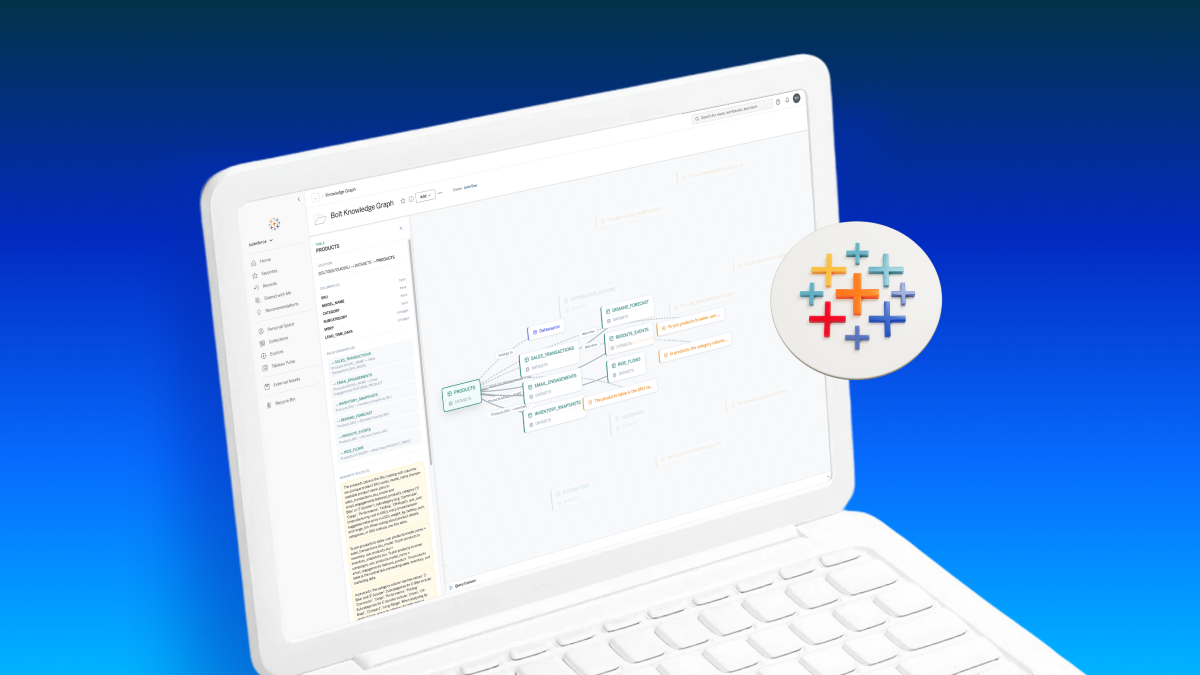
The Tableau announcement frames the platform around six pillars: Knowledge Engine, Conversational Analytics, Headless Analytics, Decision Engine, Command Center, and secure governance. Headless Analytics is especially relevant because it uses MCP server architecture to bring Tableau's trusted insights into surfaces such as Slack, Salesforce, Microsoft Teams, Claude, and ChatGPT. In the current AI application ecosystem, MCP is becoming more than a plugin standard. It is becoming a boundary for enterprise data access.
The more important term, though, is not MCP. It is "trusted knowledge." Enterprise data is often ambiguous by name alone. A metric called "revenue" may mean gross revenue or net revenue. It may or may not exclude refunds. It may apply different exchange-rate treatment by region. It may recognize renewals at different moments in the contract lifecycle. Human analysts correct for this context through experience. Agents do not have that experience by default. Before agents can query data directly, the meaning of the data has to be represented in a machine-readable structure.
Slack First Sales moves the work surface
Summer '26 also includes Slack First Sales. Salesforce says most sales AI stops at recommendations, while Slack First Sales brings CRM context and Agentforce Sales into Slack to help with prospecting, lead engagement, and pipeline management. The message is clear: Salesforce is repositioning Slack from a collaboration tool into a work surface for agents.
The main battlefield for workplace AI is not only model selection. It is where users spend their day. Sales reps do not work from CRM records alone. Slack conversations, email, meetings, notes, contracts, and lead alerts keep blending together. If AI only works inside CRM, users still have to copy, paste, check, and reconcile. If CRM context and agent actions happen inside Slack, AI sits closer to the flow of work users already follow.
Momentum fits the same pattern. Salesforce says call, email, and meeting data often never makes it back into Salesforce, which leaves deal signals incomplete and agents operating blind. Momentum captures and structures that data in real time, then writes it back into Salesforce. The feature matters because agent quality often depends more on context quality than model quality. If an agent is going to manage a sales pipeline, the actual conversation with the customer needs to be reflected in the CRM.
Customer Engagement Agent and Self-Service
Salesforce is also pushing agents into customer touchpoints. Customer Engagement Agent talks with buyers 24/7 across websites and email, qualifies leads, and hands warm leads to sales teams. Agentforce Self-Service includes Help Agent, a new portal experience, and simplified pricing. Salesforce says Help Agent works across websites, the new portal, and WhatsApp, and can be set up in 10 clicks or less.
This direction blurs the line between customer support and sales automation. Older chatbots usually answered FAQs or created tickets. The agent Salesforce is describing resolves customer issues, qualifies leads, creates follow-up work, and hands tasks to internal systems. The user should feel less like they "talked to a bot" and more like "the work moved forward." For companies, that creates a chance to improve both support cost and conversion. It also raises the stakes for accountability and explanation when the system fails.
This is where the strengths and weaknesses of a multi-agent structure show up. If specialist agents are well coordinated, users get a consistent experience without repeating themselves. If orchestration is weak, each agent may act on different policy, different customer state, or different permissions. Salesforce's emphasis on shared context across all channels suggests the company knows this risk. Multi-agent success depends less on the number of agents and more on the quality of the shared context.
The same battlefield as Microsoft, ServiceNow, and Snowflake
Salesforce's Summer '26 announcement is not happening in isolation. The broader enterprise AI market is converging around two layers: an agent control plane and a business context layer. Microsoft is strengthening agent management and work surfaces inside M365, Teams, and Power Platform through Copilot and Agent 365. ServiceNow is pushing AI agent orchestration and governance around IT and HR workflows. Snowflake and Databricks emphasize semantic and context layers so AI can query enterprise data reliably.
Salesforce's advantage is that it has CRM, Slack, and Tableau: a system of record for customer relationships, a collaboration and execution surface, and an analytics layer with business metric meaning. With Agentforce on top, Salesforce can argue that it is becoming the platform where teams of agents coordinate customer-related work.
The weakness is also clear. Organizations already deep inside Salesforce may get more value faster. Organizations with mixed data stacks and work tools still face integration costs. Agentforce Trust Layer, Tableau semantic models, and Slack workflows have to fit together. A license add-on will not do that work by itself. The real bottleneck in enterprise AI is often not the model. It is data cleanup, permission modeling, process standardization, and agreement on who owns the decision boundary.
What developers and AI teams should notice
The first practical point is MCP's role. Tableau MCP is a channel that lets agents query an analytics engine. For developers, this means an MCP server is not merely a tool-call interface. It can become a data access gateway that includes permission, meaning, and audit. The user experience may be "ask Tableau from Claude or ChatGPT." Behind it, teams still need to decide which metrics are exposed, which users can reach which data, and which query results are allowed to trigger workflow execution.
The second point is observability. In a multi-agent system, teams need to reconstruct who made which decision. If a customer inquiry is mishandled, a lead is qualified incorrectly, or a Tableau answer relies on the wrong metric, operators need to see which agent used which data and rules. Salesforce says the Tableau Agentic Analytics Command Center, planned for general availability in the fall, will show which agents are running and which data they access. That is the right direction because multi-agent operations are not manageable without traceability.
The third point is the human approval boundary. Salesforce emphasizes productivity and automation, but not every task should execute automatically. Discounts, refunds, contract-term changes, security permissions, customer communications, and regulated-industry data processing all need approval steps. Good agent design should be explicit not only about what to automate, but also about where the system stops and hands control to a person.
Agentic Enterprise is an operating model
Salesforce's phrase Agentic Enterprise still carries plenty of marketing weight. The underlying direction is realistic. Enterprises already run too many apps, data sources, workflows, and conversation channels. If AI is going to reduce that complexity, it needs domain-aware agents and a platform that controls them. A single chatbot is not enough.
Summer '26 spreads this view across the Salesforce portfolio. Agentforce becomes the execution layer for work-agent teams. Tableau becomes the knowledge and analytics layer for meaning. Slack becomes the surface for work conversation and execution. Salesforce CRM remains the system of record for customer relationships. If those four elements connect well, AI becomes less like an app that answers and more like a layer that continues the work.
The actual deployment story will be harder than the announcement. Multi-agent systems introduce more failure modes. Handoffs can break, shared context can go stale, and semantic models can drift away from real business practice. Users will also need evidence and control before they trust AI decisions. Tableau's emphasis on trusted knowledge over raw data points back to the same problem.
That is the significance of Salesforce's release. The next enterprise AI contest is not "who ships the smarter chatbot?" It is who can connect work context, data meaning, permission, collaboration surfaces, and execution workflows into one agent operating model. Summer '26 is Salesforce saying it will bring CRM, Slack, Tableau, and Agentforce into that fight together.