Genie swallowed Street View, and maps are the world-model bottleneck
Google added Street View grounding to Project Genie. The world-model race is moving from prompts toward real spatial data and responsibility boundaries.
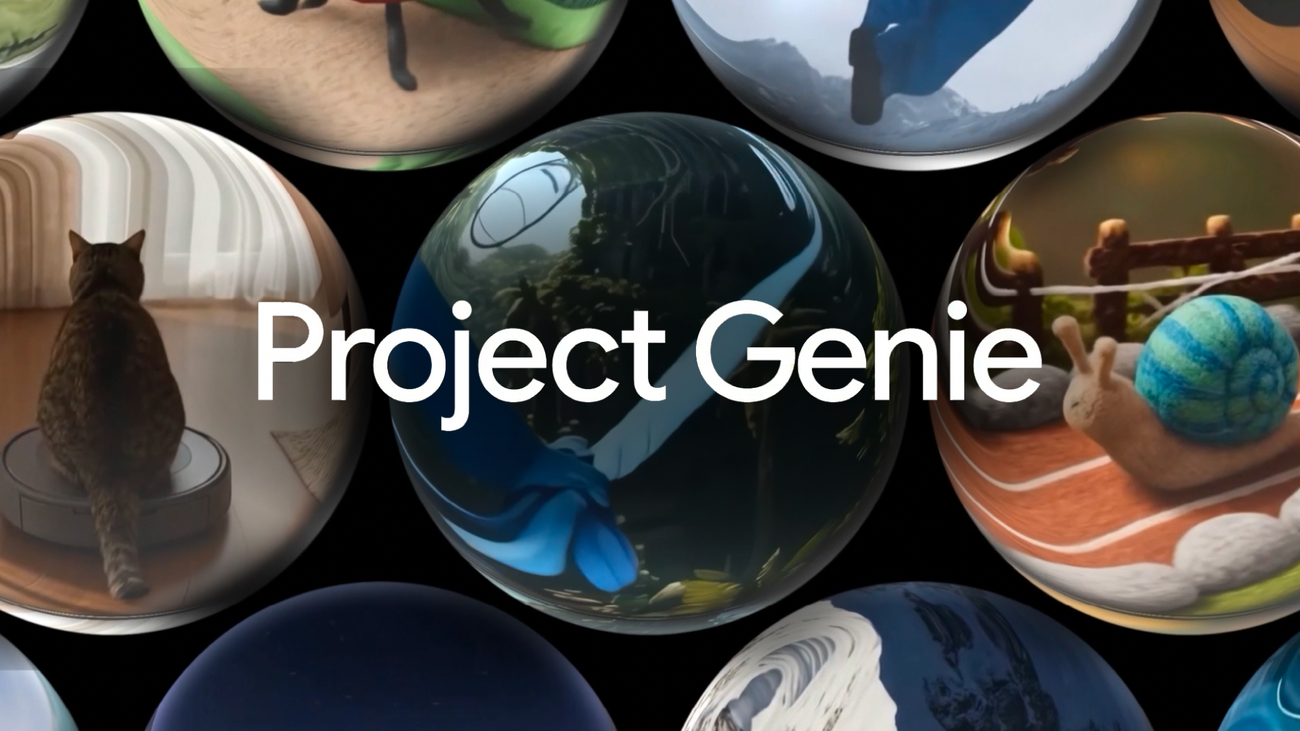
- What happened: Google added
Street Viewgrounding to Project Genie.- Users can pick a real U.S. location from a Maps pin, add a style and character description, and generate an explorable world from that place.
- Why it matters: The input surface for world models is expanding from prompts into real spatial data.
- Google says the feature is powered by
Maps Imagery Grounding, which makes Street View a grounding layer rather than just a visual reference.
- Google says the feature is powered by
- Builder impact: The stronger signal is not game generation, but simulation, robotics, and agent training environments.
- Watch: Google still describes Project Genie as an experimental research prototype.
Project Genie made a quiet but important turn at Google I/O 2026. The announcement looks, on the surface, like a consumer demo. You pick a real U.S. place from a Maps pin, add a style such as Ocean World, Desert Sands, Stone Age, or B&W film, describe a character, and Genie turns the location into an explorable imagined world. A bridge can become an underwater scene. A historic district can be reimagined as a 1920s black-and-white film set.
The main story is not "AI can generate a game-like world." The bigger shift is that Google connected nearly two decades of Street View imagery to a world model's grounding layer. Project Genie, first shown in January, was already an experimental world-model prototype that could start from text and image prompts. The May update changes the starting point: it anchors generation in the visual context of real places. The generated scene is no longer only an imagined space. It begins from the surface of the world that a map product has spent years collecting.
That difference matters for developers and AI product teams. A world model is not just a model that makes attractive video. It can become an environment where agents act, fail, recover, and learn. Google DeepMind describes Genie as a general-purpose world model for generating diverse interactive environments. Google has also connected Genie research to agents learning and reasoning in complex virtual settings, and to Waymo's simulation of realistic road environments. Once Street View enters the loop, the question becomes more concrete: what can a simulation grounded in real place data teach, and what might it distort?
What Project Genie was built to test
Project Genie first became available on January 29, 2026 to adult Google AI Ultra subscribers in the United States. Google presented it as a Google Labs research prototype for trying the Genie 3 world model, not as a finished game-authoring product. Users could sketch a world with text or images, explore it in first-person or third-person view, and remix existing worlds. The world was not a static prebuilt 3D map. As the user moved and interacted, Genie generated the path ahead in real time.
That framing quickly pulled Genie into game-industry speculation. Could it replace a game engine? Was it a threat to Roblox or Unity? Could a prompt generate something like an open-world game? The early reaction mixed excitement and skepticism. Some observers focused on two hard problems: world consistency and playable frame rate. Others pointed to the short sessions, lack of narrative, lack of goals or scoring, and recurring consistency issues when a user returned to the same place.
Reading the Street View update only through that game lens misses the more important change. Google did not add game rules, quests, physics-engine authoring, or a commercial publishing pipeline. It added a specific real-world location as the starting point. When a user picks a U.S. place through a Maps pin, Genie builds a new world from that location's Street View imagery. Google says this is powered by Maps Imagery Grounding. In other words, map imagery becomes the substrate under a generative world.
Grounding is more expensive than prompting
The first demo of an AI product usually centers on the prompt. What did the user type? What image appeared? How fast did it respond? In production systems, the more durable distinction is often grounding. Which external world is the model connected to? How current and accurate is that connection? What permission and responsibility boundaries come with it?
Project Genie's Street View integration makes that point visible. While OpenAI, Runway, Pika, Decart, and others push video generation and interactive simulation forward, Google is reaching for an asset that is hard to duplicate. Street View is not merely a photo collection. It combines geographic coordinates, camera perspective, road and building context, and accumulated traces of places over time. If a world model can transform or explore real locations instead of creating arbitrary fantasy spaces, that data becomes a competitive advantage alongside model quality.
Google's announcement describes the feature in consumer terms: people can explore favorite places or reimagine them with a creative twist. From a builder's point of view, it is a change in the input space. World models are moving from text, image, and video into maps and street-level spatial context. That touches game concepting, virtual field trips, urban design mockups, robotics simulation, and autonomous-driving edge-case generation.
Pick a real U.S. location from a Maps pin
Street View imagery and Maps Imagery Grounding
Style and character prompts meet the Genie 3 world model
An explorable imagined world is generated
What Google did and did not claim
The boundaries in the announcement are important. Street View imagery in Project Genie currently works with U.S. places, and Google says it plans to expand to more regions over time. Project Genie, including the new Street View feature, is rolling out to eligible adult Google AI Ultra subscribers globally. Google's post names the $200 Google AI Ultra tier. That access model also points to the current cost structure. A real-time world model is operationally heavier than generating a single video shot. It has to create the next view as the user moves, preserve perspective changes and world consistency, and keep response latency low enough to feel interactive.
The Genie 3 page says the system supports real-time interaction at 20-24fps and renders photorealistic worlds at 720p. It also emphasizes world consistency and stability, including remembering previously seen details when they are revisited. At the same time, Google still labels Project Genie as an experimental research prototype. The January launch post also noted areas still being improved, including realism and character control. Calling today's Project Genie a commercial game engine, a general simulator, or a faithful digital twin of a city would be premature.
The more useful framing is layer, not replacement. A game engine includes rules, state, physics, asset pipelines, networking, deployment, performance tooling, and debugging. Project Genie does not offer that full stack. It offers quick visual situation generation and explorable environment samples. Today's Genie is closer to a way to surface ideas or create provisional environments for people and agents to try than a tool for shipping final products directly.
The agent-training angle is clearer than the game angle
The longer arc for world models is agents, not games. LLM-based agents began with text and tool calls, but they increasingly operate across browsers, terminals, documents, user interfaces, robots, and maps. An agent needs more than answer generation. It needs to observe environment state, choose an action, inspect the result, and plan again. Running that loop directly in the real world is expensive and risky. That is why simulation quality matters.
Google's mentions of agent learning and Waymo simulation fit this context. It is hard to collect and replay every road edge case in the physical world. A fully arbitrary generated world, on the other hand, may fail to reflect real complexity. Street View grounding sits between those extremes. The visual structure of a real place can be the starting point, while weather, era, style, characters, and situations are varied to create many scenarios.
That does not automatically make the generated world trustworthy training data. It is not an exact copy of the real world. Google itself uses the phrase "creative twist." Even when a location's visual context is present, physics, routes, object relationships, traffic rules, and human behavior may be changed by the model's generation. In high-risk domains such as robotics or autonomous driving, teams must distinguish between a generated world used as a reference, a synthetic scenario for early exploration, and auxiliary data that requires human review.
Street View expands the responsibility boundary
Once real spatial data enters a generative system, the responsibility boundary expands. Starting with U.S. places may be a product-scope decision, but it also has a regulatory and rights context. Street View contains public-place imagery, building exteriors, roads, storefronts, and traces of people and vehicles. Google has long applied measures such as face and license-plate blurring. A generative world model that reinterprets and stylizes this imagery raises a different set of questions.
For example, turning a real neighborhood into a ruined desert, a crime-film set, or a disaster scene may be creatively interesting. But when the output is tied to a real place, local businesses, residents, and community image, the boundary between acceptable remix and harmful representation is not simple. A virtual field trip is not the same product as a satirical remix. An urban-planning mockup is not the same use case as a distorted depiction of a specific building. When world models handle real locations, AI safety has to include the context of geographic data, not only the toxicity of the generated pixels.
Builders should watch the permission model. Project Genie is currently closer to a Google Labs consumer experiment. If this direction expands into APIs or developer tooling, product teams will need clearer answers: which place data can be called for which purposes, whether generated results can be stored or distributed, where commercial rights and derivative-work rights sit, and how a product should label the difference between a real location and an AI-generated scene. Google also discussed SynthID and C2PA Content Credentials at I/O 2026, which suggests it sees provenance and labeling as a separate axis of the problem.
The community skepticism still applies
This announcement does not need to be read optimistically by default. January reactions to Project Genie repeatedly made the same points: it looked fun but rough, it did not yet provide much to do as a game, a technical demo is different from a commercial product, and server cost could become a constraint. Some game communities also showed fatigue with the idea that AI would flood the market with generic games. On the other side, some observers argued that world consistency and playable frame rate were the hard problems worth noticing.
Both readings can be true. The claim that Project Genie replaces Unity or Unreal today is weak. Games are not made from visual worlds alone. They need rules, feel, difficulty, narrative, level design, performance, and authorial intent. But stopping at "it is not a game yet" is also too shallow. If a system can quickly create an explorable scene from a real place, and that scene can be inspected by a creator or an agent, parts of pre-production and simulation workflows can change.
The realistic use case is not finished-product generation. It is intermediate output. A game team could explore the mood of a real city-like location before building a level. An education team could prototype a historical field trip that reimagines a place in another era. A robotics team could create synthetic scenarios that resemble the visual complexity of real spaces and then observe agent behavior. An AI product team could give users an explorable draft from location and intent, without requiring them to model a 3D scene manually. In all of these cases, the last stretch still needs human review, editing, and domain expertise.
A more favorable battleground for Google
This update is interesting because Google is not competing only with the model. The larger Google I/O 2026 message was the agentic Gemini era. Search, Android, Workspace, Flow, AI Studio, Antigravity, and Chrome DevTools for agents were all connected to AI-agent workflows. Project Genie plus Street View is the spatial version of that strategy. Google owns models, maps, browser surfaces, a mobile operating system, developer tools, and cloud infrastructure.
That mix is powerful in the world-model race. Every major AI lab can try to build a larger model. Far fewer companies have real-world map data, consumer surfaces, and developer surfaces at the same time. Street View is not an asset a rival can quickly copy. Even if Project Genie remains experimental for now, the update shows Google treating world models as an extension of maps and agent infrastructure, not merely as a generative demo.
The burden is also larger for Google. A generated world based on a real place blurs the boundary between accuracy and imagination. Users may struggle to tell how much of a scene reflects the real location and how much was invented. Developers will ask about reproducibility, persistence, licensing, and evaluation standards. Enterprise customers will ask about data use and liability. Keeping the feature inside a Labs-style rollout while expanding slowly is likely part of that calculus.
The current takeaway
Project Genie's Street View update is easy to read as a fun I/O demo. For AI builders, it is better read as a signal that the world-model bottleneck is moving. Text prompts are not enough. Models need to connect to structure, coordinates, visual context, time, permissions, and responsibility boundaries. Google is starting that connection with Street View and Maps Imagery Grounding.
So the accurate reading is not "Google made an AI game generator." It is "Google is beginning to place world models on top of map data." That shift may matter first in simulation, robotics, education, urban experiences, and agent-evaluation environments rather than in finished games. It also brings the harder questions of labeling, usage rights, and accuracy verification whenever a real place becomes a generated scene.
As AI agents move beyond text windows into browsers, apps, and proxy environments for the physical world, the standard for a good world model changes. Generating one impressive scene matters less than grounding an interactive environment in reality, making that interaction repeatable, and marking what is real versus generated. The question Project Genie now raises is simple: in the next phase of world-model competition, is the scarce asset model size, or the map that holds the real world steady?