OpenAI is turning YC API tokens into startup equity
OpenAI reportedly offered YC startups $2 million in API tokens through an uncapped SAFE, turning inference compute into a new investment instrument.
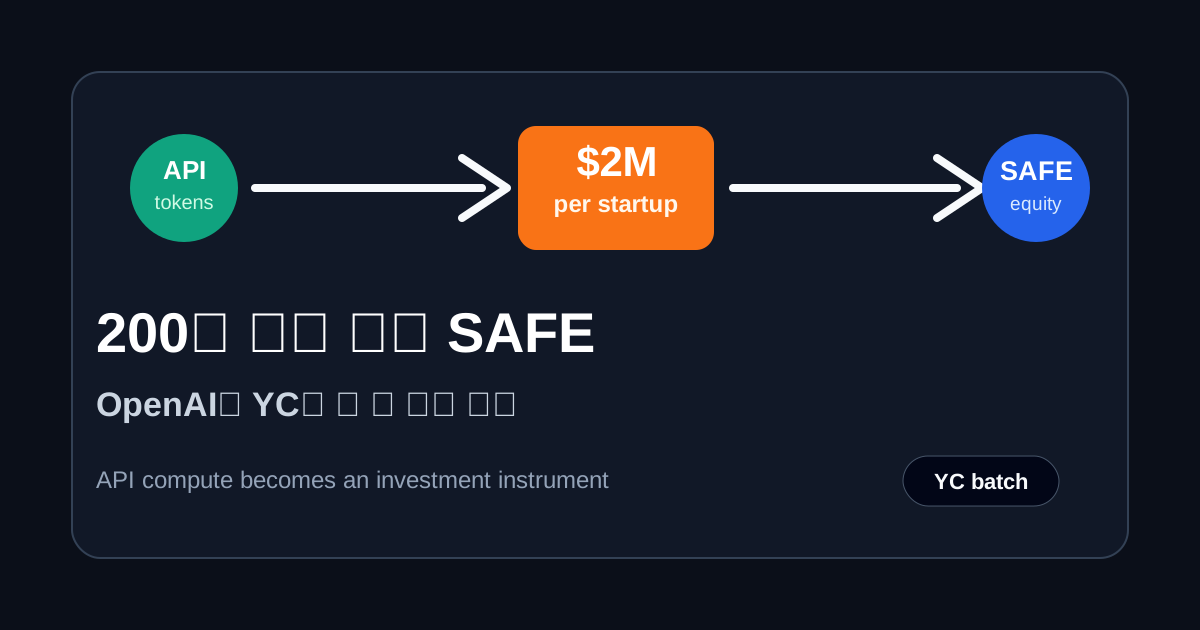
- What happened: OpenAI reportedly offered each startup in the current YC batch
$2 millionworth of API tokens.- TechCrunch cited YC managing director Jared Friedman saying the deal is structured as an uncapped SAFE, not a conventional free-credit grant.
- Why it matters: Inference compute is becoming a financing unit for AI startups, not just a line item in the cloud bill.
- Builder angle: Model choice now shapes cost, data flow, evaluation, latency, and long-term vendor leverage in the product architecture.
- Watch: OpenAI's credit terms say service credits are not cash, currency, refundable value, or freely transferable assets.
OpenAI and Y Combinator have surfaced a deal structure that says a lot about where AI startup financing is moving. TechCrunch reported on May 20, 2026 that Sam Altman offered every startup in the current YC batch $2 million worth of OpenAI tokens. At first glance, this can look like a large API-credit giveaway. The more interesting part is the structure. According to TechCrunch, YC managing director Jared Friedman said the offer is being provided as an uncapped SAFE.
That makes it different from a normal cash investment. It also makes it different from the startup credits distributed for years by AWS Activate, Google for Startups, Microsoft for Startups, and other cloud programs. OpenAI is not simply subsidizing infrastructure usage as a marketing expense. It is reportedly offering compute that can only be spent inside its own service boundary, and receiving a future equity instrument in return. If API tokens are the raw material of many AI-native products, this offer turns raw material into a financing primitive.
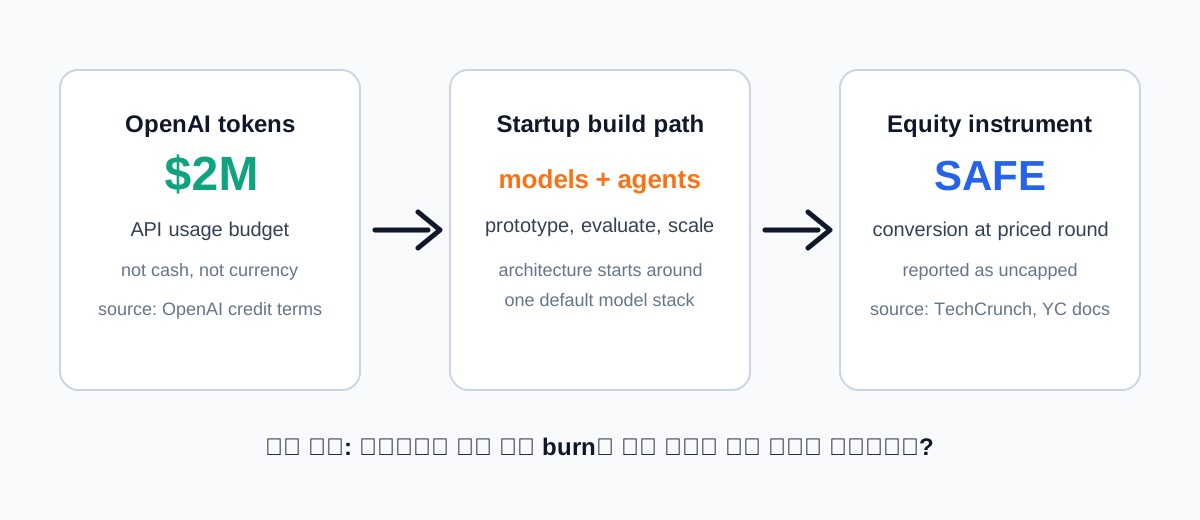
The distinction matters because early AI products are often constrained less by web hosting or database capacity than by repeated model calls. A user may press one button, but the product behind that button can run planning, retrieval, tool calls, evaluation, retries, and summaries. Coding agents, voice agents, research assistants, document systems, and multimodal generators all turn user value into recurring inference work. The more useful the product becomes, the more work users tend to delegate to it.
OpenAI understands that loop. In April 2026, the company said its API was processing more than 15 billion tokens per minute, and that Codex had passed 2 million weekly users. That announcement was a separate funding and platform update, but it is useful context for reading the YC offer. OpenAI's platform strategy is not only ChatGPT subscriptions. It spans API usage, Codex, agentic workflows, enterprise deployment, and developer defaults. If a YC company builds its first product and internal workflows on OpenAI tokens, that habit can matter long after the initial credit balance is gone.
This is not just free credit
The reported number is large: $2 million worth of OpenAI tokens for each company. TechCrunch also described the relevant YC cohort as roughly 169 startups based on YC's directory. Multiplying those numbers produces a headline nominal value in the hundreds of millions of dollars. But "worth" needs careful handling here. OpenAI's Service Credit Terms say service credits are not legal tender, cash, or currency, cannot be exchanged or refunded for cash, and cannot be transferred unless OpenAI allows it. They are a right to use OpenAI services, not general-purpose money.
That gives the offer two faces for founders. On the positive side, it can reduce cash burn in exactly the category that often hurts AI startups early: model experimentation. A small team can run more prompt tests, evaluation jobs, agent retries, voice sessions, document analysis flows, and user trials before paid usage catches up. For products where inference is the core cost driver, the practical value can be real.
On the other side, these tokens are not liquid runway. They cannot pay salaries, cloud bills outside OpenAI, contractors, legal invoices, or customer acquisition. Their value drops if the product uses Claude, Gemini, Grok, Mistral, open-weight models, self-hosted inference, or a routing layer where OpenAI is only one provider. The more a company designs around OpenAI as the default stack, the more useful the tokens become. The more a company needs provider flexibility, the more visible the opportunity cost becomes. That is why this is not merely a subsidy. It is a force acting on architecture.
| Category | Cash investment | Standard cloud credits | OpenAI token SAFE |
|---|---|---|---|
| Where it can be used | Payroll, infrastructure, sales, operations | Specific cloud services | OpenAI service usage |
| Consideration | Equity or convertible security | Usually marketing or partnership spend | Reportedly an uncapped SAFE |
| Primary risk | Dilution and investor terms | Cloud dependency and expiration | Dilution and model lock-in at the same time |
| Founder question | How much runway does this add? | What is the real bill after credits? | Do we want this stack as our long-term default? |
Why the SAFE label matters
YC's own SAFE documents describe SAFE as a simple investment agreement widely used in early-stage fundraising. YC introduced the original SAFE in 2013 and later published post-money SAFE forms in 2018 so founders and investors could more immediately calculate ownership sold. The instrument itself is familiar in startup financing. The unusual part is what goes into it. Here the reported investment material is API tokens, not cash.
TechCrunch says the offer is an uncapped SAFE. Uncapped means there is no valuation cap governing the future conversion. The actual ownership impact depends on the priced round where the SAFE converts and the specific terms founders sign. TechCrunch also noted that social posts speculated about what the stake might look like at a $100 million valuation, but those estimates cannot be verified without the actual deal terms. That caveat is the point. The headline "$2 million" number is less important than conversion mechanics, expiration, eligible services, model availability, price changes, data terms, and privacy settings.
There is another subtle issue: the nominal value of API tokens is not the same as their cost to OpenAI or their strategic value to a startup. Model prices and capabilities change quickly. If inference costs fall, OpenAI's effective cost of honoring credits can fall too. If prices fall for customers, the same credit balance can support more experimentation. If the model market shifts, a provider-specific credit can become more or less valuable depending on where quality, latency, compliance, and developer tooling move.
OpenAI is buying more than upside
The obvious upside for OpenAI is exposure to successful YC companies. If even a few startups from the batch become large, a SAFE can carry meaningful financial upside. But the more strategic asset may be default behavior. AI products are harder to move between model providers than they look from the outside. A single model string is rarely the whole integration.
Prompts, eval sets, safety filters, latency budgets, caching behavior, cost attribution, fine-tuning plans, distillation experiments, tool-calling schemas, memory layers, and observability all accumulate provider-specific assumptions. A switch from one frontier model to another can change quality, cost, failure modes, and user trust at the same time. In agent products, the coupling can be even tighter because the model reads files, calls tools, edits code, opens pull requests, searches the web, and invokes external APIs. Model choice becomes part of the harness, sandbox, audit log, permission model, billing layer, and evaluation pipeline.
That does not make the offer inherently bad. Early startups need focus. Spending months building model neutrality before proving customer demand can be a mistake. Users usually care less about provider purity than whether the product solves the problem. The real issue is whether the team understands what it is choosing. "We started with OpenAI because it was free" is not the same decision as "we started with OpenAI because its quality, cost, latency, safety, and compliance fit this product."
Treat credits as an experiment budget
For a founder, the first question should not be "How much money am I getting?" It should be "What learning loop can this budget unlock?" API tokens cannot pay payroll. They can, however, make a product team learn faster. A support-agent startup can run denser evaluations on real conversation traces. A coding-agent startup can test more repositories and collect more failure cases. A voice-agent startup can push latency, interruption handling, and retry behavior harder before usage revenue catches up.
The danger is spending the credits as if they hide the real unit economics. Agentic workflows consume tokens quickly. One user task can expand into planning, retrieval, code generation, test execution, error analysis, retry, verification, and final reporting. Without early metrics such as cost per successful task, retry rate, cache-hit rate, fallback frequency, tool-call failure rate, and user-level quota behavior, a large credit pool can disguise a cost structure that becomes painful after the credits expire.
The due-diligence checklist is practical. Founders should ask what expires and when. They should ask which models, APIs, regions, and enterprise settings are eligible. They should ask how pricing changes affect credit consumption. They should ask whether customer data can be kept out of training or improvement loops, whether zero-retention or enterprise privacy settings are available, and how those settings interact with the credit offer. They should also ask what fallback architecture is worth building now so one provider outage, policy change, or quality regression does not stop the product.
Competitors now face a more expensive question
This is not only an OpenAI and YC story. Anthropic, Google, xAI, Mistral, Cohere, AWS, Microsoft, Cursor, GitHub, and other AI infrastructure companies will face the same distribution question: what should they offer early AI startups so their stack becomes the default? Basic credits are one answer. Enterprise support is another. Early model access, coding-agent workflows, security agreements, data controls, marketplace placement, and investment-like structures are all possible moves.
Cloud companies have distributed startup credits for years. The difference is that model API credits sit closer to the product's core value. AWS credits can make hosting cheaper without necessarily determining the application's intelligence. Model credits can shape the quality of recommendations, analysis, code generation, customer support, search, and automation. The subsidy reaches into the user experience itself.
That is why the reported YC offer is bigger than a perk. It shows how a model company can treat venture distribution as part of platform strategy. Knowing where promising AI startups begin, what evals they run, which tool-call patterns they use, where costs break, and which product categories burn inference fastest is valuable information. Equity upside is one prize. Becoming the default execution layer for a generation of YC companies may be the larger one.
The community discomfort is rational
TechCrunch reported that debate on X was already active. Supporters saw a practical benefit: early AI startups can reduce one of their most expensive operating categories. Critics focused on whether credits justify equity dilution when the value cannot be spent outside one supplier, whether the structure deepens model lock-in, and whether OpenAI would sit too close to startup usage patterns and product direction.
Those concerns are not abstract. AI product logs can reveal a lot: which user problems repeat, which prompts and tools work, where evals fail, what feature creates usage, and what tasks customers are willing to delegate. Paid API customers already leave operational signals with providers. But when the provider is also an investor-like counterparty, the perceived boundary changes. Contracts need to be explicit about what is visible, what is retained, what can be used for improvement, and how customer data and product secrets are separated.
There is also a pragmatic counterargument. Many early AI companies already depend on frontier providers. Total independence is expensive. Building a complex multi-model router, self-hosted inference stack, and abstraction layer before finding product-market fit can slow the company down. So the answer is not automatically "do not take it." The better answer is to price it correctly: not as cash, but as an experiment budget tied to a particular architectural direction.
The lesson for AI product teams
Teams outside YC should still pay attention. Startups everywhere receive cloud credits, model credits, accelerator perks, enterprise pilot support, and strategic partnership offers. Each one can extend runway. Each one can also steer technical decisions. The vector database, model provider, observability stack, agent framework, and deployment pattern selected during the first six months can become migration work later.
This is especially important for regulated or enterprise AI products. Customer requirements around data residency, retention, audit, private networking, fallback, and provider risk may not match the easiest way to consume free credits. A prototype built around a credit-funded default can become expensive to rewrite if the production architecture needs different privacy, routing, or compliance assumptions.
The core lesson is simple: AI cost is not an accounting item discovered after the product is built. It is part of product design. Model choice, token budget, eval automation, fallbacks, data retention, logs, and user quotas belong in the MVP conversation. OpenAI's reported YC offer makes that visible. In the AI era, infrastructure credits are no longer just server subsidies. They can be tools for buying product defaults.
The next benchmark is switching cost
More offers like this are likely. Model companies want developer distribution, and startups want lower costs. The incentives align. But as the market matures, founders should evaluate these deals with a different yardstick. The question is not just how much credit is available. It is whether the unit economics still work after the credit is gone. It is not only how fast the first version can ship. It is whether the team keeps the option to move to another model, add a fallback, negotiate enterprise terms, or bring part of inference in-house later.
OpenAI's reported offer to the YC batch is not ordinary free-credit news. It is a signal that API compute can bind equity, distribution, product defaults, and model competition into one financial instrument. For AI startups, the most expensive resource may not be GPUs. It may be a default chosen too casually. A $2 million token budget can be a powerful accelerator. The important part is remembering that an accelerator also points the company in a direction.