OpenAI’s unit-distance proof puts AI research automation on the record
OpenAI’s counterexample to the Erdős unit-distance conjecture shows both the promise of AI research automation and the reproducibility gap left by an unnamed model.
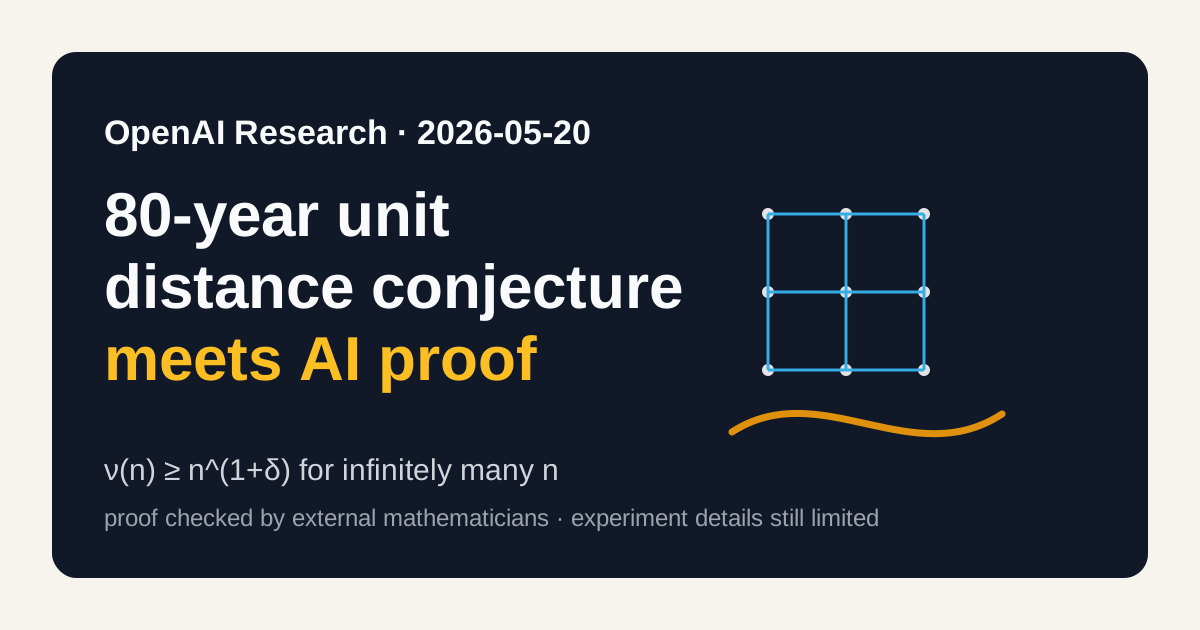
- What happened: OpenAI says an internal general-purpose reasoning model found a family of counterexamples to Erdős’s
planar unit distance problem.- The formal proof shows that for some δ > 0, there are infinitely many
nwithν(n) ≥ n^(1+δ).
- The formal proof shows that for some δ > 0, there are infinitely many
- Why it matters: The claim is not about a math-specific scaffold, but about a general-purpose model producing a proof path for an open problem.
- What is missing: OpenAI published the proof PDF and companion remarks from outside mathematicians, but not the model name, sampling setup, attempt count, or compute budget.
- That makes this both a strong signal for AI research automation and a test case for reproducibility standards.
- Builder lens: As with coding agents, AI science now depends on verifiers, provenance, audit trails, and human review as part of the product.
OpenAI’s May 20, 2026 announcement about the unit-distance problem raises a sharper question than the familiar headline, “AI solved a math problem.” The important point is not just that a model produced a difficult theorem. A long-standing expectation around Paul Erdős’s 1946 planar unit-distance problem has been broken, and OpenAI says the counterexample family was found by an internal general-purpose reasoning model. The company also published a formal proof PDF and companion remarks from external mathematicians.
On the surface, this is a math story. For AI developers and product teams, it is closer to an operations story about research automation. How was the model output graded? Who verified the proof? Which artifacts were released? Which experimental details remain closed? In coding agents, “the patch was generated” matters less than “the patch passed tests and review.” AI mathematics is reaching the same split: a proof can be correct while the discovery process remains difficult to reproduce.
Why this 80-year-old question mattered
The planar unit-distance problem is easy to state. Given n distinct points in the plane, what is the maximum number of pairs that are exactly distance 1 apart? OpenAI describes it as a combinatorial geometry problem that is simple to explain and very hard to solve. The company’s post also notes that Brass, Moser, and Pach called it one of the best-known and easiest-to-state problems in combinatorial geometry, while Noga Alon described it as one of Erdős’s favorite problems.
The old intuition came from the square grid. Put many points on a grid and unit-distance neighbors appear naturally. Erdős’s 1946 paper gave a construction in this direction with roughly n^(1+Ω(1/log log n)) unit distances, and mathematicians long expected that this family was close to optimal. In that view, ν(n) should not grow much beyond n^(1+O(1/log log n)).
Known upper bounds were looser. The proof PDF explains an elementary O(n^(3/2)) upper bound and cites the Spencer-Szemerédi-Trotter line of work for the best general upper bound, O(n^(4/3)). A large gap remained between the lower and upper bounds, but the near-linear side carried much of the field’s intuition. OpenAI’s result attacks that intuition directly.
The main theorem says that there is an absolute constant δ > 0 such that for infinitely many values of n, ν(n) ≥ n^(1+δ). This does not determine the exact maximum growth rate. It does, however, contradict the expectation that the square-grid-type constructions are essentially optimal.
The model did not improve the grid
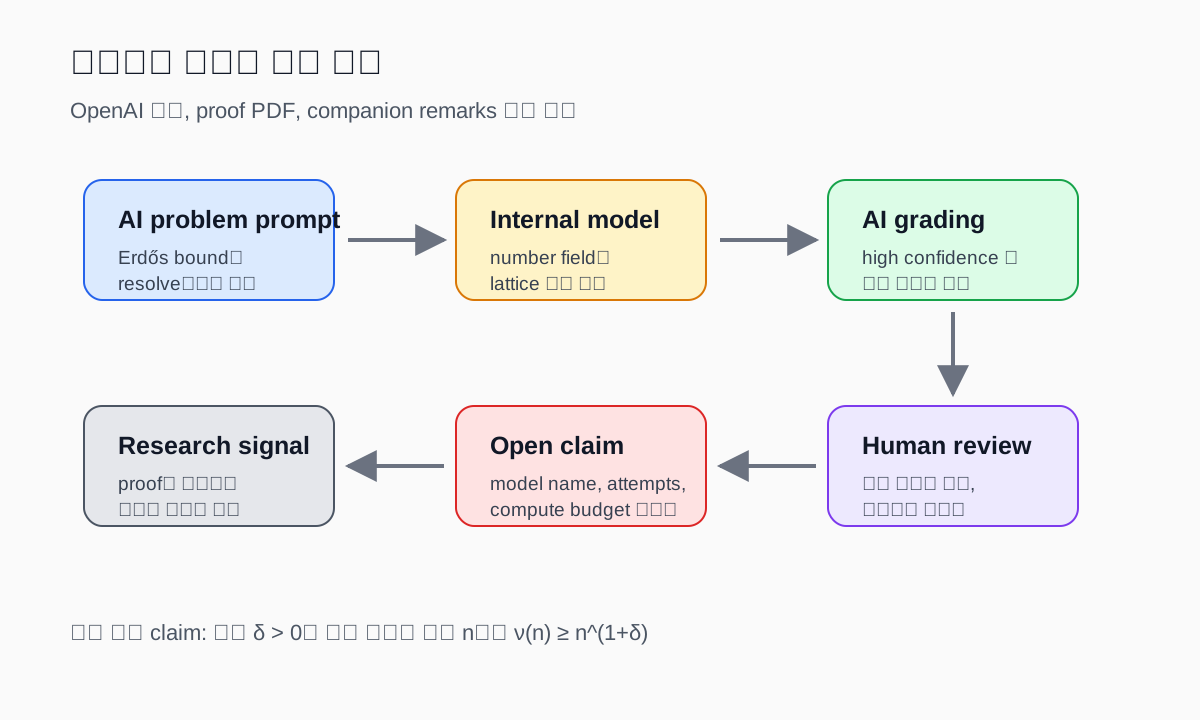
The route to the result is the interesting part. OpenAI says the proof did not come from a system trained only for mathematics, a bespoke proof-search scaffold, or a unit-distance-specific tool. It came from a new general-purpose reasoning model while OpenAI was evaluating that model on a collection of Erdős problems. The proof candidate then moved through an AI grading pipeline and human review.
The mathematical idea is not a direct improvement to the square grid. It detours through number fields and lattices. The proof connects infinite unramified towers of totally real number fields, a 3-power Galois group, splitting rational primes, the CM field K=L(i), norm-one elements, a Minkowski lattice, products of discs, and a projection back into the plane. In plain terms, the construction uses high-dimensional number-field structure to produce many elements whose complex embeddings all have absolute value 1, then turns that structure into many unit-distance pairs in a planar point set.
The companion remarks describe a human-digested, simplified, and partly generalized version of the proof. The external mathematicians also connect the argument to ideas around Ellenberg-Venkatesh, Golod-Shafarevich, and Hajir-Maire-Ramakrishna. One notable thread is the proof’s suggestion that “number fields deserve a closer look”: very large degree is not merely an inconvenience, but part of the counterexample engine.
That is why this result matters for AI research automation. OpenAI is not just claiming that a model repeated a calculation quickly. The claim is that a general-purpose model found a structural connection that cut around a long-standing expectation. The final paper still required humans to organize the argument, add references, and verify the result. But if the initial path truly came from the model, this is a strong case study for AI systems proposing combinations that experts had not prioritized.
| Layer | What this result shows | What is still missing |
|---|---|---|
| Math claim | A family with ν(n) ≥ n^(1+δ), checked by outside mathematicians | The exact maximum growth rate |
| AI claim | A general-purpose model automatically generated the proof path | Model name, sampling setup, attempts, and compute budget |
| Operations claim | AI grading, internal review, and external review formed a workflow | The full grading pipeline and failed candidates |
The proof is public, but the experiment is not
The key distinction is between mathematical verification and ML reproducibility. Publishing the proof PDF, the companion remarks, and the external correctness check makes the mathematical claim much stronger. It does not tell us enough about how the AI system found the proof.
The proof PDF’s statement on AI use says the internal model received an AI-written problem statement, produced an output that went into an AI grading pipeline, and was flagged with high confidence before internal researchers and external mathematicians reviewed it. It also says a preliminary AI-assisted verification and rewriting step happened before the draft was sent to outside mathematicians, who confirmed correctness and helped simplify and strengthen the argument.
But the details ML readers naturally want are mostly absent. OpenAI does not name the model. It does not report how many samples were tried, how many attempts were made on this problem, what the compute budget was, whether hidden system prompts or tool access were involved, or how the grading pipeline produced high confidence. The r/MachineLearning discussion focused on exactly this gap. To decide whether this is evidence of frontier models doing genuine autonomous research, or a valuable but cherry-picked success from a large search process, the public record needs more detail.
That caveat does not diminish the proof. It explains why this case matters. When a coding agent fixes a bug, we want more than the final diff. We want to know the failing test, the number of failed attempts, the tool permissions, and where human review entered. AI mathematics now needs a comparable provenance standard.
The weight of the word autonomous
OpenAI frames this as a prominent open problem solved autonomously by AI. That is a strong word. If the model output initiated the proof and humans later organized and checked it, the automated contribution is substantial. At the same time, the final artifact clearly went through expert mathematical review and editing. The companion remarks explicitly present a human-digested, simplified, and generalized version.
The more precise reading is not “AI wrote a finished paper by itself.” It is: AI proposed a research path, produced a verifiable proof candidate, and human experts turned it into a form the mathematical community can inspect. That is still a large milestone. One of the hardest parts of research automation is not generating random ideas; it is generating candidates that can survive expert verification.
OpenAI’s broader framing also fits this view. Mathematics is a useful testbed for reasoning because the problems are precise, proofs are checkable, and one broken step can collapse a long argument. If a model can maintain that structure and find unexpected cross-domain connections, the same pattern may eventually matter in biology, physics, materials science, engineering, and medicine.
The boundary is important. Mathematical proofs have relatively crisp truth conditions compared with wet-lab science or engineering deployment. In biology or materials science, verification involves experiments, data quality, measurement error, cost, safety, and ethics. A model producing a math proof candidate does not imply fully automated science across domains. It does suggest that workflows built around verifiable intermediate artifacts are becoming central.
For developers, this is verifier news
For AI builders, the result is less about another LLM benchmark and more about verifier architecture. The model produced a proof candidate. An AI grading pipeline assigned high confidence. Internal researchers and external mathematicians reviewed it. Companion remarks made the proof more readable and somewhat more general. Taken together, this looks like a research CI pipeline.
The same shift is happening in coding agents. Generated code is hard to trust without tests. Tests are incomplete without coverage and review. Review is incomplete without permission boundaries, audit logs, and security checks. That is why the coding-agent market has moved beyond raw model quality into sandboxes, test harnesses, policy engines, approval flows, and observability. AI math and AI science are moving in the same direction.
The weakest part of OpenAI’s announcement is the missing CI log. Which problem set was used? How often does this kind of success happen? How many incorrect proof candidates did the grader accept or reject? What false-positive rate does the grading pipeline have? What changed during human review? If those details were public, the research-automation claim would be much easier to evaluate. A correct proof and a repeatable discovery process are related but separate questions.
The practical lesson is straightforward: for agents that do complex knowledge work, design the verification loop before trusting the output. Code, documents, equations, and scientific hypotheses each need different verifiers. Code with tests is relatively easy to check automatically. Architecture judgments or scientific hypotheses require more elaborate human-in-the-loop systems. OpenAI’s unit-distance result highlights the verification workflow as much as it highlights the model.
Why the math community’s reaction split
The response has separated into two layers. One layer recognizes the mathematical significance. In r/slatestarcodex, commenters cited a positive reaction from Tim Gowers and treated the result as closer to a real AI mathematics milestone than many previous AI-generated proof claims. The sentiment that this would be accepted as significant if written by a human is an important signal.
The other layer asks what the result proves about machine-learning capability. The r/MachineLearning discussion linked the proof PDF and the abridged reasoning writeup, then focused on the missing model name, sampling setup, attempt count, compute budget, hidden prompt, and grader details. That is not nitpicking. In AI capability evaluation, a single success and a repeatable capability can be very different things.
Those reactions do not really conflict. Mathematicians are asking whether the proof is correct and what it means for the field. ML researchers are asking what system capability the proof demonstrates. AI product builders are asking what workflow can turn this into a reliable tool. The story is interesting because all three layers are open at once.
What OpenAI gains
This announcement gives OpenAI a strong moment in the AI-for-science race. Research automation has been expanding through Google DeepMind’s Co-Scientist, AlphaProof, AlphaGeometry, OpenAI’s GPT-Rosalind, and a growing set of domain-specific scientist agents. Mathematics is a particularly visible arena because it combines symbolic rigor with long-horizon reasoning and relatively clear verification. Claiming a prominent open-problem result in that arena is strategically important.
The announcement also shows the usual tension of a closed frontier lab. The result is public, but the system is not. The proof can be checked, but the discovery process is only partially visible. There may be safety and competitive reasons for that choice, but it limits the scientific evaluation of the automation claim.
That tension will likely become more common. As AI systems write code, find vulnerabilities, produce proofs, and propose scientific hypotheses, we may see more public result artifacts paired with private models, prompts, toolchains, compute budgets, and failure logs. Society will need better norms for verification, credit, and reproducibility when the output is inspectable but the process is not.
What to watch next
First, watch the follow-up from the mathematics community. The companion remarks already include outside verification, but more time may produce a simpler proof, stronger bounds, or extensions to related problems. The key question is whether the AI-suggested path becomes a research program rather than a one-off construction.
Second, watch whether OpenAI discloses more about the process. Even without naming the exact model, the company could share the problem-set size, approximate attempt counts, an outline of the grading pipeline, the rate of failed candidates, or the scope of human editing. That would make the autonomous-research claim much easier to interpret.
Third, watch the connection to proof assistants. This announcement is centered on human mathematical review. If future systems connect more directly to Lean or other formal verification tools, the trust model for AI proof generation changes. The important agent may not be the one that writes the most fluent natural-language proof, but the one that can iterate with a formal verifier and produce proof objects.
Fourth, watch translation into other scientific domains. OpenAI links this result to biology, physics, materials science, engineering, and medicine. Each field has a different verifier. In mathematics, proof checking and expert review are central. In life sciences, experimental design, replication, data provenance, and safety review enter the loop. The next bottleneck for AI research automation may be verification infrastructure rather than model intelligence.
Bottom line
OpenAI’s unit-distance result is a serious event even without hype. It breaks an old expectation around an Erdős problem that has stood for nearly 80 years, and OpenAI says the starting point was a general-purpose reasoning model. That changes the baseline for what AI mathematics systems may be able to contribute.
It is not a simple story about AI replacing mathematicians. It is a story about a mixed workflow: a model produced a proof candidate, AI grading filtered it, human mathematicians verified and organized it, and the public received a checkable mathematical artifact. For developers, the operational question is more useful than the philosophical one. How do we verify difficult outputs from AI systems? Which logs and artifacts make a discovery reproducible? Where should human experts enter the loop? How should we read frontier-lab announcements when the result is public but the process is private?
The proof is a strong mathematical signal. The product conditions for AI research automation are still being defined. A model-name-free math breakthrough is impressive. The next question is whether it was a rare flash from a large search process or an early output from a repeatable research engine. This result matters because that boundary is now attached to a concrete proof.