OpenAI Realtime 2 turns voice agents into tool callers
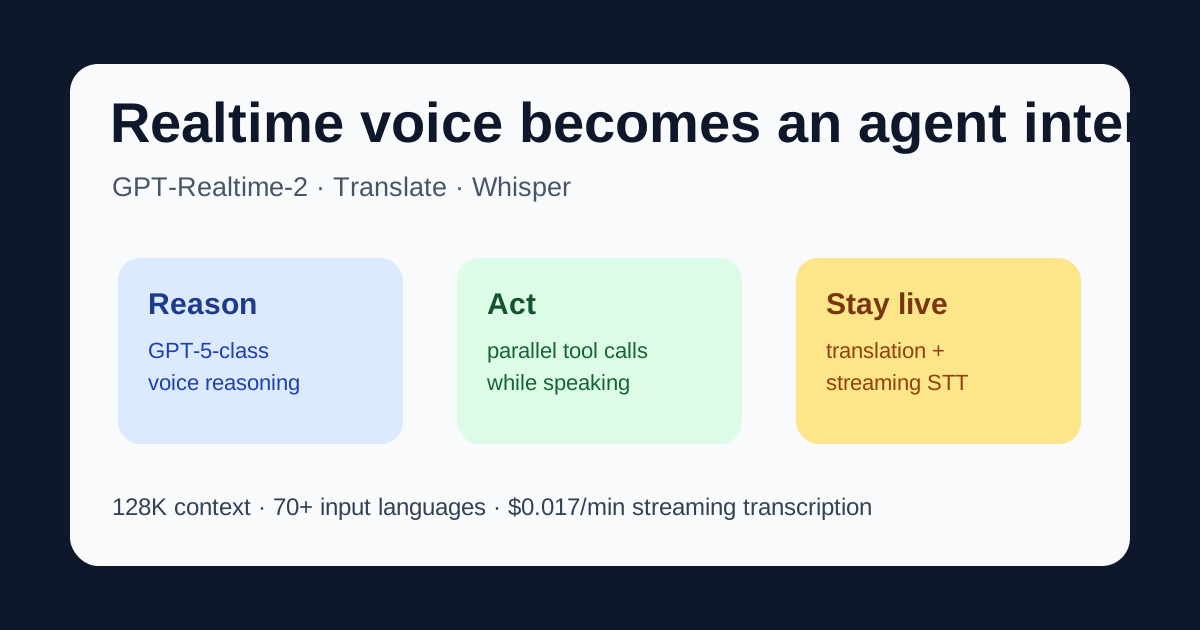
OpenAI GPT-Realtime-2 moves voice AI from a conversational interface into a tool-calling agent runtime.
- What happened: OpenAI released
GPT-Realtime-2,GPT-Realtime-Translate, andGPT-Realtime-Whisperfor the Realtime API.- The May 7, 2026 announcement frames voice models as interfaces that can reason during a conversation, call tools, and complete work.
- Why it matters: Voice AI competition is moving from natural speech alone toward an agent runtime that combines
latency, tool calls, context, recovery, and cost control. - Watch:
GPT-Realtime-2is priced by tokens, while translation and transcription are priced by minutes, so production voice agents need their own cost model and fallback design.
OpenAI announced three new voice models for the Realtime API on May 7, 2026. At first glance, this could look like another speech-quality update. The sharper point is different. OpenAI is trying to move voice from an input and output channel into a real-time work interface, where a person can operate a product and an agent can execute tools while the conversation is still happening.
The three models split the surface area. GPT-Realtime-2 is the flagship model for real-time voice conversation, reasoning, and tool use. OpenAI describes it as its first voice model with GPT-5-level reasoning. GPT-Realtime-Translate handles live translation from more than 70 input languages into 13 output languages. GPT-Realtime-Whisper generates streaming speech-to-text while someone is speaking. In one sentence, OpenAI is bundling voice conversation, translation, and transcription into the Realtime API as an agent surface rather than treating them as separate product features.
This matters to developers for reasons that go beyond "the voice sounds better." Anyone who has shipped a voice AI product knows that the bottleneck is not only speech synthesis. The whole pipeline is the experience: a user starts speaking, speech recognition produces an input, the LLM reasons, tools are called, and the answer comes back as audio. Latency accumulates across each step. A small error in the middle can break the whole conversation. If a tool call takes too long and the voice agent goes silent, the user often assumes the system has stopped working. This announcement repackages that pipeline around the idea of a voice agent runtime.
Voice is now a work surface, not just an input method
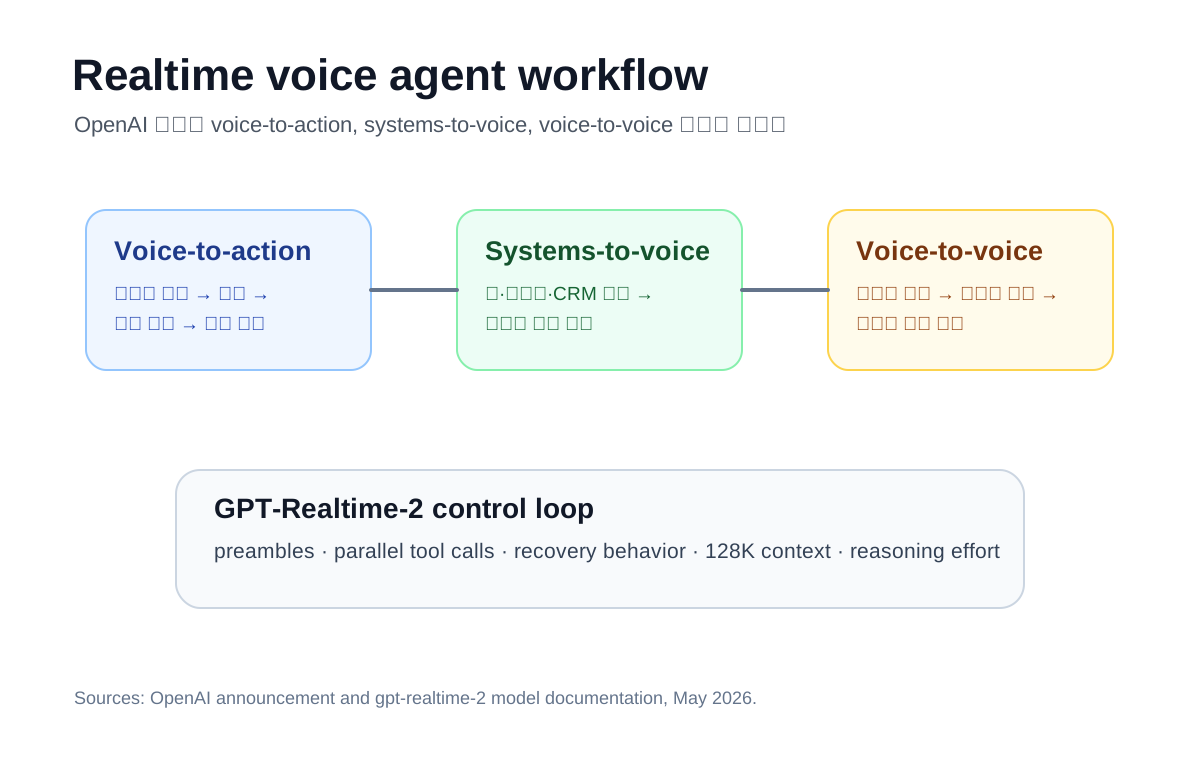
OpenAI's announcement describes three voice AI patterns. The first is voice-to-action. A user might say, "Find a quiet neighborhood within my budget and schedule a tour on Saturday." The model has to understand intent, search listings, inspect calendars, and book something through tools. The second is systems-to-voice. Flight delays, gate changes, CRM state, support tickets, or account updates become real-time spoken guidance. The third is voice-to-voice. People speaking different languages can continue a conversation while the model handles translation and transcription.
These patterns sound familiar on the surface. Call center automation, navigation prompts, and translation apps have existed for years. The change is that the LLM is no longer just a classifier or a scripted dialog engine. It becomes the work coordinator in the middle of the conversation. OpenAI says GPT-Realtime-2 can say short preambles such as "let me check that," call multiple tools in parallel, and reveal which tools it is checking through speech. That sounds like a small UX detail, but it is important in real-time agents. Silence reads as failure. A model that briefly explains what it is doing does not remove latency, but it turns latency into a state the user can understand.
Recovery behavior is another meaningful shift. OpenAI says the model is better at responding to failures without going quiet or breaking the flow, for example by saying that a task cannot be completed right now. Voice agents have a higher failure cost than text chatbots. Users cannot scan a screen to reread previous messages, and when the model hesitates they cannot easily infer what will happen next. Recovery wording, retries, fallback paths, and handoff to a human operator become as important as raw model quality.
GPT-Realtime-2 is really about 128K context and tool calls
The most visible number in the announcement is the context window. OpenAI says GPT-Realtime-2 increases the context from the previous 32K to 128K. The developer documentation also lists gpt-realtime-2 with a 128,000-token context window and 32,000 max output tokens. That matters for long support calls, meetings, travel changes, complex purchasing workflows, and other sessions where the model needs to retain prior constraints, revisions, tool outputs, and user preferences.
But 128K context does not automatically produce a better product. In real-time voice, longer context also means higher cost, more latency pressure, and more privacy risk. Customer support, healthcare, finance, and recruiting sessions can contain sensitive information over time. Developers have to decide whether every spoken turn should remain in the model context, whether intermediate summaries should be generated, or whether some state should be extracted into structured fields outside the model. Long context looks like convenient memory. In operations, it also demands retention and deletion policies.
Tool calling brings the same tradeoff. The OpenAI developer documentation lists function calling support for gpt-realtime-2, and the announcement emphasizes parallel tool calls and tool transparency. Together, those features make it possible for a voice agent to "work while talking." A travel agent could check flights, hotels, transport, and translation at the same time while telling the user what is being checked. In text agents, users can read intermediate logs. In voice agents, deciding how the system exposes intermediate state through speech becomes part of product design.
Benchmarks point in the right direction, but product evaluation is harder
OpenAI says GPT-Realtime-2 (high) scores 15.2% higher than GPT-Realtime-1.5 on Big Bench Audio, and GPT-Realtime-2 (xhigh) scores 13.8% higher on Audio MultiChallenge. These evaluations measure audio reasoning and multi-turn voice conversation behavior such as following instructions, integrating context, staying self-consistent, and handling natural corrections. The Zillow example in the announcement is also strong. Zillow says its call success rate on the hardest adversarial benchmark rose from 69% to 95% after prompt optimization.
Those numbers show direction. Voice models are improving beyond recognizing speech and producing natural audio. They are getting better at reasoning over spoken constraints, preserving a tool-calling flow, and adapting to multi-turn corrections. Still, product teams cannot adopt a voice model on benchmark numbers alone. Real voice agents run into background noise, accents, interruptions, call quality issues, tool outages, consent requirements, latency, and human handoff. Even if instruction following improves, teams still need to test what happens when the user interrupts, when a tool takes more than three seconds, or when a downstream system returns partial data.
Reasoning effort is a double-edged control. OpenAI says developers can choose levels such as minimal, low, medium, high, and xhigh, with low as the default. Higher reasoning effort can help with complex requests, but in real-time voice the added latency and cost are immediately felt. Low reasoning may be the right fit for first response, booking confirmation, or simple FAQ. Higher reasoning may be justified for insurance comparison, medical triage, or financial workflow decisions. Voice agent design is no longer just choosing a model. It is allocating a reasoning budget by utterance type.
| Model | Role | Official pricing unit | Developer concern |
|---|---|---|---|
GPT-Realtime-2 | Real-time voice reasoning and tool calling | audio input $32/1M tokens, output $64/1M tokens | reasoning effort, context length, tool latency |
GPT-Realtime-Translate | Real-time voice translation | $0.034/min | language pairs, domain terminology, simultaneous speech |
GPT-Realtime-Whisper | Streaming speech transcription | $0.017/min | caption latency, summarization pipeline, storage policy |
Translation and transcription become agent senses
The translation and transcription models are also worth reading as more than supporting features. GPT-Realtime-Translate supports more than 70 input languages and 13 output languages. OpenAI cites Deutsche Telekom and Vimeo to show customer support and product education content being delivered in a user's own language in real time. OpenAI also says BolnaAI measured 12.5% lower Word Error Rate than other models on Hindi, Tamil, and Telugu evaluations.
GPT-Realtime-Whisper is quieter news, but it may be more operationally important. Real-time transcription connects directly to meeting notes, customer support summaries, broadcast captions, education accessibility, clinical documentation assistance, and recruiting workflows. Whisper-style models are already widely used by developers, but "process after the recording" and "process while the person is speaking" are different product architectures. In the latter case, a transcript can trigger search, summarization, alerting, CRM updates, or follow-up agent actions as soon as partial speech becomes available. For a voice agent to work well, listening has to become an event stream.
This is where voice AI and agent infrastructure meet. A text agent starts from a prompt. A voice agent handles a continuous audio stream, partial transcripts, tool results, user interruptions, and translation output at the same time. Developers have to design session state, interruption handling, backpressure, audit logs, and human handoff. That is why OpenAI is centering the Realtime API. A voice agent is not one model call. It is a session operations problem.
Pricing does not allow easy comparisons
Pricing is one of the most practical parts of the release. In OpenAI's announcement, GPT-Realtime-2 costs $32 per million audio input tokens and $64 per million audio output tokens. Cached input costs $0.40 per million tokens. GPT-Realtime-Translate costs $0.034 per minute, while GPT-Realtime-Whisper costs $0.017 per minute. Even within the same Realtime API family, one product is token-priced and the other two are minute-priced.
Development teams should understand this before procurement teams do. The cost of a voice agent is not determined only by call duration. It depends on how much the user speaks, how long the model speaks, how much intermediate explanation the agent gives during tool calls, how long context is retained, whether cached input helps, and where reasoning effort is raised. Two calls of the same length can have very different output token profiles if one includes human handoff and the other stays fully automated.
Small-sample Reddit reactions split along these lines. Some developers reacted positively to the 128K context and live translation model. Others focused on real production cost and vendor lock-in. That reaction is reasonable. Voice AI demos can look good quickly. In production, teams have to count minute cost, fallback cost, retry cost, and human handoff cost together. To validate the claim that call success improves, model price has to be measured alongside average handling time, conversion rate, customer satisfaction, and regulatory risk.
Safety still has to exist outside the model
OpenAI says the Realtime API applies active classifiers and can end specific conversations when harmful content policy violations are detected. It also says developers can add their own guardrails and should make clear to end users that they are interacting with AI. The announcement also mentions EU Data Residency and enterprise privacy commitments.
That does not mean voice-agent safety is solved by the model provider. Voice is persuasive, and users are more likely to perceive a spoken system as human-like than a text box. When a customer support agent asks for payment information, a healthcare agent asks about symptoms, or a recruiting agent interviews a candidate, the product needs clear rules around consent, retention, sensitive-data masking, and human handoff. Real-time translation adds another layer: if a phrase is mistranslated and heard immediately, responsibility is harder to reason about than in a written document that can be corrected later.
The developer checklist should be concrete. First, limit which speech intents can trigger tool calls. Second, add confirmation steps for payments, booking changes, personal-data edits, or any action that is hard to undo. Third, define when low confidence or downstream tool failure should move the session to a human. Fourth, separate transcript retention from audio retention. Keeping text logs and keeping raw audio are different privacy decisions, especially in regulated industries.
The competition will move toward voice operating systems
Reading this as only an OpenAI launch would be too narrow. Google, Microsoft, Amazon, Deepgram, ElevenLabs, AssemblyAI, and others are also combining speech recognition, synthesis, translation, and LLMs. Microsoft said in an Azure AI Foundry blog post that OpenAI's new realtime models are rolling out in Foundry. For cloud platforms, voice agents are an entry point into contact centers, meetings, field work, education, healthcare, and travel workflows.
The center of competition is likely to shift from "who sounds more human" to "who provides the more reliable real-time work loop." Voice quality still matters, but enterprise buyers will also look for tool integration, audit logs, data residency, latency SLAs, cost predictability, incident handling, and human handoff. OpenAI's emphasis on parallel tool calls, tone control, recovery behavior, and reasoning effort in GPT-Realtime-2 fits that direction. Voice is becoming an operations feature, not only an affective interface.
The remaining product questions are straightforward. Does your product actually need voice, or does voice only make the demo look more impressive? Does real-time interaction create real value, or would asynchronous transcription and summarization be enough? Should the model call tools directly, or should voice capture intent while the user confirms important actions on screen? OpenAI's announcement makes those questions harder to postpone.
Start with a small agent loop
The practical path is to test a small loop before trying to automate an entire contact center. A support product might start with "check order status," where there is one tool call and a clear human fallback. A productivity product could draft calendar action items during a meeting. An education product could test how naturally the model recovers when a learner interrupts or changes the question mid-sentence.
The metrics should also differ from text chatbots. Teams should measure first response time, interruption handling rate, tool-call success rate, quality of recovery utterances, average call length, human handoff rate, repeated-user-utterance count, and cost per minute. Since GPT-Realtime-2 exposes reasoning effort, low and high settings should be compared in the same flow. Higher reasoning will not always create a better experience. In real-time voice, a slightly less capable model that is faster and more predictable may feel better to users.
OpenAI's release is a sign that voice AI has become an important interface again. But this is not the smart-speaker era's version of "say a command out loud." A Realtime voice agent listens, keeps context, calls tools, explains failures, and can translate or transcribe at the same time. That is closer to system design than model demo work. For developers, the takeaway is simple: voice now belongs in agent infrastructure, not just frontend feature planning.