Malta makes ChatGPT Plus a national AI access experiment
OpenAI and Malta’s AI for All program bundles AI literacy with one year of ChatGPT Plus or Microsoft 365 Copilot access.
- What happened: OpenAI and the Government of Malta announced a national
ChatGPT Plusaccess program.- Maltese citizens and residents can complete an AI literacy course, then receive one year of ChatGPT Plus or Microsoft 365 Personal Copilot.
- Why it matters: AI subscriptions are starting to look less like individual software purchases and more like state-managed access rights.
- Builder signal: AI products are being deployed with identity, education, procurement, and data governance wrapped around the model.
- Watch: Public AI access can reduce the digital divide, but it also raises vendor lock-in, privacy, renewal, and accountability questions.
OpenAI and the Government of Malta announced a national ChatGPT Plus access partnership on May 16, 2026. At first glance, the headline reads like a consumer benefit: a country is giving people a year of ChatGPT Plus. The more important story for developers and AI product teams is broader. Malta is tying AI subscriptions, AI literacy, national identity, public procurement, and platform governance into a single deployment model.
OpenAI describes the program through the phrase "intelligence as a national utility." The claim is that people should be able to draw on intelligence the way they rely on electricity or internet access. Malta's government launched the same effort as AI for Everyone, or AI Ghal Kulhadd, a program where citizens and residents complete a free online AI literacy course before receiving one year of ChatGPT Plus or Microsoft 365 Personal Copilot.
The condition matters as much as the benefit. Malta is not simply handing out accounts first and hoping people learn later. It is making literacy the entrance ticket for premium AI access. That changes the unit of AI policy. Many national AI programs have focused on research funding, data-center investment, school pilots, or internal government productivity tools. Malta's version puts everyday personal AI use into a state program.
What was announced
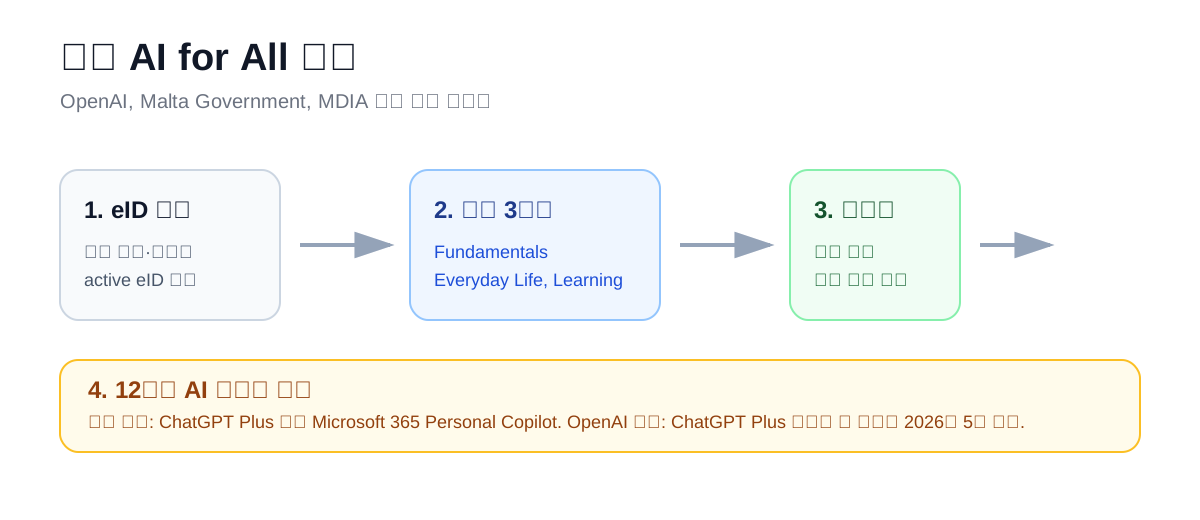
OpenAI says Malta's AI for All initiative includes an AI literacy course developed by the University of Malta. The course is meant to help people understand what AI is, what it can and cannot do, and how to use it responsibly at home and at work. After completing the course, eligible participants receive one year of free ChatGPT Plus access. The first phase begins in May 2026, and the Malta Digital Innovation Authority manages distribution to eligible participants.
The Maltese government release adds useful detail. The program is aimed at citizens and residents of Malta and Gozo aged 14 and older. It is a free, self-paced online course developed by MDIA and the University of Malta. Participants can access it from a phone, tablet, or computer using eID. The basic course is described as roughly two hours long, and completion unlocks a choice between ChatGPT Plus and Microsoft 365 Personal Copilot for one year.
MDIA's service page breaks the course into core modules: AI Fundamentals & Critical Use, AI for Everyday Life, and AI for Learning. Participants can then choose additional modules such as AI for Professionals, AI for Job Seekers, AI for Entrepreneurship, AI for Accessibility and Independent Living, and AI in Formal Education. The core modules produce a completion certificate, and each optional module can produce an additional certificate.
Reuters reported that the program starts in May 2026, expands as more Maltese residents complete the course, and is also open to Maltese citizens living abroad. The financial terms were not disclosed. That missing detail is important. Public materials do not yet explain the subscription price negotiated by the government, what data OpenAI or Microsoft will or will not receive through the program, or what happens after the first 12 months.
| Area | What was announced | Open question |
|---|---|---|
| Eligibility | Citizens and residents, with the government release citing ages 14 and older | Treatment of overseas citizens, minors, and school-managed accounts |
| Access condition | Completion of an eID-based online course | Assessment quality, fraud prevention, and accessibility support |
| Tools | ChatGPT Plus or Microsoft 365 Personal Copilot | Vendor selection, switching rights, and renewal after 12 months |
| Policy goal | AI literacy, productivity, learning, creativity, and daily use | How skill gains and economic impact will be measured |
| Governance | MDIA administration and University of Malta course design | Data protection, procurement terms, and public auditability |
The policy unit is changing
Malta's program is newsworthy not because the country is large. It is the opposite. Malta's size makes a national experiment easier to run. The important change is the policy unit. AI is being treated not only as a tool government departments can use, but as a general intelligence access layer distributed directly to citizens.
That resembles earlier internet adoption policy. Governments did not only build broadband networks. They also pushed digital identity, online public services, digital education, security habits, and public access programs. Internet access alone did not guarantee that citizens could benefit from it. People had to learn search, email, passwords, privacy, payments, forms, and online public services. AI is entering a similar phase. A ChatGPT Plus account is not enough by itself. People need to know how to ask useful questions, test answers, avoid entering sensitive data, and decide when AI should not be used.
Malta's design appears to recognize that distinction. MDIA describes learning goals around identifying reliability problems in AI output, protecting privacy, using AI for learning and creative work, and judging when not to use AI. That is more important than a prompt-writing class. AI literacy is not only the ability to extract a better answer from a model. It is a basic framework for judgment and responsibility when a model becomes part of everyday decisions.
The same message applies to developers. AI product teams can no longer assume that people will sign up individually and teach themselves. When countries, schools, and enterprises deploy AI tools at scale, users arrive through training flows, administrator policies, identity checks, entitlements, audit requirements, and data-processing terms. Onboarding becomes part education, part compliance, and part product experience.
OpenAI for Countries becomes a distribution strategy
OpenAI presents the Malta program as a new example of OpenAI for Countries. The initiative is meant to help governments and institutions move from early AI interest to strategic national adoption. OpenAI says it works around local priorities such as education, workforce training, public services, startup support, and AI literacy. The announcement also references work with the education systems of Estonia and Greece.
That matters because OpenAI's distribution strategy is expanding beyond consumer apps and APIs. ChatGPT already has a powerful consumer surface. In enterprises, OpenAI reaches teams through ChatGPT Enterprise, Codex, the API, and partner ecosystems. A national program sits in between. Citizens may use personal accounts, but access is routed through a government-backed program. Education is designed by local institutions, while the platform layer comes from OpenAI and Microsoft.
If the model works, other governments will face similar choices. Should every citizen receive access to a premium AI tool, or should the first programs target students and teachers? Should access prioritize job seekers, small businesses, public servants, older adults, or people with disabilities? Should governments choose a single vendor, let citizens choose among several, or fund an open alternative? Should literacy training be mandatory? How should personal data and training data be separated? Who pays after the first year?
For OpenAI, the experiment is also strategically useful. Consumer AI is expensive to run. Premium models, long context, files, voice, images, and tool features are not free infrastructure. If governments procure education and access together, AI companies get large-scale distribution while governments get a fast digital-skills program. Whether that is public infrastructure, subsidized customer acquisition, or both depends on procurement design and transparency.
Why Microsoft is part of the story
The Maltese government announcement names Microsoft as well as OpenAI. Participants can choose ChatGPT Plus or Microsoft 365 Personal Copilot. That makes the program broader than a single chatbot subscription.
ChatGPT Plus is closer to a general-purpose assistant. It supports questions, writing, coding, file analysis, images, learning, and idea generation. Microsoft 365 Personal Copilot is closer to the productivity-app layer. It is tied to documents, email, and the Office workflow. From a citizen's perspective, both are AI tools. In practice, the contexts are different. A student may prefer ChatGPT, while a worker who lives in documents and spreadsheets may prefer Copilot.
Giving people a choice is reasonable if the goal is not only to promote one product but to improve everyday capability. It also creates new governance questions. Which tool handles which data? Which terms apply? What happens to user data and workflows after the free year ends? Does the course stay product-neutral, or does it become a tutorial for a small number of vendors?
These questions point to a larger theme: national AI programs may need to focus less on "model access" and more on tool choice and data portability. If citizens spend a year building habits and workflows inside one AI product, the next year's payment structure can create lock-in. If the government keeps renewing access, AI subscriptions become a recurring public budget line. Either path needs clear evaluation criteria.
Literacy can be a safety layer
One of the biggest risks in mass AI deployment is overconfidence. AI answers often sound coherent even when they are wrong. In finance, medicine, law, education, jobs, and public services, a plausible mistake can create real harm. OpenAI's announcement does not only emphasize ChatGPT Plus access. It also emphasizes learning what AI can and cannot do.
The Critical Use language in MDIA's core module is worth noticing. Good AI literacy should not mean "use AI more often." It should mean knowing when an AI answer needs verification. Health guidance should be checked with a clinician. Legal documents need expert review. Personal data and company secrets should not be pasted casually into external tools. AI-generated media needs source, rights, and authenticity checks. Without these habits, a premium account can become a confidence amplifier rather than a productivity tool.
There is a product lesson here. As AI tools reach mainstream users, safety cannot live only in policy pages. It has to appear in onboarding, permissions, confirmation steps, data handling, and escalation paths. On first use, a person should understand model limits, sensitive-data boundaries, result verification, and how to report or delete problematic content. Enterprise AI is the same pattern at a different scale. Employees should receive data classification, approval boundaries, sharing rules, and retention policies before AI accounts are widely enabled.
The utility metaphor is useful and uncomfortable
OpenAI's "national utility" framing is persuasive because AI access is becoming a practical capability gap. Students, developers, creators, office workers, and small businesses already use AI tools daily. People without access to strong AI tools may fall behind. If premium tiers provide longer context, faster responses, better models, and more capable tools, paid access can translate into real opportunity differences.
But if AI is a public utility, the bar rises. Electricity is not locked inside a single company's chat interface. Water is not a one-year SaaS coupon. Utilities imply interoperability, transparency, price discipline, privacy protections, reliability expectations, accessibility, and competitive neutrality. Citizens using a public AI access program should be able to understand what data is processed, what model class generates answers, where information is stored, and which contractual protections apply.
Malta is a small-country experiment, so it should not be expected to solve every issue on day one. Still, if other countries follow, the governance standard will need to become much clearer. Once a government buys AI subscriptions with public money, it becomes a steward of citizen data and digital capability, not just a software customer.
The builder signal
This announcement does not require developers to call a new API tomorrow. It does send a market signal.
First, distribution is becoming identity-gated. Malta links course access and subscription distribution through eID. As AI tools move through public, educational, and enterprise channels, users will arrive through national identity, organizational identity, student status, role permissions, and regional eligibility. Products need strong support for SSO, entitlements, license lifecycle, and policy-aware access.
Second, education is becoming part of the product package. Docs and help centers are not enough. Governments and companies buying AI tools will increasingly ask for training modules, certifications, role-based guidance, abuse handling, and privacy education. AI startups may need to sell adoption systems, not just interfaces.
Third, subscriptions are meeting public procurement. Consumer ChatGPT Plus is usually a personal payment. National access requires bulk licensing, regional pricing, renewals, support, data-processing agreements, accessibility requirements, and public accountability. Those constraints become part of the product.
Fourth, outcomes will matter more than signups. If Malta wants to declare success after one year, account activations will not be sufficient. Better measures would include changes in AI understanding, learning outcomes, workplace productivity, small-business usage, older-adult accessibility, privacy incidents, harmful overreliance, and willingness to continue after the free period.
The real headline
The important part of the Malta and OpenAI announcement is not simply that ChatGPT Plus is free for a year. The important part is that AI access is being distributed as a national policy instrument. More precisely, AI subscriptions become a mass social deployment model only when they are combined with education, identity, certification, procurement, and governance.
The upside is clear. A public program can narrow the gap between people who can afford premium AI tools and people who cannot. It can make AI less mysterious and less blindly trusted by putting basic literacy first. It can give students, job seekers, small businesses, older adults, disabled people, public workers, and creators a real chance to test the tools.
The risks are just as clear. Public budgets can become a subsidy for one platform's user acquisition. Data-processing rules may remain too vague. Access can collapse after 12 months if renewal is not planned. A literacy course can drift from critical thinking into product training. If AI is going to be treated as a public capability, governments need the evaluation, procurement, and privacy standards to match.
Malta is starting the experiment at national scale. If other countries copy it, the next phase of AI platform competition will not be decided only by model scores. It will also be decided by which companies can offer governments, schools, employers, and civil society a deployment model they can trust.
Sources: