An 80-year conjecture broke, and OpenAI showed a research automation pipeline
OpenAI says a general-purpose reasoning model disproved Erdos unit distance conjecture. The bigger story is verifiable research automation.
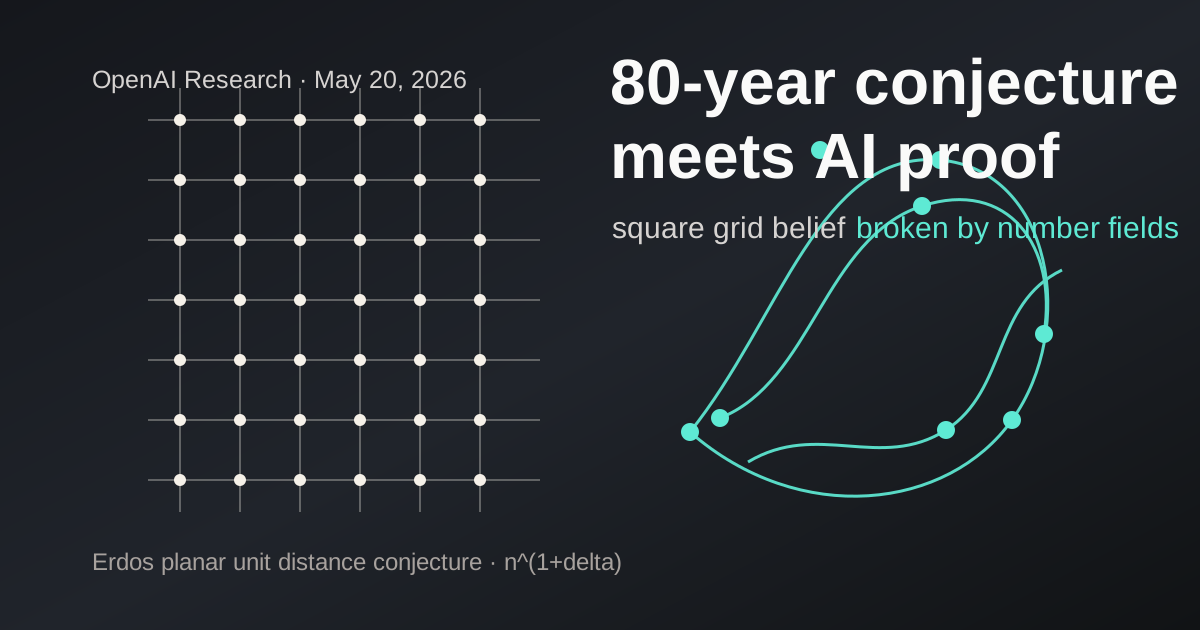
- What happened: OpenAI says an internal general-purpose reasoning model generated a proof that disproves Erdős's planar unit distance conjecture.
- The released proof constructs, for infinitely many
n, point sets withn^(1+δ)unit-distance pairs.
- The released proof constructs, for infinitely many
- Why it matters: The important signal is not "AI replaced mathematicians." It is a research automation workflow where model output, grading, expert review, and public exposition all matter.
- Watch: OpenAI did not disclose the model name, full access path, or complete reproduction procedure. The proof should be read together with the companion remarks and follow-up verification.
OpenAI's latest AI news was not a chatbot feature, a coding agent, or another productivity surface. It was a pure mathematics result. On May 20, 2026, OpenAI announced that an internal general-purpose reasoning model had generated a proof disproving a long-standing conjecture around Paul Erdős's 1946 planar unit distance problem. The problem is easy to state: if you place n points in the plane, how many pairs of points can be exactly distance 1 apart?
According to OpenAI's official post, the model was not a mathematics-only system, not a proof-strategy scaffold designed for this problem, and not a unit-distance specialist. The company says a "new general-purpose reasoning model" solved one of the problems in an Erdős problem set, after which the result passed through an AI grading pipeline, internal review, external mathematician review, and human-edited exposition before OpenAI published the proof and companion remarks.
The easy headline is "AI solved an 80-year-old math problem." That is directionally true, but it misses the part builders should study. This event is less about a single model claiming intellectual victory and more about a workflow for turning an AI-generated research artifact into something experts can inspect, simplify, challenge, and cite. Research agents will not become useful because they produce impressive answers. They become useful when their outputs can survive verification, attribution, review, and publication.
What was disproved
The planar unit distance problem is simple enough to explain without notation. Put n points on a plane and count every pair of points exactly one unit apart. If the points sit on a straight line, you get roughly n - 1 such pairs. If you arrange them on a square grid, you can do better. For decades, variants of Erdős's grid construction shaped the intuition around the problem. OpenAI's post describes the prevailing belief as the idea that square-grid-style constructions were essentially optimal.
The released proof PDF, "Planar Point Sets with Many Unit Distances", states the main theorem in a more formal way. It shows that there is a fixed δ > 0 such that, for infinitely many positive integers n, ν(n) >= n^(1+δ). Here ν(n) is the maximum number of unit-distance pairs that can be realized by n points in the plane. That breaks the expected n^(1+o(1))-style barrier directly.
OpenAI also adds a useful numerical detail. The original AI proof did not give an explicit value of δ, but OpenAI says a forthcoming refinement by Princeton's Will Sawin can take δ = 0.014. That number may look small to a general reader. In this setting, the important part is not the size of the decimal. It is the fixed positive gap in the exponent. A world that looked almost linear now has a polynomial improvement.
Why number theory enters the story
The striking part is not only that the model found a counterexample. It is how the route arrived. OpenAI says the proof brings tools from algebraic number theory into a combinatorial geometry problem. The proof and companion remarks repeatedly invoke ideas such as infinite class field towers, Golod-Shafarevich theory, CM fields, splitting primes, and root discriminants.
The intuition is roughly this. Erdős's classical grid construction can be viewed through Gaussian integers, numbers of the form a + bi. When a number can produce many vectors of the same length in different ways, it can create many point pairs at the same distance. The new construction pushes that idea into a much richer number-field setting. It builds fields with useful symmetry, extracts many norm-one elements, and turns them into candidates for unit translations in the plane.
The introduction to the companion remarks makes the human role explicit. The mathematicians describe their document as a human-digested, simplified, and somewhat generalized version of the argument. In other words, the public remarks are not a raw model transcript. They are the result of mathematicians reading, reorganizing, and explaining the proof in the language of the field. That distinction matters. An AI output does not become a mathematical result merely because it looks plausible. It must be translated into a form the research community can verify and build on.
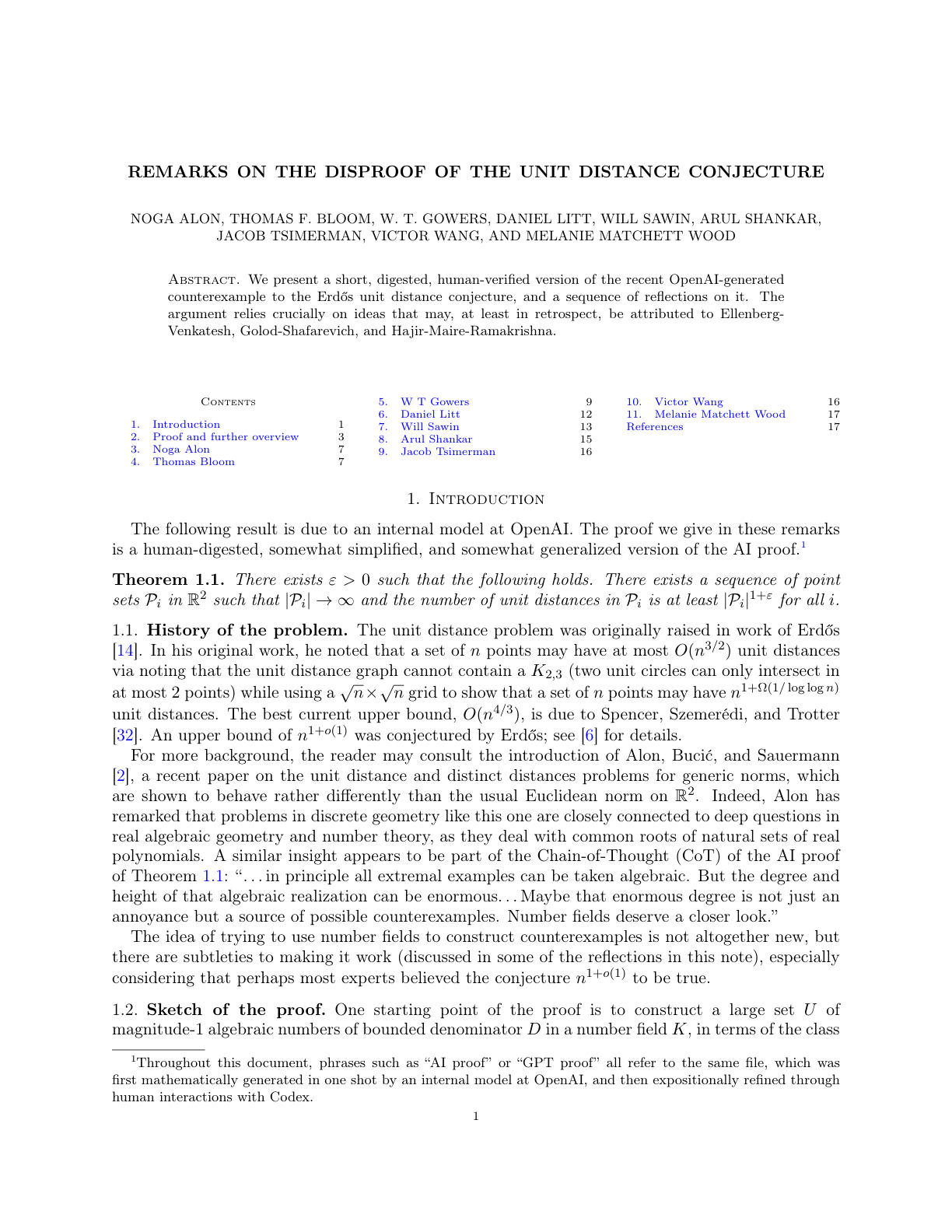
The verification chain matters more than the screenshot
OpenAI's proof PDF includes a "Statement on AI Use." For builders, this may be the most important part of the release. The document says the internal model received an AI-written problem statement and that the output was routed to an AI grading pipeline. Only after that pipeline marked the solution as likely correct with high confidence did internal human researchers and mathematicians inspect the solution in detail. The process then continued through AI-assisted verification and rewriting, external mathematician review, and human-edited exposition.
That description says two things at the same time. First, OpenAI frames the original discovery as automated. Second, the path from automated discovery to a public mathematical artifact depended on human review. If we collapse those two steps, the research-agent discussion becomes too easy to overstate. A model's ability to find an idea and a community's ability to accept that idea as knowledge are related, but they are not the same capability.
For software builders, the pattern is familiar. When a coding agent writes a patch, it still needs tests, CI, code review, and deployment policy. When a security agent reports a vulnerability, it still needs reproduction steps, impact analysis, and false-positive review. Research agents follow the same shape. In mathematics, the verification unit is the proof. In this case, the public proof PDF and the companion remarks act as the reviewable artifact.
| Stage | This case | What AI product teams should notice |
|---|---|---|
| Problem framing | An AI-written prompt presented the unit distance problem to the model. | A task spec must be verifiable, not merely well worded. |
| Initial triage | An AI grading pipeline flagged the answer with high confidence. | Automated evaluation is a triage layer, not the final authority. |
| External review | Mathematicians checked correctness and simplified the explanation. | Expert review and public artifacts create trust. |
| Knowledge artifact | OpenAI published the proof PDF and companion remarks. | Outputs should remain inspectable after the run is over. |
What mathematicians saw
OpenAI's announcement includes reactions from Noga Alon, Tim Gowers, Arul Shankar, and Jacob Tsimerman. The useful summary is that they treated the result as a serious contribution to a long-running combinatorial geometry problem. They also emphasized that the released version is not merely a raw answer. The companion remarks interpret the result carefully and explain why the unexpected bridge between discrete geometry and algebraic number theory is part of the contribution.
Thomas Bloom's framing is especially useful for thinking about research automation. The question is not only whether an AI produced a correct answer. The deeper question is whether the proof gives humans a new understanding of the problem. OpenAI describes Bloom's answer as a moderated yes. That yes depends on more than the model's original output. It depends on mathematicians reading the structure, connecting it to prior literature, and turning it into a simpler explanation.
This same distinction matters across AI development. Many agent demos stop at "it worked" and show a screenshot. Hard domains require more. Why did it work? Where does it generalize? Who reviewed it? What are the failure boundaries? Mathematics exposes those demands in their sharpest form. A proof that cannot persuade experts does not become knowledge, no matter how impressive the generating system sounds.
Community reaction sits between awe and verification
The Hacker News discussion was large. In HN Algolia, the OpenAI post appeared as story 48212493; at the time of the Korean article's research pass, it had 1,296 points and 945 comments. The conversation was not simple celebration. Some readers took the result as a meaningful sign that general-purpose models can find new mathematical constructions. Others focused on model access, chain-of-thought disclosure, the reliability of automated grading, and the role of human mathematicians in verification.
Reddit threads in r/mathematics and r/MachineLearning showed a similar split. The r/mathematics discussion centered more on the mathematical meaning of a counterexample to the n^(1+O(1/log log n)) expectation, Sawin's simplification and strengthening, and the relation between AI grading and expert review. The r/MachineLearning discussion was more interested in whether this should be credited to a general-purpose model or to an undisclosed internal workflow around the model.
That tension is healthy. The two worst reactions to research automation are both too simple. One says the model produced it, therefore we should believe it. The other says the model produced it, therefore it cannot matter. This case avoids both extremes. OpenAI's materials and the external review are strong signals. At the same time, the model itself, the search procedure, the grading pipeline, and the reproduction path remain only partially disclosed.
A different signal from AlphaGeometry
AI has been moving into mathematics for years. Google DeepMind's AlphaGeometry and AlphaProof lines have already made a strong impression on olympiad-style geometry and formal reasoning. The Lean ecosystem and proof assistants are also changing what verifiable mathematics can look like. Against that backdrop, OpenAI's announcement stands out because of the general-purpose reasoning claim and the assertion that this was not a domain-specific system.
That claim still needs careful reading. "Not a domain-specific system" does not mean "no tools, no filtering, and no process." OpenAI's public description does not reveal the training data, test-time compute, candidate filtering, or grading-pipeline details. It would be a mistake to jump from this result to "every general chatbot can replace researchers soon." A more defensible interpretation is that frontier reasoning models can now propose high-value research ideas in difficult domains, and that human-machine verification workflows are becoming a real competitive layer.
That interpretation has product implications. Future research tools may differentiate less through the answer box and more through the verification system around it. In mathematics, that could mean formalization, citation trails, proof simplification, and reviewer workflow. In life sciences, it could mean experiment design, data provenance, and wet-lab validation. In software, it means tests, sandboxes, code review, and supply-chain checks. The first answer is not the product. The gates it must pass are the product.
Practical lessons for builders
The first lesson is not to confuse an evaluator with a final judge. In OpenAI's case, the AI grading pipeline was a crucial filter, but public confidence came from external mathematician review and published documents. In agent products, automated evaluators are excellent at narrowing candidates and setting priorities. They are weaker as final authorities for deployment, legal responsibility, security response, or research publication.
The second lesson is that artifacts matter. This announcement did not remain a press claim because OpenAI also released the proof and the companion remarks. Readers can move beyond the announcement page and inspect a structured proof and external commentary. AI agents should leave similar trails. What input did they receive? What evidence did they use? What changed between raw output and reviewed artifact? Who signed off? Without that record, an organization does not get repeatable capability. It gets one-off magic that cannot be audited.
The third lesson is the value of counterexample search. OpenAI says the model's reasoning was notable in part because it tried to construct a counterexample rather than simply prove the widely believed upper-bound intuition. That is an important pattern in research and software alike. If AI systems can systematically ask "where would this assumption break?" rather than merely summarize consensus, they become much more valuable in security, testing, science, and product strategy.
The event gets larger when we do not overstate it
The easiest sentence around this announcement is "AI beat mathematicians." It is also the least useful one. The more important change is that an AI system proposed a new mathematical route, mathematicians verified it, the explanation was made more readable, and the result was published as a reviewable artifact. That is closer to collaboration than replacement, but it is far stronger than a normal assistant tool.
As similar announcements become more common, the questions will become sharper. Can outside researchers access the model? Has the proof been formalized? Who reviewed it? How does the result connect to prior literature? How many failed candidates were generated? What role did test-time compute and grading play? If those questions are avoided, research automation becomes marketing language. If they are answered directly, AI can become a serious productivity tool for science and engineering.
OpenAI's unit distance result is therefore more than another model-race milestone. Coding agents and workplace agents have already forced the industry to think about execution. This case forces a different question: how do we turn AI-generated outputs into knowledge that experts can trust? The counterexample to an 80-year-old conjecture matters because it shook a mathematical belief. It may matter even more because it made the operating model for verifiable research automation unusually visible.