OpenAI Daybreak brings cyber defense into the development loop
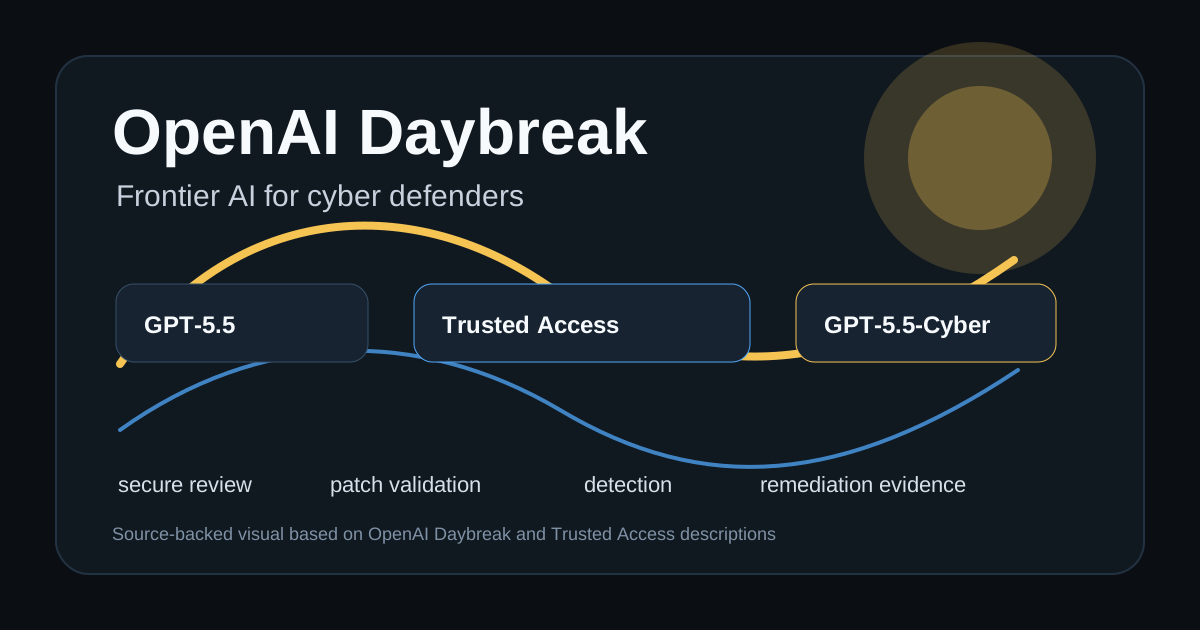
OpenAI Daybreak connects GPT-5.5-Cyber and Codex Security to vulnerability discovery, patch validation, detection, and audit evidence.
- What happened: OpenAI introduced
Daybreak, tying GPT-5.5, Trusted Access for Cyber, GPT-5.5-Cyber, and Codex Security into one cyber-defense workflow.- The official page puts vulnerability identification, threat modeling, patch validation, dependency risk analysis, detection, and remediation guidance inside the development loop.
- Why it matters: The competition is shifting from "who has the stronger security model" to "who can verify which systems, under which permissions, with which evidence."
- Watch: Daybreak still looks closer to partner-centered distribution than a broad public product, so the operational quality of identity, authorization, and dual-use boundaries will matter.
OpenAI has introduced Daybreak. The tagline is short: "Frontier AI for cyber defenders." But the change behind the page is larger than another security product launch. On May 7, 2026, OpenAI announced the expansion of GPT-5.5-Cyber and Trusted Access for Cyber. The next day, it published a detailed account of how OpenAI runs Codex safely internally. Daybreak packages those two threads into a commercial message.
The earlier announcements answered two questions: who should get access to models with cyber capability, and how should coding agents be controlled inside an organization? Daybreak asks the next question. Where should that capability sit in real security work? OpenAI's answer is the development loop. Instead of a security team reading vulnerability reports in one place, developers patching code in another, and operations teams adding detections somewhere else, the model reads the codebase, builds threat models, validates patch candidates, interprets dependency risk, and connects detection and audit evidence.
Reading Daybreak only as "OpenAI released a stronger hacking model" misses the main point. The news value is in the product shape, not only the model name. GPT-5.5-Cyber is an important component, but OpenAI's May 7 post does not frame the first preview as a model that beats GPT-5.5 across every cyber evaluation. The emphasis is more permissive access for approved defensive workflows, stronger account verification, misuse monitoring, approved-use scoping, and partner feedback. OpenAI is not simply releasing a powerful model. It is trying to reduce friction for defenders while keeping dangerous offensive workflows constrained.
The three layers Daybreak ties together
Daybreak's defensive workflow has three visible layers. The first is the model layer. Standard GPT-5.5, GPT-5.5 with Trusted Access, and GPT-5.5-Cyber sit at different access levels. The second is the agent execution layer. OpenAI says Daybreak combines the intelligence of OpenAI models, the Codex agentic harness, and security partners. The third is the security ecosystem. The Daybreak page names Cloudflare, Cisco, CrowdStrike, Palo Alto Networks, Oracle, Zscaler, Akamai, Fortinet, and other infrastructure and security providers.
That combination matters because security work does not end with a good answer. Vulnerability analysis needs a reproduction environment. Patch validation needs tests. Detection needs logs and endpoint telemetry. Supply-chain security connects to package registries, SBOMs, and build pipelines. Network defense often turns into a WAF rule, edge mitigation, or configuration change. For Daybreak to work as a product, the hard problem is not merely inserting model output into each step. It is keeping permissions, execution boundaries, and evidence consistent across the whole chain.
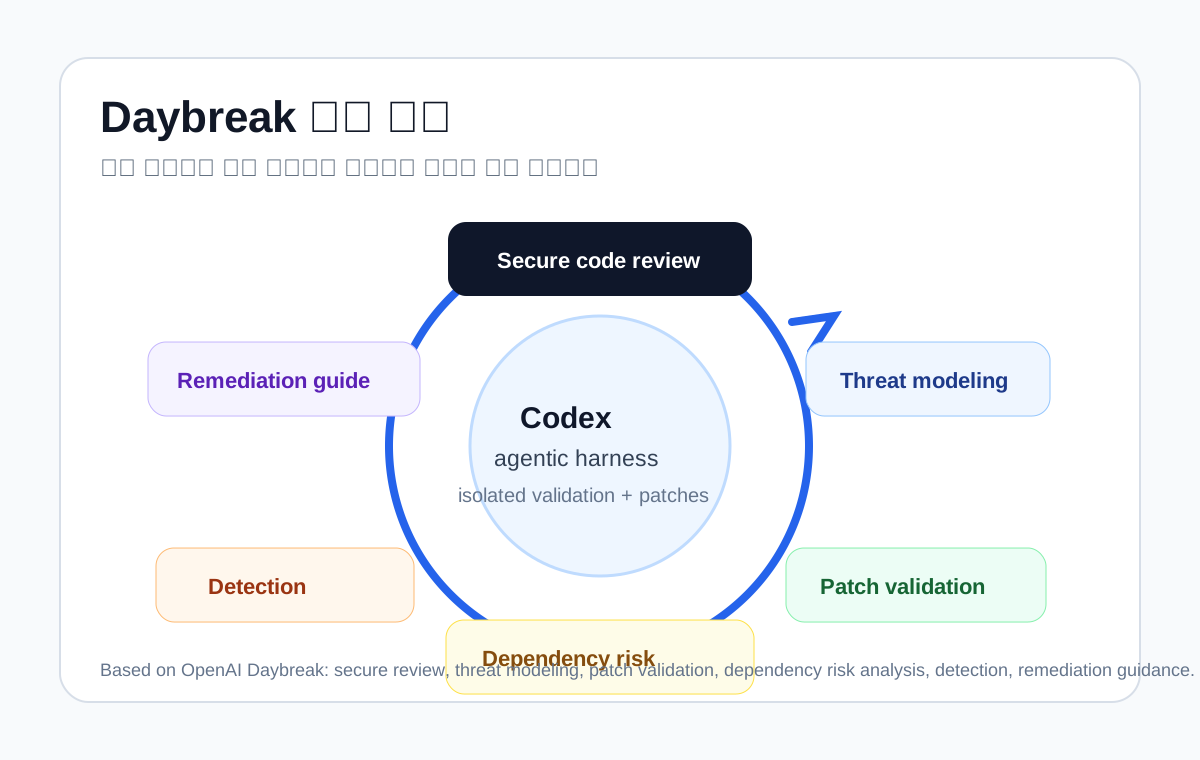
This is why OpenAI places "secure code review, threat modeling, patch validation, dependency risk analysis, detection, remediation guidance" in the same sentence. The list looks like a security team's task list, but it actually maps to many doors in the software development lifecycle. Code review sits near pull requests. Threat modeling attaches to design and change requests. Patch validation belongs in CI and test environments. Dependency risk analysis touches lockfiles and build stages. Detection belongs to operational logs and security tools. Remediation guidance flows into tickets, pull requests, and audit reports.
The access table is effectively the product brief
The most practical part of the Daybreak message is the access model. OpenAI presents three levels. Standard GPT-5.5 keeps the usual safeguards for general development and knowledge work. GPT-5.5 with Trusted Access for Cyber provides more precise safeguards for verified defenders working in authorized environments. GPT-5.5-Cyber is a specialized preview with the most permissive behavior, but it also comes with stronger verification and account-level controls.
| Access level | What changes | Main uses |
|---|---|---|
| Standard GPT-5.5 | General-purpose safeguards | Development, knowledge work, everyday tasks |
| GPT-5.5 with TAC | More precise safeguards for verified defensive work | Secure code review, vulnerability triage, malware analysis, detection engineering, patch validation |
| GPT-5.5-Cyber | More permissive specialized access with stronger account controls | Authorized red teaming, penetration testing, controlled validation |
This table is almost the product brief because "performance" and "permission" are hard to separate in cyber AI. Vulnerability explanation, reproduction proof of concept, live-target testing, and third-party exploitation all carry different risk levels. For defenders, a model that refuses too much is not useful. For abuse prevention, a model that eagerly writes concrete exploit workflows is dangerous. Daybreak does not try to solve that contradiction with one universal safety policy. It separates the problem by identity verification and access tier.
OpenAI's example is the React Server Components vulnerability CVE-2025-55182. The baseline model may refuse exploit-writing requests or redirect to safer guidance. With Trusted Access, a verified user in an authorized context can work through reproduction, documentation, and mitigation. GPT-5.5-Cyber is designed for more specialized controlled validation, where more dangerous live-target exploit workflows may be relevant. That distinction is uncomfortable but realistic. In security work, abusive knowledge and defensive knowledge cannot be cleanly separated by the text of a request alone.
Daybreak is OpenAI's answer to Mythos
Viewed alone, Daybreak is an OpenAI security product. Viewed competitively, it is OpenAI's answer after Anthropic's Claude Mythos Preview and Project Glasswing. Anthropic did not release Mythos broadly. It limited access to partners such as Apple, Microsoft, Google, the Linux Foundation, Cisco, CrowdStrike, and NVIDIA. The logic was direct: releasing strong cyber capability publicly can help attackers, but giving it selectively to defenders can help find and fix vulnerabilities in open-source and critical infrastructure faster.
OpenAI has reached a similar dilemma, though its framing is different. Anthropic emphasized model capability and risk, then positioned Project Glasswing as a defensive initiative. OpenAI's Daybreak foregrounds a "security flywheel" and Codex Security. Vulnerability research and patching, network and security protection, detection and monitoring, and software supply-chain security are described as mutually reinforcing steps. The story is that a model finds a vulnerability, a patch is produced, edge mitigation protects systems while the patch rolls out, exploitation signals are detected, and supply-chain tooling prevents similar risks earlier in the build process.
The difference matters for product strategy. Mythos and Glasswing read like an answer to "who should receive a model this powerful?" Daybreak reads like an answer to "what operating loop should a verified defender use after receiving it?" That is why Codex Security is placed so prominently. OpenAI describes Codex Security as a workflow that creates codebase-specific threat models, explores realistic attack paths, validates them in an isolated environment, and proposes patches for human review. The model is not just a chatbot for security advice. It becomes part of an agentic workflow that can read code, test hypotheses, and prepare fixes.
What the partner flywheel means in practice
The Daybreak page features Cloudflare, Cisco, CrowdStrike, Palo Alto Networks, Oracle, Zscaler, Akamai, and Fortinet. The May 7 post points to a broader partner map. Network and security providers, vulnerability research and patching organizations, detection and monitoring companies, and software supply-chain security vendors each play different roles. This can look like a logo wall, but it also shows why AI security products are unlikely to succeed as isolated apps.
Imagine a new open-source vulnerability is disclosed. If Daybreak works well, the model should not stop after saying "this package is vulnerable." It should find the affected surface in a specific organization's codebase. It should create a reproducible test. It should propose a patch, run regression checks, and suggest temporary network mitigation when an immediate patch is not possible. It should detect whether exploitation has already happened in production. And it should leave evidence that a human reviewer can inspect later.
That is where Codex becomes important. A general LLM response can explain a vulnerability to a security team, but reading files inside a repository, writing tests, applying a patch, and summarizing results requires an agentic harness. This is why OpenAI connects Daybreak to Codex Security. Security teams do not want a plausible vulnerability explanation. They want to know whether this repository is actually vulnerable, which path is exploitable, which patch passes tests, and what evidence supports that conclusion.
The developer community is still quiet
One interesting detail is that developer community reaction to Daybreak itself appears muted so far. Hacker News had several Daybreak links at the time of research, but there was no large discussion. The "Daybreak Frontier AI for cyber defenders" story had about 10 points and one comment, while other Daybreak links sat around one to three points. GeekNews did not show a notable Daybreak curation item either.
The more durable concern had already appeared in earlier discussions. In a Hacker News thread about GPT-5.3-Codex being routed to another model because of cyber-risk detection, developers complained that if a model changes, the API should return an error rather than silently serve a different model and charge for it. That reaction points directly at Daybreak's central UX challenge. Identity verification and access controls should reduce friction for legitimate defenders, but for ordinary developers they can look like unpredictable refusals or routing changes.
Cyber AI has a harder user experience problem than ordinary productivity AI. The same exploit proof of concept can mean different things in a CTF, an internal reproduction, an approved customer penetration test, or a third-party attack plan. The sentence alone does not carry enough context. For Daybreak to succeed, model intelligence may matter less than context judgment, authorization checks, proof of target ownership, execution isolation, and consistent audit logging.
What changes for development teams
For development teams, Daybreak is not only a security-team story. It says that security work is moving into the development loop. In many organizations, security reviews cluster around release gates, quarterly audits, penetration tests, or external vulnerability reports. If AI can continuously read codebases and create threat models, security review moves closer to pull requests, dependency updates, architecture changes, and incident response tickets.
That can improve productivity, or it can create fatigue. A well-designed Daybreak-style workflow could identify attack paths that developers missed, generate safer patch candidates, and reduce translation cost between security and engineering teams. A poorly designed one could attach excessive warnings to every pull request, flood teams with low-confidence exploitability claims, and turn developers into triage staff for AI-generated security issues.
The adoption question is therefore not "should the AI merge patches automatically?" The first question is what evidence the AI should create and who approves the result. The controls OpenAI emphasized in its Codex safety post -- sandboxing, approvals, managed network policy, identity, credential control, and telemetry -- apply directly to Daybreak. A security agent is likely to touch more sensitive files, environments, and systems than an ordinary coding assistant.
Metrics worth watching
The first metric to watch is real remediation time. OpenAI describes a future where risk analysis moves from hours to minutes, patches are generated safely, and fix evidence flows back into systems. For that claim to matter, "number of vulnerabilities found" is less important than "time from validated vulnerability to production fix." Finding more issues that the team already knows about is not enough. The question is whether more real issues are fixed.
The second metric is the balance between false positives and refusals. If legal defensive work is blocked too often, security researchers will route around the tool. If dangerous requests are allowed too easily, the deployment policy fails. OpenAI's emphasis on Advanced Account Security, phishing-resistant authentication, and organization verification is an admission that prompt classification alone cannot solve the problem.
The third metric is the depth of partner integration. A logo wall does not create a flywheel. The useful question is whether Cloudflare or Akamai integrations can become edge mitigations, whether supply-chain tools can block risky pull requests and guide remediation, and whether detection systems can close the loop with incident evidence. If Daybreak remains a separate dashboard, it becomes another security tool. If it attaches to development and operations systems, it can become a default rail for security workflow.
Conclusion
OpenAI Daybreak is more important for its deployment structure than for the GPT-5.5-Cyber name. Model companies are acknowledging that cyber capability cannot be sold as raw API power alone. Who has access, which systems are in scope, what verification and account controls apply, and which partner systems receive the results become the body of the product.
For developers, the message has two parts. Security review is moving closer to everyday work: pull requests, dependency updates, incident tickets, and CI validation can all become places where AI-based threat analysis and patch validation appear. At the same time, the standard for introducing powerful coding agents into organizations is becoming stricter. It will no longer be enough to ask whether an agent writes good code. Teams will also ask what authority it has, which network it can reach, what evidence it leaves, and which human approvals govern its actions.
Daybreak is not a finished answer yet. It is closer to OpenAI's productization statement for the cyber-defense market. But the direction is clear. AI security competition will not end at model benchmarks. The next fight is who can close the defensive loop faster, more safely, and with evidence that organizations can actually trust.